High Country History Group
Contents
Article 1 of 13
Ongar’s First War Memorial
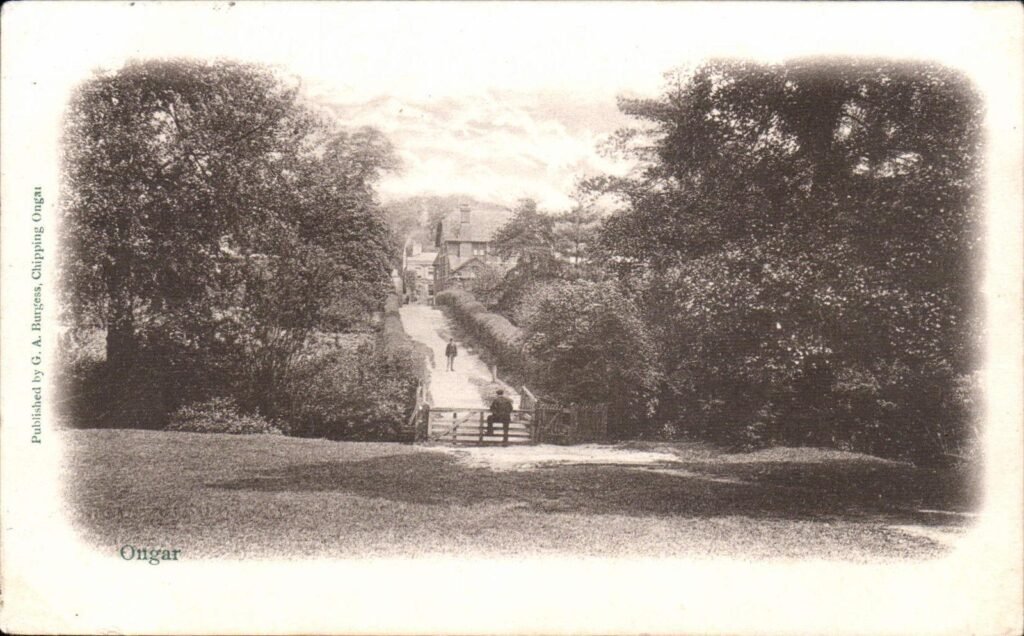
I recently acquired the postcard showed below which clearly says ‘Ongar Roll of Honour.’ I was not aware such roll existed, and as far as can be ascertained it is no longer in existence. This of course set me on a mission to find out about it.
Fortunately there were two references to the Roll of Honour in local papers:
Reported in the Chelmsford Chronicle 15 December 1916
A meeting was held in the Council School in December 1916 to consider whether to erect a ‘War Shrine’ to the memory of those men connected with the parish who are serving in H.M. Forces and those who have fallen.
The meeting was presided over by the Revd. E. Barber and after a discussion it was resolved to erect a shrine in the Market Place (subject to the approval of the surveyor). A committee was formed, consisting of;
Revd. Barber
Revd. G. F.White
Revd. Father Boyland
Col. C.H. Christie
Mrs Christie
Dr Wilson
Dr Ferguson
Mr F. M. Noble
Mr. H. E. Barnard, J.P
Mrs Ward
Miss B. Foster
Mr C. Rose
Mr. T. E. Rose
Miss Tanner
Mrs Barlow.
Mrs Charles Rose was appointed Hon Secretary.
The intention was for the committee to submit designs and report back to the meeting.
Reported in the Essex Newsman 19th May 1917
The Shrine was unveiled on Sunday 13th May 1917 and on it were inscribed the names of 250 men now serving, discharged, and dead from the Ongar district. The roll of honour was inscribed by a Miss Hadler, of Marden Ash.
In attendance at the unveiling were members of the local detachment of the Essex Volunteer Regiment, under Sergeant C. H. Foster. Also present were the Epping Platoon, under Lieutenant Baddeley, Waltham Abbey (Lt. Trounce), and Harlow (Lt. F. Jones); Grammar School Cadet Corps (Capt. Wildman); 23 Special Constables (Sgt. Merchant); 24 Boy Scouts (Ass. Scoutmaster F. H. Smith). Also present were some wounded soldiers. The band of the Hackney Homes, under Mr Dean, formed up in the square, and Colonel C. H. Christie was in command of the whole parade.
The unveiling was performed by Captain Howell J. Price, D.L. An impressive service was conducted by the Revd. Barber, the hymn, “O God our help in ages past,” being sung, accompanied by the band. The Revd. G. White, Congregational minister, took part in the service. The Rector (Revd Barber) dedicated the shrine, which was then handed over to the care of Sgt. C. Foster, as chairman of the Parish Council. Mr Christie gave a short address.
What is interesting is that the Roll of Honour was unveiled before the end of the Great War which is unusual. Was it ever updated as more reports of casualties were received? Perhaps someone can throw some light on this.
Images
Ongar’s First War Memorial

Article 2 of 13
Stanford Rivers Vestry Minutes – 2nd October 1817
The parishioners agreed to pay all persons who will destroy the sparrows in this parish in the following manner – for every dozen sparrows four pence.
During the two World Wars, the Government were very concerned with the preservation of food supplies and by prevention of waste, less money needed to be expended for the import of food and the obvious risk of getting shipping past the enemy. In order to try and prevent waste, pests needed to be culled. This gave rise to correspondence initially from the Home Office.
The Under Secretary of State, Home Office, 6th June 1917
Sir,
In view of the importance of taking all practical measures at the present time for protecting the National food supply, the Board of Agriculture have recommended that certain measures be taken for the destruction of rats and house sparrows.
The Board of Agriculture issued a leaflet detailing the following rewards to be made:
•Rats tails 1/- per dozen
•Heads of unfledged house sparrows 2d per dozen
•Heads of fully fledged house sparrows 3d per dozen
•House sparrow eggs 1d per dozen
The leaflet also encouraged the setting up of Sparrow and Rat Clubs to encourage the population in the destruction of the pests.
Greensted and Stanford Rivers both had such cubs during the Second World War.
Difficult to imagine anything like this happening today, but desperate times called for desperate measures.
Article 3 of 13
Christmas in the Trenches
Nick Dobson gave a marvellous talk to the High Country History Group on this topic drawing on original sources by way of illustration. The Christmas truce of 1914 has become a legendry halt in hostilities in what was a war of attrition, killing millions and lasting four and a half years. Revd. Edward Henry Lisle Reeve, of Stondon Massey, kept notes for a parish history (now preserved in the Essex Record Office). He gives this account of Christmas Day 1914 on the Western Front.
28th January 1915
“When travelling by train to London from Ongar on Jan 25th I had for a fellow passenger for part of the way a Lancashire man who had returned wounded and frost-bitten from the front, and was now sufficiently convalescent to be going for a short spell to his native county before returning to France.
His first-hand report of the conditions of things abroad was very interesting. He had often been for days together standing in water in the trenches, and the plight of the soldiers in the cold, wet, and filth was, he said indescribable. The Germans were in as bad or worse plight. During an interval on Christmas-day some of the enemy had approached our trenches and joined in conversation with our men. One German soldier had given his cigarettes and offered him brandy.
In reply to the German invitation to drink with him the British soldier declined, until by way of assuring him took a pull himself at the flask he was offering! Lancashire shyness was then overcome, and the soldier accepted a draught of the “Cognac” for such it proved to be. The time was soon over for these pleasantries, and the two dropped back again into their several positions, having apparently no special desire to kill one another, save at the call of duty! I wished my fellow passenger a safe return to England at the close of war.”
Article 4 of 13
Theydon Mount: Wills during the Reign of King James I (Part 6). Family Connections
The study of Wills allows local historians and genealogists to trace ancestry particularly in instances where Parish Registers do not exist. Ten Theydon Mount wills are preserved in the Essex Record Office during the reign of King James I. I have transcribed most. Having written two items on this set, this concluding note draws these documents together as a whole.
The ten Wills studied were:
1605 Richard Gilson, husbandman
1612-13 Robert Hill
1612 Thomas Bredge
1613-14 William Winter, husbandman
1614 Robert Knoppe, yeoman
1616-17 John Moore, yeoman
1623-24 Thomas Gilson, tailor
1624 Thomas Herd, yeoman
1624-25 Richard Gladwin, bricklayer
1625 Susan Winter, widow
Richard Gilson (d. 1605) was the father of Thomas Gilson (d. 1623). He names his wife, Mary, and children: Richard, Thomas, George, Elizabeth, Susan and Mary who were all under 21 years old at the time. When Thomas dies a bachelor eighteen years later he mentions his siblings: Elizabeth, who by then had a son Richard and two other children; Richard, who had 4 children; Marie (Mary); George; and John, who is unnamed in his father’s will so may have been unborn at the time of his death. Susan is not mentioned in Thomas’ will but his brother-in-law George Herd receives an inheritance as does his children, Thomas and William. We must assume that Susan had married into the Herd family but died. The Gilson and Herd families would want to search further.
When we look at the Will of Thomas Herd (d. 1624) we note he had a brother George with a son Thomas and realise a growing family tree. William is the other named brother of Thomas Herd. The testator has a son, Thomas, and grandson, Thomas. Family historians have to be careful not to omit a generation when constructing their family tree. He also leaves money to “John Heard my uncle George Heards sonne his fower Children that he had by his first wife”. John was Thomas’ cousin.
A Thomas Herd is mentioned as “my kinsman” in Susan Winter’s will of 1625, appointed as an overseer alongside the minister, M[aste]r Juby. She had three sons: Thomas, John and William. When her husband, William, writes his Will in October 1613 he mentions only Thomas (who was not 20 years old) and John “my yongest sonne” but later mentions “these my three Children”. Perhaps William was alive but did not receive an inheritance, or was perhaps unborn with a daughter not receiving an inheritance. A puzzle for the Winter family.
Robert Hill’s will (d. 1613) does not mention by name his family. “I give to my wife all the goods and Chatles as 7 beaste 26 sheepe 2 mares and 2 Colts with all my houshold stuffe and moufable goods also I giue to my 5 chilldren at 18 years of age 3 to oxenone of them”. He names Thomas Hill his brother as overseer. He names the people who owe him money. There is no note for write off but a reminder.
Robert Knoppe’s lengthy will (d. 1614) names his wife Mary, Robert his son and three unnamed children. It is full of conditions, including provision should “thre skore poundes” not be paid to “the residue of my children”.
John Moore, yeoman, wrote his Will on 16 November 1616. He was buried on 20 December 1616. He mentions firstly his wife, Catherine, his children William and Joan, and brothers and sisters, including the children of Thomas the older and Elizabeth. Here follows an extract, which has some interesting spellings and unusual bequests to modern eyes.
9 It[e]m doe giue and bequeath unto Cathron moore my wiffe twenty poundes of good and lawfull money to be paid
10 hir w[i]thin wone month after my goodes shall be sould by my Exec[u]et[o]r. Item I giue my daughter Joone forty
11 shillings to be paid her at the age of wonantwanty years or day of maridg by my Ex[e]c[u]ter. Item I doo will
12 and giue to my sonn William Moore the sum of threescore pounds to be paide him by my Ex[e]c[u]tors
13 upon he shall acomplesh the age of wonantwanty yeares p[ro]vided that my son William deseas
14 befoore hee shall com to the age of xxi years my will and mynd is that the remainder of his ledgesie I giue
15 and bequeath as followeth first I giue to my sister Elizabeths Children x Li[bor] pounds to be paid them when they
16 shall com to the age of wonantwanty years of p[ro]vided that if ether of them s[h]all deaseas befoore thay
17 acomplesh to thare Seavorall ages of xxi years then my will is that his or her porsion so deseas shall be
18 equally devidded amonste them that are living. Item I will that … shall rest in my Ex[e]c[ut]ors
19 handes shall be dividded amonste my brother Thomas Mores Children equally to be divided amonste them
20 upon they shall com to thar severall ages of xxi years p[ro]vided alwaies that if any of them shall suffer
21 to deaseas befoore thay com to the severall ages of xxi years then my will is that thar leggeses so deseased
22 is also equally dividded amonste them that are livinge. Item I will and giue to my brother Thomas Moore
23 the older three pounds of good and lawfull money to be paid him within six months after my deseas. Item I will
24 and giue to to Alys Ingold vis viijd to be paid by my Ex[ecu]ters which are underwritten. Item I will and giue
25 to catarne my wiff the bed steed which I liupon with the worshe fether bed and a pare of sheetes to blankets and
26 won pillow …
27 … will all her aparill with the yarne and a linne whode.
28 Item I will and giue to my older brother Hen Moore my Cloock and my best hat and all my wordadaie
29 apparill. Item I will and giue to my brother Thomas More the younger my best seute of apparill
30 and I do intreate my loving nabore Thomas Filde of theydon mount and William Start
31 of lucton … to be my Exsectors and Itim I giue them for thare pains xxs apece and
32 and I intreate my loving naber Thomas Feuens to be my overseer of this my last will
33 and teastament and I giue him for his pains xxs in witness wharof I the said John Moore hand hear unto sett to
34 my hand and seale the daie and yeare firste about written sined sealed made in the p[re]sent of us
35 whoos names are heare under written
36 The mark of John Moore
37 The mark of Joone Inggoll
38 The mark of Phillos Sharpe
39 [Probatum]
Richard Gladwin (d.1625), our bricklayer, had a wife, Susan, and two children, Richard and Bridgit.
Finally, the Will of Thomas Bredge (d.1612) led me to conclude that he died fairly young. He wrote his Will on 27 April 1612 and was buried three days later at Theydon Garnon believing that his wife, Agnes, was pregnant with their fifth child: “If it happen my wife to be with childe …”. A search of Registers may determine a baptism thus revealing a fifth child in addition to James, Margaret, Anne and Elizabeth. Also named were his brothers Robert and Richard.
D/AEW 13/78.
D/AEW 14/292
D/AEW 14/218. Full transcription in Journal 54. Thomas Bredge / Bridge was buried at Theydon Garnon. He wrote: “Item. I give to the rep[ar]acion of Theydon mounte Church ten shillings.”
D/AEW 15/22.
D/AEW 22/240
D/AEW 16/15
D/AEW 17/175. Full transcription in Journal 55.
D/AEW 17/209. Full transcription in Journal 55.
D/AEW 17/248. Full transcription in Journal 55. Sidesman and bricklayer who might have been involved in the rebuilding of the church?
D/AEW 17/296
Kinsman can mean a neighbour not necessarily a relative.
A repetition of pounds.
cloak
Perhaps Latton?
Article 5 of 13
Royal Visit to Greensted Church
H.R.H. the Princess Royal of Belgium paid a private visit to the ancient and unique church of Greensted, on Wednesday. She was accompanied by Lord Lambourne and ladies, and received by the Rector, the Rev. Ralph Doyle, who conducted the party, and gave a brief explanation of the leading features of the church. H.R.H. was deeply interested and pleased with her visit, and asked several questions.
One of the ladies expressed the hope that the church was well supported by its numerous and many of them wealthy visitors from all parts. The Rector said he could not truthfully answer in the affirmative. Some few did give, but not the majority. The greater weight of money placed in the box for the church’s upkeep consisted of copper coins. He thought it was well worth a fixed entrance fee for everyone. This was approved.
Chelmsford Chronicle, 27th August 1926.
++++++++++
Rector in Court Scene
The Rev. Ralph Doyle, rector of Greensted, was summoned at Ongar on Saturday for the non payment of rates. He said he was willing to pay the rates, which he has withheld as a protest against the way in which the road near the church was kept.
The Chairman: “This court has nothing to do with the roads. All we wish to know is whether you are going to pay, or whether you wish us to issue a distress warrant.”
Defendant, “I deny that you have any right to issue a warrant. I will pay under protest.”
Essex Newsman, 15th October 1927.
Article 6 of 13
Rector in Court Scene
The Rev. Ralph Doyle, rector of Greensted, was summoned at Ongar on Saturday for the non payment of rates. He said he was willing to pay the rates, which he has withheld as a protest against the way in which the road near the church was kept.
The Chairman: “This court has nothing to do with the roads. All we wish to know is whether you are going to pay, or whether you wish us to issue a distress warrant.”
Defendant, “I deny that you have any right to issue a warrant. I will pay under protest.”
Essex Newsman, 15th October 1927.
Article 7 of 13
Theydon Mount Constable
A petition from Theydon Mount in 1612 shows that even in rural areas they could, if sufficiently united appeal successfully against the will of the lord of the manor. In this case Sir William Smith of Hill Hall, had appointed George Mott parish constable seven years previously without the consent of the parishioners, and had not provided an opportunity for another constable to be elected, though George Mott was
‘one of the poorest men in all the parish, and a man of evil disposition and very bad qualities, who had wronged the parishioners very much, and made great strife amongst them.’
Sir William Smith, the petitioners stated would not allow another constable to be appointed because George Mott ‘serveth his term.’ They asked the justices to appoint instead,
‘an honest man, Thomas Field, a subsidy man and very sufficient for that office.’
Thomas Field was duly sworn after an investigation which revealed that no court leet had been held in Theydon Mount for more than twenty years.
[Taken from Essex Heyday, by William Addison, pub. 1949]
Article 8 of 13
Insolvent Debtor
The Revd. Richard Thomas, formerly of Stanford Rivers, near Chipping Ongar, in the County of Essex, clerk, curate for the parish of Stanford Rivers aforesaid, and also Chaplain to the Union House there; then in lodgings at No 3 Newcastle Street, Farrington Street, then in lodgings at no. 48, Holborn Hill, both in the City of London; afterwards in lodgings at Mr William Smith’s, of Hemswell, near Spittal, in the County of Lincolnshire, farmer, and late in lodgings at Mr George Brown’s, in Church Street, Gainsborough, in the County of Lincoln, grocer and shoemaker; during the whole of the above residences, clerk and incumbent of the parish church of Hemswell, aforesaid.
To be heard on the 19th November at Lincoln, at 10 o’clock in the forenoon.
Stanford Mercury 20th August, 1841
Insolvent Debtors’ Court, Lincoln
Nov. 19 – before Mr. Commissioner Harris.
The Rev. Rd. Thomas, Perpetual Curate of Hemswell, late of Chipping Ongar, Essex, and formerly Master of Lincoln Grammar School, applied to be discharged under the Act. The detaining creditor was Mr. Robert Williams, general dealer, 22 Old Bailey, London: his claim was £5.11s., with law costs amounting to £12.9s.4d. The Rev. Gentleman was opposed by Mr Pashley, spirit merchant, who contended that the insolvent had contracted debts at a time when he had no visible means or prospect of payment, and was supported by Mr Dowse. Mr Pashley added that, whilst the income of the insolvent was only £140 per annum, he was living at the rate of £160. The Commissioner said that was no fraud under the circumstances occasioning the insolvency. The amount of his debts was £240. The income of Hemswell had been £62 per annum, but had been reduced to £43. During the brief examination, it transpired that the principal part of the debts had been contracted in 1837, when the sickness of the insolvent’s wife, who died 12 months since, occasioned him greater expense than the pitiably small income would meet. The Commissioner said the case was an extremely hard one: the insolvent confessed that so great had been the poverty to which he had been reduced, that for the past six weeks he had been out on bail, he has not has a bed to lie upon. The Commissioner quoted the adage, “Poverty acquaints us with strange bedfellows,” and ordered the insolvent to be discharged,
Stanford Mercury 26th November, 1841
Article 9 of 13
The Petre’s of Stanford Rivers
In 1623 William, 2nd Baron Petre purchased the estate from Sir Thomas Elliott. William was married to Catherine, second daughter of Edward Somerset, fourth earl of Worcester. Lord Petre settled the estate in 1628 upon his 3rd, but 2nd surviving, son William (born 29 July,1602 at West Horndon, died 15 January 1677) as a jointure for William's wife Lucy (died 3 March 1679), daughter of Sir Richard Fermor, of Somerton, Oxfordshire. They had three sons and three daughters.
The Petres at this time acquired all the other manors in the parish except Littlebury. Their estate in Stanford Rivers became known as Bellhouse, from the name of their capital mansion. It comprised about 1,600 acres in the 17th century. Both William and Lucy are buried in the chancel at St Margaret’s. In 1645 Stanford Rivers was granted by Parliament to the Earl of Essex, on account of William Petre's adherence to Charles I
Upon the death of Sir William, the states passed to his son, also William (born 2 July, 1666, died April 1728). He was married, firstly to Anne Poulter, who died in childbirth, aged 23 years, on the 21 February, 1628. He then married Penelope Wolphe (Woolfe), who gave birth to eleven children. William is also buried in the chancel at St Margaret’s.
He raised substantial mortgages to endow his daughters, at least six of whom became nuns. His son Robert (1700- 66) became a Jesuit. This outlay was, however, more than balanced by the marriage portion of £4,000 brought into the estate by Lady Mary Radcliffe (died 16 March, 1756), only daughter of Edward, Earl of Derwentwater, who in 1722 married William Petre, heir of his father.
In 1737 William handed over the administration of the Stanford Rivers estate to his kinsman Robert, Baron Petre (d. 1742). An account book for the years 1738-44 shows that the estate (which also included the manors of Stanford Hall, Traceys, and Bellhouse) had a rent roll of slightly over £1,000 a year, out of which William Petre was allowed £350 tax free. William died on the 21 September, 1745, and is also buried in the chancel at St Margaret’s.
William’s heir was John Petre, son of his brother Edward. Shortly before William's death John, who was under age, had been given into William's care by his grandfather and previous guardian William Keep. After William Petre's death John was sent by his aunt, Lady Mary Petre, to Douai to be educated as a Roman Catholic. William Keep thereupon started an action in Chancery to regain custody of the boy. An order was made to this effect but was defied by Lady Mary. In 1747 a receiver was appointed in Chancery to administer the Stanford Rivers estate. John Petre probably assumed control soon after this, for he was said to have been eighteen years old in 1745.
John Petre died in 1762. In 1759, on his marriage to Frances Man, he had provided that if he had no sons his estates should pass to Robert, Baron Petre in trust for Lord Petre's second son, if one should be born to him. Provision was made for any daughters left by John Petre. In the event he left only one, Catherine, who became entitled on his death to a jointure of £4,000 from his estate.
From 1762 to 1775 the Stanford Rivers estate was administered by a steward acting for John Tempest, executor of John Petre's will. The estate accounts for this period show that the rent roll was still about £1,000 a year. Most of the income, and in some years all of it, was taken up by expenses and the payment of annuities. Catherine Petre, whose jointure of £4,000 remained in the estate, received interest at the rate of £160 a year. Susan Petre, sister of John, similarly received £120 a year as interest on a jointure of £3,000, and John Petre's widow drew £300 a year from the estate. By 1774 there was £905 in hand on the running of the estate, but most of this was accounted for by the fact that the annuities had for some reason not been paid in 1772. During the period covered by the accounts the whole estate was leased to various farmers and smallholders.
In 1775 John Tempest conveyed the estate to Lord Petre as guardian of his second son George William Petre. In 1791 the estate was found to be encumbered to the extent of £9,750: in addition to the jointures of Catherine and Susan Petre a mortgage of £2,750 had been raised from a William Plumer. In 1793 a further mortgage of £10,000 was raised from Thomas Heron of Chilham Castle, Kent. In
1796 part of the estate (evidently Stanford Hall), was sold to Charles Smith of Suttons in Stapleford Tawney for £7,650. George William Petre, who died 22 October, 1797, aged 32. His heir was George Petre, his son.
In 1819 the remainder of the Stanford Rivers estate, including the manorial rights, was bought from George Petre for £25,280 by Judith Smith of Stratford, Essex, who was probably sister of the above mentioned Charles Smith of Suttons. Judith was lady of the manor up to 1830; in and after 1833 the lordship (and presumably the estate) had passed to Charles Joshua Smith, Bt., son and heir of Charles Smith of Suttons.
Roman Catholicism
The Petres were one of the families, which have played a great part in the preservation of the Catholic Faith in England. In the 17th century and the first half of the 18th Roman Catholic worship was carried on by the Petres at Bellhouse. This was one of the places served by the secret Jesuit mission in eastern England which was founded about 1633 and largely financed by the Petres. The first William Petre of Bellhouse was a servant of Charles I and in 1639 the king personally intervened to prevent him from being prosecuted for recusancy. In 1676 there was an unusually large number of papists in Stanford Rivers. There was probably a private chapel at Bellhouse, and Roman Catholic worship continued there until after the death of William Petre in 1745. The date when it finally ceased is not certain, but it is unlikely to have continued for long after the death of John Petre in 1762.
The Petres also contributed generously to the support of Roman Catholicism elsewhere. During the reign of Charles II an annuity of £40 out of the manor of Stanford Rivers was being paid to each of two members of the family, Richard and Robert Petre, who had become Jesuits. In 1678, however, these revenues were seized by the government.
Jointure - an estate settled on a wife for the period during which she survives her husband, in lieu of a dowry.
All three daughters became nuns.
Bridget, born 1695, died 1739 in Liege; Anne, died in 1734 in Bruge. Penelope, born 1698, died 1717, in Liege; Winefride, born 1704, died 1735, in Liege; Mary Anne, born 1706, died 1762, in Brussels; Agnes, born 107, died 1741 in Liege. All six were born at Bellhouse.
Article 10 of 13
Leverton Charities, Waltham Abbey. A manuscript volume in private hands
Thomas Leverton (c.1743 – 1824), architect, left in his Will £6000 to be spent on charitable causes in Waltham Abbey. Invested in annuities it generated an annual dividend of £180 and was allocated as follows: “£80 in clothing 20 boys and 20 girls; £30 to a schoolmaster, and £20 to a mistress, for teaching the said forty children; £10 to provide them with school books and stationary; £10 for apprenticing two of the said children; £5 to be given to five of the children who behaved well in their first servitude; £12 to be given in clothing to six poor men and six poor women; £5 to be distributed in bread among the poor on Christmas day; £3 for keeping his monument in repair, and the remaining £5 to be reserved by the trustees for contingencies.” (Wright, 1848)
A manuscript volume in private hands, to the extent of 285 pages, covers the working of the charities from 1852 to 1863. It provides a list of trustees appointed “by Will” to May 1863. This included at inauguration Revd. William Whalley, and throughout the period members of the Jessop family who were local solicitors. In a separate development, the executors of George Fawbert, “late of Harlow [1824] … purchased a [school] House and Premises [in High Bridge Street], which they presented to the Trustees of the Leverton Charities for the use of the Leverton Trust”. Joseph Jessop Esqr was one of Fawbert’s executors.
Benjamin Howard Merriman and Martha Merriman his Wife were elected as schoolmaster and schoolmistress in 1849 followed by George Smith and Jane Smith a decade later. Children were elected to the school by the trustees as vacancies occurred. They were expected to attend daily from 9.00am to 12pm, and 2.00pm to 4.30pm (4.00pm between Michaelmas and Lady Day) as well as three times on Sunday at Divine Service. “The children to be in the Schools by the striking of the Church Clock … to be sent well washed, their hair combed, their linen and shoes clean, and stockings and clothes neatly mended.“ It was their parents responsibility to “see their Children’s Behaviour at Home and in the Streets, is in unison with the principles taught at School, and that they cause them to say their Prayers Morning and Evening; also Grace before and after Meat.” The master and mistress were also obliged to follow a code of conduct in accordance with the Trustee’s wishes. Holidays were granted “Easter Week (2 Days Church), Whitsuntide Week; Queen’s Birth Day [24 May]; Hay Harvest, a fortnight; Wheat Harvest, a fortnight or 3 weeks; Statute (26th Sep); Christmas, a fortnight; and, from 1859, every Saturday”. The volume then lists the admission of 161 pupils beginning with those already in the Leverton School on 1 January 1852. Five children annually were rewarded the sum of £1 for good behaviour in their first year of employment. One such recipient was James William Turnham, born 22 June 1841 who joined the school at the age of nine, leaving just short of the age of 14 to go to work “as a Cooper at the Powder Mills”. Emma Carr, aged 14 on 15 November 1853 went to work “in a factory”. Jane Carpenter “went into Mr Sidgwick’s Service in Sun Street”. It appears that children stayed until their fourteenth birthday. There are a few records showing “time out”. Other pupils did not make the grade: William Henry Powell at 13 was described as “Boy Impudent. Parents took him away”; Henry Walker, “Clothes Ragged. Taken out by his mother. See Minute April 28 1852”; and, Henry Simpson, age 13, “expelled for bad conduct”. The list ends with a note, “continued Vol 2 p150”.
Towards the end of the volume are reports from ladies on the girls’ school, covering 1853 to 1864, confirming compliance with the founder’s aims. The mistress was required to teach “reading, plain needle and useful housework and writing to ten of the elder girls.” The trustees added that “the Girls are not to be Taught any thing to the neglect of the above, and that if any thing else is Taught, it should be approved by the Ladies, and permitted as a Reward to those Girls”. In 1853 it was noted “that Mrs Merriman informs us common arithmetic has been taught, which, although not provided for by the Founder, we highly approve of. We are also informed that ‘Crochet-Work’ has been taught to some of the children, but we think it desirable that this should be discontinued; we would however suggest that knitting socks or stockings may be taught as being very useful to the humbler classes at an advanced period of life”. In 1855: “We beg to suggest that once a week the Girls’ own Stockings be brought to the School to be darned.” In the boys’ school the Master was required “to Teach Reading, Writing and Common Arithmetic”.
The volume then lists the applicants for and recipients of “Cloak and Gown to 6 Poor Women” and “Coat and Underdress to 6 Poor Men” for the years 1849 to 1859. (1860 can be found in Vol 2, p100).
The distribution of bread follows beginning with a table showing how £5 worth was to be distributed annually. In December 1849 and 1850 it was possible to buy 200 4lb loaves at 6d each. The price varied dramatically with each year being as little as 127 loaves at 9½d in 1853 and as many as 230 loaves at 5¼d in 1858.
Several pages are then devoted to copies of income and expenditure accounts and Balance Sheets for the years 1852 to 1859. There then follows a long table over a number of pages listing the attendance of trustees at monthly meetings between January 1843 and October 1864. The volume appears to be entirely in the same hand, with annotations here and there, but the author is not identified.
Thomas Leverton’s memorial is in the church. He lived in Bedford Square, London, dying aged 81 on 23 September 1824. His second wife, Rebecca, died 4 August 1833, aged 76 and “is buried [with him] in a Vault near this spot. This Monument was Erected not from ostentation, but as an incitement to the youth of his native Parish, to pursue the path by which he rose to Honor, Wealth, & Comfort; by relying humbly on God, acting with Integrity, Industry & true Benevolence.” Other members of his family are buried in the churchyard. The monument erected by Thomas remembers Lancelot, his brother (d.1784), Alice his first wife (d.1802), and “Henry Leverton only Child of Thos Leverton who departed this World Feby 1789 aged 12 years and 10 Months”. They were later joined by William (d.1849) and Sarah (d.1843), his other brother and sister-in-law.
Leverton’s name lives on in Waltham Abbey. Although the Charity School closed in 1942 a Charitable Foundation continues offering students of the town educational grants. The local school, which opened in 1971, is called The Leverton Junior School.
Notes
Wikipedia entry: http://en.wikipedia.org/wiki/Thomas_Leverton
Wright’s Directory of Essex (1848), as recorded in http://www.historyhouse.co.uk/placeW/essexw02a.html.
Article 11 of 13
The 1831 Census for Stapleford Tawney
The fourth census of Great Britain (England, Scotland and Wales) was taken on Monday 30th May 1831. The returns gave a population of 16.5 million people, an increase of 1.9 million over 1821. There were 2.85 million inhabited buildings, occupied by 3.4 million families.
The Census Act 1831, was titled,
"An Act for taking an Account of the Population of Great Britain, and the increase or diminution thereof".
The following questions to be answered by the overseers of the poor in England and Wales, and for schoolmasters in Scotland:
1. How many inhabited houses are there in your parish, township or place; by how many families are they occupied?
2. How many houses are now building, and therefore not yet inhabited?
3. How many other houses are uninhabited?
4. What number of families in your parish, township or place, are chiefly employed in and maintained by agriculture; how many families are chiefly employed in and maintained by trade, manufacture or handicraft; and how many families are not comprised in either of the two preceding classes?
The number of males, 'upwards of twenty years' was to be given for seven economic categories. These were those employed in:
a). agriculture (sub-divided into occupiers of land who employed labourers, other occupiers of land, and agricultural labourers);
b). manufacture;
c) retail trade or handicrafts;
d) as capitalists, merchants and professionals;
e) as miners, fishermen, non-agricultural labourers;
f) those retired or disabled;
g) those employed as servants.
In addition a schedule of the Act of 1830 carried the following questions to be answered by the clergy in England and Wales:
1. What was the number of baptisms and burials in your parish or chapelry, in the several years 1821, 22, 23, 24, 25, 26, 27, 28, 29 and 30; distinguishing males from females?
2. What was the number of marriages in your parish or chapelry, in the several years 1821-1830
3. Be pleased to specify, on the schedule annexed for that purpose, the ages of individuals registered in your burial register in the several years from 1813 to 1830, both inclusive.
4. What number of illegitimate children may have been born in your parish or chapelry during the year 1830, according to the best information you possess or can obtain; and distinguish male and female children?
5. Are there any matters, which you think it necessary to remark, in explanation of your answers to either of the preceding questions? Especially whether any and what annual average number of baptisms, burials and marriages, may, in your opinion, taken place in your parish, without being entered in the parish registers?
The information for Stapleford Tawney appears not to have survived. However in the Essex Record Office there is a copy of the Schedule for Stapleford Tawney, completed by the Rector Giving some of the information he was required to submit:
Article 12 of 13
Vestry Order Book for Stapleford Tawney (commenced 1824)
1824:
Oct 2
Maria Bray went to Mr Witham at 1s. per week.
Oct 12
Harriott Westmoreland went to Wm. Laundy at 1s per week.
Nov 9
Harriott Westmoreland a pair of high shoes and 3yd check and 5 1/2yd of calico and 5 1/2yd of print and 1 yd to line her gown.
Nov 16
Wm. Pegram a pair of high shoes
Widow Bright a pair of high shoes
Harriott Baker a pair of high shoes.
1826:
Nov 8
Old Pegram new wasket
Charles Latchford’s girl Mary pear of shoes
Dec 7
Brown’s boy James pear of britches
1827:
Feb ?
Brown two boy’s, a smock each
August 2
Mary Bright child a pear of shoes and a peace of callo to make a shift and a peace of flannel to make a petcote.
September 5
Richard Pegrum a shirt and a jacket
1828:
Feb 7
Richd. Pegrum a pear of shoes and a shirt and a smock frock.
1829:
March 5
Maddels wife 12 yeard of calloco
Thomas Summers 3 yeards of flannel.
May 7
Jery Reaves girl 3 yards of flannel for petticoat. 3 yards of dyed linning.
ERO Ref D/P 141/8/3
Article 13 of 13
In The News
Fire:
The particulars of a fire which occurred at Park Hall, Theydon Garnon, the residence of W.C. Marsh, Esq. on the 21st ult. Having been incorrectly given, we have been favoured with an extract of a letter from that gentleman, which states, that having dined at Hill Hall, on his return home, he found the fire raging in his farm yard. A barn, containing 20 acres of barley, 5 of wheat, 5 of oats, and 6 calves, a shed with 20 loads of hay, a cart stable, and 7 stacks of wood were totally destroyed. The trees were also on fire, and it was only by cutting off the branches that the large stable and coach house were saved. The carter put his horses into the stable without a light, and left the door open for them to walk out to grass as usual, which they fortunately did, while he went to his harvest supper. Mrs. Marsh was in Norfolk. The cause of the fire has not been discovered.
Chelmsford Chronicle 4th October, 1833
Epping Wool Fair:
The annual Epping Wool Fair was held on Friday, and both in the attendance of growers and the quality of wool exhibited was on a larger scale than usual. Nearly 8,000 fleeces were offered; and the greater proportion disposed of, the ruling prices being 13d. for teg, and 11d. per ewe wool – and advance of about 2d. per lb. as compared with the prices at the last fair. The only buyers present at the dinner, at which business was chiefly transacted, were Mr. Waite, on account of Mr. Oram of Harlow; and Mr. Hall, as the representative of Messrs Johns and May of Chelmsford.
Mr. Wm. Kirkby occupied the chair; and was assisted by Mr. Scruby, the secretary, in offering the various lots of wool.
The following is a list of the business transacted:-
Mr. Sworder, of Tawney Hall, offered to Mr. Waite 90 half bred tegs, 134 Down ewes, 2 long-wool rams, at 13d and 1s.; Mr. Waite offered 13d. and 11d. which was declined, and the lost was offered to Mr. Hall, who said he could not accept it, as he thought Mr. Waite had offered the full value. It stood over, but at the close of the day was sold to Waite at 13d. for the tegs and 11d. for the ewes.
Mr. A. Berkeley, Stanford Rivers, 38 half bred ewes, 15 half bred tegs – 53 – Offered to Mr. Waite at 13d. and 1s.; Mr. Waite offered 13d. and 11d., which was accepted.
Sir. C. Smith, Stapleford Tawney, 103 Down ewes, 4 Down tegs, 39 Welch wethers – 146 – Sold to Mr Waite at 11d.
Essex Standard 12th July 1850
Images
Epping Wool Fair
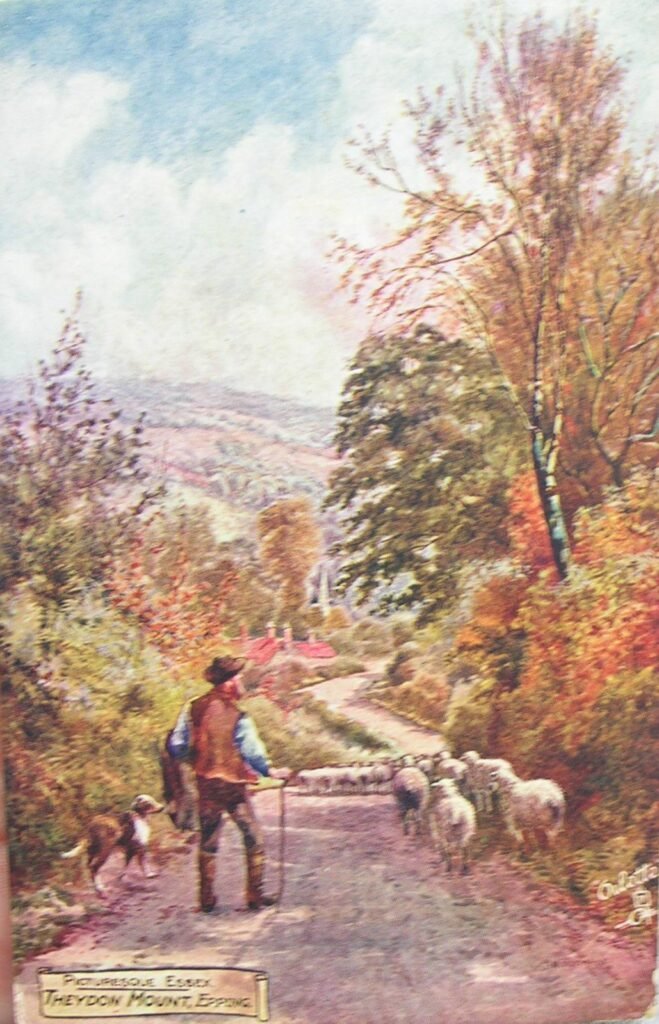
Teg – a sheep in its second year.
Wether – a castrated male sheep