Curated collection
Sporting Parish Prowess
Curated by Paul Brooks
A collection of sporting articles and photos, from Essex villagers playing quoits to a boxing match in Ongar, shopping at Piggots and an impressive run for a wager. Discover the beginnings of the Football Association and the wonderful life of Richard Thomas Dutton Budworth, alongside fascinating stories of local sporting life and achievement.
Article · 1 of 9
Cricket at Stapleford Tawney
MATCH AT PASSINGFORD, ESSEX.
An interesting game was played at the Talbot Inn, Passingford-bridge, Essex on the 30th August, between two sides chosen by the Messrs. B. and S. Cooper.
Score:- Mr S. Cooper’s side – First innings, 62; second innings 49; total, 111; of which -
S. Cooper (run out) obtained 18 and (st. Steere) 1.
Whichford (st. Gee) 6 and (b.Gee) 8.
Basham (b. Banks) 12 and (c and b Banks) 13.
Self (b Gee) 3 and (b Banks) 0.
Wright (c Heard, b Gee) 2 and (Cooper) 8.
Silcock (not out) 5 and (not out) 8.
Steere (b. Gee) 0 and (b Gee) 0.
Mott (b Banks) 3 and (b Banks) 0.
Surridge (run out) 0 and (b Gee) 0.
Byes, &c., 24.
Mr B. Cooper’s side – First Innings, 66; second innings, 45, total, 111; of which
B. Cooper (b Basham) obtained 2 and (b Silcock) 0.
Billings (run out) 3 and (c Basham, b Silcock) 3.
Gee (b Whichcord) 16 and (c Mott, b Basham) 1.
Banks ( cBasham, b Silcock) 13 and (not out) 15.
Heard (b Basham) 0 and (st Basham) 21.
R. Smith (c Mott, b Whichcord) 2 and (c Silcock, b Whichcord) 0.
Carter (b Basham) 1 and (b Basham) 0.
Palmer (b Whichcord) 7 and (run out) 2.
Barnard (not out) 20 and (absent) 0.
Byes, &c., 5.
The company afterwards partook of an excellent dinner provided by Hostess Cooper; and the singing of Mr. T. Gee delighted the company in the evening.
Media · 2 of 9
Best Calf Football Boots
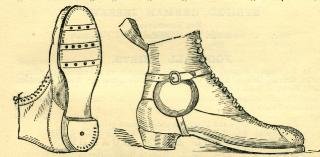
Figure 2: Best Calf Football Boots
Article · 3 of 9
A Wager
In 1807, Captain Bennett, of the Loyal Ongar Hundred Volunteers, engaged to trundle a hoop from Whitechapel Church to Ongar, in three hours and a half, a distance of twenty-two miles, for the wager of one hundred guineas.
He started on Saturday morning, November 21st, precisely at six o’clock, with the wind very much in his favour and the odds about two to one against him. Notwithstanding the early hour the singularity of the match brought together a numerous assemblage. The hoop used by Captain Bennet on the occasion was heavier than those trundled by boys in general and was selected by him conformably to the terms of the wager.
The first ten mile Captain Bennet performed in one hour and twenty minutes, which changed the odds considerably in his favour.
He accomplished the whole distance considerably within the given time, as the Ongar coachman met him only five miles and a half from Ongar, when he had a full hour in hand.
Article · 4 of 9
Epping Forest and the Founding of the Football Association
A book, a Christmas present, can sometimes provide a lead to an unexpected local connection. In this case, the book recorded the development of the rules of sports in Britain.20 In describing the development of the game of football in the mid-nineteenth century, early reference is made to Epping Forest - and the context is unexpected at least to me.
On 26 October 1863, fourteen individuals met in the Freemason's Tavern in Great Queen Street, Covent Garden. They represented a number of organizations and clubs. As individuals they were generally from prominent public schools, as they were the emerging participants in football. The organizations attending the meeting were various and included Barnes (a club of mainly rowers), the War Office, the Crusaders, Perceval House Blackheath, Blackheath School and the Blackheath club itself, Crystal Palace and Surbiton. Another club present was the oddly titled N. N., or No Names, from Kilburn. Forest, based in Epping Forest, and the point of this note, was also represented. The public school of Charterhouse merely sent an 'observer'. Geographically, the flavour was strongly southern, the important northern clubs being excluded!
At the time, there was no single set of rules to govern the game of football and the purpose of the meeting was to draw up a unifying code.21 Cambridge University, for example, played by their own Cambridge rules', although perhaps surprisingly they did not attend the meeting. Agreed rules would allow teams to play each other under a common understanding and in comparative safety, a consideration in a game which then permitted considerable physical violence. The group's first action was to form the Football Association (FA), 'with the object of establishing a definite set of rules for the regulation of the game'.22 The initial draft of the code continued to allow running with the ball, tripping and hacking. thought to maintain the overtly masculine element of the game.23 Subsequently, running with the ball and hacking were made illegal but catching the ball and claiming a free kick was still then permitted.
Forest Football Club, originally formed in 1859, was also known as Forest of Leytonstone where they appeared to be based later. However in 1864 the local link was severed when the club moved to a ground in Battersea Park, London. This move was accompanied by a change in the club name to the Wanderers, appropriately.
The club progressed to become arguably the leading club in the country, a position that was reinforced by the fact that Charles William Alcock, a member of the club, and Captain of their football team, became the Secretary of the Football Association around 1870. He is credited with being the creator of the Football Association Challenge Cup, the first knockout competition and the oldest football contest in the World. Twelve teams entered the first running of the competition, and the Wanderers became the first winners, captained by Alcock, thereby presumably fully justifying his personal support for the cup. On 16 March 1872 they defeated the captains and lieutenants of the Royal Engineers by 1-0 at the Kennington Oval.24 The following year the Wanderers won again, this time beating Oxford University.
Alcock later became Chairman of the FA until 1895. It should also be noted in passing that another celebrated member of the Wanderers, A. G. Guillemard, has been referred to as the father of the Rugby Football Union. It may therefore be claimed that Epping Forest had some influence on the development of the two major sports of these islands. The link is perhaps tenuous now that the Wanderers had assumed their new title and moved away from the area, but the name of Epping is linked with the very carliest steps towards the establishment of the most popular game in the World.
Article · 5 of 9
Boxing Match at Ongar
From the Ipswich Journal 13 October 1787
Chelmsford October 12:
Saturday last a battle was fought at Ongar, between Thomas Lloyd, of Clunn, in Shropshire, and John Smith of Toot Hill, in the parish of Ongar, for a guinea a side: it was a very hard battle, as they fought 16 rounds before it was decided, when the Welchman, giving Smith many hard blows, he was obliged to give out, and the Welchman remained master of the field.
From Jackson’s Oxford Journal 30 May 1829
Bare-knuckle Fight
The battle between Barney Aaron and Jem Raines took place yesterday on Knavestock (sic) Green, Essex, for £50 a side. After thirteen severely contested round, occupying 28 minutes, Barney was declared the victor.
Media · 6 of 9
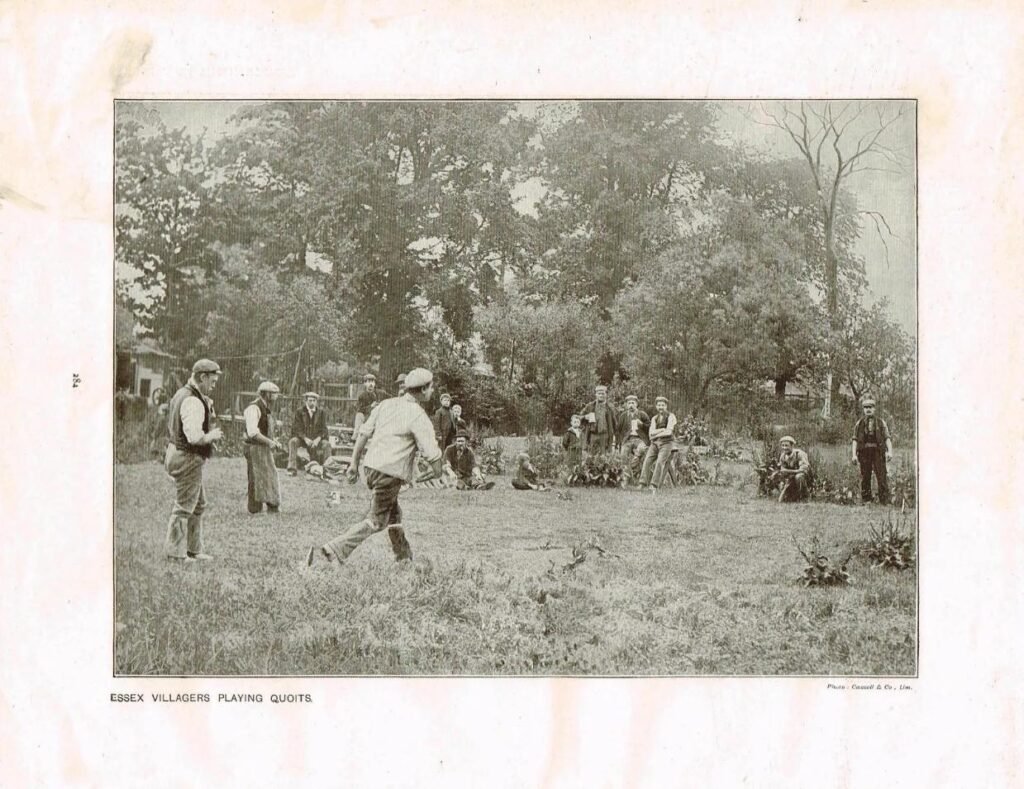
Essex Villlagers Playing Quoits
Antique Print date 1906 - Location Unknown - Essex Villlagers Playing Quoits
Article · 7 of 9
Richard Thomas Dutton Budworth (Part 1)
Richard Thomas Dutton Budworth was born on the 17th October 1867 at Greensted, Essex. He died on the 7th December 1937 in London.
He attended Brecon College and Magdalen, Oxford. His father was Philip John Budworth, a magistrate, and unsuccessful parlimentary candidate for the Borough of Sandwich in 1840, who settled at Greensted Hall, Essex in 1854 where he lived until his death in 1885. His mother was Annie Emily Thomas, daughter of David Thomas. She was his fathers second wife, the first was Blanche Trimmer who he married in 1850 but she died in 1862.
His parents married in 1866. His Grandfather was Revd. Philip Budworth who originally bought the manor of Greensted in 1837.
He was selected to play rugby for England while playing for Blackheath.
Richard Budworth was an Oxford Blue in 1887-9. He scored his England try against Wales on 3rd January 1891. One of the original members of the Barbarians Club, Budworth was a clergyman, being ordained in 1902. He taught at Lancing College, Clifton College (1898 until 1907), was headmaster at Durham School and served in World War One. He became Canon at Durham Cathedral and retired in 1932. Budworth's first match for England was the first game England had played after the international dispute. The game started in controversy when England had been unable to field their star half-back, Fred Bonsor of Bradford. He had captained the side the previous season against the 'Maoris', but was thought to have deliberately withdrawn at a late hour from the game so that his Bradford co-half, Wright, could win his first cap for England. Well, Wright secured the coveted cap, but neither he nor his colleague ever appeared in England colours again.
Article · 8 of 9
Advice to Players
In 1946 the Ongar and District Football League issued hints to those who wanted to play football for their club. –
1. Be courteous to your opponents; they are friendly rivals, and worthy of your respect.
2. Always be in good time for the kick-off.
3. Don’t make useless appeals; the referee is not influenced by them in giving his decisions.
4. Don’t argue with the referee; his decision is final.
5. Don’t stop playing until the whistle goes; the referee may not be of the same mind as you.
6. Don’t go on the field with the idea that your team stands no chance of winning.
7. Don’t say anything to dishearten the rest of the team.
8. Always play your best and the result may surprise you. Remember there are ten others on your side.
9. Don’t leave all the work to the Club Secretary. Give him a little help.
10. Play the game for the sport and enjoyment it provides and you will appreciate it all the more.
11. Wishing you all a happy and enjoyable season.
W.J. Wilson - Hon General Secretary.
Article · 9 of 9
Richard Thomas Dutton Budworth (Part II)
On September 25th 1935 a letter from Richard Budworth was published in the The Times newspaper.
FOOTBALL MEMORIES
TO THE EDITOR OF THE TIMES
Sir.- After reading your correspondent's "Football Memories" in your issue of September 19 various old memories came to me.
I can recall the time when in Rugby Football matches there was no referee, and each side appointed its own umpire. This led to various complications of course. I can recall a match in which the visitors' umpire disallowed a try by the home XV., though he was at the moment unable to see what had happened owing to a large oak tree that grew just on the touch-line. Afterwards he was always known (by supporters of the home team) as "the umpire who could see through a tree." I can also remember the delightful story of a match between two famous Yorkshire XV's. This was after referees had been instituted. The referee could blow his whistle, but only if one or both umpires waved his flag. On this occasion nothing had been scored up to nearly the call of time. Then suddenly one of the home team dropped a brilliant goal, to the huge delight of the many hundred spectators, but to their horror the referee blew his whistle and the goal was disallowed! When asked what the objection to the goal was, he said that he had seen Mr.___, the home team's umpire, waving his flag, and felt sure that unless some very gross breach of the rules had taken place, Mr.___ would never have raised an objection. He had seen nothing that could invalidate the score. As a matter of fact, Mr.___ had waved his flag in sheer delight at his own team's success!
Later on, of course the system was changed, and the referee was given the absolute decision, and the umpires being relegated to the touch-line.
I am, &c.,
R.D.BUDWORTH
Budworth spent his last days as Vicar in Horspath, Oxfordshire and died in London on 7th December 1937. He was in London to see Varsity match.
His obituary appeared in The Times on 11th December 1937, and said
CANON R.D.BUDWORTH
The funeral of Canon R.D.Budworth took place at Horspath, Oxford yesterday. The service was conducted by Prebendary L.J.Percival, Precentor of his Majesty's Chapels Royal and Domestic Chaplain to the King, the Rev.R.N.Douglas and the Rev.O.S.E.Clarendon. Family mourners and others present.
A memorial service for Canon Budworth was held yesterday at Durham School Memorial Chapel. The robed clergy present were the Bishop of Durham (Dr.Henson), the Rev.H.K.Luce (Headmaster), who officiated, the Rev.M.J.Ellingsen, and the Rev.F.A.Youngman. The Dean and Canons of Durham were absent, attending Evensong in the Cathedral, at which reference was made to the death of Canon Budworth.
On Saturday July 14th 1973 at the annual reunion dinner of the Old Dunelmian Society the headmaster of Durham School, Mr.M.W.Vallance, announced that the sports centre was to be named after the late Canon R.D.Budworth.
Conclusion
Conclusion
If you are interested in trundling maybe we could recreate
