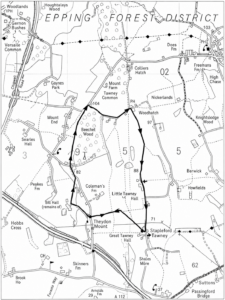
Little Tawney Hall is a mediaeval site, but the farmhouse was rebuilt in 1756. About a century later, the front was faced in brick and the sides hung with tiles. The unusual hexagonal barn dates from the 1850s. The Old Rectory is a 16th or 17th century timber-framed house, elegantly Georgianised in the 18th century and extended in the 19th century. The group of farm buildings - stables, granary and cartshed - recall the time when parsons farmed their own glebe, but sadly the great tithe barn has gone. The village pound, where stray animals were held until a fine was paid to release them, has now become a small hedged enclosure just north of Church Cottages, built in 1884 to replace a pair of cottages which used to stand in front of the church. The school (Old Tawny Cottage) was built in 1872, and the schoolteacher's house added the following year. It closed as a school in 1939. St Mary's Church dates back to the early 13th century, but much of the interior is Victorian, with a 15th century timber tower and a Parish Room completed in 1999. The stone coffin near the porch is even older than the church. The large casket tomb in the churchyard belongs to the Cunliffe-Smiths of Suttons Manor, and has the family vault beneath it. Their emblem is a collared hound called a talbot. Great Tawney Hall was rebuilt as a farmhouse in 1764. The original mediaeval manor house (Stapleford Tawney Hall) used to stand within a moat between the present house and the church. Richard de Tani, who lived here in the 14th century, gave his name to the parish. Across the fields and over the brook which forms the parish boundary, takes us to St Michael's Church, an unusually complete brick church of the early 17th century. It was rebuilt in 1614 after a fire, and contains a remarkable group of family monuments to the Smyths of Hill Hall, who dominated the history of Theydon Mount for nearly 400 years. Hill Hall is a unique Elizabethan mansion, designed and built by Sir Thomas Smyth, an eminent Tudor scholar and statesman. It is the earliest ‘Classical’ house in the country and also has a fine set of wall-paintings. Built as a prestigious country house, it has over the years been a wartime hospital, maternity unit, RAF billet, women's prison and burnt-out ruin. It is now being redeveloped as luxury apartments. Down the drive and along the road, the former brickfields have been built over during the 20th century. The little brickmaker's cottage shown on the map of 1657 survives, now hidden behind trees. The Beachet Wood is an area of ancient woodland, once a mediaeval deerpark. It contains huge (and rare) wild service trees, and evidence of centuries of coppicing. From here the hamlet of Mount End can be seen and compared with the 1657 map. Several houses and many of the field boundaries survive to this day, but Theydon Mount Common has all but gone. Through the gap in the woods first pierced by the Roman Road, lies Tawney Common, open land until 1851, when Sir William Bowyer-Smyth enclosed it and in 1853 built New Farm (now Mount Farm) right across the parish boundary - the front door is in Theydon Mount and the back door in Stapleford Tawney. The houses set back from the south edge of the common show its original extent, right across to Colliers Hatch. The Moletrap was probably built in the 18th or early 19th century, but the cottages next door are older. It is said to be the only pub in the country with this name, commemorating a new improved moletrap designed by its 19th century landlord, Joseph Threader. At Woodhatch Farm, the barns are older than the house. The remains of another hexagonal barn, the twin to the one at Little Tawney Hall, can be seen across the yard. The bridleway leads south, through sheep and cattle pasture, back to the starting point at Little Tawney Hall.

Loading…