High Country History Group
Contents
See images from this issue
Images from this issue
Article 1 of 15
Painting Stolen from Greensted Church
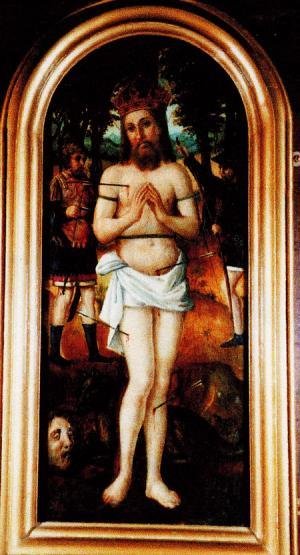
The picture (page 2), depicting the martyrdom of St Edmund, was stolen from St Andrew’s Church Greensted between noon and 4.30pm on Sunday, 22nd January. David Tester, the church warden who found that the painting was missing, said: “It’s irreplaceable, so it’s a bitter blow.”
The last time the painting was valued, more than 25 years ago, when it was estimated to be worth £8,000.
The painting dates from the 16th century and is painted on a wooden panel about two feet tall and a foot wide, which would originally have formed part of a trio of paintings joined together with hinges.
Anyone with information on the theft should call Pc Lisa Kennedy at Epping or Ongar police stations.
Images

Article 2 of 15
Church Dedications
I have recently read The Church Dedications and Saints’ Cults of Medieval Essex by Dr Janet Cooper, editor of the Victoria County History of Essex, and it showed some interesting facts about the church dedications in the High Country.
For much of the Anglo-Saxon period pastoral care was provided by priests based in monastic or minster churches. The modern parish system developed between the Tenth and Twelfth Centuries as new churches were built by landowners to serve their tenants and perhaps to display their wealth. Almost all churches and chapels were dedicated to a saint. What I had not comprehended was that some changed their dedications as other saints became more fashionable, or records were lost or not documented at all.
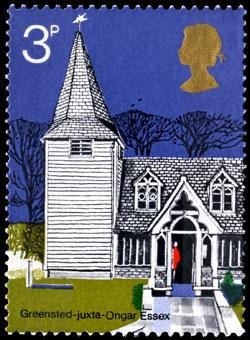
Greensted was originally dedicated to an English saint, St Edmund. His body rested at Greensted on its way back to Bury St Edmunds in 1013. The dedication is recorded in 1300. However from 1504 it changes dedication to St Andrew. This may have been an error in recording as Greensted near Colchester is also dedicated to St Andrew.
Stanford Rivers was originally dedicated to St Mary the Virgin, documented from 1500 to 1710, but from 1768 to St Margaret; again this could be due to documentary confusion with Stanford -Le-Hope. In 1537 there was an image of the Assumption of St Mary in the chancel. A light of Mary the Virgin is recorded in 1432 and later referred to in a will ‘the light of our Lady of Stanford’ written in Ongar in 1517.
Stapleford Tawney has always been dedicated to St Mary the Virgin and it is documented from 1583.
Theydon Mount is interesting as it had a double dedication to St Michael and St Stephen in 1400, only one of two churches in Essex to have a double dedication. However by 1487 it had reverted to just St Michael. A fair for the Feast of St Michael, on September 29th, was granted in 1225 and another in 1239.
This book is a scholarly investigation with much detailed research.
Images
Cooper, Janet, The Church Dedications and Saints’ Cults of Medieval Essex (Scotforth Books, 2011)
Article 3 of 15
New Newspaper Archive is Top Resource and a Gift for all Historians
The British Library has launched online its vast newspaper archive. Visitors to the website http://www.britishnewspaperarchive.co.uk can search for entries in newspapers free of charge. Digitised copies of the originals are subject to a subscription payment.
The site boasts, quite rightly:
“We have scanned millions of pages of historical newspapers and made them available online for the first time ever.
“Search millions of articles by keyword, name, location, date or title and watch your results appear in an instant.
“Compare this with hours of painstaking manual searching through hard copies or microfilm often requiring a visit to the British Library in North London and it is easy to appreciate the ground breaking nature of this project.”
Up to 40 million pages will be scanned onto the archive over the next ten years.
Several Essex newspapers are included in the project, including the Essex Chronicle, which first published in 1764. Microfilm copies of this newspaper (along with the Essex Weekly News) are available to view in the Local Studies section of Chelmsford Library.
It is now possible to use the British Library website to pinpoint, by date and page number, articles in the Essex Chronicle then look at the detail free of charge on microfilm in the local Library. The resource will drastically cut the length of time taken to find relevant articles – previously a needle in a haystack approach - and opens the door, for the first time, to a wide range of undiscovered local topics.
To illustrate the site’s usefulness, one of my friends is writing a history of a local church – Ingatestone United Reformed Church – which celebrates its bicentenary in 2012. It was known that the first building, erected in 1812, was pulled down and replaced in 1840, but little else from this early period. Using the archive pinpointed within minutes three highly relevant articles:
Essex Chronicle 1 May 1840. Page 3, “independent chapel at Ingatestone has been pulled down and is about to be rebuilt on an enlarged scale”
Essex Chronicle 8 May 1840. Page 3, “dilapidated state … pulled down”.
Essex Chronicle 16 October 1840. Page 3, “to be reopened … 22 inst”
Why not try the site for yourself?
Article 4 of 15
A Victorian Antiquarian’s Scrapbook
In Journal No. 39 (March 2011) I reported on the rediscovery in the Essex Society for Archaeology and History office of a Victorian Gentleman’s scrapbook. The work contains several drawings of local churches which in some cases pre-date their Victorian rebuilding. I stated that the compiler was unknown, other than the initials CKP.
Two members have advised me that CKP is C.K. Probert of Newport (1820-1887). Probert was an early member of the Society, an antiquary and collector. The Society's printed library catalogue of 1923 lists MS items described as the Probert Collection ('Chas K Probert, Newport, Essex Nov 24 1883 written on the inner cover'). These were rough notes about 48 churches (the few listed in the catalogue were all in NW Essex, but Gt Chrishall is not mentioned). The catalogue indicates that they formed the basis of 12 MS volumes which were bequeathed to the British Museum in 1889. His papers may be consulted at the British Library and College of Arms (http://www.nationalarchives.gov.uk/nra/searches/subjectView.asp?ID=P23530).
The scrapbook dates from the second half of the 1850s through to 1885, and begins by concentrating on parishes in the north west of the county. Of particular interest are the sketches of churches made before the Victorian restorers appeared on the scene. For example, Bobbingworth shows the timber bell tower prior to restoration in 1841, and St Mary’s, High Ongar with a belfry and tall and slender spire before much rebuilding in 1858. .
James Bettley, a member of the Society (known to many as the author of the updated Buildings of England; Essex book) wrote: “Apart from the Suckling/Buckler cuttings, I thought it the single most useful source on 19th century church restoration in Essex that I have come across – the sketches and photos of churches before they were restored provide very valuable evidence. I was surprised to find, when I compared some of the photos of Radwinter, that the very photos in the scrapbook were used to illustrate A Deuce of an Uproar, where they are credited to Probert – so someone knew of this resource and used it in the 1980s”.
It is intended that the book be transferred to the Essex Record Office for safe keeping and allow it to be used by the public.
Addendum
Images
Article 5 of 15
Another New Online Resource – Essex Ancestors
‘Essex Ancestors’ is a pay-per-view service offered online by the Essex Record Office displaying images (not transcripts) of parish registers (baptisms, marriages and burials). The service was originally free of charge, although not as extensive as now, but in these difficult times Essex County Council (who runs the excellent archive service) has found it necessary to charge. This has upset a minority of researchers who believe that access to archives should be completely free. One-day access costs £5, with prices on a scale up to £75 for a year.
The latest News from the Essex Record Office:
“Essex Ancestors was officially launched on Monday 7 November 2011 and it is clear the new service has been welcomed by genealogists and family historians. The project has been a demanding and complex one, resulting in Essex County Council’s first international trading. UK customers are in the great majority among our new clients so far, followed by Australians. The Americans have some catching up to do.
We are planning to expand the range of images by completing parishes and wills. Other collections and record series are included in our digitisation programme and we welcome suggestions.
The online accessibility of images of archives is an important contribution to the public’s awareness of historical documents, old handwriting and a long-lost way of life. We hope more people will be motivated to use original documents and become local historians.”
To use Essex Ancestors visit:
www.essexancestors.co.uk
or
http://seax.essexcc.gov.uk
Article 6 of 15
The Epping Highway Trust
The Epping Highway Trust was created by an Act of Parliament in 1768, when it took over responsibility for maintenance of the turnpike roads in this area, from the local and county Justices of the Peace. The Act, which came into force in May 1769, referred to the repairing, widening and keeping in repair of the road from the north part of Harlow Bush Common to Woodford. The road already had turnpikes and toll-houses erected upon it and tolls continued to be charged. The route at this time took the road through Epping, Loughton and Buckhurst Hill to Woodford.
The Act also gave the Trustees the power to divert, shorten, vary or alter any parts of the road through private lands, subject to agreed compensation. The roads were to be measured and milestones erected.
The first meeting of the Trust was held at Epping Place on 2 May 1769, and was attended by 49 Trustees, most of whom were well known local landowners. John Conyers, Esq, of Copped Hall, was appointed Treasurer, William Dare and Thomas Smith, joint clerks, and William Hatchman the (senior) surveyor. Golden’s (Goldings) Hill and Buckhurst Hill, two of the hills surrounding Loughton, were serious difficulties in the way of traffic into the eastern counties through Epping. In whichever direction a waggon or cart was travelling, it had to descend or ascend very steep hills.
The road through Loughton had existed since the early part of the seventeenth century, but no steps had been taken to lessen the gradients. However, in 1770 the Trustees instructed that a survey should be made of Golden’s Hill, and an estimate provided of the cost of making the ascent more easy. A committee was established to examine the results of the survey, and we find that Richard Lomax Clay (the family after whom Clays Lane is named) and William Hamilton, both residents of Loughton, were appointed members.
The estimated cost of lowering the hill was £360. A contractor was appointed to carry out the work, but there appear to have been problems and delays, which resulted in a new contractor being brought in to complete the work. Golden’s Hill was not again brought to the notice of the Trustees, except for occasional repairs to the railings by the side of the road, until October 1825, when the necessity for a drain at the bottom of the hill to carry off water from the road, was taken into consideration, resulting in an order that a brick drain of 18 inches in diameter, should be made. In December 1774 the Trustees’ attention was drawn to the state of Buckhurst Hill and the Surveyor was directed to fill up several holes, but it was not until 1777 that a survey and estimate for the reduction of the gradient was requested. Little was done immediately, although the road was widened in 1778. In 1780 action was taken to reduce the gradient. Following a meeting at the Roebuck, at which the estimated cost of £976 was discussed, it was proposed to make a cutting through the top of the hill, instead of following the route through North End and along the front of the Roebuck.
A short road would made at the bottom of the hill, where there was a sudden turn to the right. Work started, but increased costs led to an order to stop. Later the clerk to the Trustees was instructed to advertise in the Chelmsford papers for tenders to complete the work, but it was 1784 before this was done.
However, landslips resulted in a new survey in 1789 and work continued until 1794. In 1787 the responsibilities of the Trust were extended to include a turnpike road from Epping, through Ongar, to Chelmsford, and thus the Trust became known as the Epping and Ongar Highway Trust.
Vehicles travelling through Loughton had not only to contend with the gradients of Golden’s Hill and Buckhurst Hill, but also with both sides of Church Hill. Complaints by stage coachmen and others led, in 1824, to a lowering of the hill on the King’s Head side, at a cost of a little over £120.
At the meeting of the Trust in April 1830 a new surveyor was appointed – Mr James McAdam, son of the celebrated maker of roads. At a meeting on 14 June 1830, McAdam reported that a great improvement might be made in the road between Epping and Woodford, by adopting an entire new line between the Wake Arms and Woodford Wells. He was instructed to prepare a survey and identify the best line. A plan of the new route was produced very quickly, and the Trust agreed that £7,000 should be borrowed towards the expense of construction. A tender from Messrs Bough and Smith was accepted at a price of £5,417. This included a small deviation, made at the suggestion of General Grosvenor, which took the road slightly further away from his house – ‘The Warren’ Construction of the new road started before the end of 1830, continued throughout 1831 and into 1832. An extensive landslip occurred in 1832 and counsel’s opinion was sought as to who was liable. It appears that it was not the contractor, as he was paid an additional £540 to repair the road. However, in January 1833 the clerk to the Trust was ordered to write to the contractor to state the dissatisfaction of the Trustees at the contractor ‘having left the works of the new road in their present unfinished state, and unless they satisfied the Trustees as to their intentions with reference to completion of the work, the Trustees would commence proceedings against them and their sureties.’ Following discussions it was decided, in May 1833, that the Trustees would take into their own hands the completion of the work, and deduct from the (alleged) balance due to the contractor, the estimated cost of completing the unfinished work. In fact another contractor was brought in and the work was finished in 1834.
The lord of the manor of Loughton was paid £28 for trees used in the construction of the new road, but no money appears to have been paid in compensation for the manorial rights over the land taken from the Forest, for making the road.
In June 1835, Sir James McAdam, as he had now become, reported that the brick arch, underfilling at Long Valley, had broken in and become useless. A new drain was ordered to be made (drainage problems on this stretch of the road have continued, and major remedial works took place about four years ago, when the road was temporarily closed from the Robin Hood to the Wake Arms).
As there was no tollgate at the southern end of the new road, it was thought advisable to remove the turnpike by the Baldfaced Stag (called the Stag Gate) to a spot near the junction of the old and new lines of the road into Woodford. A new toll-house and gate were built, near to where today is Bancroft’s School, and old photographs showing this have survived. Other improvements to the road were carried out in 1837 and 1838, but thereafter the minutes of meetings of the Trust make no reference to the road until the 1860s.
The Trust continued to be responsible for turnpike roads until 1870, but in the last 20 years revenue from the tolls was falling, interest on loan capital still had to be paid, and railways had come to Loughton in 1856, and later to Epping and Ongar, causing competition for traffic. It was not surprising that a letter from the Secretary of State was received in February 1870 about the course to be adopted in winding up the Trust. Tolls were to be abolished and responsibility for roads was taken over by Highway Boards appointed under an Act of 1862. The County Quarter Sessions became a Highway Authority in 1878, and was responsible for bearing half the cost of the ‘main roads’ of the County.
In 1889 the newly-formed County Council took over the whole cost of these roads, but it was not until 1909 that money grants from central government were available to finance the cost of maintaining the roads, and in 1919 the Ministry of Transport was set up.
[Taken from an article by Richard Morris in the Newsletter of the Loughton and District Historical Society, 1994.]
Article 7 of 15
The Smith Family of Suttons Manor, Stapleford Tawney
The Smith, later Hamilton-Spencer-Smith, later Spencer-Smith Baronetcy, of Tring Park, in Hertfordshire.
The baronetcy was created on 11 June 1804 for Drummond Smith, with remainder to the male heirs of his niece Augusta (daughter of his eldest brother Joshua Smith, of Stoke Park, Wiltshire), the wife of Charles Smith, MP, of Suttons, Essex. Drummond was born in 1740 and died 22 November, 1816. He married Elizabeth Moncton.
Sir Charles Joshua Smith, the 2nd Baronet was the grand-nephew of Drummond. He was on the born 31st May 1800. He married twice, firstly Belinda Colebrooke who died in 1825) and secondly Mary Gosling (died 3rd July 1842), with whom he had three children, Charles Cunliffe, Mary Charlotte and Augusta Elizabeth.
Sir Charles died on the 14th January, 1831.
Sir Charles Cunliffe Smith, the 3rd Baronet was born on the 15th September, 1827. He married in 1855 Agnes Fredrica, the youngest daughter of Capel Cure of Blake Hall, Bobbingworth, near Ongar.
Sir Charles died on the 31st July 1905.
Sir Charles Cunliffe Smith
They had two sons, Drummond and Reginald.
Sir Drummond Cunliffe Smith, the 4th Baronet who was born on the 23rd February 1861. He remained a bachelor all his life and died on the 8th May 1947.
He was succeeded by his kinsman, Drummond Cospatric Hamilton-Spencer-Smith, OBE.
The fifth Baronet (whose father Reverend Spencer Compton Hamilton-Spencer-Smith had assumed the additional surnames of Hamilton and Spencer in 1872, having married Mary, daughter of Admiral Cospatric Baillie-Hamilton. Drummond was born on the 4th November 1876 and died 18th December 1955.
He was succeeded by his son, Thomas Cospatric Hamilton-Spencer-Smith, who was born 8 December 1917, who became the 6th Baronet. During World War II he served as a Captain in the Oxford and Bucks Light Infantry. He died 14th October 1959.
On the death of Sir Thomas, Suttons manor was sold.
He was succeeded by Sir John Hamilton Spencer-Smith, who is the current Baronet, and who was born on the 18th March 1947.
Images
Article 8 of 15
Gaspard Le Marchant Tupper
In St Mary’s church at Stapleford Tawney is a memorial to Mary Charlotte, daughter of Sir Charles Joshua Smith Bart. The memorial shows that she was married to Colonel Gaspard Le Marchant Tupper.
Mary died on the 22 April, 1879 at the age of 50 years.
Her husband Gaspard Le Marchant Tupper was born in 1826, into one of the most influential and possibly the wealthiest family in Guernsey, in the Channel Islands. He was educated at Elizabeth College, and joined the Royal Regiment of Artillery in 1845. He was gazetted a First Lieutenant in 1846.
He served in the Crimea from 1854 to 1856, taking part in the battle of Balaklava, was slightly wounded at Inkerman, and took part in the Siege and Fall of Sebastopol. He was promoted to the rank of Captain in 1856. In 1858 he was back in England, in command of A Troop, Royal Horse Artillery.
Gaspard married Mary Charlotte Smith, daughter of Sir Charles Joshua Smith, on the May 13th, 1861 at Kinwarton Church, Warwickshire.
He was posted to Ireland in 1862, and was gazetted a Brevet Lieutenant-Colonel. By 1865 he was back to England, but in December of that year he had arrived in India.
By 1871 he was back in England attached back to the Horse Artillery. The Times newspaper (October 17th, 1871), reported:
“The Duke of Cambridge arrived at Woolwich yesterday morning by road from London, for the purpose of making the annual inspection of the troops under the command of Major-Gen. Sir David Wood, K.C.B., Commandant of the district. (…) The first line consisted of the F and G Batteries of the B Brigade, RHA, under the command of Col. G le M. Tupper (...)"
He was then in command of the B Brigade of Royal Horse Artillery. Promoted to the rank of Colonel in 1877, he was gazetted a Major-General in 1884, Lieutenant-General in 1888. He was made a Companion of the Bath (CB) in 1905, on the occasion of the "Jubilee of the Crimean War".
He died on the 5th July 1905. His death being announced by The Times newspaper (on July 5th, 1906):
"TUPPER.- On the 2nd July, at 24, Cornwall-gardens, S.W., Lieut.-General Gaspard Le M. Tupper, C.B., Colonel-Commandant Royal Horse Artillery, in the 80th year of his age. No flowers."
Gaspard was an accomplished water-colourist who is known for his views of such places as Bermuda, the Crimea, and Puerto Rico. One of his water colours hangs in the Victoria and Albert Museum, in London.
Images
Article 9 of 15
Bert Burton
Doug Burton, a member of the High Country History Group, dropped in to me a small collection of medals, photographs and sports programmes. The collection all relates to the interest in competitive cycling of Doug’s great-uncle, Bert Burton.
From the medals and programmes, Bert Burton was a keen amateur cyclist around the period 1908-12. He entered a number of events at local sports meetings; the Saffron Walden Friendly Societies’ Athletic Sports and Flower Show; the Athletic Sports at the Harlow and District Floral and Horticultural Society; Hertford Town Fete Athletic Meeting and the Bishop’s Stortford Athletic and Bicycle Club, Athletic Meeting. The programmes for these meetings, circa 1910, are well produced, informative and demonstrate a sense of the ceremonial. Judged from these programmes and from the organizations that accompanied them, they were well-attended local events that generated interest from outside the club itself.
The Sports Meeting at the Epping Cycling and Athletic Club is typical and demonstrates considerable formality. There are numerous stewards, named and organized under various categories including the judges, timekeeper and starter, stewards to control the gates and enclosures, and the Telegraph Board Steward. Racing began at two-o-clock with two heats of the men’s Two Mile Cycle Handicap. Bert Burton competed in heat 1, not as the scratch man but in second place, 140 yards ahead of S. F. Bailey. The handicapper also reckoned that Bert justified an advantage of 100 yards ahead of the fastest man from heat two. Three from each heat were to qualify for the final, held after a rest of about 40 minutes, the winner receiving a cup and salad bowl, with second and third winning a cruet and handbag, respectively.
Event 2 was a 100 yards flat race. There were 15 entrants, again organized into two heats, with three from each again going into a final. Domestic equipment, for example a butter dish, was usually given to the first three in the final; such prizes would avoid any controversy involved in disputed amateurism or professionalism. This sprint race was followed by the Epping Tradesmen’s Race, a one-mile handicap, for which there were only seven entrants and just two prizes accordingly.
A variety of athletic and cycling events filled the afternoon in quick succession. There was the Half-Mile Cycle Handicap, the One-Mile Flat Handicap, the American Boot Race, the One-Mile Cycle Handicap, a 200 yards school-boys’ race, the One Lap Flat Handicap, a Cycle Fruit Race, the Half-Mile Novice Cycle Handicap, the One Mile Walking Handicap, and the final event, the Five Mile Championship. The latter was the main event since the winner was to be known as Champion of the Club, and was the recipient of a gold medal. Conditions for the American Boot Race and the Cycle Fruit Race, presumably novelty races, were to be announced “on the Ground”. And throughout, the Epping Town Band played on with an advertised programme of music.
The medals are heavy, decorative and handsome. They record some of Bert’s competitive times; 10 miles in 28 m 32 ½ s at the Tolgate Club, 43 m 45 s for fifteen miles at the same club, and 25 miles in 1 h 16 m 7 s at Bishop’s Stortford. Perhaps these times are overshadowed by the equivalent times of the present day, but then so was the equipment then in use overtaken by modern racing bikes. As an example, the gearing of racing bikes was allowed only in the 1930’s; previously only two speed bicycles had been permitted. Two speeds were achieved by having one sprocket wheels, one on each side of the rear wheel. To change the gearing, the rear wheel was detached and the wheel turned round to allow engagement with the other sprocket.
Doug has a few photographs of Bert in racing strip. One of these shows Bert posing next to a table, covered with a heavy cloth, on which are displayed his recent prizes. The photo’ has been carefully posed in a corner of the garden; the stance strongly suggests that the cyclist has just cycled through the hedge! The handlebars are dropping and, as the bike has a ‘fixed wheel’, there are no brakes. Thoughtfully a bell is retained on the handlebars. Mudguards have been left off.
Now, a century ago, the period in which Bert raced was an exciting one for competitive cycling; as one contemporary example of this, the first Tour de France was held in 1903. Nationally, Great Britain had been successful at the Olympic Games in 1908 in London, winning 56 gold medals. This was more than half of the total of 110 to be won (we were at home, of course) but in the cycling, Great Britain did proportionately better being victorious in winning five of the seven events. This success at national level was reflected at local level in the sporting shows staged in the area. The many local cycling events, often supported by a programme of athletics, were a result of the high enthusiasm in cycling at the time. There is much current argument and controversy about the likely legacy of the forthcoming 2012 Olympics. Was Bert’s interest in cycling attributable to the legacy of the first London Olympics? Whatever the spur may have been, Bert was a successful participant in the competitive part of the ‘bicycle craze’.
Images
Article 10 of 15
Advertisement – ONGAR UNION
Persons willing to CONTRACT for the supply of Bread, Flour, and Meat as Out Relief, and at the Workhouse, for Three Calendar Months; and for Grocery, Beer and Coals, Wine and Spirits, Drapery, Hats, Hose, Shoes, and ready-made Clothes, according to sealed samples, which may be seen at the Union Workhouse; and for Coffins and conducting Funerals, for Six Calendar Months, from the 26th March instant, may apply to me or the Master of the Workhouse for Forms of Tender, which must filled up and sealed with an Indorsement denoting the Articles Tendered for, and forwarded to me on or before Eleven o’clock on the 20th March instant; and the same will be considered by the Board of Guardians at Half-past Twelve at noon on the same day; the estimated amount of the articles required being as follows, viz:-
For the Three Calendar Months
Bread for Districts as described in Forms of Tender
}Nos. 1 & 2, about 1,500 loaves
} 3 & 4, about 1,800 loaves
Flour for each District
} Nos. 1 & 2, about 10 sacks
} 3 & 4, about 12 sacks
Bread for the Workhouse, about 2,600 loaves
Flour for ditto 3 sacks
Meat for ditto, about 200 stones of 14lb. to the stone.
For Six Calendar Months
Coals for the Workhouse, about 30 tons (Seaborne)
Beer for ditto 16 barrels
Groceries for ditto, £80 to £100
Drapery, Hats, Hose, &c, for ditto, £40
Shoes and Mending for ditto, £20.
By order of the Board
CHARLES MOTT
Clerk
[Advertisement appeared in the Chelmsford Chronicle March 1866]
Article 11 of 15
SEVERE STORM – ONGAR, 1866
On Saturday last this town and neighbourhood were visited by a terrible thunderstorm or rather a series of storms; the forenoon was intensely hot, and there were evident signs that the air was charged with electricity. Shortly after two o’clock the first storm burst with terrible grandeur over the place, flash succeeded flash with great rapidity, while the thunder was heavier than is usual, in many instances resembling rapid discharges of artillery in close proximity, while the rain fell in perfect torrents, converting the streets into a river, the water pouring down the town towards the river with great rapidity carrying large quantities of soil and gravel in its course. After a few minutes suspense other storms followed until eight o’clock when the elements became calm, after the most alarming storms ever known in the neighbourhood; the highways presented the appearance of fallow fields by the quantity of sand and stones thrown up in many places, while great damage was done to the gardens, the fruit trees in many places being stripped of their fruit especially the apples.
We have not heard of any serious accident, but Mr Christy, of Stanford Hall, lost a fine bullock, which was so frightened by the storm that it rushed into a ditch, and received such injuries that it died. A shed in the occupation of Mr Brittain, grocer, Willingale, was set on fire, and it was only through the prompt attention of the neighbours that the house &c. were saved. Mr Brittain lost a £10 note from the bureau, someone having stolen it amid the bustle of putting out the fire.
From the Chelmsford Chronicle 6 July 1866
Article 12 of 15
The Death of Isaac Taylor
Isaac Taylor (1787-1865) was a member of the celebrated local family known as the Taylors of Ongar. His first name was not unique within the family but the Isaac, the subject of this article, is generally referred to as Isaac Taylor of Stanford Rivers. Isaac Taylor (1787-1865) was a member of the celebrated local family known as the Taylors of Ongar. His first name was not unique within the family but the Isaac, the subject of this article, is generally referred to as Isaac Taylor of Stanford Rivers.
The Eclectic Review was published between 1805 and 1868. It was "clearly aimed at the highly literate and thoughtful reader" but it was "anything but elitist about the audience it sought". The founders deliberately set a low price so that many classes of people could purchase the journal. For a period, Isaac was on the staff of the journal. The following is his obituary taken from The Eclectic Review of July 1865.
“On Wednesday 1st, after many weeks of great suffering, borne with Christian resignation, the author of Natural History of Enthusiasm closed a long career of usefulness at the advanced age of 77.
Originally trained as an artist, Isaac Taylor at an early age abandoned his profession for that literary career in which so many members of his family had attained distinction. His father, the Rev Isaac Taylor, or Ongar; his uncle Charles Taylor, the learned editor of Calmet; his sisters, Ann and Jane Taylor, the joint authors of Original Poems and Hymns for Infant Minds; his mother, Ann Taylor, and his brother, Jefferys Taylor, have all written works which have attained a wide popularity.
In 1818 Mr Isaac Taylor first became a contributor to the Eclectic Review, in conjunction with Robert Hall, John Foster and Josiah Conder. His first independent literary venture was a small volume entitled Elements of Thought, published in 1822. This was succeeded by a translation of the Characters of Theorphrastus, with clever original illustrations, etched by the author; by the History of the Transmission of Ancient Books to Modern Times, the Process of Historical Proof, the Memoirs and Correspondence of Jane Taylor, and by a new translation of Herodotus. None of these early literary ventures had achieved any very eminent success. Mr Taylor at last discovered the true vein in which his genius lay. In 1829 the Natural History of Enthusiasm was published anonymously. Coming out at a time of great political and religious ferment, and offering a philosophy of the problems of the day, the book was received with extraordinary fervour by the public, and rapidly ran through eight or nine editions. With the object of giving continuity to the philosophical and religious theories which he has advanced in the History of Enthusiasm, Mr Taylor in the course of the next seven years published that series of works on which his fame must rest, Fanaticism, Spiritual Despotism, Saturday Evening, and the Physical Theory of Another Life, works which have all had and continue to command and extensive sale.
The publication of the last of these works led to the reluctant surrender of the author's incognito. The unknown writer received an urgent request from the late Dr Chalmers to stand for the chair of Logic in the University of Edinburgh in opposition to the late Sir William Hamilton, who was elected by a small majority.
In 1838 Mr Taylor gave to the world the thoughts which had suggested themselves while a large family was growing up around him in his country seclusion at Stanford Rivers. This work, Home Education, has had an extensive popularity, and has induced many parents to endeavour to promote the enjoyments of children — to educate rather than to instruct.
In the following year Mr Taylor was induced to take part with the Rev Robert Traill in bringing out a new translation of Josephus. This costly and magnificent work was accompanied with numerous illustrations engraved by some most ingenious and elaborate machinery, the invention of which had been the amusement of Mr Taylor's leisure hours. The inopportune death of Dr Traill at the eve of the publication of this work brought upon Mr Taylor ruinous pecuniary responsibilities, from which for many years he was unable to extricate himself. The engraving machine was patented in England, Scotland and America, and, though, productive of small benefit to the inventor, has realised large returns in the hands of others.
About this period the Tracts for the Times were creating an unexampled excitement in the religious world. Mr Taylor had long made himself familiar with the whole range of patristic literature; he felt that the writers of the Tracts were giving an essentially perverted view of the tendencies, doctrinal and ritual, of the early Church. As a layman, standing clear of any secular embarrassments of an ecclesiastical kind, Mr Taylor felt himself impelled to come forward and state the results to which his independent and unbiased study of the Fathers had led him. This he did in a work entitled Ancient Christianity, a work which was virulently attacked, and as warmly defended, by the respective partisans in the great controversy which was then shaking the English Church. Some of the leaders of the succession which ensued have acknowledged that the facts and reasonings of this work did more than anything else to drive them over to Rome.
After an interval of seven years, Mr Taylor published essays, partly philosophical, partly historical, on the lives of Loyola and Wesley. Shortly afterwards a volume on the Christian argument was published anonymously at Cambridge, entitled the Restoration of Belief. Two volumes of essays — Logic and Theology, and Ultimate Civilisation — a series of lectures, originally delivered in Edinburgh, on The Spirit of Hebrew Poetry, and a series of autobiographical papers published in the last year in Good Words were the last occupations of his declining years. To the end his mind retained all its power. He leaves, we believe, a large family.
A work by his eldest son, the Rev Isaac Taylor, entitled Words and Places, we recently had occasion to notice very favourably in these columns.”
Isaac Taylor is buried with his wife, Elizabeth Medland, in the churchyard of St Margaret’s, Stanford Rivers. A memorial plaque to him is situated on the north wall of the chancel. In a future note Isaac Taylor of Stanford Rivers will be revisited.
Images
The Eclectic Review, Wikipedia
28th June, Dictionary of National Biography
Article 13 of 15
Epping and Ongar Railway
The Beginning
In 1856 The Eastern Counties Railway (ECR), which later became part of the Great Eastern Railway (GER) opened a double track railway between Stratford and Loughton. A single-track extension between Loughton and Ongar was added in 1865. Increased usage on the line led to the building of double track between Loughton and Epping. At this point 50 trains operated between London and Loughton each day, with a further 22 continuing to Epping and 14 more to Ongar.
New Works Plan
The London Passenger Transport Board, later to become London Transport (LT) was established in 1933. Between 1935 and 1940 LT and mainline rail companies, with input from the government implemented their New Works Programme. This was a huge scheme, which aimed to, amongst other things, electrify main line track and work together to reduce costs to companies and provide an improved service. - At this point it should be noted that the government did not support the plans to electrify track. Under this scheme the Fairlop loop of the Central line was built.
During the Second World War (1939-45) extensions to the Central line were postponed and service between Ongar and London reduced to seven trains per day.
Post-War Years
In 1946 the Central line extension reached Leytonstone, and in 1947 progressed to Woodford. It finally reached Loughton in 1948. A steam shuttle service continued to run from Loughton to Ongar and a passing loop was put in at North Weald the following year to allow more trains to operate. Following nationalisation of the railways in 1948 individual assets of the main line rail companies and LT were transferred to the control of new executive bodies. The London Transport Executive (LTE) was the inheritor of the former LT assets and as the line from Leyton to Loughton was served by LT trains the track, stations and staff were transferred to them. Questions arose about what was to happen to the service between Loughton and Ongar. The government initially resisted the electrification of the line however, the arrival of new housing in the area allowed electrification of the track through to Epping. The Central line officially reached Epping in 1949. LTE also took control of the branch line to Ongar, and hired the steam shuttle from the Eastern regions railways.
Improving the Branch Line
During the 1950's attempts were made to improve the steam service between Epping and Ongar. It was eventually decided to give the line light electrification: this avoided the need for a sub station at Blake Hall. Modification was made to the rail and signals in 1957 allowing two 4-car trains or one 8-car trains to run on the branch line, however, in practice the short platform length made the use of the 8-car train unworkable. A twenty-minute passenger service was offered between Epping and Ongar, although freight service continued to run on steam.
Decline of the Line
Due to reduced passenger numbers Blake Hall station was closed on Sundays and a reduced weekday timetable implemented from 17th October 1966. In the same year Central line 1962 stock replaced the two 4-car trains on the branch line. Continued decline in passenger numbers led to the decommissioning of the passing loop and signal box at North Weald in 1976, and complete closure of Blake Hall station on 31st October 1981. A reduced service operated on the rest of the branch line. In 1989 an attempt was made to run an all-day service. It was unsuccessful and London Transport closed the loss-making section on 30th September 1994.
1994-2008
Shortly after 1994 a private company 'Pilot Developments' purchased the Epping to Ongar section of the line. Despite assurances that they would run a passenger service within five years of the purchase, no trains ran. In the early part of the new millenium The Epping Ongar Railway Volunteer Society (EORVS) was formed. Initially, this consisted of a small group of enthusiasts, volunteering their time to repair and preserve, damage and wear and tear, to the neglected buildings and track. Working alongside the owners the volunteer group gradually restored the line and station building at Ongar so that trains could run once again and provide a passenger service to North Weald. On 10th October 2004, almost ten years to the day since the line closed, the first EORVS train service left Ongar at 11am. EORVS operated five train services every Sunday until December 2008.
Recent Developments
A change in ownership occurred in 2009. It was decided to cease running trains and to concentrate on improving the track in preparation for reopening with Steam as well as Diesel units. Both Ongar and North Weald Stations have seen huge changes:
ONGAR
The previous Good Yards area (wasteland for many years) has been purchased by David Wilson Homes who have now built a small collection of houses. The Cattle Dock still remains, as does the main station building which has been repainted in GER colours (1900-1930's). On reopening Ongar will be the only operational GER station in GER colours!!
The milk dock is being restored into a bay platform, and just to the north of the old cattle dock will become Platform 1 and will host much improved refreshment and shop facilities in newly restored static coaches.
NORTH WEALD
North Weald is being repainted in LNER / BR (E) (1940's-1960's) colours.
The track height is being corrected for UK standard stock and is being re-laid through the loop as well as into the bay platform making 3 operational platforms at North Weald, which can all be used thanks to the signalling, allowing bi-directional working (trains can arrive / depart from any platform in either direction), as well access to improved siding facilities and enable safer shunting at both locations.
ALL of the essential infrastructure improvements (both track, signalling and rolling stock) will widen the variety and frequency of heritage operations, and is a key part as we work towards our central goal - to once again run trains to Epping; both to preserve our transport heritage and for the wider benefit of the local community in restoring this important link in our transport network.
Like all heritage railways, the Epping Ongar Railway could not operate without our friendly team of volunteers and helpers as well as the local businesses and groups that kindly assist.
Volunteers undertake all the jobs that are essential for the safe and smooth operation of the railway, both the jobs that might first come to mind, as well as many that may go unnoticed, but are never the less essential to making the trains run, whether it is...
Selling tickets
Helping passengers onto the train
Being part of our on-train teams - a guard, train driver, fireman or ticket inspector
Safely signalling trains
Helping out in the shops, refreshment facilities and museum display
Keeping our stations and coaches clean and tidy
Being a bus conductor on our vintage bus to Epping
Caring for and restoring our heritage rolling stock
Restoring and maintaining the stations and gardens
Keeping the track in good order
Managing the vegetation and environmental ecosystems along our beautiful line
Maintaining drains, bridges and structures
Working on keeping the steam and diesel locomotives running that haul the trains
With the huge variety of tasks, the railway can often be likened to a small town - and everyone is welcome and no matter how you choose to help, everyone plays an important part in ensuring the railway can operate trains and our visitors enjoy their visit. Please do not feel apprehensive - we all started from scratch!
HELP WANTED
Do you have memories of using the service between Epping and Ongar? Then the Epping and Ongar Railway are keen to hear from you.
Images
am grateful to the Epping Ongar Railway for allowing us to publish the history of the line from their website.
Further information can be obtained from
www.eorrailway.co.uk
Article 14 of 15
After Dinner Anecdotes – (Errata)
In Journal No. 41 (September 2011), I misquoted the dates when Rectors of Stondon Massey were incumbents.
The parish was served by only five clergymen during a two hundred year period:
Revd. Thomas Smith 1735-1791
Revd. John Oldham 1791-1841
Revd. Thomas Hubbard 1841-1849
Revd. Edward James Reeve 1849-1893
Revd. Edward Henry Lisle Reeve 1893-1935
Andrew Smith
Article 15 of 15
Programme 2011/2012
PROGRAMME
2011/2012
Thursday, 22 March, 2012
AGM followed by
“The High Country Then and Now”
A Photographic Journey
**
Thursday, 26 April, 2012
“How to Speak Essex”
Martin Astell (Essex Record Ofice)
Meetings are held in Toot Hill Village Hall.
Meetings start at 8.00pm.
Visitors £3. Refreshments.
Details from 01277 364305.