High Country History Group
Contents
See images from this issue
Images from this issue
Article 1 of 10
‘Cold enough to freeze the balls off a brass monkey’
No, it's not as coarse and rude as it might appear! This very common description of the British winter weather actually comes from the times when the navy fought with cannon balls. These were stored on deck, besides the actual cannon. With the rolling of the ship the balls would roll aound the ship. They were welded to small stable upright called, a brass monkey. In the bitter cold the weld could snap and the let loose the balls!

Article 2 of 10
The Epping Railway Company 1859-1863
The Epping Railways Company is not well known. This is not surprising since it never built a mile of railway. There had been, of course, many railway companies remarkable mainly for their lack of achievement but they were more uncommon by the 1860’s. This company’s real interest is that it is a local example of elbowing for position, parliamentary manoeuvring and wasteful expenditure that characterised railway promotion in England generally.
The Act of Incorporation, which received the royal assent on 13 August, 1859 empowered the company to make an extension of the Loughton Branch of the Eastern Counties Railway to Epping and Chipping Ongar and to raise capital of £100,000 in £10 shares with the customary limited liability.
The directors, who were George Parker Bidder (chairman), John Chevallier Cobbold, M.P., E S Cayley, M.P., and George Josslyn, explained the purpose and prospects to the proprietors at the first half-yearly meeting at Epping on 25 February, 1860. Promotion had been supported by the Eastern Counties as a protective measure against a competing line which was threatened from London, avoiding Epping, to Ongar, Dunmow and Bury. When this line was withdrawn the Eastern Counties said the Epping line was intended only ‘as a foil’ and should be abandoned. The Epping promoters therefore carried their Bill through Parliament against the opposition of the Eastern Counties.
The directors held out the prospect of a highly remunerative line, arising from the beauty of the locality, the close proximity to the metropolis and the ‘fertile and populous district beyond Ongar.’ The estimated cost from Loughton to Epping was between £52,571 and £54,571 for construction and land not including the, always considerable, item of parliamentary and legal expenses. The company’s own common seal was duly approved.
The conflict with the Eastern Counties involved the Epping men in expensive courses. Faced with a refusal to co-operate they deposited a Bill, as a protective measure, to obtain independent connection to Fenchurch Street by a line to the Barking extension of the Tilbury Line; this was the Epping Railways Ilford Bill. They also promoted a Bill to extend from Ongar to Dunmow. Both Bills were opposed in parliament by the Eastern Counties. Negotiations were then begun. The proposal was that the Eastern Counties should come to a fair working arrangement in return for withdrawal of the Ilford Bill, provided the Eastern Counties withdrew opposition to the Dunmow Bill.
The Ilford Bill was accordingly withdrawn. The legal costs had been £1,245. 12s. 11d., the engineering costs about £500. The Ongar-Dunmow Bill was passed since parliament considered the Eastern Counties had no locus standi for opposition, but it never produced a railway. In this case the legal costs were £1,682. 6s. 4d., and the engineering costs about £700.
The end of the conflict came with the approaching amalgamation of the Eastern Counties, Eastern Union and Norfolk companies into the Great Eastern Railway. An agreement between the companies provided that the Epping-Ongar and Ongar-Dunmow lines should be made by the associated companies, the Eastern Counties to deposit five-sevenths of the money required for the Loughton-Epping line. But the Ongar-Dunmow line was to be reconsidered and so it was.
The Epping Company was not quite dead. It had its interests, its assets and, more important, its liabilities to hand on. Its interests were protected by a separate Bill to vest its powers legally in the associated companies, before the proposed amalgamation.
Then, its manoeuvres had been accompanied by other difficulties. In order to dispose of unsold shares it had offered a commission of one-eighth of each share to ‘some of the professional gentlemen of Epping.’
The purchase of land created problems. Notice had been served, in the usual way, on landowners, the chief of whom was the Revd Mr Maitland mentioned by William Addison in Epping Forest as the first clerical lord of Loughton Manor, contracts of sale had been entered into, but the company was not ready or able to pay. And so when the Revd Mr Maitland owners amounting to £9,650 had to be passed with the rest to the associated companies and so to the G.E.R..
Lastly the local people became impatient. They, shareholders and residents in Epping, memorialised the company to start the works. This too was handed on.
In 1863, then, the new Great Eastern Railway inherited from the Epping project firstly legal and parliamentary expenses of £5,029. 10s. 2d., and engineering expenses of £2,525, a total of £7,554. 10s. 2d., of which only £3,414. 11s. related to the line to be actually built, secondly a railway on paper and thirdly a certain amount of local discontent. The Great Eastern became the L.N.E.R. and today the Eastern Region.
This story deals with only quite a small affair but it could be repeated many times over. It is based on the minutes of the Epping Railways Company.
By P W Kingsford
Essex Review - Extract from No 232 Volume LVIII (October 1949)
Article 3 of 10
The Picture of St Edmund at Greensted Church
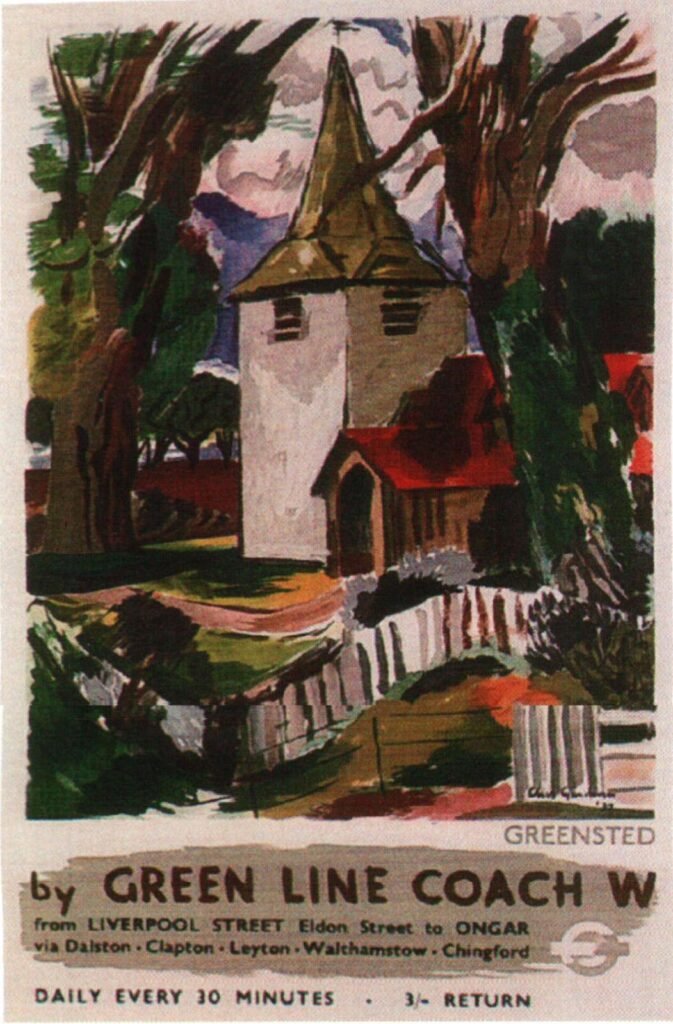
In the Essex Review of 1913 there appeared an article on Greensted Church, by Aug. V. Phillips. Many other notices of the church have appeared in our past volumes from time to time. But no allusion has hitherto been made in the Essex Review, or in the Transactions of the Essex Archaeological Society, to a remarkable painting of St Edmund, preserved in the church, nor has any reproduction of that picture appeared. We are now able to show it for the first time. It is a small picture painted in oil on a round-headed wooden panel.
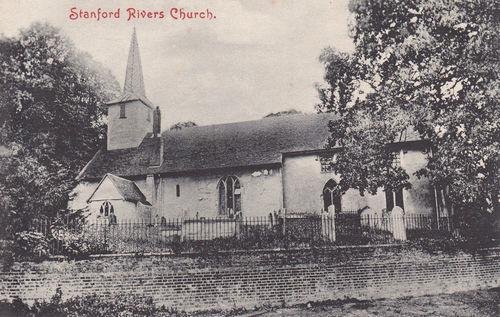
The story is that in the year 870 King Edmund, the last nominal King of East Anglia – that is of Norfolk and Suffolk – was defeated by the Danes at a battle near Thetford and was captured. Refusing to renounce Christianity he was tied to a tree and shot by Danish archers. They also decapitated him. His body was removed 33 years later to the town afterwards known as Bury St Edmunds. A great Abbey was built there and the relics of King Edmund became famous for working miracles. A century later, in 1010, the Danes were again on the warpath, devastating Suffolk. They pillaged Bury St Edmunds and its Abbey. One faithful monk remained in the Abbey and succeeded in taking away St Edmund’s body to London, finding refuge for it in St Gregory’s church near St Paul’s. Three years later, when panic had subsided, the sacred remains were solemnly taken back to Bury St Edmunds. The procession passed through Stratford Langthorne to Chigwell, Lambourne and Stapleford Abbotts, and thence by Stanford Rivers to Greensted near Ongar. There it rested for the night in a chapel near the Manor House. The present parish church of Greensted is believed to be that privileged sanctuary.
The structure is unique, the nave being built of split oak trees. …. As evidence of the antiquity of their workmanship it was pointed out by the late Dr Henry Laver, F.S.A., that the trunks were not sawn, but cleft by axes.
As to the painting there is no record of how and when it was given to the church. It is considered by experts to date from the year 1500. The manor and living of Greensted belonged to the Bourchiers, Earls of Essex, from 1367 onward till the family became extinct in the male line. In 1491 the presentation was in the hands of ‘Thos. Bourchier and other feoffees of the manor’. Sir Wm. Parr married the sole heiress of the Bourchiers and became the Earl of Essex and Lord of the manor. The picture might have been given by some member of the Bourchier family or by one of the Parr family.
It will be seen that the picture shows the King bound to a tree, wearing a crown, but otherwise nude, except for a loin cloth. Three arrows are shown piercing him. Two archers are portrayed in the background, one in Roman armour. At the foot is shown the Saint’s severed head. This duplication of the head in the painting is to emphasise the fact that he was decapitated – according to some accounts before he was dead. A painted panel in the rood-screen of Stambourne Church (near Yeldham) represents St Edmund carrying his head, another method of indicating martyrdom by decapitation. This latter method gives rise to legends, in the case of St Denys of France and St Osyth of Essex, that the martyred saints actually carried their heads after decapitation.
We may suppose that the painting was at one time shown in the church, and that it was removed to the tower either to save it from the iconoclasts or because it was regarded as superstitious and unsuitable for display in a Protestant place of worship.
Saint Edmund, King and Martyr, has two days in the Calendar, namely 20 November, the reputed anniversary of his martyrdom, at Hoxne, in Norfolk, and 9 June, ‘Translation of Edmund, K. and M.’ meaning the date of the restoration of the remains from London to Bury St Edmunds Abbey in 1013. Only the former (20 November) is retained it the Church of England Calendar. There is some reason for supposing the correct day for the Feast of the Translation of St Edmund, should be 29 April, the 9 June being really the Feast of Translation of St Edmund, an Englishman by birth, Archbishop of Canterbury, who died a natural death in France, at Soissy, on 16 November, 1242, his remains being translated to Pontigny, where (says Baring Gould) his relicts attract numerous pilgrims.
By Sir Gurney Benham, F.S.A.
Essex Review - Extract from No 186 Volume XLVII (April 1938)
Article 4 of 10
What The Papers Say
Chelmsford Chronicle, 23 January 1846
NOTICE IS HEREBY GIVEN, that an aged BLACK HORSE, which came astray in the manor of Theydon Mount, in the County of Essex, on the 3rd day of November last, will be SOLD by AUCTION, at the town of Epping, in the said county, on Friday, 30th of this instant January, unless the same is claimed by the owner previous to that day, and all expenses of its keep, advertisements, &c. paid.
Application must be made to Isaac Smith, Bailiff of the said Manor.
Essex Newsman - Saturday 28 January 1905
WALKED 185,000 MILES
Mr. A. Yates, rural postman from Epping to Theydon Mount, has retired after 37 years service, during which period he is said to have travelled 185,000 miles. His colleagues – indoor and outdoor staff – have presented him with a cruet as a token of esteem.
Lincolnshire Echo - Friday 07 June 1901
PARISH WITHOUT A CLERGYMAN OR A POLICEMAN.
The parish of Theydon Mount, in Essex, is able to lay claim to the distinction of possessing no clergyman and no policeman, and as the nearest station is three miles away, on the Ongar branch railway, strangers seldom set foot in the quiet village. Furthermore, Theydon Mount has no public house and, consequently, no publican; and as the population does not total 300 there is no Parish Council.
Essex Newsman - Tuesday 29 August 1950
PARSON WINS BUS FIGHT
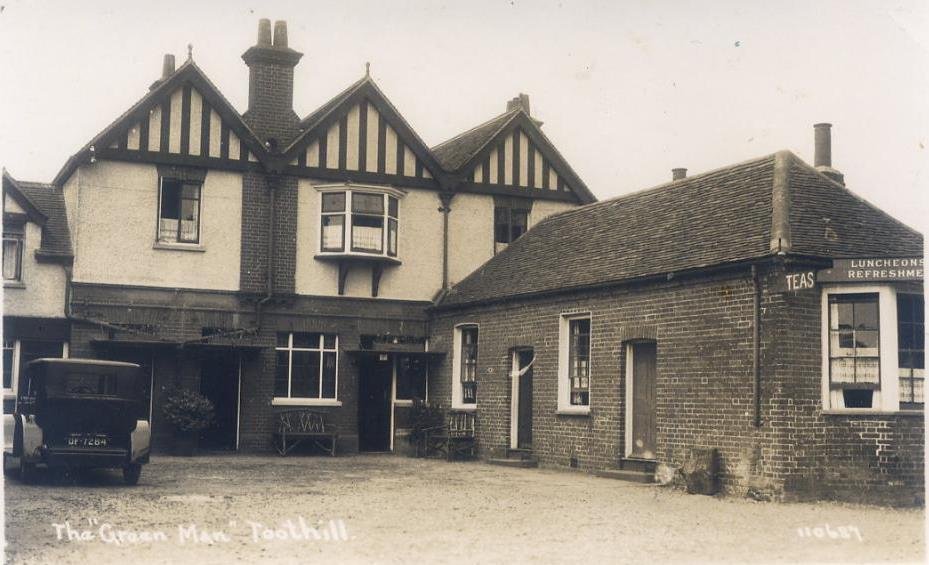
After five years of agitation, a group of North Essex villages have persuaded London Transport to run a bus service from Epping to Toot Hill, near Ongar, through Theydon Mount and Stapleford Tawney.
Chief protagonist for the villager has been the Rev. E. Bennett Rees, M.C., Rector of Stapleford Tawney and Councillor for Ongar Rural District.
He says he will ride in the first bus – scheduled to run tomorrow.
When the villagers started their own service, the Transport Commissioners stopped them.
Theydon Mount School
Chelmsford Chronicle - Friday 20 October 1911
EDUCATIONAL EXTRAVAGANCE!
SHOULD PROTEST MEETINGS BE HELD?
At the meeting of the Ongar Rural Council on Tuesday, Capt. Wellesley G. Pigott referred to an inquiry held by a deputation from the Essex Education Committee at Theydon Mount Schoolroom, which school was considered by the County Committee to be structurally inadequate. That view was not shared by the people of the district, parents as well as ratepayers, and Mr. Prance and his friends fought well. He though it would be a good idea to have a meeting to protest for the whole district against the spirit of extravagance in education which prevailed. There was a very strong feeling about it. He could see that by the way that they had fought at Tawney, where the ratepayers turned up splendidly, and they defeated the extravagant people.
The Rev. L.N. Prance: Unfortunately they are judge and jury too.
Mr R. Waltham: The parents will be quite as strongly with you as the larger ratepayers.
Capt. Pigott: They cannot build a new school there without holding a public inquiry at which anybody can attend and protest. It is the County Education Committee that I blame. I do not include Mr. Atkins, but otherwise I believe they are worse offenders than the Board of Education – they are more extravagant.
Several members expressed agreement with the idea of holding a meeting of protest for the whole district.
THEYDON MOUNT SCHOOL THREATENED
The Inquiry to which Capt. Pigott referred was held at Theydon Mount schools. The members of the special committee of the County Education Committee present were Mr B. N. Buxton, chairman, Mr W.S. Chisenhale Marsh, and Mr J. H. Burrows. There was a large attendance, among those presents being the Rev L. N. Prance, chairman of the managers, Sir William Bowyer Smyth. Sir Drummond Smith, Capt Wellesley, G. Pigott, J. P., Mr T Atkins C. C., Mr C. Hunter, Dr. Gidley Moore, Mr Jacob Miller, Mr John Miller, Mr A. Richardson, Mr Page and Mr Laws.
The inquiry was held with a view to hearing local views as to the decision of the County Education Committee that the structure of the school was inadequate.
Mr Buxton said the demands of the Board of Education were not very low and they would not regard Theydon Mount school as one to be maintained indefinitely. He, with Canon Tancock, had visited the school and came to the conclusion that it was hopelessly out of date and it was not worthwhile spending money upon it. There was a comparatively small number on the books in the county could not be expected to maintain a small school with the building past redemption. The objection was that the school was built low, appearing to be an adapted house; it was not well lighted ventilated, and was unlikely to be permanently recognised by the Board of Education and if brought up to such a standard it would be at the risk of those who spent money on it.
The Rev. L. N. Prance said it was a small parish of 150, and the average attendance at the school for the last year was 42. It was a small country school and very well attended because it was placed in the very best position. He read the report of H.M. Inspector on the visit referring to the careful teaching and excellent behaviour and said they tried to get the best possible education. The work of the girls was so successful that their scholars took no fewer than eight prizes at the Ongar Agricultural Show for needlework. With regard to the health of the school, when the schools around were closed their school was open. The structure was sufficient for the purpose to which it had been put, and it had worked admirably in giving the education they required.
Mr Buxton: Whatever good it has done in the past, it does not come up to the modern standard.
Mr. Prance said there were six windows and it was well ventilated, capable of accommodating 52 children. The report stated that the height was only 9ft, but it was more, and in some parts 13 1/8 ft. The average height was 11ft. It seems hard for the committee to complain that the offices would not up-to-date when the County Architect himself drew up the plans in 1904. It was not possible to have the same arrangements in a small school as in a large one, but the Inspector said some of the best teaching took place in small schools.
Mr Chisenhale Marsh: We all know you have a very good teacher here.
Mr. Prance said the children received a thoroughly good education, and he submitted that the school was perfectly sufficient for the needs of the parish. The managers had done their best, and were satisfied by regular visiting that the school was well suited to the requirements.
Mr. Atkins referred to a visit to the school in July, when there were 40 children present, and they found the room well ventilated. He suggested that the cost per head was not £4 to £5 as stated by the county, but £3 8s.
Mr. Nicholas (clerk to the Committee) said the corrected cost per child was £3.13. 9d.
Mr Atkins said on behalf of the children he made an urgent appeal to the Committee to use their influence with the Board of Education that the school, with certain improvements might remain, and on behalf of the agricultural population he asked that they should not be put to extra expense, as the increase of rates must re-act on labour. He hope that they would do their best to preserve the Theydon Mount and Stapleford Tawney Schools.
Mr. Buxton said that they had satisfied themselves that the school could not be made satisfactory structurally and in the best interests of the parish a new school should be built.
Captain Wellesley Pigott: If you had already formed an opinion isn't this inquiry superfluous? It is prejudged before the inquiry.
Mr. Buxton: It is for the purpose of hearing what anybody may say to the contrary. If you wish to carry it further when we give notice of our intention to build a school, you will have the opportunity of challenging then.
Mr. Chisenhale Marsh: Do you think it satisfactory to have the room 9ft high?
Mr. Atkins: If it is not unhealthy for the children. My room is 7ft 6in. (Laughter).
Mr. Chisenhale Marsh: we are not responsible for you. (Laughter).
Mr Laws said he had two children to school for the past seven years and was perfectly satisfied with the way they had been treated. They had had excellent health all the time and their education compared well without other children.
Mr. Prance: I think all the parents say the same.
Sir W. Bowyer Smyth said that they were all very much against the change and the school had done very well in the past. Two small schools are better than one because when one was closed on account of illness, the other could remain open.
Mr. Hunter said that as the largest ratepayer, he would look much more favourably reasonable alteration than a magnificent school built the public charge, which would be very disastrous to a poor rural district where it was a struggle for many to make both ends meet.
Mr Chisenhale Marsh thought the cost of alterations would not be under £312.
Sir Drummond Smith said he considered their school good enough, wholesome, clean and healthy. Prices were rising and economy should be considered. He understood that they had ordered a large number of schools to be closed in the county. This was not economy, but an attempt to do away with a small schools and Church Schools. It would be a monument of extravagance, and in his opinion it was all nonsense. The managers who devoted their time to the work had not been considered.
The inquiry then closed.
Not strictly true. Theydon Mount and Stapleford Tawney for ecclesiastical purposes were considered to be one parish and the Rector, the Rev. L. N. Prance lived in the Rectory at Stapleford Tawney.
Pc James Upshire was the village constable at Stapleford Tanwey and would have been responsible for Theydon Mount.
But then don’t let the facts get in the way of a good story.
Theydon Mount School was closed in 1942 because of the insufficient number of pupils attending the school. Those remaining were sent to Theydon Garnon School. Average attendance was 1900 – 37; 1910 – 45; 1929 – 36; 1938 – 24.
Stapleford Tawney School was closed in 1939 due to insufficient numbers. Average attendance in 1938 was only 15.
Article 5 of 10
You Might Find These Useful
Family History Books Collection:
https://familysearch.org/#form=books
On this LDS Church web pages are 40,000 plus digitised books useful to family historians including histories of families. “How to” books on genealogy, parish register transcriptions, periodicals and gazetteers. You can search or browse the collection of surnames, places etc. to find resources such as the transcription of baptisms, marriages and burial.
Centenary of the Great War:
www.1914.org
The Imperial War Museum is leading a partnership of over 500 museums, libraries and archives to commemorate the lives of over 16 million people worldwide who died in the first world war. There are audio podcasts from the IWM’s sound collection to bring you the voices of those who lived through the First World War. Of the 25 topics currently included are “Joining Up”, “The Christmas Truce”, “Zeppelins over Britain” and the “First Day on the Somme.”
Article 6 of 10
Essex Quarter Sessions Order Book 1652-1661
Stanford Rivers
Whereas it appeareth unto this Court, upon Complaint made by the Inhabitants of Stamford Rivers in this County, That Susan Hamond, spinster, Covenant servant with Thomas Simonds [th]e younger of that parish, is lately delivered of a bastard child likely to become a charge to that parrish, And upon examinac[i]on shee accuseing the said Thomas Simonds her Master to been the Father thereof, The said Thomas is thereupon fled in token of his guilt and conveyed away by Thomas Simonds the elder his Father, who in his absence takes upon him the disposic[i]on of the goodes of his said Sonne to prevent the execuc[i[on of Justice. It is thereupon Ordered by this Court that the Constables of Stanford Rivers aforesaid or any other parish in this County Doe forthwith apprehend the said Thomas Simonds the elder and carry him before some one of the Justices of the peace of this County, to be bound over to the next Quarter Sessions of the Peace for this County, there to produce his said Sonne or to be dealt withal as the Court shall then thinke fitting.
[Source: Essex Quarter Sessions Order Book 1652-1661. Published by Essex County Council 1974]
Article 7 of 10
Sayings – A Square Meal, Show a Leg
'A Square Meal'
The saying having a square meal comes from the English Royal Navy during the time of Nelson. In order to stop the plates/ dishes slipping around on the table when the ship was at sea, four pieces of wood were nailed to the benches in the shape of a square to stop the plates from slipping... hence 'having a square meal'.
‘Show a Leg’
Apparently, when the ships of old were about to leave port, the sailors might try to smuggle a lady aboard, concealing her in their hammock. The officers or mates would do a final inspection of the ship and crew before she left. Anybody in a hammock was bidden to 'show a leg'. Should a hairless and shapely one dangle the owner was usually a Jill not Jack Tar and eviction swiftly followed!
Article 8 of 10
The Budworth Family of Greensted Hall
Captain Philip John Budworth was born on the 27 December 1817. His father was the Revd. Philip Budworth (died 1861), who was rector of High Laver. He had taken over as rector from his father Revd. Richard Budworth, who had been granted the living from his brother-in-law in 1778, holding it until his death in 1805.
The Budworths had originated from Cheshire, but had previously resided in Middlesex for several generations, and were connected by marriage to the Cleeve family who had acquired Greensted Hall in 1695.
Philip (the son) was educated privately, but then studied at Jesus College, Cambridge, where he graduated in 1839 with a B.A. degree. [M.A. 1843].
From Jesus College he kept terms at the Inner Temple, but was never called to the Bar. In 1840 he stood unsuccessfully as a parliamentary candidate for the Borough of Sandwich. For eight years he travelled in Europe, returning home in about 1848 as a result of the French revolution and the resultant political unrest throughout Europe.
Whilst in England he met and married Blanche Trimmer (born 1820), in 1850 and the couple were to spend a year on their honeymoon travelling through France, Germany and Italy.
On their return the couple lived at the Wilderness, situated in Ongar High Street, before moving to Greensted Hall, which is father had acquired in 1837.
Captain Budworth became a Justice of the Peace in 1850 and was for many years sat as a magistrate for the Ongar Petty Sessional Division. He was High Sheriff for Essex 1878-1879.
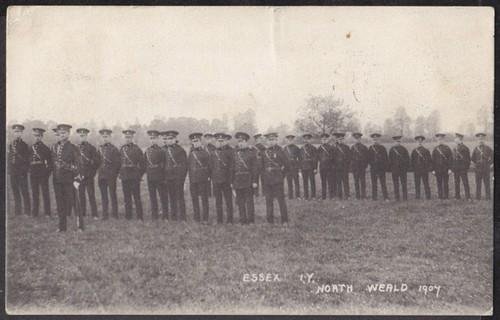
He served in ‘G’ Company (Ongar and Epping) 1st Volunteer Battalion Essex Regiment,
Blanche died in 1862 within a few days of giving birth to his first child. He re-married four years later to Annie Emily Thomas (1842-1921), and had four more children.
Although in poor health he remained in public life until his death on the 9 January 1885, aged 67 years. He was buried in Greensted churchyard.
Captain Budworth’s grave in Greensted churchyard
His lasting memorial is of course the Budworth Hall, in High Street, Ongar which was opened in February 1887.
His five children were:
Philip Henry Cresswell Dutton Budworth born 1862 (died 1939)
Richard Thomas Dutton Budworth born 1867 (died
Charles Edward Dutton Budworth born 1869 (died 1921)
David Philip Dutton Budworth born 1871 (died 1941)
Anne Blanche Dutton Budworth born 1873
His son Richard achieved fame playing rugby for England and his biography was covered in our journal ..
Charles Edward was also to lead a distinguished life:
Maj.-Gen. Charles Edward Dutton BUDWORTH
Born on the 3rd October, 1869; he was the third son of Captain Budworth.
He married Winifred, daughter of Sir Patteson Nickalls. Sadly she died in 1914 and there were no children. He married secondly in 1918, Helen, daughter of Major General W. E. Blewitt, of Langley Hill House, King's Langley, Hertfordshire. They had two sons.
He joined the Royal Artillery in 1889, and served in the South African War 1899 - 1901 (mentioned in despatches); First World War, 1914–17, (mentioned in despatches ten times).
He was formerly Adjutant of the Honourable Artillery Company and Chief Instructor of the Royal Horse and Field School of Gunnery;
M.V.O. in 1903, C.B. in 1916, C.M.G. in 1917. Commander of the Legion of Honour; Croix de Guerre; Order of St Stanislaus
He died on the 15th July 1921, whilst in the post of Inspector General of the Royal Artillery in India. He is buried at Simla cemetary.
There is a memorial to him in Greensted church.
Images
[Notes regarding Captain Budworth taken from Michael Leech’s article in Aspects of the History of Ongar, pub. 1999]
Article 9 of 10
Rookes Evelyn Bell Crompton FRS (31 May 1845 – 15 February 1940)
A British electrical engineer, industrialist and inventor. He was a pioneer of electric lighting and public electricity supply systems. The company he formed, Crompton & Co., was one of the world's first large-scale manufactures of electrical equipment. He was involved with both the practical and academic sides of his discipline, being a founder member of the International Electrotechnical Commission and twice president of the Institution of Electrical Engineers. He was a fellow of the Royal Society and a founder member of the Royal Automobile Club.
Evelyn Crompton was born at Sion Hill, near Thirsk, in 1845, one of five children. From an early age he was interested in machines and engineering. A trip to the Great Exhibition aged 6 had a profound impact on him:
“For me, the unforgettable part and focus of the whole exhibition was the Machinery Hall…neither Koh-I-Noor diamond, nor Osler’s crystal fountain…had any attractions for me to compare with those of the locomotives, with their brilliantly polished piston rods and brasses burnished like gold.”
He went to Harrow School (1858–60), but his education was interrupted by the outbreak of the Crimean War in 1854 and he was keen to see action, despite his young age. In mid-1856, after the conclusion of the war, he travelled to the Crimea on HMS Dragon and visited his brother. After the Crimea, he returned to Harrow, where he studied extra mathematics. He built his own static electricity generator. During a summer holiday, he designed and built a road-going steam tractor called Bluebell.
From Harrow Crompton joined the Doncaster Works of the Great Northern Railway where he received theoretical education and practical experience in engineering. However Crompton still favoured the military life and in 1864 joined the British Army and served in the Rifle Brigade in India. Whilst there, he witnessed the work of the Royal Engineers building narrow gauge railways and developed a deep interest in steam traction. He had Bluebell shipped to him from Britain and convinced his superiors to adopt traction engines and steam lorries for transporting cargo instead of bullock-drawn carts. He designed some of the military steam wagons himself.
Crompton returned from India in 1875 and decided to pursue his interest in engineering, becoming a partner and manager at T.H.P. Dennis & Co., an engineering company building agricultural mills and heating plant in Chelmsford. In this capacity, and as a family favour, he designed a new mechanical foundry for an iron and steel business owned by his brother. To maximise efficiency, the mill was to run day and night, requiring the best possible lighting. Crompton designed and oversaw the installation of an arc lamp system, even designing his own improvements to the Swiss-built dynamo.
Crompton became convinced of the future of electric lighting, and at the same time saw several faults in the French-developed arc lamps then in use. He developed his own design which gave a much brighter and steadier light than existing types. His faith in his design was such that he bought out T.H.P. Dennis and in 1878 Crompton & Co. was formed to manufacture, sell and install Crompton's lamp. His reputation quickly spread, to the extent that when Joseph Swan was developing his incandescent light bulb, he consulted Crompton over its design. Soon Crompton was building Swan's light bulb under license and the company dominated the British lighting market.
By 1881, the company's range had included to cover complete electrical systems. Crompton designed and manufactured dynamos, switchgear, circuit breakers, motors and electric meters, as well as lamps. Crompton gave demonstrations of his lamps at highly public events such as the Henley Regatta and at the Alexandra Palace. He installed lights at Windsor Castle and King's Cross Station as well numerous country houses, factories, tram networks, railway yards and docks. Foreign jobs included lighting the Vienna State Opera, which became the world's first theatre to be lit by electricity.
In 1887 Crompton designed and installed one of the world's first public electricity supplies using a centralised power station. Installed on the Kensington Gardens estate in London, 7 steam engines coupled to Crompton dynamos supplied power. The success of this installation led to numerous orders for similar systems worldwide. Crompton supplied equipment throughout the British Empire, with power stations being built as far away as Australia, which received its first Crompton lighting plant in 1887. In 1899, the company installed a generator set in a Calcutta hotel, producing India's first ever electricity supply. India became a significant market for Crompton & Co., and he appointed an agent in Calcutta to manage his business in the subcontinent. Similar subsidiaries were later founded worldwide.
Crompton was keen for electricity to be used for domestic as well as industrial purposes. In 1893, Scotsman Alan MacMasters approached Crompton with the prototype for a device that heated bread by running electricity through a metal element. The design went in to production as the Eclipse, the world's first electric toaster and the world's first widely-sold electric oven. Crompton kept his company at the cutting edge of electrical engineering. Despite having invested heavily in promoting and installing direct current systems, following the War of Currents, Crompton quickly developed alternating current equipment as well. He also encouraged the design of new equipment for new power sources, such as dynamos specially designed for high-speed steam engines, hot bulb engines and steam turbines.
Crompton kept a very 'hands on' approach to his business.
At the site of the former Crompton Parkinson Works (later Marconi and E2V) at Writtle Road, Chelmsford, the Crompton Building still exists, although it is now used an NHS surgery, pharmacist & residential flats. The housing development that is located on part of the former works has roads named Rookes Crescent, Evelyn Place and Crompton Street. There are numerous stone plaques in the buildings which record the achievements of Crompton and others. Nearby, there is also road named Cromar Way, which derives its name from a contraction of CROmpton and MARconi.
When the Second Boer War broke out in 1899, Crompton returned to the Army as a colonel in the Royal Engineers. He designed a range of searchlights for military use, ranging from small tripod-mounted types to large fixed designs using his own arc lamp design.
After the war, Crompton became concerned by the large range of different standards and systems used by electrical engineering companies and scientists. In 1904, Crompton represented Britain as part of a delegation by the Institute of Electrical Engineers. He presented a paper on standardisation, which was so well received that he was asked to look into the formation of a commission to oversee the process. By 1906 his work was complete and he drew up a permanent constitution for the International Electrotechnical Commission, which held its first meeting that year in London, with representatives from 14 countries.
The IEC's work was interrupted by the Great War. During this conflict, Crompton was asked by the Landships Committee to submit designs for a 'Land Ship' that could cross enemy trenches and barbed wire whilst protecting its occupants from bullets. His design formed the basis of the first practical tanks. The Commission reconvened in 1919 in Geneva. Although Germany was not officially invited to send delegates, an unofficial representation was sent, and Crompton insisted on greeting them, despite unease from other members.
In 1926 Crompton was awarded the Faraday Medal for his work, and two years later work began on Britain's National Grid.
Whilst Crompton & Co. was one of Britain's largest electrical equipment manufacturers, the emergence of global conglomerates in the 1920s such as General Electric, Siemens and Metropolitan-Vickers meant that Crompton's was beginning to lose ground. In 1929, in a move that greatly surprised the industry, Crompton & Co. merged with its rival F. Parkinson Ltd. to form Crompton-
Parkinson.
After conducting the merger, Crompton retired, leaving the company in the hands of Frank Parkinson. He moved from his London home to a house in his native Yorkshire in 1939. The house had no electricity, but his former company installed a generating plant free of charge.
Colonel Crompton died in February 1940, aged 95.
As well as his professional and private interests in engineering and electricity, Crompton was a keen cyclist. He bought his first bicycle in the 1890s. Inevitably he modified and adapted the vehicle, changing the wheel diameter and pedal cranks. He claimed to be able to cycle 200 miles (320 km) without getting tired. As one would expect of a devotee of all things mechanical, he was an early motorist and a founder member of the Royal Automobile Club and president of the Institute Automotive Engineers.
Crompton-Parkinson itself became part of the Hawker Siddeley Group in 1968. That group was broken up in stages during the 1980s, and several unrelated companies, all directly descended from Crompton & Co. through an often-complex series of mergers, break-ups and buy-outs, using the Crompton name:
Crompton Lighting- One of the oldest lighting manufacturers, this company is still based in Britain, with manufacturing in Doncaster, Yorkshire and head offices in Waltham Abbey, Essex. The company is now part of the American company Cooper Industries.
Images
Article 10 of 10
Ongar District Cottage Hospital War Memorial Scheme
It is usually accepted that the Ongar Cottage Hospital was established exclusively by Dr Hackney in a bungalow at 67 Fyfield Road in September 1928, and that it was a totally separate entity from the War Memorial Hospital which did not open until 1933. Close examination of the minute book of the Ongar District Cottage Hospital War Memorial Scheme (ERO A/HW 4/1/2) shows that this account is not entirely correct.
The minute book begins in December 1926 with funds at nearly £4500. It was agreed that the ‘present site’ in Fyfield Road should be used for building a nursing or convalescent home at a cost not exceeding £1500, and that the site should be vested in nominated trustees who included two of the local GPs, Dr Ferguson and Dr Wilson. Messrs Pertwee and Howard, architects in Chelmsford, were to be employed to draw up plans for a convalescent home. Twelve months later, their finalised proposals were duly discussed by the committee. The estimated cost of construction was £2225.
Progress was very slow until November 1928 when there was a ‘long discussion’ about the newly opened cottage hospital. This event seems to have spurred the committee into action as, only 10 days later, they agreed to build a new hospital for about £2000 and to support the cottage hospital in the meanwhile. Five weeks later, the cost of the hospital project had risen to £3000, and it was agreed that during its construction the cottage hospital would be called ‘Ongar & District War Memorial Hospital’ and would be supported financially by the committee. On completion, the new hospital would take over all the equipment currently in the cottage hospital.
However, eleven months later nothing had happened. About £850 had been paid to support the cottage hospital, but Pertwee and Howard’s designs for the new building seem to have been abandoned, as a prize of 5 guineas was to be offered for the best design produced as a result of an advertisement in ‘The Builder’ of 6 December 1929. In February 1930 the committee considered about 50 submissions and proposals and chose a design by Mr J B Wise of Stratford. Something must have gone badly wrong at this point, as only a week later Mr Howard of Pertwee and Howard was invited to be the architect for the new hospital. By May, Howard’s plan had been costed at £7000 and he was instructed to reduce this to £3000. The modified plans, not surprisingly, were considered inadequate and lacked an operating theatre.
The impossible conundrum of adequate facilities and affordability continued to dog the committee for another ten months, but finally in March 1930 plans estimated to cost £3627 were agreed. The agreement must have been fragile as, only two months later, Dr Hackney resigned from the committee, having expressed strong disapproval of the proposed hospital which he believed was too small. In spite of this, the same meeting agreed the contract to construct the hospital with the Ongar builders F M Noble at the cost of £3307-14-8. However Dr Hackney’s resignation seems to have precipitated a major row, and there were several more resignations noted at the next and final meeting on 8 June 1931, on the grounds that ‘the hospital seemed to be for one particular man, and that the doctors would not work with other medical men’.
One suspects a clash of personalities (not unusual amongst independent-minded individuals like GPs) but no subsequent minute books have survived to elucidate this. The fact that the last entry left many blank pages in this minute book would suggest that a new committee was constituted in order to administer the War Memorial fund and to oversee the building of the new hospital.
It is interesting to compare the sequence of events revealed by the minute book with the usually accepted version that Dr Hackney, dissatisfied with both the design and the lack of progress, branched out on his own in 1928 and had nothing further to do with the War Memorial project. On the contrary he remained involved until 1931, and his own cottage hospital was partly funded from the War Memorial fund, probably until the new hospital opened in 1933. Also he had agreed to the transfer of equipment from his hospital to the new one when it opened. As a keen surgeon, he was probably correct in believing that the new hospital would be too small. There is no doubt that the new operating theatre was woefully inadequate and within a few years it required an extension to provide a proper scrub and sterilising room. Also his was by no means the only dissenting voice, as others were clearly unhappy about the committee being dominated by certain (unnamed) individuals. It is a shame that subsequent minute books have not survived to reveal more of the story, but perhaps they were victims of the wartime drive for scrap paper.
Images
[This article first appeared in the OMHS Newsletter February 2011 and is printed here with the permission of Michael.]