High Country History Group

Contents
Article 1 of 12
Mr Charles Edward Hunter
The death occurred at his residence in London, at the age of 65, of Mr Charles E. Hunter, who was a prominent figure for many years in the Northern coal trade and North of England politics. Mr Hunter was the son of Mr William Hunter, a former Mayor of Newcastle, and largely interested in the coal trade, having been Chairman of Charlaw and Sacriston Collieries (Limited), Durham, and the Houghton Main Colliery (Limited), and the Manvers Main Collieries (Limited), Yorkshire. Mr Hunter had been a member of the Durham Conciliation Board, and the Durham County Council, and was a magistrate for the county. He served for some time in the Northumberland Hussars, and though retired when war broke out, again offered his services and found useful employment on home defence work.
Mr Hunter was a keen sportsman, hunted a good deal, and for some years leased the Wemmergill Moors from Lord Strathmore, while he owned several horses which one honours in steeple chases. In politics Mr Hunter was a Conservative; and had been an active partisan for a number of years. He fought several election, but none successfully, although he had reduced Radical majorities. Mid Durham against the late Mr John Wilson, Hexham (Northumberland), against the present Lord Allendale, and Scarborough were the seats he contested.
For a number of years Mr Hunter resided at Selby Hall, Gainford, near Darlington, but latterly had lived at Hill Hall, Epping. Mr Hunter married Miss M.E. Smyth, daughter of General J.H. Smyth, and leaves a widow and three daughters, Mrs L. Carey-Elwes, Mrs F.C. Wiliamson and Lady Grant Lawson.
[Source The Yorkshire Post May 18th, 1917]
He was also a deputy lieutenant and in his will left estate valued at £250,000.

Article 2 of 12
Wills to 1720 Online at Essex Ancestors
The Essex Record Office has announced a major update of Wills digitised and available online through Essex Ancestors, its subscription site. A further 22,500 wills have just been added to the 20,000 previously available to create a complete collection of those archived up to 1720. Work is in progress to complete the run of Wills up to 1858, thus creating a database of 70,000 records. To subscribe go to Essex Ancestors
http://seax.essexcc.gov.uk/EssexAncestors.aspx
Earlier this year I worked on transcriptions of Wills for Theydon Mount during the reign of King James I (1603-25). Seeing the original documents at the ERO brings a sense of excitement in a way that sitting in the comfort of your home logged onto your laptop does not. Digitisation widens accessibility to these archives which undeniably will be of enormous benefit to local, social and family historians alike.
Article 3 of 12
Theydon Mount: Rebuilding of Church following Lightning Strike
St Michael’s Church, Theydon Mount commemorated the 400th anniversary of its rebuilding in 2014.
A search through old documents held at the Essex Record Office reveals some interesting facts.
Theydon Mount was, and still is, a very small parish. The Parish Register1 shows that during the period 1603 to 1625 there were 7 marriages and 38 burials, with none at all in some years and particularly between 1611 and 1613. Baptisms were more frequent.
This is a short extract from the baptisms pages of the Register:
1611
Jonne [th]e2 daughter of Richard Smith was baptized [th]e 21 of Aprill A[nn]o sup[ra]dicto3
for Two yeeres we had none Christened in o[u]r Church because it was so long in building after it was burnt
1614
Margaret daughter of Tho Juby Clarke was baptized [th]e first day of May A[nn]o sup[ra]dicto
The note in the Register suggests that the old building may have been of wooden construction, but fire can damage stonework and mortar too.
The new church, as we know, is built of brick and must have reopened either on or before 1 May 1614, when Thomas Juby’s daughter was baptised.
Thomas Juby was the clerk or rector of the parish.
Images
An extract from the Baptism Register of Theydon Mount Church
1 ERO D/P 142/1/1: also available online through ‘Essex Ancestors’ by subscription – with free access at the
Essex Record Office in Chelmsford.
2 Throughout the document a symbol known as the thorn, which looks like a letter ‘y’ is used. It is a contraction
for ‘th’. Nowadays we see quaint names such as ‘Ye Olde Royal Oak’. The word ‘ye’ does not exist. It is ‘the’. In
palaeography the thorn is converted to [th].
3 Anno supradicto is Latin for “the year written above”
Article 4 of 12
Theydon Mount: Wills during the Reign of King James I (Part 1). The Last Will and Testamentof Thomas Bredge, 1612
Ten Wills survive in the Essex Record Office for Theydon Mount during the reign of King James I.4 Did any of them mention anything about the church rebuilding between 1611 and 1614?
The answer is ‘yes’.
Thomas Bredge devised the following Will5:
Bredge. Anno domini6 one Thousand six hundred and twelve dated the Seaven and twentith7 of Aprill.
In the name of god Amen. I Thomas Bredge of Theydon-Mounte in the Countie of Essex. First I bequeath my soule to Almyghtie God my creator and to Jesus Christ my redeemer and to the holieghos my santifier.
As for my bodie I bequeath to the Earth from whence it came. And to be buried in the churchyard of Theydon Garnone8 aforesaid9.
I give to the poore of Theydon Mounte ten shillings to be disposed accordinge to the discrecon10 of my Executors.
Item I give to the rep[ar]acon of Theydon mounte Church ten shillings.
Item I give and bequeath to my sonne James twentie pounde to be paid when he shall come to the full age of one and twentie years.
Item I give and bequeath unto my eldest daughter Margaret Bredge thirteene pounde six shillings and eight pence11 to be paid when she shall come to the full age of eighteene yeares.
Item I giue to my daughter Anne Bridge12 thirteen pound six shillings eight pence to be paid when shee shall come to the full age of eighteene yeares.
Item I giue to my daughter Elizabeth xiiiLi[bor] vis viiid13 to be paid when she shall come to the full age of eighteene years.
If it happen that any of theis my children should die before theie come to age, then my will is that theire porcion should be devided amonge the rest of my children.
Item if it happen that my wife to be w[i]th childe at the time of my decease my mynd and will is that it should have xiiiLi[bor] vis viiid at the end of eighteene yeares.
Item I give and bequeath to Agnes my wif all the rest of my moveable goodes w[hi]ch is unbequeathed, whom I make my full and whole Executor of this my last will and Testament.
Item I make my brother Robert and my brother Richard my overseers of this my last will and Testament.
The marke of Thomas Bredge, Richard Maynard, William Kobinet, Edward Aylett. The marke of Thomas Stevens.
Probatum …14
“Thomas Bridge of Thoidon Mount” was buried at Theydon Garnon on 30 April 1612, the register for that parish reveals15.
We can estimate Thomas’ age at the time of death as being at most in his mid-30s. This was quite common.
This will is typical of most. First the testator leaves his soul to Almighty God, then directs where his body is to be buried. The text is pretty standard.
When this will was written the word ‘aforesaid’ was included in error. Two parishes are mentioned: Theydon Mount and Theydon Garnon.
So was Theydon Mount an error? Where did Thomas Bredge live?
Here the Parish Register for Theydon Mount comes to our rescue because all his four children were baptised there:
“Margaret [th]e daughter of Thomas Bridge baptized the first of August 1602”;
“James Breages the sonne of Thomas Breages was baptized the 8 of July 1604”;
“Ann daughter of Tho Bridge was baptized [th]e 9 of December [1607]”;
and, “Elizabeth daughter of Tho Bridges was baptized [th]e 29 of Aprill [1610]”16.
We can deduce that Thomas Bredge was a Theydon Mount man. Also, that the writer probably used a template copy to complete the will. Would we want to commit to memory all those standard words?
Legacies to the poor and to the church follow the instructions for disposal of the body. In the case of Thomas Bredge he leaves 10 shillings for the repair of Theydon Mount church.
Then the inheritance is divided, often to his children first, then his spouse who is often appointed executor to the Will. At the end are the witnesses to the Will.
Many, including Thomas Bredge, are illiterate so sign the document with a squiggle or mark.
One of the most interesting marks I have seen is that of Richard Gladwin of Theydon Mount, a bricklayer, who signs documents with an oblong brick-shaped symbol.
There are two such documents: his own Will dated 14 December 162417 and as a witness to a terrier of glebelands, written by the rector, Thomas Juby, in the parish register on 1 December 162118.
Richard Gladwine was a sideman at the church. (See below.) I wonder whether this bricklayer had some responsibility for rebuilding the church?
Three further testators are not buried at Theydon Mount.
Robert Knoppe, a yeoman, who writes his Will on 1 May 1614, requests “my bodye to be buryed where it shall please my executrix”19. We can be confident that the church had reopened by then since the will was written on the very day of the baptism of Thomas Juby’s daughter.
Robert Hill’s undated will of 1612/13 merely bequeaths his body “to the ground”20.
William Winter’s will of 23 October 1613 requested his body “to be buryed in [th]e church yard of Theydon mount”21, but this was not carried out.
His widow, Susan Winter, who writes her will on 1 March 1624 (now 1625)22, bequeathing her body “to [th]e earth from whence it came”23, neither specifies a place of burial.
I looked at other registers in the locality – Stapleford Abbots does not survive – but could not find their resting places.
Six of the ten wills transcribed have been referred to in this note. More will be written about these in a future note.
On the basis of evidence, we can deduce that the church and churchyard reopened sometime between October 1613 and May 1614.
4 These have all now become available to view online through Essex Ancestors.
5 ERO D/AEW 14/218
6 Anno domini is Latin for ‘year of our Lord’
7 It was quite common to write dates in this way. We know the nursery rhyme “four and twenty blackbirds
baked in a pie” – this number is 24. Thomas Bredge wrote his will on 27 April 1612. Standardised spelling did
not exist.
8 Immediately recognisable as the neighbouring parish of Theydon Garnon.
9 ‘aforesaid’ implies a repetition of place name, which is not the case here.
10 Discretion – very often ‘c’ was substituted for ‘t’ and the letter ‘i’ omitted.v
11 £13.6.8d seems a strange sum of money to leave. However 13s.4d. was equivalent to one mark. So, for
people who don’t remember old money, £2 is 3 marks. £12 is 18 marks, and because there were 20 shillings to
£1, this meant £1.6s.8d. is 26s.8d or 2 marks. So, the bequest was for 20 marks.
12 Note a different spelling of the surname.
13 This is also £13.6s.8d. Pre-decimal money was divided into pounds (libor in Latin), shillings and pence (denari
in Latin). In sixteenth and seventeenth century handwriting a horizontal bar in the script represents a
contraction of a word, which palaeographers “fill in” by putting letters in square brackets. The symbol £, with
which we are familiar is a capital letter L crossed through.
14 Probate of the will is written in Latin.
15 ERO D/P 152/1/1
16 ERO D/P 142/1/1
17 ERO D/AEW 17/248
18 ERO D/P 142/1/1
19 ERO D/ABW 22/240
20 ERO D/AEW 14/292
21 ERO D/AEW 15/22
22 England adopted the Gregorian calendar in 1752. Until then the Julian calendar placed New Years’ Day on 25
March. A will written on 1 March 1624 is occasionally referred to nowadays as 1624/25.
23 ERO D/AEW 17/296
Article 5 of 12
Ongar Radio Station – North Weald 1939-85 (part 2)
The Second World War. The war- and the immediate period before brought many changes. The files are not complete but record the following events.
September 1938. Instructions were issued about air raid and blackout precautions. The radio station was to close down on receipt of an air raid warning. Lengthy instructions were given on the construction of ‘garden trenches’ as air raid shelters. These were simple trenches with a timber roof covered with earth, closed off with a wetted blanket to form a gas curtain.
September 1939. A single line from Electra House, Embankment was installed in case Electra House, Moorgate was put out of action. Further blackout instructions were issued, and the previous instruction to stop transmissions during air raid warnings was revoked (with the exception of long wave transmissions).
December 1939. Qualified volunteers were being sought to listen for illicit transmissions. Ongar Radio Station was listed as a "key point" of national importance, carrying an obligation to notify the County ARP Controller of full details of any damage or sabotage.
May 1940. A trial of the emergency arrangements from Electra House, Embankment took place, with the disconnection of all lines from Moorgate. The redoubt was being used as an air raid shelter for non- essential personnel during air raids. Instructions were given that the plant should be shut down, and all lights extinguished, if the skylights of the transmitter hall or power house were blown out. Armed police were on duty and staff were advised for their own safety to stop promptly for identification on being challenged.
June 1940. Further instructions were issued to cover the possibility of the destruction of the Central Telegraph, Electra House, Moorgate. Ongar's transmitters were to be controlled by London through the five Brentwood Radio Station tone sender channels. Mast warning lights were not being switched on at night, except on special request from North Weald airfield.
August 1940. There was a visit by General Sir Walter Kirke to advise on protective measures. He advised that the proximity of "a considerable garrison" at the neighbouring airfield reduced the risk of sabotage, but increased the risks of attack by air. He felt that the aerials were not particularly vulnerable, but that it would be advisable to maintain a store of materials for making temporary aerials, or repairing damaged ones. He noted the presence of six armed policeman, day and night. Round the main
building was a concertina wire fence with several gaps in it! He wanted this fence heightened and the gaps closed with "knife rests". He noted that personnel at the station numbered about 60, 23 of whom were in the Home Guard. The station had twelve rifles which could be used from three defensive posts "erected by the Military". He recognised that the main buildings were highly vulnerable to air attack and that nothing could be done to alleviate this. He recommended the building of 14 inch thick brick blast walls outside all ground floor windows, to protect both personnel and equipment from flying glass in the event of a near miss. Firefighting equipment was limited to stirrup pumps and chemical extinguishers. As the cooling ponds contained about 50,000 gallons, he advised the acquisition of a trailer pump and hoses to improve firefighting capacity. A small brick building provided for this on the access road just to the east of the Redoubt.
September 1940. Royal Artillery Officers visited to agree a site for one or two anti-aircraft guns. Field 17 was chosen, midway between the railway and the house of the Engineer-in-Charge, Mr L.D. Hill. The latter was concerned about the proximity of a high tension feeder cable, and felt that the guns would increase rather than reduce the vulnerability of the station to attack
November 1940. Sufficient barbed wire arrived to erect a breast high fence nine feet deep, running 50 to 60 feet from the main building, with removable ‘knife rests’ for the roadways. Camouflage officers from the Directorate of Camouflage at Leamington Spa visited the site.
September 1941. Instructions were received that in the event of invasion, civilian personnel were to remain at their posts until the last moment, when the radio station should be ‘immobilised in accordance with the scheme already agreed’. The Vulnerable Points Adviser was anxious that all but one entrance to the main building should be blocked to make the guard more effective.
October 1941. The question of camouflage rumbled on, nearly a year after the first visit of the camouflage officers. There was concern the difficulty in obtaining materials, and the risk of fire due either to sparking (‘which could he reduced by earthing the fence wires at regular intervals’) or from incendiary bombs. The scheme involved constructing artificial hedges and trees with posts, wires, brushwood and ‘tree tops’. The hedges were to vary from five to ten feet in height, with ‘tree tops’ mounted at twelve to fifteen feet on posts. A complicated netting scheme was devised to conceal the redoubt but eventually this proved too complicated, and the area was planted with trees.
November 1941. Cable and Wireless were still having doubts about the camouflage. One scheme alone required 20 miles of wire and a very large number of wooden stakes. The military authorities were insistent, and felt that camouflage was essential. The cost was to be split equally between the Government and the company.
September 1042. Cable and Wireless noted that the camouflage scheme was only partially completed, and that on the aerial photographs the barbed wire was conspicuous, and the artificial trees were ineffective!
A Civil Defence document, dated 1/9/1952, listed the defence measures which had been undertaken at Ongar Radio Station during the 1939 – 1945 War antiblast walls in 14 inch brickwork were built to protect ground floor windows at T" station, the office block and the power house. All Window glass was covered with cellophane tape or brown paper, and plywood black-out screens were made for the upstairs windows. Outdoor air mid shelters constructed of steel and covered with four feet of earth, with bench seating for twelve, were provided at "C" station and the power house. Concrete blockhouses were constructed inside "C" station and the power house, and two steel domed look-out shelters were installed by the
military authorities on the earthworks of the redoubt. The main buildings were enclosed by a coiled barbed wire screen, with double gates at the entry point. The sentry boxes here were manned first by Special Constables, then by the Home Guard and subsequently by the Military Police. Firefighting provision consisted of a static water pond close to WC station, and a trailer lire pump. Precast concrete air raid shelters were provided at the stall houses, and steel helmets for all employees. An auxiliary telephone switchboard was installed in the redoubt for use by staff if "C" station had to be abandoned. There was also a 150 mHz radio link with Electra House which provided a VHF link for carrying six tone channels if the landlines were disrupted, with the necessary aerial mounted on top of one of the beam aerial masts. Finally there was a petrol engine generator set of about 5 kw in the ex GLB feeder hut, together with a low power transmitter and receiver, operating on 5 mHz.
Apart from a direct hit on the power house (necessitating extensive repairs to the battery room), and damage to one of the beam aerial masts by a VI flying bomb, Ongar Radio Station escaped damage.
Further developments and expansion. In December 1943, “D” station was opened, three quarters of a mile east of "C” station and just north of Ongar Park Farm. This contained five unattended short wave transmitters, remotely controlled from "C” station. The frequency of one of these could be changed quickly by remote control to one of four pre-set frequencies. A later commentator wrote “In 1943, a star exhibit of the station was the 20 kw transmitter which could be started up, any one of four frequencies selected, and the transmitter tuned and connected to the right aerial – all in twenty seconds. This however necessitated the use of numerous electric motors, chains and cams, far removed from the sophisticated circuitry ...which we are pleased to accept and put into operation today".
The next development was "E" station, completed in December 1946 just to the south of the bridge over the railway cutting. This had a further six remotely controlled Marconi SWB 8/10 transmitters, though frequency changes required a visit by technical staff. However, aerial direction was remotely controlled from "C" station.
A staff list of November 1949 shows that a work force of 91 was required to keep the station running 24 hours a day. There were 42 technical staff working in the transmitter hall and power house, 15 staff (riggers, fitters, electricians and labourers) looking after the aerials and feeders, and a further 18 classified as "skilled and unskilled" working in "C" station and the power house. Six labourers worked on site and road maintenance, and two store keepers, four clerical staff and a total of six mechanics, carpenters and a lorry driver completed the staff.
Under the Commonwealth Telegraphy Act of 1949, all UK radio services run by Cable and Wireless and the General Post Office were integrated on 1/4/1950, and Ongar was controlled by the GPO Engineer-in Chiefs office from that date. Three years later, control passed to the External Telecommunications Executive.
The rapid growth in demand for radio telex and radio telegraph circuits necessitated the installation of seven remotely controlled 30 kw DS13D S.T.C. IBS transmitters at "D" station in 1959. These had remote wave change facilities, with a choice of six pre-set frequencies between 4 and 27.5 mHz.
Safety considerations were becoming more important, with oil filled
equipment enclosed in a fire proof space, and the transmitter cubicles interlocked with the main power supply so that access was impossible until the power was off. The older transmitters with water cooled valves were enclosed in cabinets by 1955. In 1957, the original Vickers-Petters diesel generators, with their potentially lethal hot bulb ignition, were replaced by diesel power units capable of generating 1.5 mw.
New transmitters required new aerials, and "D" station was provided with rhombic aerials slung in pairs between masts - the upper aerial for 4 to 12mHz and the lower one for frequencies above 12 mHz. Remotely controlled aerial switches selected the correct unit for any particular transmission. A contemporary account states "This latest addition to the capacity of Ongar Radio Station will enable more and better services to be provided. Flexibility in use, in that any of the seven transmitters can he used to transmit any type of telegraph or picture transmission – they could equally well be used for telephony should this he required - and the saving in manpower by the almost complete automatising of the processes of operating and monitoring the transmitters are the keynotes to the
design"
However, by the mid 1960's, much of the equipment (apart from the ISB transmitters) was regarded as obsolete, and the station underwent
extensive modification. New transmitters, built and installed by Standard Telephones and Cables Ltd, were all controlled from the Central Control Position in "C" station and operated by one man.
Aerials changed too. There were nineteen beam aerials in 1952, but rising maintenance costs and demand for greater frequency flexibility resulted in their removal in 1966. They were replaced by the more versatile rhombic and log periodic aerials. Rhombic aerials grew from 20 in 1952, to 51 by the early 1970's. The original 1922 Marconi short wave aerials with their lattice masts and earth screens were still in use in 1952, but were removed over the next twenty years.
After the IRA Post Office Tower explosion in central London in 1971, the station was deemed to be a potential target and was surrounded by a security fence. This necessitated the diversion of the road to Ongar Park Farm to loop round the fence which enclosed the power house and cooling tank. Up to this time, local people were free to come and pick blackberries which grew well on the Redoubt!
The next major telecommunication revolution - satellite communication - resulted in the centralisation of services at Rugby and the closure of Ongar Radio Station on 31/10/1985. All masts were demolished soon after and all that can be seen today is a cellular telephone mast adjacent to "E" station. At the time of writing, all the buildings are derelict and badly vandalised, with part of the main transmitter hall at "C" station damaged by fire. The original Marconi buildings of "A" and "B" stations remain in splendid isolation almost exactly as built in 1922, and the original "C" station building of that period can be identified in the south west comer of the transmitter building complex, largely unaltered externally. "D" station is vanishing under scrub and brambles, but "E" station has been partly let and partly used for equipment in connection with the adjoining cellular telephone mast.
Attempts by the Post Office to obtain planning permission for 900 houses on the site were rejected by the planning authority, and the subsequent owners, London and Continental Developments, have applied for a variety of schemes including a hotel, golf courses, a business park and a holiday village as well as residential development. All have been refused. At present, there is discussion about the use of 13 acres for residential development, with the rest of the site remaining as Metropolitan Green Belt. It seems that all the radio station buildings may be demolished, though Essex County Council and English Heritage stated in 1966 that "some of the buildings may be worthy of retention owing to their historic interest".
Images
Essex Redoubt at Ongar Radio Station, North Weald Bassett
[Taken from an article written by Michael Leach in September 1997]
Article 6 of 12
A tribute to Doris Messinger 1918-2014
Doris Messinger (nee Padfield) was a member of the High Country History Group from the outset and until her death. She died on the 12th June 2014. Her family have given permission for the following story of her life to be included in the Journal.
Doris was born on the 18th March 1918, the eldest daughter of John and Laura Padfield, who resided at Little Tawney Hall Farm, Stapleford Tawney. John (also known as Jack to his many farming friends) and Laura Phelps were married in April 1916. Both hailed from long established dairy-farming families in the Mendip Hills and on the Somerset Levels – families that were proud to trace their farming ancestry back to the early 18th century, and probably before. In 1894, Doris’s paternal grandfather, Hamilton Padfield, had hired a train from Bridgewater in Somerset to Buckhurst Hill in Essex in order to transport his family, animals and implements to a farm that was in easy reach of London - where a pint of milk on a doorstep before breakfast, could provide a good livelihood for a hard-working Somersetshire dairy farmer.
John and Laura Padfield
Doris was joined by her young brother, Ralph Padfield, on the 15th July 1920 and the two spent their childhood in Stapleford Tawney, attending school at the little village schoolhouse next to the church.
As a teenager Doris attended Writtle Agricultural College in Chelmsford. There, when being told to kill malformed day-old chicks, Doris refused. When she was rebuked and told that she would never be a poultry farmer’s wife, Doris exclaimed, “I’m only here for the dairy stuff – butter and cheese-making!”
The idyll of Essex farming life was soon to be completely overturned by the horrors of World War Two, which started just five months after Doris’s 21st birthday. Doris’s memories of this period were particularly vivid. During the War Doris’s first task was to distribute gas masks to farms, houses and cottages between Stapleford Tawney and Ongar. As an Air Raid Precautions Warden, one of her duties was to patrol the lanes at night, making sure that no lights could be spotted by German aircraft. Due to its location to the North of London, Stapleford Tawney was on the route taken by German bombers as they headed home, and therefore a dumping ground for bombs that had not been dropped on London. During the course of the War a large number of bombs were jettisoned over the Essex countryside, with some even landing on the farm.
There were RAF fighter aerodromes at Stapleford Tawney and North Weald, and these were frequent targets for the German bombers. Doris never forgot the sight of two Spitfires colliding shortly after taking off from Stapleford Tawney, bursting into flames and crashing to the ground. The pilots were young Polish men - they had escaped Poland, only to lose their lives in the skies over England.
Doris was a highly proficient driver, from driving the tractors on the family farm to ambulance driving and later speeding along the Essex lanes in her beloved black classic Austin Allegro. Doris drove for over 67 years without mishap. She did however incur the odd scandalous speeding ticket which she tried her best to keep a secret from the family! Doris was also a skilled car mechanic – hence she had a second Austin Allegro stored in her shed for spare parts. Doris used to say that she had to drive the Allegro as “no one will recognise me otherwise.”
The War had seen the arrival of a searchlight battery at the farm operated by handsome young men eager to chat up the farmer’s daughter. However, whilst Doris had some fun memories of this, she was not at all interested. Doris’ heart had already been won by a sailor. One afternoon, when Doris was driving home with her father after a visit to Romford Market, they gave a lift to a young man in naval uniform, weighed down by a heavy kit bag. His name was William Messinger and his parents and siblings lived in the cottages, just up the lane from this Church. Doris used to see Will's younger siblings quite a lot before they started "courting" and she couldn't understand why sometimes they'd run away when they saw her. Later, when she and Will became engaged the children said to her "oh no, now we won't get any more money" and Doris found out that Will used to pay them to run and tell him when she was walking down the lane - so he could casually appear, raise his hat and say "Good morning Miss Padfield, may I walk with you?".
oris and Will were married in July 1942, at St Marys Church. Their wedding banns were called no less than four times, but with Will away at sea during the War it proved difficult, even for Doris, to pin him down! Will was serving in the Royal Navy, in the thick of it, on the staff of Admiral Sir James Somerville, aboard the Force ‘H’ flagships, HMS Nelson, Renown and Ark Royal.
They had three sons, Nicholas Richard, Phillip and Robert and Doris was very proud of them. Tragically Will was diagnosed with cancer and died at home on the 15th March 1993.
Images
Doris Messinger 1918 – 2014
Doris Messinger 1918 – 2014
John Padfield on the binder with Doris driving the tractor in 1940
Article 7 of 12
Theydon Mount Glebe Land
1 A true Note or Terrier of all [th]e 2 glebe lands w[hic]h
2 are belonging to [th]e p[ar]sonage 3 or Rectory of [th]e p[ar]ishe
3 of Theydon Mount in [th]e County of Essex made by [th]e
4 Minister Churchwarden & Sideman of [th]e same
5 p[ar]ishe [th]e first day of December 1621.
6 There are belonging to [th]e abouenamed 4 Rectory or p[ar]sonage
7 fiue seuerall p[ar]cels of lands or grounds
8 1 The first is a poore or p[ar]cel of ground called [th]e Meads whereon [th]e
9 dwelling house & other out houses do stand & it is by estimacon 5
10 together w[i]t[h] Orchard & [th]e yard fiue Acres orchard abouts
11 The second p[ar]cell of glebe land is a close called & knowne by [th]e name
12 2 of p[ar]sonage close w[hic]h close butteth vpto [th]e Mead aboue named on [th]e
13 East vpon A p[ar]cell of ground called Kytchen Field on [th]e west vpon [th]e
14 garden of Hill hall 6 on [th]e North & vpon a p[ar]cell of land called great
15 Connyners on [th]e South this p[ar]cel of ground called p[ar]sonage close
17 The third p[ar]cell of glebe land is A close or Field comonly knowne or
18 called by {th]e name of Stony downes & it is by estimacon twelve Acres
19 3 or thereabouts And there is adioyning to the field on [th]e west side
20 A ground, being by estimacon one Acree & a halfe or thereabouts w[hi]ch
21 ground butteth upon a wood of Sir W[ilia]m Smiths called Bartholmew
22 ground. This aforsayd Field called Stony downes butteth vpon a
23 Field of Sir W[ilia]m Smiths called great Connyners on [th]e East vpon
24 A field called kytchen field on [th]e North & upon a grene called Bushe
25 grene on [th]e South.
26 The fourth & fift p[ar]cels of glebe do both of [th]m lye & adioyne vpon a
27 tenem[en]t of Sir Thomas Edmunds now at this p[re]sent in the occupacon 7
28 4 of W[ilia]m Wright, & [th]e one of chefe 8 two p[ar]cels is by estimacon three
29 Acres or thereabouts w[hi]ch p[ar]cell of three Acres is thus butted on [th]e
30 North side it buts vpon A grene of Sir W[ilia]m Smiths called Bushe
...
31 grene vpon [th]e South side vpon a field vpon Sir Thomas Edmunds
32 tenem[en]t called by [th]e name of kemefield upon [th]e East it butts vpon
33 a p[ar]cell of ground of Sir W[ilia]m Smiths called eight Acres & upon [th]e
34 west vpon a p[ar]cel of land of Sir W[ilia]m Smiths called Longhils
35 The other of these two p[ar]cels of glebeland is a longfield by
36 5 estimacon foure Acres or thereabouts & it butteth vpun
37 siresays field of three Acres on [th]e North & vpon [th]e kings high
38 way on the South.
39 And this is [th]e true Note or Terrier of all [th]e glebe lands
40 belonging to [th]e abouenamed p[ar]sonage. In witness
41 whereof we haue hereunto sette o[u]r hands [th]e day
42 & yeere aboue written.
43 T Juby Rector
44 The m[ar]ke of Richard Okeman
45 Churchwarden
46 The m[ar]ke of Richard Gladwine
47
1 ERO D/P 142/1/1: also available online through ‘Essex Ancestors’ by subscription – with free access at the Essex Record Office
in Chelmsford.
2 Throughout the document a symbol known as the thorn, which looks like a letter ‘y’ is used. It is a contraction for ‘th’.
Nowadays we see quaint names such as ‘Ye Olde Royal Oak’. The word ‘ye’ does not exist. It is ‘the’. In palaeography the thorn
is converted to [th].
3 Several words in this document have a line through the letter p. this is shorthand for ‘par’, ‘per’ or ‘por’.
4 Throughout the document we see the interchangeable ‘u’ and ‘v’, ‘i’ and ‘j’, and ‘i’ and ‘y’
5 estimation
6 Hill Hall near the church was in the ownership of the Smith family.
7 occupation
8 chief
Article 8 of 12
Stanford Rivers and John Stuart, Viscount Mount Stuart
John Stuart, Viscount Mount Stuart was born on the 25th September 1767 at Grosvenor Square, Mayfair, the son of John Stuart, 1st Marquess of the County of Bute and Hon. Charlotte Jane Windsor. He was the grandson of Prime Minister John Stuart, 3rd Earl of Bute.
He was educated between 1775 and 1779 at Eton College. He matriculated at St. John's College, Cambridge University, on the 27th May 1784. (M.A. in 1787).
He married Lady Elizabeth Penelope MacDowall-Crichton, daughter the 6th Earl of Dumfries and his wife Margaret (Crauford), on the 12th October 1792 at Dumfries House, Cumnock, Ayrshire.
He died on the 22nd January 1794 at the early age of 26, at Bassingbourn Hall, Stansted, from a fall from his horse, in Pishiobury Park, whilst returning from hunting. He died intestate and was buried on the 27th day of January, at St Margaret’s, Stanford Rivers.
His wife, Lady Mount Stuart survived him by three years and died in July 1797, aged 24.
He held the office of Member of Parliament (Tory) for Cardiff between 1790 and 1794. He was appointed Colonel of the Glamorganshire Militia in 1791 and was also Lord-Lieutenant of Glamorganshire between 1793 and his death.
They had two sons, who both added the surname "Crichton" before that of "Stuart" in 1805:
John Crichton-Stuart, 2nd Marquess of the County of Bute born 10 August, 1793, died 18th March, 1848
Lord Patrick James Herbert Crichton-Stuart born the 25th August, 1794, died the 7th September, 1859.
To discover the reason why the Viscount Mount Stewart was buried in St Margaret’s, I have referred to the work of Harold Scott, in his history of Stanford Rivers, who carried out research with the archivist to the Marquess of Bute.
In 1794, Richard Beadon, Bishop of Gloucester, who also held the living of Stanford Rivers as Rector (1775 – 1794), gave permission for a vault to be built in the chancel of the church, at the expense of John, 4th Earl of Bute (1st Marquess 1796), and it was in this vault that Viscount Mount Stewart was buried in 1794. He was apparently buried alongside his one day old sister, Elizabeth. However it would appear that both bodies were later removed and buried in the Bute tomb at Roath, Glamorgan.
It would seem that Richard Beadon was on friendly terms with the Bute family and this would appear to be the only reason that he was buried initially at St Margaret’s.
Images
John Stuart, Viscount Mount Stuart
Bassingbourn Hall which was demolished in the early 1990s to make way for the Stansted Airport development.
Article 9 of 12
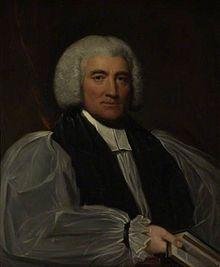
Richard Beadon, Rector of St Margaret’s Stanford Rivers
April 21. At his house in The Circus, Bath, aged 87, the Rt. Rev. Father in God Richard Beadon, D.D. Lord Bishop of Bath Wells. This prelate was a native of Somersetshire, and was educated at Tiverton, whence he removed to St. John's College, Cambridge. He was nearly related to the wife of Dr. John Newcome, Master of St. John's, a very learned and excellent woman, who is noticed in the "Literary Anecdotes," vol. vii. p.286. Dr. Newcome, who died in 1765, appointed him one of his executors, and left him a considerable part of his fortune. In 1758 he stood high among the Wranglers for his Degree, and was also a successful candidate for one of the prizes for the best dissertation in Latin prose. Having proceeded B.A. in 1738, and M.A. 1761, he became a Fellow of St. John's College, and was appointed Orator of his University.
He was presented to the Rectory of Stanford Rivers in Essex; and in 1775 appointed Archdeacon of London. He took the Degrees of B.D. 1769, and D.D. 1780. In 1781, he was elected Master of Jesus College, which he resigned in 1789. The present Duke of Gloucester having been sent to Cambridge, and entrusted to Dr. Beadon's peculiar care, his conduct secured the Royal favour, and paved the way to his subsequent high eminence in the church. His first dignity was that of Archdeacon of London; was nominated in 1789 to the See of Gloucester; and in 1802 was translated to that of Bath and Wells. He printed a Fast Sermon, preached before the House of Lords, April 19, 1793, 4to.
On the 30th April the Bishop's remains were conveyed to Wells. The body lay in state at the Palace four hours. At three o'clock the funeral procession moved to the Cathedral in grand state. Major Beadon (sic), the late Bishop's son, was the chief mourner. The Rev. Archdeacon Trevelyan read the ceremony; and some of Handel's best pieces were performed. The throne and pulpit were covered with fine cloth and crape; a mourning mantle surmounted the throne. A solemn dirge was performed over the grave to great effect. The solemnity of the occasion was increased by the tolling of the great bell of the Cathedral (muffled) and by all the shops being closed. In Bath, where the memory of his lordship will be cherished with lasting affection, the bells of the churches were tolled at intervals during the day, and on Sunday in the pulpits, &c. of the different churches exhibited emblems of mourning.
Images
The Reverend Richard Beadon (1737 – 1824)
Richard Beadon, (1737-1824)
From The Gentleman's Magazine, Volume 94 (1824)
Article 10 of 12
William King M.M.
Born in Stanford Rivers in about 1887, the son of Abram & Matilda King, of Clatterford End, Toot Hill. In the 1911 Census he is shown as a Cowman at Burrows Farm, and resided in Vine Cottage, Clatterford End. He was the holder of the Military Medal, awarded 13th March 1918.
He was a Lance Corporal in the 24th Battalion of the Royal Fusiliers (City of London Regiment). He was killed on the 1st October 1918.
He is buried in the Flesquieres Hill British Cemetery, France.
Images
William King M.M.
Article 11 of 12
Malcolm Sworder
He was born on the 11th February, 1893 at Stapleford Tawney. He attended King Edward’s Grammar School in Chelmsford, where he received the Cadet Corps Recruits’ prize in 1907. He resided at Great Tawney Hall.
He was a Lieutenant in the Canadian Reserve Cavalry Regiment. He was a pilot with the Royal Flying Corps attached to 59th Squadron. He was 26 years old when he was killed on the 18th March 1918. He is buried in Achiet-Le-Grand Communal Cemetery Extension, France.
Images
Malcolm Sworder
Article 12 of 12
Norman Sworder
He was a Lieutenant in the RAF and was killed on the 17 April 1918. He was previously with the Canadian Infantry (British Columbia Regiment). He is buried at the La Targette British Cemetery, Neuville-St. Vaast, France.
He was born on the 4th January, 1887, at Stapleford Tawney, the son of Harry and Eleanor Sworder. The family lived at Great Tawney Hall.
He was married to Emily Murial Sworder of Maidenhead. They had one child, Robert Ian, born in 1917.
Images
Norman Sworder