High Country History Group
Contents
See images from this issue
Images from this issue
Article 1 of 11
Green Man Public House, Toot Hill – an update
Further to the article in the Journal 60, Doug Burton contacted me with details of additional licensees of the public house.
In the 1940’s there was a licensee named Weston. Jim Darby was there in 1952/53, when he left and the licence was taken over by a chap called Tomlinson. Also in the early 1950’s a Frederick Mills was also known to be the licensee of the pub. John Road took over the licence in 1964/65.

Article 2 of 11
Verdun Oaks
One hundred years ago the terrible events of the Battle of Verdun touched the hearts of the British public.
More than 400,000 French and German lives were lost in the longest running battle of the First World War. Verdun’s oak and chestnut forests were devastated, and still today bear the scars of the conflict. 185,000 hectares of forest were destroyed - an area of land bigger than Surrey, where England’s Centenary Wood will stand.
After the fighting ended, acorns were collected from the battlefields and planted in our towns as a tribute to the fallen. Why and how the acorns
came to the UK is an unfolding story and one we would love to complete.
Extracts from newspapers and magazines written at the time provide possible clues.
One story suggests that Lord John French, who led the British into Northern Europe in 1915, took a handful of acorns to commemorate the stand the French had made at the Battle of Verdun.
There are also reports that the Mayor of Verdun sent a box of acorns to the London and North West Railway Company (LNWR) in early 1917 to be sold for the benefit of the War Seal Foundation, a charity which supported ex-servicemen and their families. Sample boxes were sent to mayors in towns and cities along the route of the railway.
Help us find the Verdun Oaks
Today, these smallest of gestures have grown into grand tributes providing shade, enjoyment and homes for wildlife.
The Woodland Trust are asking history buffs to turn detective and help us discover more Verdun Oaks in the hope of growing a new generation in our First World War Centenary Woods so that, in another hundred years, our grandchildren’s children can enjoy them.
Images
Article 3 of 11
Toot Hill Windmill
The post mill at Toot Hill was probably erected in c1815. The following articles were taken from local newspapers.
On Thursday 18th June 1829, a terrible thunderstorm raged over the area of Ongar and Stanford Rivers. As the thunder clouds hovered over Toot Hill windmill there was a "hissing noise and sound like artillery" and then the smell of sulphur. Mrs Rayner, the miller's wife, was in her cottage when she heard the shrieks of her husband in the mill. She rushed outside to see the mill had been struck by lightning.
Mr Rayner's nephew and others came to the rescue and the miller, Joseph Knight, was found on the second floor of the mill. His hair was singed, he had facial injuries, and his right leg was almost separated from the rest of his body.
Mr Potter, the Ongar surgeon, was called for and quickly arrived. With the assistance of several other professional gentlemen, he immediately amputated the leg.
It appears that the miller survived the ordeal and a print of the mill's destruction (see page 11), was sold locally to raise funds for the miller and his family as, no doubt, he was unable to work.
As for the mill, it had been struck on the sails cutting two of them off. The lightning then entered the mill demolishing the interior, thrusting two half-hundred weights out through the side of the mill. The roof was blown off, as was the weather boarding on it sides. It was left like a skeleton with its machinery exposed. The mill was repaired and operated until about 1904.
It was demolished in 1935.
Toot-hill Windmill in the News
Essex Standard 5 December 1851
Nov. 19th, aged 34, Hannah Lambert, the beloved wife of Mr George Lambert, Toot-hill Mill, Stanford Rivers, in this county
Essex Standard 20 January, 1860
Jan 11th at Lewisham, aged 34, Jane, wife of Mr. John Rippington, formerly of Toot Hill Mill, near Ongar.
Essex Herald, 18 March, 1862.
POST WINDMILL TO LET, situate at Toot Hill, Stanford Rivers, driving two pairs of stones: in a thorough state of repair, and capable of doing a good trade, with Cottage and convenient premises. Possession to be had at Lady-day next. For particulars apply to Mr Smith, Greenstead, Ongar.
Essex Herald, 14 May, 1872.
TO MASTER MILLERS – SITUATION WANTED, as UNDER STONEMAN or GENERAL MILLER. Apply E.C.R., Toot-hill Mill, Ongar.
Chelmsford Chronicle, 7 January 1887.
BUSINESS INTIMATION
H. SURRIDGE & SONS
HAY, STRAW, CORN, SEED, AND COAL
MERCHANTS
TOOT HILL MILL and ONGAR
BEG respectfully to inform the inhabitants of Ongar and surrounding district that they have SUCCEEDED to the BUSINESS lately carried on by Mr. WILLIAM BOOR, and hope by strict attention to orders entrusted to them to merit a continuance of their support.
Essex Herald, 29 December 1888
OUTBREAK OF SWINE FEVER – At the Ongar Petty Session on Saturday last, Inspector Robinson reported an outbreak of swine-fever on the premises of Mr. D. J. Surridge, Toot-hill Mill. Mr Surridge bought seven pigs at Epping market on the previous Friday and soon afterwards they were discovered to be suffering from swine fever and were slaughtered.
A FIRE. A fire occurred on the premises of Mr Surridge, at Toot-hill Mill, on Friday evening, Dec.21st. The outbreak occurred in a backroom of the Mill Hose, and was caused by the upsetting of a paraffin lamp by a child. The Ongar fire engine was on the spot in good time; but the flames had fortunately been extinguished by pails of water before its arrival.
Essex Herald 5 June, 1894
DROWNING FATALITY near ONGAR
On Wednesday afternoon the four-year old son of Mr Daniel Surridge, of Toot-hill Mill, Ongar, was missed from near the mill pond, where he had been playing. His mother went out to find him, but the only trace she could find was his wooden toys, which were floating on the water. Upon further search she found the body of the poor child in the water. With the assistance of a man named Barnard she got the body out, but it was found to be quite lifeless. It is conjectured that the child went to the pond to draw water in a squirt, when he fell in. At the inquest held by Mr Lewis last evening a verdict of “Accidentally drowned” was returned.
The Essex Chronicle 17 February, 1928.
TOOT HILL MILL ABLAZE
During the storm the old mill at Toot Hill, near Ongar, was struck by lightning and set on fire. The mill, which is owned by the Misses Price, has not been worked for 18 years, and is over 100 years old. It was struck by lightning 80 years ago. It was feared when it caught fire on Friday that a wooden cottage adjacent would become involved, but the Epping Fire Brigade attended so promptly that this was averted. There is only one sail to the mill, and this and the struts were damaged. After the brigade left flames broke out again and the foremen were again summoned.
The Owners/Millers of the Mill.
1815 ? Rayner
1832 Edward Rayner
1842 Edward Rayner
1851 John Crisford Rippington
1853 George Lambert
1858 Henry Moor
1860 J.S.A. Willis
1865 Daniel Surridge
1894 Daniel Surridge
1898 Comyns Owers
Images
Details taken from the Rate Books.
John Crissford Rippington (1823 – 1867), was living in the Mill House (1851 Census). He had moved there in 1850 as a son, William was born in the house in that year. However by 1852 he was resident in Barnston (near Dunmow).
Article 4 of 11
Memorials against the Police
A memorial was presented from the united parishes of Stapleford Tawney and Theydon Mount, agreed to in vestry, stating that although the police had made a considerable addition to the burdens laid on them, it had not answered the purpose for which it was instituted within the parish, as the number of depredations during the night had increased rather than diminished since it institution. It seemed to them impossible to prevent such depredations in retired villages without an increase of expense too great to be borne by rural parishes. The petitioners considered themselves by the act of parliament entitled to a strict equality of taxation for the rural police within the towns and larger villages, whereas, in reality, the burthen of this force fell most unequally upon the portions of the county that were agricultural, the towns and larger villages having nearly all the benefit from the police. They therefore prayed the Justices in Quarter Session to take into their serious consideration whether it is not expedient forthwith to report it as their opinion to the Secretary of State that the rural police force is unnecessary, and should be discontinued in this county.
Chelmsford Chronicle 7th January 1842.
Editor’s Note:
The Essex County Constabulary had been formed in 1840, and from the outset there were a number of petitions to the Essex Quarter Sessions as to the cost of providing a police force which fell to the rate payers of the County, and asking that the old system be re-introduced.
Article 5 of 11
Threatened Closures of Stapleford Tawney and Theydon Mount Schools in 1911
Essex County Chronicle 20 October, 1911
EDUCATIONAL EXTRAVAGANCE
SHOULD PROTEST MEETING BE HELD?
At the meeting of the Ongar Rural Council on Tuesday, Capt. Wellesley G. Piggott referred to an inquiry held by a deputation from the Essex Education Committee at Theydon Mount Schoolroom, which school was considered by the County Committee to be structurally inadequate. The view was not shared by the people of the district, parents as well as ratepayers, and Mr Prance and his friends had fought well. He thought it would be a good idea to have a meeting of protest for the whole district against the spirit of extravagance in education which prevailed. He could see that by the way they had fought at Stapleford Tawney, where the ratepayers turned up splendidly, and they defeated the extravagant people.
The Rev. L. N. Prance: Unfortunately they are judge and jury too.
Mr. R. Waltham: The parents will be quite as strongly with you as the larger ratepayers.
Capt. Piggott: They cannot build a new school there without holding a public inquiry at which anybody can attend and protest. It is the County Education Committee that I blame. I do not include Mr. Atkins, but otherwise I believe they are far worse offenders that the Board of Education – they are far more extravagant.
Several members expressed agreement with the idea of holding a meeting of protest for the whole district.
THEYDON MOUNT SCHOOL
THREATENED
The inquiry to which Capt. Piggott referred was held at Theydon Mount Schools. The members of the special committee of the County Education Committee present were Mr. E. N. Buxton, chairman, Mr. W. S. Chisenhale Marsh, and Mr. J.H. Burrows. There was a large attendance, among those present being the Rev. L. N. Prance, chairman of the managers; Sir William Bowyer-Smyth, Sir Drummond Smith, Capt. Wellesley G. Piggott, J.P., Mr. T. Atkins, C.C., Mr. C. Hunter, Dr. Gidley Moore, Mr. Jacob Miller, Mr. John Miller, Mr. A. Richardson, Mr. Page and Mr Laws.
The inquiry was held with a view to hearing local views as to the decision of the County Education Committee that the structure of the school was inadequate.
Mr. Buxton said the demands of the Board of Education were not very low, and they would not regard Theydon Mount School as one to be maintained indefinitely. He, with Canon Tancock, had visited the school, and came to the conclusion that it was hopelessly out of date, and that it was not worth while spending money upon it. There was a comparatively small number on the books, and the county could not be expected to maintain the small school with the building past redemption. The objection was that the school was built low, appearing to be an adapted house; it was not well lighted and ventilated, and was unlikely to be permanently recognised by the Board of Education, and if brought up to such a standard it would be at the risk of those who spent money on it/
The Rev. L.N. Prance said it was a small parish of 150, and the average attendance at the school for the last years was 42. It was a small country school and very well attended, because it was placed in the very best position. He read the report of H.M. Inspector on a visit, referring to the careful teaching and excellent behaviour, and said they tried to give the best possible education. The work of the girls was so successful that their scholars took no fewer than eight prized at the Ongar Agricultural Show for needlework. With regard to the health of the school, when the schools around were closed their school was open. The structure was sufficient for the purpose to which it had been put, and it had worked admirably in giving the education they required.
Mr. Buxton: Whatever good it has done in the past it does not come up to the modern standard.
Mr. Prance said there were six windows and it was well ventilated, being capable of accommodating 52 children. The report stated that the height was only 9ft., but it was more, and in some parts 13 1/8ft. The average height was 11ft. It seemed hard for the committee to complain that the offices were not up-to-date when the County Architect himself drew up the plans in 1904. It was not possible to have the same arrangements in a small school as in a large one, but the Inspector said some of the best teaching took place in small schools.
Mr. Chisenhall Marsh: We all know you have a very good teacher here.
Mr. Prance said the children received a thoroughly good education, and he submitted that the school was perfectly sufficient for the needs of the parish. The managers had done their best, and were satisfied by regular visiting that the school was well suited to the requirements.
Mr. Atkins referred to a visit to the school in July, when there were 40 children present, and they found the rook well ventilated. He suggested that the cost per head was not £4 to £5 as stated by the county, but £3.8s.
Mr. Nicholas (clerk to the Committee) said the corrected cost per child was £3.13s.9d.
Mr. Atkins said on behalf of the children he made an urgent appeal to the Committee to use their influence with the Board of Education that the school, with certain improvements, might remain, and on behalf of the agricultural population he asked that they should not be put to extra expense, as the increase in rates must react on labour. He hoped they would do their best to preserve the Theydon Mount and Stapleford Tawney Schools.
Mr. Buxton said they had satisfied themselves that the school not be made satisfactory structurally, and in the best interests of the parish as new school should be built.
Capt. Wellesley Piggott: If you have already formed that opinion, isn’t this inquiry superfluous? It is prejudged before the inquiry.
Mr. Buxton: It is for the purpose of hearing what anybody may say to the contrary. If you wish to carry it further, when we give notice of our intention to build a school, you will have the opportunity of challenging then.
Mr. Chisenhale Marsh: Do you think it satisfactory to have the room 9ft. high?
Mr. Atkins: If it is not unhealthy for the children. My room is 7ft.6in. [Laughter]
Mr. Chisenhale Marsh: We are not responsible for you. [Laughter]
Mr Laws said he had had two children at the school for the past seven years, and was perfectly satisfied with the way they had been treated. They had had excellent health all the time, and their education compared well with that of other children.
Mr. Prance: I think all the parents say the same.
Sir W. Bowyer Smyth said they were all very much against the change, and the school had done very well in the past. Two small schools were better than one, because when one closed on account of illness, the other could remain open.
Mr. Hunter said that, as the largest ratepayer, he would look much more favourably on reasonable alteration than a magnificent school built at public charge, which would be very disastrous to a poor rural district, where it was a struggle for many to make ends meet.
Mr. Chisenhale Marsh thought the cost of alterations would not be under £312.
Sir Drummond Smith said he considered their school good enough, wholesome, clean and healthy. Prices were rising, and economy should be considered. He understood that they had ordered a large number of schools to be closed in the county. This was not economy, but an attempt to do away with small schools and Church Schools. It would be a monument of extravagance, and in his opinion, it was all nonsense. The Managers, who devoted their time to the work, had not been considered.
The inquiry then closed.
*********
Essex County Chronicle 3 November 1911.
Petition to County Council
The following petition has been sent to the Essex County Council from the parish of Stapleford Tawney in the matter of the school:-
To the Chairman and Members of the County Council of Essex
The petition of Stapleford Tawney in the matter of its school.
We understand that a proposal has been made to close the school in this parish. To this we most strongly object. We built the school in 1873 at the request of the Government, and have recently added a classroom, all at our own expense. The school is in thorough good order, well lighted, warmed and ventilated, and in the best position for the children of the parishioners. In July, as frequently before, it has the best attendance of the 29 schools in the Ongar district, 98.5 per cent. The Government Inspector at his visit in October said to the correspondent, ‘Your school is in very good order, and the teaching and discipline leave nothing to be desired. I shall not report on the school as I have nothing to suggest for its improvement.’ The children took 3 prizes for needlework at the Ongar Agricultural Show. The health of the children is very good. Neither this school, nor Theydon Mount has ever been closed by order of the doctor. We have an able, college trained mistress, and are well satisfied with the progress and behaviour of the children.
Stapleford Abbotts, the nearest school is 2½ miles from here. To send the children there would involve 5 miles walk per day, i.e.210 days(the year, 1,959 miles extra) – too much for the little children, who would not attend regularly as they do now. There are 28 children on the books. Last year the average attendance sank to 19, but in the 5 previous years it was 29. In calculating the expense to the ratepayers, you must take account of the £20 extra grant to this, as a small school which is not given to the larger schools reducing the expense last year by about £1 per head. In the past 19 years our Log Book shows and average of 28 children receiving instruction in this school in the course of each year.
Theydon Mount school is 3 miles from here and serves well for its immediate neighbourhood; the roads thereto each way go round the verge of the parishes, and the inhabitants of both parishes agree that it is fully necessary for each to have its own school. We have been lately paying in education rates more than double what the rates have expended on the schools.
We protest that to close the school would be unjust to the ratepayers as making them pay for schools in other parishes and depriving them of their own; and cruel to the children in adding to many 1,000 miles extra walking per annum, and exceedingly disastrous to their education, as they could not attend so regularly as they do now. We request you to continue the support of our schools as heretofore.
Oct.25, 1911.
This petition is signed by Sir Drummond Cunliffe Smith, Bart., Sir Wm. Bowyer Smyth, Bart, Mr. C.E. Hunter, the Rev. L.N. Prance, Mr. Jas Wither, Mrs Jas. Miller, Mr R.P.Scott, Mr. H.O. Blott, Mr Jacob Miller, Mr. A. Green, Mr. Pittam and upwards of 40 others.
******
The Essex Newsman, 1st April, 1939
Essex Education Committee Meeting 1939.
There are now fifteen pupils at Stapleford Tawney and twelve at Theydon Mount, and consideration had been given to the question of the future of these two small Church of England Schools. The Managers were anxious that both schools should be retained, but the Chelmsford Diocesan Committee stated that, with reluctance they were prepared to agree to the amalgamation. On a report from the County Architect in regard to the condition of the two schools the Elementary Education Committee were of the opinion that Theydon Mount should be the one to continue. There were two rooms of 450 and 360 square feet respectively at this school. They therefore recommended that Stapleford Tawney school be closed, and that the pupils be conveyed to Theydon Mount School. Agreed.
Theydon Mount School: The average attendance was 37 in 1900, 45 in 1910, 36 in 1929, and only 24 in 1938. In 1939 it was reorganized for mixed juniors and infants and in 1942 it was closed because of the insufficient number of pupils.
By the Education Act of 1902 the school passed under the administration of the Essex Education Committee as a non-provided Church school.
Article 6 of 11
Extensive Fire at Greensted
Source: The Essex Herald, 21st June, 1892.
Yesterday (Monday) morning, about ten o’clock, an alarming fie broke out at Hardings Farm, Greensted, near Ongar, in the occupation of Mr. William White. Mrs. White observed smoke coming from the barn, and, upon going to see what was the mater, she found that the premises were on fire. He immediately sent for her husband and son, who were in the fields. They did all they could to extinguish the flames, and Mr. Surridge, who lived close by, rode into Ongar on a bicycle for the Fire Brigade. He arrived about a quarter past 10, and the engine was at once got out and proceded to the scene of the fire, arriving about 5 minutes to eleven. By this time the farm premises were razed to the ground, with the exception of the dwelling house and one of the piggeries, which was detached from the other buildings. The property destroyed consisted of cow-houses, cartsheds, double barn, piggeries, corn and chaff house, bullock shed, mealhouse, toolhouse, granary, hen house, &c. a stump of meadow hay and a small quantity of machinery were also destroyed. The damage is estimated at about £700. The premises are insured in the Union Assurance Office, through the agency of Mr. Fenn, Ongar. The cause of the fire is at present unknown.
Article 7 of 11
St James Church, Marden Ash, Ongar
Images
Article 8 of 11
Programme for 2016
Article 9 of 11
St. James Church, Marden Ash, Ongar
St James Marden Ash, lies in the parish of High Ongar. It was in 1879 that local residents decided that they needed their own church to provide a place of worship for those unable to travel to St Mary’s High Ongar through age or ill health. The public were invited to subscribe to the building of a new church. A benefactor, Mr James Trayler of Southsea in Kent generously gifted the land to the church. However, despite this kindly donation, insufficient funds were raised for the rest of the project and so a necessary modification to the original design was achieved by excluding a proposed semi-circuIar Apse.
On the 29th August 1882 the ceremony of laying the foundation stone was performed by Sir H J Selwin-lbbetson Bart., MP. During the construction stage the Bell was hung in the solid stone bell-cote at the west-end of the Church, it had been cast during 1882 by "Mears & Stainbank" at their foundry in London. Less than a year later on the Friday 26th January 1883 the Service of Dedication of St. James’ Church took place attended by a large congregation of local people.
The completed building, described as being in the late Perpendicular style, was large enough to house a congregation of one hundred. The church was entered via the porch at the west-end of the Nave, to one
side of the porch was a small vestry for the administering clergy and on the other side was a little chamber for the church organ.
The church had exterior walls laced with old English flint, having box-ground Bath-Stone groins to the angles. The buttresses, copings, plinths, eaves and strings and other parts were also of stone. Above the western end of the church was a bell-cote of solid stone, surrounded by a gable cross and the entrance below was gabled and frtuned in timber.
St James church circa 1900
The roof was tiled and surmounted at the east-end by an oak cross. Internally the walls were of red brick, the roof had exposed rafters and a central aisle composed of red Staffordshire tiles with the remaining flooring covered in wood blocks. There was a coke stove which provided heating via floor gratings and for comfort rush-seated chairs.
The church then served the local community for 62 years until January 1945, when an enemy V2 rocket fell close-by damaging it beyond repair.
In 1958 a new church was built on the site.
Images
Article 10 of 11
The Post Office Rifles at Ongar
The formation of a rifle corps at the General Post Office in London was sanctioned by the War Office in February 1868. Designated as the 49th Middlesex Rifle Volunteer Corps, the 49th consisted of seven companies and was recruited from the minor staff of the Post Office. At this time, senior members were already serving as part of the 21st (Civil Service) Corps.
The 49th became the 24th in 1880 and the following year joined the Rifle Brigade as one of its volunteer battalions. In 1882 a scheme was approved for the formation from within the 24th of an Army Postal Service. The idea of the new unit was for it to undertake all postal duties connected with an army on active service overseas.
The Army Post Office Corps was formed and in 1882 joined the Expeditionary Force in Egypt. The 24th were subsequently awarded the battle honour ‘Egypt 1882’, making the Post Office Rifles the only territorial battalion to be thus honoured.
Members of the battalion also served in South Africa during the Boer War. In 1908 the 24th became the 8th (City of London) Battalion, the London Regiment, and as such fought throughout France and Belgium during the First World War.
Although unique in its composition, the experiences of the PORs were entirely representative of life on the Western Front. The 1st Battalion embarked from Southampton on 17 March 1915 and after a period of training and acclimatisation, entered the trenches to fight in the battle for Festubert on 11 May that year. In 1916 the 24th became part of the Corps of the Rifle Brigade.
The Post Office Rifles fought at Ypres and at Passchendaele and suffered tremendous losses. More than half of their fighting force was lost at the Battle of Wurst Farm Ridge in September 1917. Alfred Knight was awarded the Victoria Cross for his bravery during this battle. They lost 1,800 and 4,500 men were wounded by the end of the War.
The Post Office Rifles received 145 awards for gallantry including one Victoria Cross for Sgt. A.J. Knight.
In 1922 the Post Office Rifles were amalgamated with the 7th London Regiment.
Images
Source: Postal Museum
Article 11 of 11
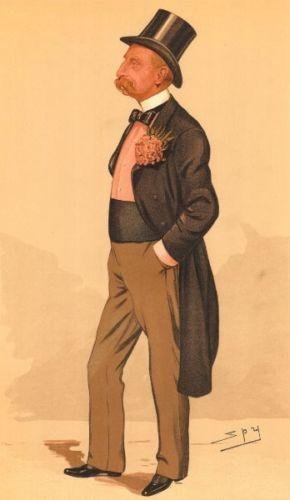
Amelius Mark Richard, 1st Baron Lambourne (1847-1928)
Born in London on the 17th August 1847, he was the eldest son of Lieutenant-General William Mark Wood (b. 1817) and Amelia Jane, daughter of Sir Robert Williams, ninth baronet, of Penrhyn, Caernarfon. General Wood, who served in the Crimean War, had changed his name from Lockwood in 1838 on inheriting the property of his maternal uncle, Sir Mark Wood, of Gatton, Surrey. His son reverted to the original name of Lockwood in 1876.
Lockwood was educated at Eton College. He entered the Coldstream Guards in 1866 and served as adjutant and aide-de-camp to Earl Spencer, lord lieutenant of Ireland; he retired in 1883 with the rank of lieutenant-colonel. In 1876 he married Isabella (d. 1923), daughter of Sir John Ralph Milbanke-Huskisson, eighth baronet; they had no children. Lockwood inherited his father's estates, which consisted in 1876 of 2300 acres in Essex, as well as 1226 acres in Glamorgan and 1440 acres in Monmouthshire. In 1892, at the age of forty-five, he entered parliament as Conservative MP for the Epping division of Essex.
Known as ‘Uncle Mark’, Lockwood was popular with all parties. Henry Lucy described him in 1902,
‘with hands in his trousers pockets, his hat pitched back on his head at an angle more miraculous than ever, the light of hospitality literally blazing on his war-bronzed face and his home-grown carnation’.
He never held office, and, as Lord Onslow recalled,
‘he came to be regarded as the typical country squire member of parliament, and exercised a considerable independent influence in the House of Commons’.
He became a Privy Councillor in 1905, and he sat on the Unionist front bench. Not that Lockwood was an entirely serious figure; at the height of the crisis over the 1909 Finance Bill he endeavoured to subvert the chancellor, Lloyd George, by taking him on a spree to the Gaiety Theatre and then to supper with what he called ‘bits of muslin’ at the Savoy Hotel, returning Lloyd George to Downing Street at 2.30 a.m. Next day the chancellor's temper was execrable. Lockwood retired from the House of Commons in 1917, when he was created Baron Lambourne.
Lockwood took an active interest in animal welfare. He was a member of the royal commission on vivisection (1906–12): he signed the minority report urging tighter controls on vivisection, and he twice attempted unsuccessfully to carry the commission's recommendations into law. Like many country gentlemen he saw no conflict between his dislike of vivisection and his support for country sports. As Lord Lambourne he served as chairman of the RSPCA from 1919 to 1924; he endeavoured to end the export of live worn-out horses for butchery on the continent; and in 1921 he piloted through the House of Lords the bill banning the shooting of live pigeons in traps.
At Bishops's Hall, his Essex home, Lockwood grew famous carnations for his buttonholes and made a collection of flowering shrubs. He was president of the Royal Horticultural Society. He collected china and books of county history. He was a generous host, and he played a prominent part in county affairs, becoming lord lieutenant of Essex in 1919. He raised money for the Essex county cricket team; he was president of the Territorial Association, honorary colonel of the 4th Essex regiment, president of the Essex Hunt Club, president of the Essex Automobile Club, provincial grand master of the Essex freemasons, and a JP. In 1928, recalled Lord Onslow, ‘Lord Lambourne refused to support the appeal for King George's Hospital at Becontree on the ground that this was a new town created by the London County Council without consulting Essex, but he withdrew his opposition immediately at the wish of the King’.
Lockwood did many things, but all of them as an amateur and a country gentleman. He was a ‘character’, an unpaid and jovial pillar of society in Essex and at Westminster; to his contemporaries he stood for more than the bare record of his achievements.
He died at Bishop's Hall, Romford, Essex, on 26 December 1928.
Images
Source: Oxford Dictionary of National Biography