High Country History Group
Contents
See images from this issue
Images from this issue
Article 1 of 12
Greensted Hall, the Seat of Captain Budworth
To the west of Chipping Ongar, reached by a walk of about a mile through pleasant meadows, and nestling among clumps of trees, as if it still stood in a forest land, is the curious little antique church of Greensted – St Edmund’s shrine. There is little doubt that this is the identical resting-place of the saint, as the register of the Abbey of St. Edmund says: “his body was likewise entertained at Aungre, where a wooden chapel erected to his memory remains to the present day.” Close by is the Hall, commanding prospects over a rich forestal district. The parish, belonged with Ongar, to Sir Richard Lucy; and subsequently the noble families of Stafford, Bourchier, and others.
The manor, with the remainder of the parish and other property in the neighbourhood, was purchased in the reign of Charles II by Alexander Cleeve, of London, merchant. Subsequently these estates were subdivided between three of the grand-daughters, one of whom marrying the Rev. Richard Budworth during the last [eighteenth] century, carried a proportion of this parish to her husband; the manor and Hall, however, passing successively through the hands of the Rebotier, Redman, and Ord families. In 1837 the trustees of the estate of the Rev. Philip Budworth (son of the above Richard Budworth) re-purchased Greensted Hall with the manor, and with one or two small exceptions, the remainder of the parish.
Greensted Hall is now [1861] the seat of Captain Philip John Budworth, son of the last mentioned, who has lately restored the mansion – a large pile of buildings dating from the reign of Elizabeth, but, owing to successive repairs and alterations, possessing no architectural remains of that epoch. The entrance hall, however, is a noble and spacious one, and contains a fine Scarsellino, brought by Captain Budworth from the Sciana Gallery at Rome, as well as a collection of arms and armour, which was partly made by him in the East. From the Hall, eastwards, a fine avenue of elms, of at least a mile in length, runs through the grounds and adjoining fields into the town of Ongar.
Images
An extract from ‘The People’s History of Essex’ written by D.W. Coller, published in 1861.

Article 2 of 12
Essex Churches Then and Now
As well as being Secretary of this fine History Group, I am also Hon. Deputy Librarian of The Essex Society for Archaeology and History. One of my roles has been to sort and catalogue the archives with a view to placing most on permanent loan at the Essex Record Office. The archive includes two volumes of church photographs taken between c.1870-1910. As someone interested in church buildings this presented the perfect opportunity this summer to go on church bagging expeditions with my wife Elaine, taking comparative ‘Then and Now’ photographs. We have gone to places never visited: Little Horkesley which was completely destroyed in 1940; Ovington, very remote by its Hall; Shalford, with its Chantry tombs; North Benfleet, in the Basildon district where hundreds of Brent Geese were assembling by the water before leaving for winter.
‘Essex Churches: Then and Now’ is a talk in preparation to be given on behalf of the Society on Thursday 27 April 2017, 8pm, at the High Country History Group.
The collection includes photographs taken between c1870-1910 by two generations. Initially it was thought to have been compiled latterly by John Edward Knight Cutts (1847-1938), church architect, whose name and date is labelled against later photographs in the collection. According to The Buildings of England: Essex by Pevsner / Bettley (2007) J.E.K. Cutts was architect of the now demolished St Augustine’s Church, Lower Dovercourt, 1883-84, and the Arts Centre, formerly the Great Burstead Board School, in Billericay, 1877-78. All Saints, Dovercourt, restored 1897-98; St Paul Church, Elmstead Market, now a house, built 1908; and, St Mary, Little Oakley, now a house, restored 1895-1902 are all the work of J.E.K. & J.P. Cutts.
This was later discounted because there were a number of errors and omissions in pencil labelling which suggested the names were added against the photographs as an afterthought. The photograph labelled “Litt. Oakley?” is clearly not Little Oakley but Ugley. On the same page a corrected entry from Great to Little Oakley is in fact, from Internet images research, Great Oakley. There is therefore sufficient evidence to determine that the volumes did not belong to the Cutts family.
The various sizes of photographs, as well as the realisation that copies appear elsewhere (e.g. Probert has a number dated 1871, ERO A13366), suggests that the mystery compiler was not the photographer but acquired copies probably from perhaps other gentlemen.
“There is no need to stress the importance to the ecclesiologist of photographs and reliable drawings of churches before they were subjected to nineteenth-century reparation.” (Benton, TEAS n.s. xxiv). This is particularly true of this collection. All Saints Church, Hutton, for example, is photographed before and after the substantial rebuild of 1873 by G. E. Street.
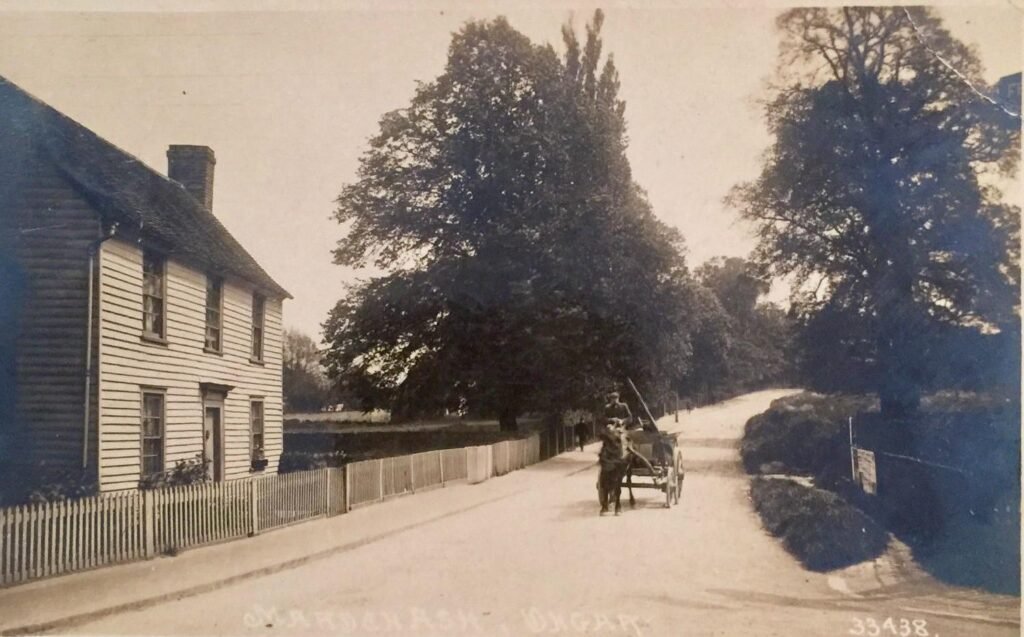
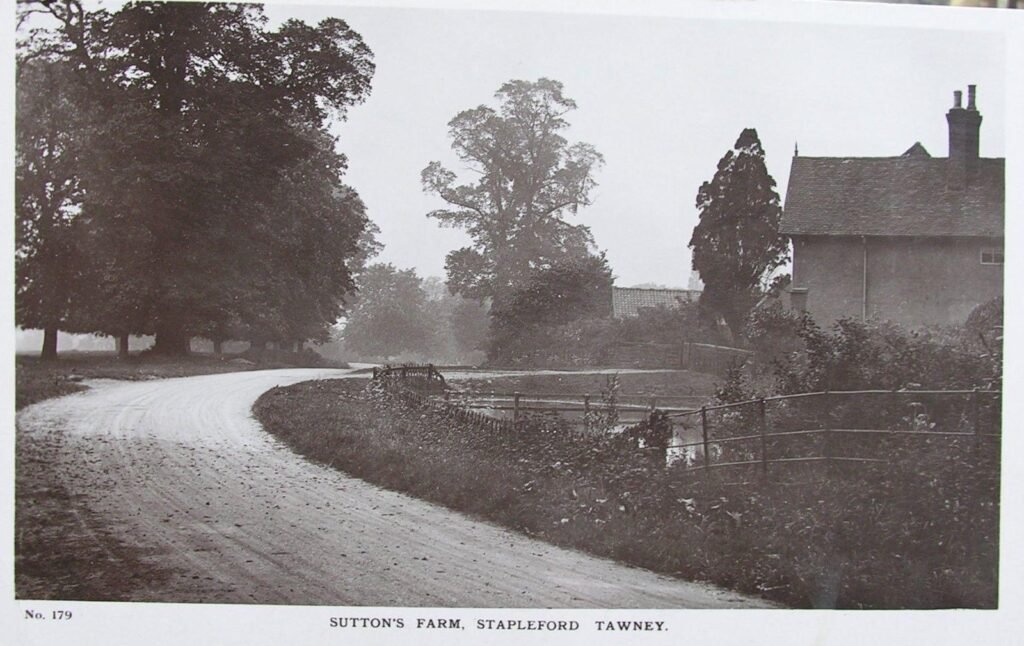
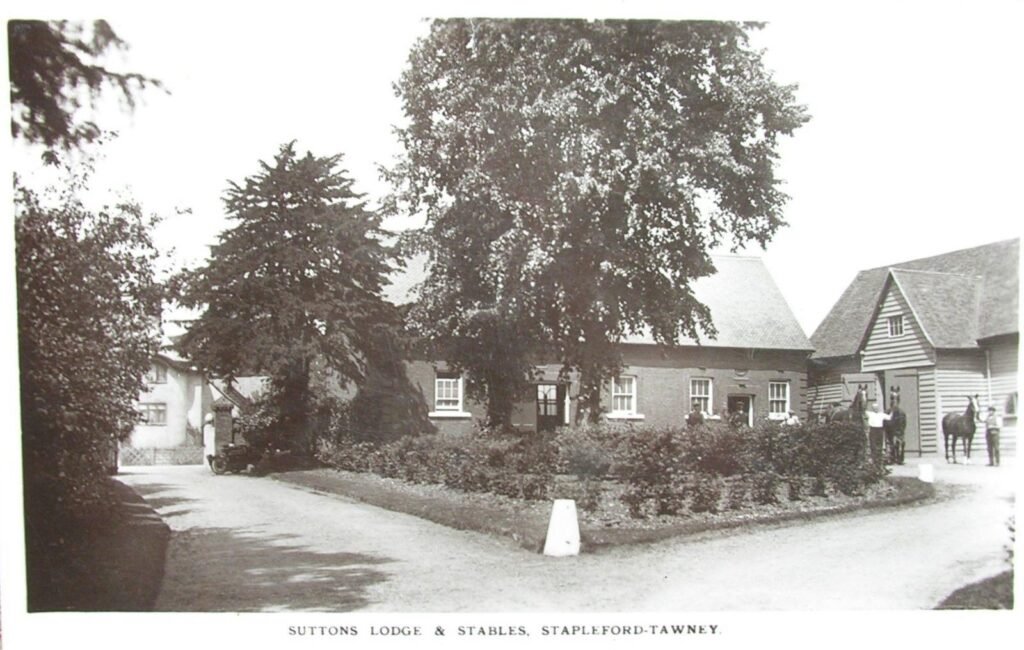
Included overleaf are photographs of Stanford Rivers and Greensted.
The talk next spring will be supported by contemporary narrative: Suckling (1846), Buckler (1856), Chancellor (as published in the Transactions of the Essex Archaeological Society, and Essex Review), and manuscript notes by King (1856-93) and C. F. D. Sperling (1892-1927), all of which will be used in the forthcoming talk.
Images
Article 3 of 12
Homeless in Stanford Rivers
In 1600 a case was brought before the Court of Archdeaconry in Essex, against one William Wallis,
‘for that they have made their habitacion in the south porch of the parishe church, and therewithal he dothe not otherwise provide; but hathe suffered his wife to travail in childbirth therein & to continue there for her whole moneth.’
Article 4 of 12
Captain Atherton Harold Chisenhale-Marsh 9th (Queen’s Royal) Lancers
He was born on the 20th August, 1883, the only son of William Swaine Chisenhale-Marsh, of Gaynes Park, Theydon Garnon. He was commissioned in the 9th (Queen's Royal) Lancers, and was attached to the 34th Division General Staff.
On the 28th September 1918 he was travelling on Wyschote Ridge near Ypres when a shell fell beside the road, killing him instantly. He was 35 years of age.
He left a widow and a son Hugh (born 1915), and he is commemorated on a brass plate in the nave of Theydon Garnon church, and also on the war memorial.
He is buried in the Lijssenthoek Military Cemetery, Poperinge, Belgium
He was the brother-in-law of Major Adam Dickson Bell, of the 4th Hussars, and Lieutenant Harold Lucas, 2nd King Edwards’s Ghurka Rifles,who both lost their lives in the war. Both men are also commemorated on the memorial in Theydon Garnon church.
Images
Essex County Council Chairman from 1916 - 1929
Article 5 of 12
Zeppelins Commemoration, September 2016: Memorial unveiled at Billericay, and Zepfest at Little Wigborough
Two significant Essex events of the First World War were remembered in two locations in Essex on 24 September 2016.
At Billericay the Reading Rooms held a display commemorating the downing of Zeppelin L32 by 2/Lt Frederick Sowrey. Members of the family were also present in Greens Farm Lane for the unveiling of a memorial near to where the Zeppelin fell at Snails Hall Farm killing the entire crew, later visiting the micro-brewery which has a beer named ‘Billericay Zeppelin’. All stock was exhausted by the time of my arrival. The Sowrey’s brought along a Cup awarded to the airman by the people of Hornchurch. It was from Suttons Farm that he flew his small aeroplane. In the evening the Reading Rooms were cleared to a Lecture venue where three talks were given hosted by the Western Front Association, two relating to the Battle of the Somme and the third to Zeppelin L32.
On both Saturday and Sunday 24/25 September the National Trust land at Copt Hall Marshes, Little Wigborough, was the venue for ‘Zepfest’ organised so well by the Wigboroughs Community Group. Visitors on Sunday could attend lectures by Neil Storey, the author of ‘Zeppelin Blitz’, Russell Savory on Stow Maries airfield, and Bishop Roger Morris, the Bishop of Colchester, who asked ‘Can the bombing of civilians ever be justified?’ Thought provoking, it has to be remembered that it was the Zeppelin raids of the First World War which brought total war away from the battlefield and to the homes of ordinary people. There were too many things to do and see: a tractor ride to the crash site where the Zeppelin’s enormous size was marked out in the field; a visit to Little Wigborough church to see contemporary films, the portion of the Zeppelin over the tower arch and memorial to Zeppelina Williams, born on the night the deflated Zeppelin L33 landed with its crew. Just time to stop for lunch and a later whisk around the displays of Zeppelin art made from retrieved aluminium.
A visitor to the ESAH blog, Fred H, made this comment which made me wonder whether this could be a good interview or exam question.
“Archaeology fascinates me. It really is a science that can date this incredible planet accurately!” Discuss. (10 marks)
Article 6 of 12
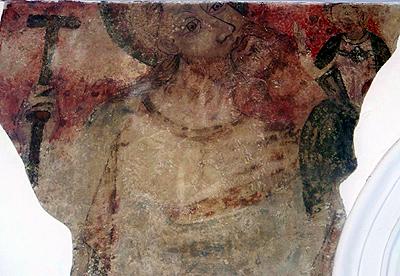
Apotropaic Marks
Apotropaic comes from the Greek word for averting evil and the marks were usually carved on stone or woodwork near a building’s entrance points, particularly doorways, windows and fireplaces, to protect inhabitants and visitors from witches and evil spirits.
The most common type of apotropaic mark is the daisy wheel, or hexafoil, which at its simplest is a six petal “flower” drawn with a pair of compasses. Daisy wheels comprise a single, endless line which supposedly confused and entrapped evil spirits.
Pentangles, which are five-pointed stars, were often used as ritual symbols and the letters AM for Ave Maria, simply M for Mary or VV for Virgin of Virgins are also a common type of apotropaic mark.
These letters, scratched into the fabric of medieval walls, engraved onto wooden beams and etched onto plasterwork were thought to beseech the supreme protective power of the Virgin Mary.
Apotropaic marks can be found in medieval houses, dating from around 1550 to 1750.
Duncan Wilson, Chief Executive of Historic England said:
“Witches’ marks are a physical reminder of how our ancestors saw the world. They really fire the imagination and can teach us about previously-held beliefs and common rituals. Ritual marks were cut, scratched or carved into our ancestors’ homes and churches in the hope of making the world a safer, less hostile place.
They were such a common part of everyday life that they were unremarkable and because they are easy to overlook, the recorded evidence we hold about where they appear and what form they take is thin. We now need the public’s help to create a fuller record of them and better understand them.”
Historic England have asked the public to help locate any ‘witches’ marks.
Images
[Information courtesy of the Historic England website].
Article 7 of 12
Hainault Forest
Hainault Forest is one of the last remaining sections of the former Forest of Essex. Epping Forest and Hatfield Forest are other remaining examples. The forest belonged to Barking Abbey until the dissolution of the monasteries. In a survey made for Henry VIII in 1544 it consisted of some 3000 acres. The forest extended northwards to Theydon Bois, east to Havering-atte-Bower, on the south to Aldborough Hatch, and westwards to Leytonstone.
In 1851 an act of Parliament condemned the forest land as waste, it was disafforested, the deer removed and some 92 per cent of the old forest growth was cut down. The land became marginal agricultural land and subsequently a significant proportion was built on.
Oliver Rackham described how the outrage at the destruction of Hainault led to the modern conservation movement with the creation of conservation groups which successfully opposed such a fate happening to Epping Forest. After public pressure to retain some remnant of Hainault Forest, headed by Edward North Buxton, a total of 804 acres of land was bought for public use on 21 July 1906. It included 253 acres of woodland and rough pasture.
The Essex section is managed by the Woodland Trust, who are contracted to do so by its owners, Essex County Council. A few remnants of the historic Hainault Forest are found in the southern fringe of Lambourne parish, and now form part of a country park.
In 1917 it is announced that a large part of the Forest was to be ploughed up during the ensuing summer and utilised for the production of food in war-time. The necessary labour would be provided by 200 German prisoners of war.
German Soldiers hay making.
(Picture from The Graphic, June 23, 1917)
German prisoners worked on several farms in the district. They were aid 3s.6d (17p) a day for skilled men, and 2s.6d (12p) for others. However this was not paid to the prisoners themselves, but to the Government, and the prisoners personally only received a penny an hour.
Images
Martyn Lockwood – with thanks to the Hainault Forest website.
Article 8 of 12
Listed Buildings in the High Country – 1. Theydon Mount
What is a Listed Building?
A listed building in the United Kingdom is a building which has been placed on the Statutory List of Buildings of Special Architectural or Historic Interest. There are just under 500,000 buildings in the UK to which this applies.
A listed building may not be demolished, extended or altered without special permission from the local planning authority (who typically consult the relevant central government agency, particularly for significant alterations to the more notable listed buildings).
Exemption is provided for some churches in current use for worship, although in such cases the church organisation operates its own permissions procedure.
For a building to be included on the list, it must be a man-made structure that survives in something at least approaching its original state. Most structures on the list are buildings, but other structures such as bridges, monuments, sculptures, war memorials, and even milestones and mileposts may also be listed. Ancient uninhabited or unmaintained structures, such as Stonehenge, are generally classified as Scheduled Ancient Monuments rather than Listed Buildings.
All buildings built before 1700 which survive in anything like their original condition are listed, as are most of those built between 1700 and 1840. The criteria become tighter with time, so that post-1945 buildings have to be exceptionally important to be listed. A building has normally to be over 30 years old to be eligible for listing.
In England and Wales, listed buildings are classified in three grades:
Grade I buildings are of exceptional interest, sometimes considered to be internationally important. Just 2.5% of listed buildings are Grade I.
Grade II* buildings are particularly important buildings of more than special interest. 5.5% of listed buildings are Grade II*.
Grade II buildings are nationally important and of special interest. 92% of all listed buildings are in this class and it is the most likely grade of listing for a private residential building.
1. Theydon Mount
No 3 Mount End (Grade II)
Cottage c.l600 with later additions and alterations. Timber framed and plastered, return wall pargetted. Red plain tiled roof with gable end to road and lean-to extension, commencing at half roof height to left. 1:1 window range of small paned casements. C20 boarded door with light to left. Plastered brick chimney stack to ridge. Internally is much exposed timber to the 3 bay cottage. Original back to back fireplaces with mantel beams over. Mullion window slots, bladed scarf joint and remains of original stairs.
No’s 5 and 6 Mount End (Grade II)
Two cottages late C17/early C18, with later alterations and additions. Timber framed and plastered with hipped, red plain tiled roof. Moulded eaves cornice. 2 storeys. 4 window range of small paned casements. To left 3 panel door with moulded pentice board over. To right, tiled, enclosed porch, with C20 board door. External red brick chimney stacks to right and left and central red brick
stacks. There is a C20 lean-to addition to right.
Barn to Left of Brook Farmhouse (Grade II)
Barn C17 with an attached lower range outbuilding. Timber framed and weatherboarded, with red plain tiled roofs, hipped to left and right. The larger build of 3 bays, with central full height double doors. Arched braces to walls and straight braces to tie beams. Side purlin roof. The smaller building C17 of similar build.
Barn to NW of Sawkins Farmhouse (Grade II)
Barn. C17/C18. Timber framed and weatherboarded with half hipped red plain tiled roof, extending forward over lean-to to right and left of central, hipped midstrey. There is a single storey forward extension to right with matching materials and hipped roof. The barn roof is sprocketed at the front and is of staggered side purlin construction. 4 bays. Straight bracing to tie beams. Through bracing to walls.
Brook Farmhouse (Grade II)
House C17 or earlier. Timber framed and rough rendered, weatherboard at rear. Hipped, red plain tiled roof with gablets. Outshot to left. Projecting eaves. 2 storeys. 3 window range to first floor, 4 range to ground floor of C19 small paned casements. Off centre is a boarded door with flat canopy and brackets. Off centre red brick chimney stack. Incorporated at rear is a smaller, similar cottage, with gable end roof and large red brick chimney stack to left.
Church of St Michael (Grade 1)
Parish Church (on site of previous Church destroyed by lightning c1611. This church completed by c1614 by Sir William Smith of Hill Hall). Red brick built with red plain tiled roof with a small shingle spire with weathervane. The Church comprises Chancel, Nave, Tower and South Porch.
Colemans Farm Barn to South West of Farmhouse (Grade II)
Barn. Late C18/Early C19. Timber framed and weatherboarded with ½ hipped red tiled roof. 7 bays. King Post roof constructions with ridge board. Through bracing to walls. Central double doors. A fine building of its type.
Colemans Farm Outbuildings to South West of Farmhouse (Grade II)
Outbuildings C16/C17. Attached outbuildings of 3 ranges. Timber framed and weatherboarded, corrugated asbestos roofed, hipped to right range and lower gables to central and left range. The right range of 5 bays,side purlin Queen post roof, arched braces to rear midstrey tie beams, straight braces elsewhere. Through bracing to walls. Central opening and double doors to right. The left and centre ranges of 5 and 2 bays respectively and Queen post and Queen strut roof construction. The 5 bay build open at rear and used as a Cartlodge. Two windows, a door opening and double doors to front. A fine building of its type.
Fisherman's Hut to South East of Hill Hall (Grade II)
Red brick, hexagonal building possibly a Fisherman's Hut. Mid C19. Pointed red tiles roof with lead finial. Moulded eaves and plinth. Double doors with vertical moulding. 2 light window opposite doors. This building is situated to SW of the previously listed pavilion and at the W end of the pool aligned East to West. It forms a Group with ponds, bathing pavilion, Hall and Garden.
Hill Hall and Attached Service Wings to North and West
(Grade I)
Built 1569-75 for Sir Thomas Smith, probably to his own design, assisted by Richard Kirby whom he described as his 'cheefe Architecte, overseer and Master of my workes'; c1714 alterations for Sir Edward Smith; 1790-1814 gardens altered by Humphrey Repton (Red Book dated 1791); 1844 altered; c1890 additions; 1909-12 major alterations by Reginald Blomfield for tenant Charles Hunter; gardens altered by Philip Tilden for Sir Robert and Lady Hudson 1927-28; converted to open prison 1952, gutted by fire 1969.
Hill Hall Bathing Pavilion (Grade II)
Bathing pavillion. 1927-28. Designed by Philip Tilden for Sir Robert and Lady Hudson. Ashlar with concrete domed roof. Circular plan with wings to east and west. 8 Tuscan Doric columns support full entablature and frieze, with 2 similar columns to wings on either side. All columns have moulded bases and capitals.
This pavilion stands at the south end of the bathing pool, it has patterned stone paving to the floor and the rear is bounded by a short stone wall with moulded coping. 3 semicircular stone steps lead from the pavilion into the pool. This bathing pavilion was designed by Philip Tilden as part of a complete new garden for Sir Robert Hudson.
K6 Telephone Kiosk to the East of North House (Grade II)
Telephone kiosk. Type K6. Designed 1935 by Sir Giles Gilbert Scott. Made by various contractors. Cast iron. Square kiosk with domed roof. Unperforated crowns to top panels and margin glazing to windows and door.
North House (Grade II)
House of 3 ranges. C17/18 with later additions and alterations. The left range timber framed and rendered with square, hipped, red plain tiled roof, and 3 red brick chimneys. 2 storeys, 3 window range of C19 casements (3 light) to left return, one to first floor front and 3 to ground floor with central, small paned, glazed door with side lights. The Central range is red brick built with hipped red plain tiled roof, 2 storeys, 3 window range of small paned casements.
The right range, weatherboard clad, with red plain tiled roof. 2 windows to first floor, 1 window to ground floor. Chimney with inscribed 1789 date.
Outbuilding to left of Skinners Farmhouse (Grade II)
Outbuilding. C18, joined to house by a red brick wall. Red brick built with red plain tiled roof ½ hipped to right, dentilled eaves. Single casement with glazing bars. Red brick chimney to left. Probably a bakehouse.
Outbuilding to North-West of Hill Hall (Grade II)
Stables, now outbuildings and garage. Late C18, additions early C20, converted mid C20. Red brick with painted ashlar dressings and hipped plain tile roof.
Exterior: single storey, with 2 storey garage addition to north. East, courtyard front has 9 openings arranged 3:3:3. Slightly projecting C20 centre with 3 pairs of glazed double doors, flanked by 3 original round headed arches with painted keystones and impost bands. The outer arches each have a stable door, the centre arches are blank and all the arches have large round headed windows with glazing bars. To south a similar round archway linking this building to the main house. Set at right angles to north a 2 storey C20 garage wing with large garage doors and 2 metal frame windows. South front has central small glazing bar sash with segment head set in round headed arch with keystone, flanked by single blind windows. Rear has single storey lean-to addition with artificial tile roof. Irregular fenestration including glazing bar sashes doors and garage doors. Interior: not inspected.
This building forms one side of the service courtyard to the north west of Hill Hall (qv).
Red Brick Wall Approximately 700 Metres North East of Hill Hall (Grade II)
Red brick wall in Flemish Bond with brick coping. C18. Originally enclosed the Kitchen garden of Hill Hall, but a short section to NW is demolished.
Rent Cottage (Grade II)
Cottage C16/C17. Timber framed and plastered. Red plain tiled roof, hipped to right, with gabled dormer to hip and 3 gabled dormers to front. 1 storey and attics. 6 window range of C20 leaded casements. Gabled, open porch, with red plain tiled roof, supported by straight brackets. Boarded door with light. Red brick chimney stack to right. Internally are chamfered beams, through bracing to walls. Re-used smoked timbers to roof structure. Original brick fireplace.
Sawkins Farmhouse (Grade II)
House. C16 house, with C14 remnant wall at rear and C19 red brick crosswing extension. The C16 build with C18 brick facing and moulded brick eaves. Red plain tiled roof. Crosswing to left. 2 storeys. 1:3 window range to first floor, 1:2 to ground floor. Some C19, 3 light casements with late C19 vertical sliding sashes to crosswing. The ground floor of crosswing with a canted bay, with red plain tile roof. To the right of the brick facing the cladding is plastered and weatherboarded. The right return has an original jowled storey post of the C14 build. There is a C20 red tiled, hipped porch, with C20 panelled door and side light. Original red brick chimney stack to left. This chimney with original circa 1550, 3 centred moulded brick fireplaces to ground and first floor. Above the first floor fireplace is a moulded plaster Tudor Rose. Stop chamfered bridging joists. Framed staggered side purlin roof. Bridled scarfs to top plates. Record of a hall on the site c1612.
Skinners Farmhouse (Grade II)
House C17/18 with earlier core, with C18 dark red brick facing. Timber framed and plastered. Triple range, red plain tiled roof, wing at rear. 2 storeys. 5 window range, first floor, 3 range to ground floor of small paned vertical sliding sashes, with gauged brick arches. Red brick plinth. C20 gabled, glazed, enclosed porch to right, with glazed door and red plain tiled roof, approached by steps. 2 plastered red brick chimney stacks. Chamfered bridging joists and internal C18/19 shutters to front windows and C20 external shutters. Internally are very heavy, C17 stop chamfered bridging joists and floor joists and a c1500 doorway, also several C18 doors with original ironmongery. There is also a blocked cellar.
Tarlings Farmhouse (Grade II)
House. C17 or earlier with later alterations and additions, at one time a Smithy. Timber framed, rough rendered to front, weatherboard rear. Red plain tiled poof, ½ hipped. 2 storeys with single storey extension to left of C18 red brick and red pantiled roof. 3 window range first floor, 3:2 ground floor of 3 light diamond leaded casements. Hipped, red tiled bay window to right. Door at rear. 2 red brick chimney stacks.
Tombstone in Churchyard of Church of St Michael Approx 100 Feet from South East Corner of Church (Grade II)
Tombstone in SE corner of Churchyard approximately 100ft. from SE corner of Church. A very large tomb to Sir William and Lady Smyth 1877. (Owners of Hill Hall). The tomb consists of 3 receding slabs, the base and top plain the centre with moulded edges. The top with a deeply incised Coat of Arms of the Smyth family.
Two Terrace Walls to West of Hill Hall (Grade II)
Two terrace walls. 1927-28. Designed by Philip Tilden for Sir Robert and Lady Hudson. Red brick with ashlar dressings. Each wall is approx 3.5ft high and 45yds long, both have ashlar coping and the upper wall also has pillars topped with ball finials. These terrace walls were designed by Philip Tilden as part of a complete new garden for Sir Robert Hudson.
Source: British Listed Buildings website
Article 9 of 12
From the Police Gazette January 9th 1880
Charged with house-breaking, and escaped from custody, at Chipping Ongar, on the 5th instant: Mark Sa, a labourer, 25 years of age, about 5 feet 7 inches high, fair hair, rtather long, light sandy whiskers, fresh complexion; dressed in a fustain jacket and trousers, hard black billcocky hat, and very strong lace-up boots, generally works with threshing machinges. information to Mr Superintendent Simpson, Epping, or to Inspector Robinson, Police Station, Ongar, Essex - Bow-street, January 7.
Images
Article 10 of 12
Book Reviews
Poison Panic – Arsenic Deaths in 1840’s Essex.
Helen Barell; Pub by Pen and Sword [2016]. Price £14.99
The names of Mary May, Sarah Chesham and Hannah Southgate, became household names in the late 1840’s as a result of deaths of several people as a result of arsenic poisoning.
The national newspapers followed the lurid details of the trials of these three women, resulting in the execution of two of them at Chelmsford. Arsenic was widely available, used in the main to kill vermin. Few questions asked as to the reason for purchasing it, even children could be sold it. Arsenic was a white powder, tasteless and odourless, and could be dissolved easily. The perfect weapon for the would be murderer and the unsuspecting victim, who often died in agony. Add to this the imperfect test for arsenic poisoning; with country doctors often putting the cause of death down to ‘English Cholera,’ and the perfect murder was possible.
The cases of the three women were even raised in Parliament and as a result the Sale of Arsenic Act, 1851, was introduced in an endeavour to restrict the easy access to the poison.
Helen Barrell has produced a well-documented and readable book, which was based on her own family researches, and extensive newspaper archives which were reported at the time of the crimes being committed.
Martyn Lockwood
The Last Flight of the L32. R. L. Rimmell. Albatross Productions Ltd. 2016. 24 pages (A4 glossy format with appendices). £10.00 (paperback)
Marking one of the major events of the First World War, this lavishly illustrated booklet tells the story of the enemy Zeppelin raids over Britain and, in particular from page 8, official and eye-witness accounts pertaining to the firing and destruction of the Zeppelin L32 which fell at Snails Hall Farm, Great Burstead, on the early morning of Sunday, 24 September 1916. It had fallen victim to incendiary bullets fired by Lewis Gun from a small biplane flown out of Suttons Farm airfield Hornchurch to about 9000 feet by 2/Lt Frederick Sowrey. All 22 on board captained by Werner Peterson perished as the 40 ton hydrogen-filled structure fell from 13000 feet to the ground burning for an hour. The victims’ bodies were discovered in the immediate neighbouring fields and placed in a barn before burial at Great Burstead churchyard a few days later. Farmhands were first on site in early morning collecting items strewn across the land. Debris was found elsewhere.
The illustrations pinpoint the location of the Zeppelins fall; tell of the sightseers who came to the farm the following morning, and of the brisk trade in souvenirs including scraps of aluminium and portions of the crew’s clothing. Those who had guarded the site – the Irish Guards, those from other regiments, policemen and fire officials – later turned many items into rings, discs and crosses and “were not short of cash for some while”.
The accounts of these Zeppelin raids over Essex have been of personal interest for some while and, in the course of research into the raid over Blackmore on 31 March 1916, I had the pleasure of meeting descendants of the Maryon family who farmed on the site of the L32. I had expected that this pamphlet would add little to what I already knew but was proved wrong. If there is one disappointment with the work it has to be the extremely small font size of the text which made it difficult to read. The review copy will be added to our Library collection.
Zeppelin. Volume 2. R. L. Rimmell. Albatross Publications Ltd. 2008. 74 pages (A4 glossy format with appendices). £25.00 (paperback)
Sent to us as a pair, this book details the German ‘R’ Class Zeppelins which attacked Britain beginning in the autumn of 1916. L33’s one and only raid occurred on the night of 23/24 September 1916, and with the fall of L32 over Great Burstead the day became known as ‘Zepp Sunday’. L33 was fired at from the biplane of Alfred de Bathe Brandon flown up from Hainault. He managed to deflate but not ignite its airbags. The crew, led by Oberleutnant Bocker, landed their craft in a field at Little Wigborough. The crew were picked up on the Peldon road and arrested by the local constabulary.
The forced landing, and the fact that the crew were unable to successfully torch their craft, enabled the British to examine every part of the Zeppelin.
Images
Article 11 of 12
From The Papers
Illustrated London News - Saturday 31 August 1946
The German prisoners were probably from the POW camp in Mill Lane, Hatfield Heath, which held 1067 men in what the Illustrated London News described as ‘pleasant surroundings.’
Although the war had ended in 1945, some 380,000 Germans remained in this country in order to assist with the harvest.
Chelmsford Chronicle - Friday 28 October 1932
Article 12 of 12
Theydon Mount School
Following on from the article in the June edition of the Journal.
Names of pupils in 1884.
Boys and Girls
Arthur Stubbings
William West
Frederick Starling
Henry Turner
George Tarling
Sydney Summers
George Stubbings
Charles Stubbings
Walter Stubbings
Stephen Starling
George Perry
Henry Gould
Edwin Freshwater
Archibald Prior
Oscar Tarling
William Tucker
Samuel Starling
Charles Latchford
William Toomie
Thomas Stubbings
Walter Freshwater
Horace Doe
James Starling
Lily Green
Emily Pain
Margaret Freshwater
Dora Freshwater
Hetty Stubbings
Minnie Freshwater
Rose Freshwater
Frances Toomie
Celia Threader
Rachel Summers
Florence Toomie
Eva Toomie
Ellen Gould
Daisy Threader
Maud Starling
Christina Spark – teacher
Average weekly attendance in 1895 was 27.
Log Books from 1894 to 1932 for the former school have survived and are now found in the Essex Record Office at Chelmsford and they provide a social picture for the time. Below I have highlighted some of the entries.
Oct 1st 1895
The new school year commences today. Two children are absent…..Stephen Starling who has not been back to school since the Harvest Holidays. I have sent several messages to his guardian and have since sent Miss Bonner (Infants Teacher) to his home to request that he should be sent back, but his guardians say that he cannot come for want of clothing and shoes.
Nov 29th 1895
Several children are absent on account of the damp weather.
There are many entries in the log book where attendance was low due to the weather. This may indicate that many of the children did not have sufficient clothes or shoes to deal with the cold and the wet.
In 1896 The Inspector of Schools reported, “The children attending this little school are orderly and attentive, but not very bright….”
Jan 23rd 1899
School closed on account of nearly all the children being ill with measles. The school was re-opened on the 15th Feb but attendance poor as several children prevented as measles are still in their homes.
Nov 6th 1899
Marion Payne commenced duties as Mistress of the school today.
2nd Jan 1900
Flossie Augusta Burrage took charge for the first time.
2nd Feb 1900
Attendance has not been good as six of the elder boys have been away brushing.
Week ending 25th Jan 1901
Attendance this week has been very poor, owing to the absence of nearly all the boys, on account of the shooting. They were engaged in ‘brushing’ in the wood
Nov 23rd 1902
Henrietta L. Cawley commenced duties as Mistress.
There are several poignant entries during the period 1914 -1918 when news of former pupils of the school are reported in the log book as ‘killed in action.’
[Source: ERO ref E/ML/68/1]