High Country History Group
Contents
Article 1 of 13
Notable Anniversaries in 2017
1000th anniversary of England divided into four
In 1017, the Danish king of England, Cnut married Emma of Normandy, the widow of his former enemy, Ethelred ‘the Unready’. Cnut also divided England into four earldoms – Northumbria Wessex, Mercia and East Anglia – each previously kingdoms in their own right.
375th anniversary of the start of the English Civil War
The so-called English Civil War (in fact, it was a British affair) was one of the most significant events in our history. On 22nd August 1642, King Charles I raised his standard over the battlements of Nottingham Castle. Thus, he marked the beginning of the armed conflict between monarch and parliament that would end with his own execution in 1649 – and the making of a more modern Britain.
200th anniversary of the death of Jane Austen
Author Jane Austen died, probably as a consequence of Addison’s disease, on 18th July 1817 in Winchester. Jane Austen was born in the rectory at Steventon, Hampshire, on 16th December 1775 and is best known for just six major novels, Sense and Sensibility (1811), Pride and Prejudice (1813), Mansfield Park (1814) and Emma (1815), followed by Northanger Abbey and Persuasion, both published posthumously in 1818. Austen may not be your thing – but as the lady said, “One half of the world cannot understand the pleasures of the other”.
150th anniversaries
Antiseptics – between March and July 1867, Joseph Lister published his theories on antiseptics in the medical journal, the Lancet. Lister was professor of surgery at the University of Glasgow and, inspired by the work of Louis Pasteur, had decided to experiment with dressings soaked in carbolic acid to cover open wounds. The rate of infection – a killer in hospitals at the time – reduced. Lister went on to advocate hand-washing, sterilising instruments and spraying carbolic in the theatre while operating.
2nd Reform Act – the Second Reform Act passed by Parliament in 1867 roughly doubled the electorate in the United Kingdom from one to two million men – an estimated 33% of all adult males. The act was introduced by the Conservative Benjamin Disraeli, who persuaded his colleagues that the people would be grateful and vote for them; the following year’s General Election was won by the Liberals.
100th anniversary of the Battle of Passchendaele
Known as Third Ypres, or, simply, Passchendaele. It is seared into the national memory. Britain and its allies had held the old Flemish cloth town of Ypres since 1914; it was a salient on the front line, with the Germans holding the surrounding higher ground on three sides. The British planned an offensive with the specific aims of breaking through to the Belgian coast to prevent the use of ports by German submarines and relieving pressure on the French, whose troops had mutinied in April. A precursor to the main assault was the need to clear German troops from high ground on the Messines Ridge south of Ypres. This commenced in the early hours of 8th June with the explosion of 19 out of 21 massive mines that had been covertly laid under the German lines. The blast could be heard in the south of England and the results were predictably horrendous – it is estimated that 10,000 Germans perished in the carnage. By 17th June the objectives on the Messines Ridge had largely been achieved.
Two mines did not explode – one is still there, buried under the Belgian countryside.
The main offensive began on 31st July and lasted until 6th November, when Canadian troops finally took the tiny village of Passchendaele. What the planners had not foreseen was the worst rain in years. This turned the low-lying, sodden ground, already pockmarked and full of the detritus of almost three years of warfare, into a slimy hell where men could drown, become disorientated and simply disappear.
The British and their allies advanced about 4½ miles and never reached the coast. Casualty figures vary from one source to another – but it is estimated that Great Britain and her allies lost 62,000 men with 164,000 wounded and the Germans 83,000 dead with 250,000 wounded.
All or most of the ground was retaken by the Germans in their offensive of March 1918; and then taken back before the armistice in November.
100th anniversary of the Russian Revolution.
In 1917, two revolutions swept through Russia, ending centuries of imperial rule and setting in motion political and social changes that would lead to the formation of the Soviet Union. In March, growing civil unrest, coupled with chronic food shortages, erupted into open revolt, forcing the abdication of Nicholas II (1868-1918), the last Russian czar. Just months later, the newly installed provisional government was itself overthrown by the more radical Bolsheviks, led by Vladimir Lenin (1870-1924).

Article 2 of 13
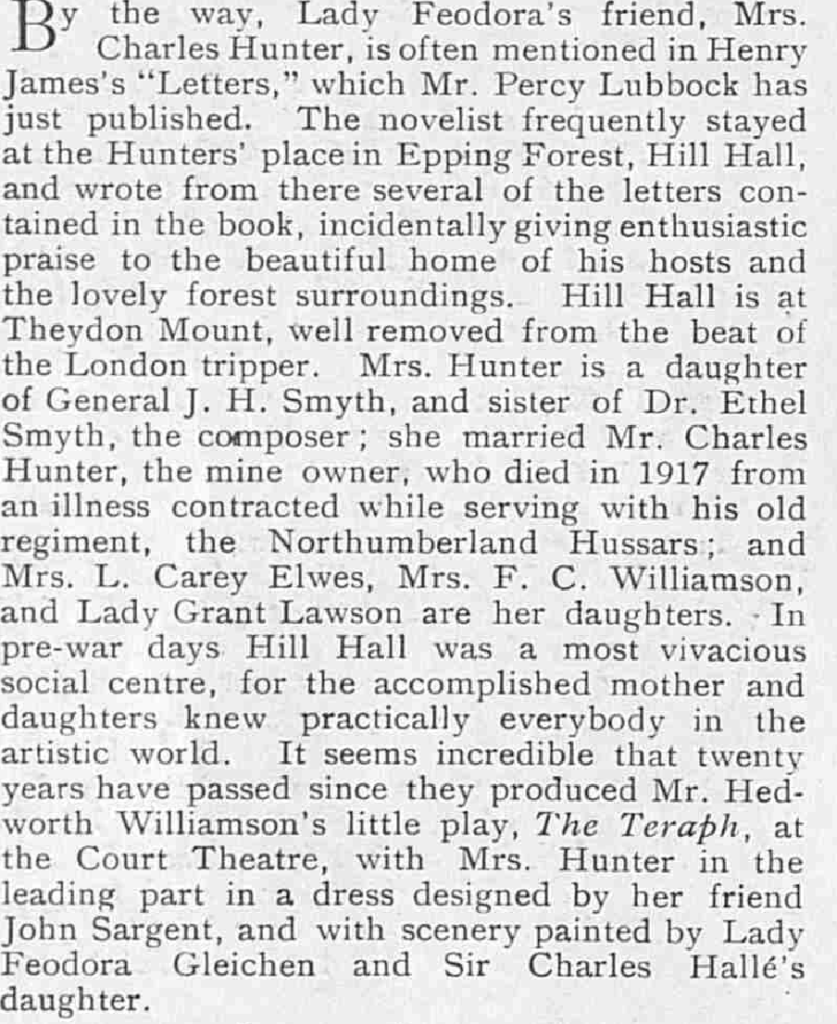
Mrs Charles Hunter, Hill Hall
Article 3 of 13
Bygone Days
In the 1970’s, Don Sharp who lived in Stanford Rivers wrote a number of articles in the local magazine, about his life working on farms in the area, and the people that he met. Eventually some of the articles were produced in a booklet called ‘Bygone Days.’ Over the next few editions of this Journal we will re-publish some of his memories.
Don was born 2 days after the start of the Great War in November 1914, and towards the end of his life he lived in Moreton. He died in August 2004 and is buried in Fyfield church.
The Country Squire and his Estate.
I think it is a shame that in this day and age we have lost our Country Estates, and our Lords and Ladies. Around Stanford Rivers and district there was Greensted Hall, the Price family. Blake Hall still existing with the Capel Cure family, Forest Hall, High Ongar with the McCorkadale family, Hill Hall with Lord Haigh (Hay), and Dudbrook estate, then Suttons estate with the Smith family.
These all had farms on the estate and woodlands. The farms and cottages were well maintained. On Suttons estate, where I worked, we had three carpenters, two bricklayers, four woodmen, three gamekeepers, three grooms, five gardeners, two horsemen, one cowman and an old chappie who chopped firewood for the big house. Then there was a butler, cook, two maids in the kitchen and two housemaids and a Bailiff.
There were sixteen farms, one mill, three shops and two blacksmiths shops, woodlands and park about two thousand acres. All the gates on the estate were tarred and maintained, and if Sir Drummond could not open one with his crop (a type of whip) then he would see that it was attended too straight away.
The farm buildings looked smart, worthy to belong to Suttons estate, hedges around the wood were kept trimmed and level. I know he would not like to see the hedges hacked with a machine.
If Sir Drummond rode up to us on his horse with his groom behind , we waited till he said ‘Good morning first.’ This was a known thing with gentry. He always asked, ‘Are you getting on alright?’ with whatever you were dong, then ‘Looks very nice’ and ‘When will you finish.’
We were always supplied with our tea from the big house at Suttons, if we had to work after five in hay time and harvest.
Once a week I used to have to turn the handle on the butter churn to make butter. All our milk was for the staff and the surplus was made into butter. Skim milk was used to feed the pigs with the peelings and waste from the house.
The groom and gamekeeper looked smart in their tweed suits which was made to measure at Roses the Tailors in Ongar. The butler and footman in his dark suit with a big watch chain, the cook in white overall and cap. The maids in the afternoon wore their lace caps, black dresses with little aprons.
Yes it all seemed to run well, we were happy in our work.
The big bell was tolled at one o’ clock for lunch at the house.
There was a walled kitchen garden about one acre in size, rose walks and lawns, summer houses, peacocks, Chinese geese, ducks on a large pond and beautiful shrubs.
Images
The Country Squire and his Estate
Article 4 of 13
An Eccentric and his Deserted Mansion
Mr. Archer, a gentleman of about £10,000 per annum, chiefly landed property in Berkshire, and partly in Essex, died some time ago, and left a very large fortune, great part of which he gave to his wife, but the bulk went to his daughters by a former marriage. He was a singular character, and possessed a princely fortune. He lived in great retirement with his wife. He had another mansion in Berkshire, where he kept a suitable establishment, and his daughters lived, but he never lived there himself.
Besides his house in Berkshire he had a fine mansion on his beautiful estate at Coopersale, near Epping, Essex. But this house had been deserted for 20 years or more, no one being allowed to reside in it. On the death of Mr. Archer it fell to the lot of his daughter, the elegant Mrs Houblon, who sent a surveyor to examine the house. His report is most curious.
Neither the gates of the court-yard or the doors of the mansion had been opened for a period of eighteen years. The latter, by order, were covered with plates of iron. The court-yard was crowded with thistles, docks and weeds, and the inner hall was covered with cobwebs. The rooks and jackdaws had built their nests in the chimney, and the solemn bird of night had taken possession of the principal drawing-room. Several of the rooms had nt been open for 30 years. The pigeons had for the space of 25 years built their nests in the library (which contained some thousands of books) having made a lodgement through the means of an aperture in one of the casements. Here they had remained undisturbed for the space above mentioned, as several loads of dung were found in the apartment. A celebrated naturalist who was present at the opening of the house declared that he had never saw cobwebs so beautiful before, or of such amazing size. They extended the length of one room from the ceiling to the ground.
The wine, ales, and rum, of which there were large quantities had not been touched for 20 years; they were found in fine order, particularly the port wine. The bailiff, the gardener and his men were expressly ordered by their late master not to remove even weed from the garden and grounds. The fish ponds were untouched for many years. A gentleman after the owner’s death, having had permission to fish caught several jacks weighing 14lbs or 15lbs each.
All the neighbouring gentry have been to view the house and grounds, whose ruinous condition forms a general topic of conversation.
Compiled from the Leeds Intelligencer, January 4th 1802.
The ‘eccentric owner of Coopersale House was John Eyre Archer, who inherited the estate from his father William in 1739. In around 1780 he ordered the house to be shut up to save taxes, although the house had apparently been deserted for some 20 years.
There is an unusual record of a journey made by John and his wife Lady Mary Fitzwilliam. The journey was from his home in Welford, Berkshire to his house in Coopersale.
“First the coach and six horses, with two postilions, coachman and three outriders; a postchaise and four post-horses, phaeton and four followed by two grooms a chaise marine with four horses carrying numerous services of plate – this last was escorted by the under-butler, who had under his command three stout fellows; they formed part of the household and all were armed with blunderbusses. Next followed the hunters with their cloaks of scarlet trimmed with silver and attended by the stud groom and huntsmen, each horse having a fox’s brush tied to the front of the bridle. The rear was brought up by a pack of hounds, the whipper-in, the hack horses and the inferior stablemen. In the coach went the upper servants. Mrs Archer accompanied Mr Archer in the Phaeton, he travelling in all weather in that vehicle, wrapped up in a swan’s down coat.”
According to his daughter, Susannah, John died,
‘miserable, half-blind, tortured with eczema and estranged from his children.’
Susannah married Jacob Houblon of Hallingbury and returned to live at Coopersale on the death of her father in 1800. After 1837, the Coopersale estate with the house and Hallingbury Place descended in the Archer-Houblon family. A point of interest here, Sir John Houblon founded the Bank of England and his photograph is on a £50 note.
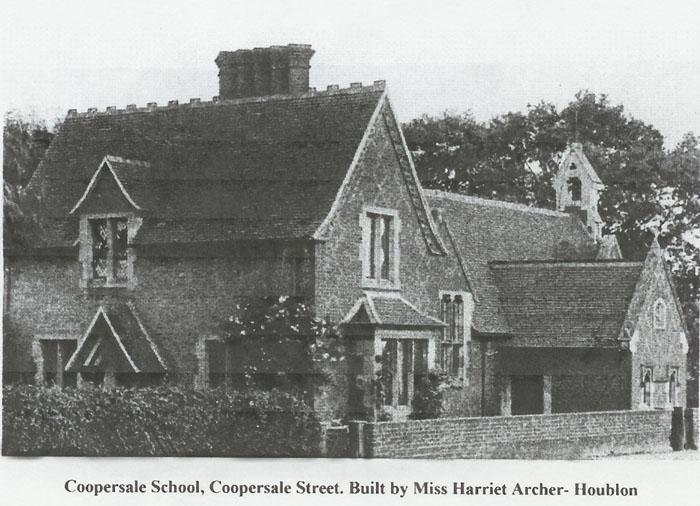
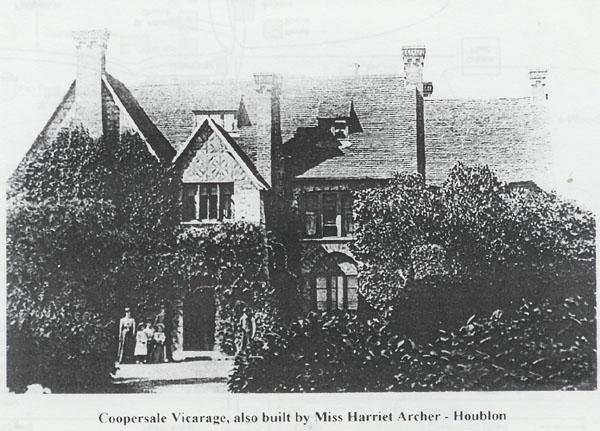
Their son, John Archer-Houblon died in 1865; his daughter Miss Harriet provided the school in Coopersale Street, St Albans Church and the Vicarage. She died in 1896 and again the house was empty for some years.
A great frost in 1895 caused many problems, hydrants were frozen
up and the lake was frozen over. Miss Archer-Houblon invited skaters to use the lake around which fairy lights and Chinese lanterns were hung, tea and refreshments were provided and an ice carnival held in the evening with a fireworks display.
The contents of the house were sold in 1908 and the estate in 1914. A religious order owned it during the 1st World War. In 1920 it was sold to Mr H E J Camps. From 1936 - 44 to Mr Dudley Ward who sold it to Countess How. In 1946 it was acquired by Mr Jocelyn Hambro and subsequently Rupert Murdoch and Mr Gerald Scott OBE.
Lancelot ‘Capability’Brown
In 1774 Lancelot “Capability” Brown advised John Archer on improvements to the small park at Coopersale, Epping, Essex.
Brown’s account book shows that he visited the 11-hectare (27 acres) park at Coopersale House in 1774 and produced a plan. Maps from the 18th century suggest that the shape of the existing lake was altered after Brown’s visits, but there are doubts over whether the work was ever done. Brown may also have advised owner John Archer about diverting the public road away from the house.
Brown’s visit
John Archer consulted Brown about making improvements to the park at Coopersale in the mid-1770s. Brown’s account book (see online) shows that he received £36 and 15 shillings (more than £58,000 today) in March 1774 from “Archer, Coopersale” for “journeys and Plans.”
Brown’s plans for Coopersale have not survived and the estate was shut up less than two years later, following the death of Archer’s wife, Lady Mary. It is unlikely that much work on Brown’s design could have been done in that short time or that it would have survived the following years of neglect.
Images
Coopersale House
Coopersale School
Coopersale Vicarage
Lancelot ‘Capability’Brown
Sir Hubert Ashton
Coopersale House was built at the end of the C17 by John Archer, whose family was established in the parish by the late C16. Archer died without issue in 1707 and left the estate to a colleague, William Eyre, on the condition he married into the family and changed his name to Archer.
William Archer 1677 – 1739 was an M.P. for Essex
Gentleman’s Magazine 1801
‘They were There’, by William Palmer. Pub.1987.
Article 5 of 13
The Mole Trap Public House, Stapleford Tawney
The Mole Trap public house was built in the seventeenth century, and is a grade two listed building. It is not known when the premises were first used as a beerhouse, but there is no mention of it in White’s Directory of Essex in 1848.
According to the Mole Trap PH web-site Samuel Threader invented a mole trap. He put it for commercial sale and made enough money to enable him to build a house. He named that house ‘The Moletrap’. However the building pre-dates Samuel by a couple of hundred years.
Licensees
1861 Samuel Treader Beerhouse Keeper
1879 Rebecca Treader Beerhouse Keeper
1894 Samuel Treader Beer Retailer
1906 John Treader Beer Retailer
1910 John Dockrill Beer Retailer
1933 James William Smith Beer Retailer
Some references show the name as Threader
Wife of Samuel.
Grandson of Samuel.
Brother of Samuel.
Article 6 of 13
Listed Buildings in the High Country – Stanford Rivers (Part 1)
3 and 5, Epping Road, Stanford Rivers
2 Cottages. C18 or earlier with later alterations and additions. Timber framed and weatherboarded with red plain tiled roof. 5 gabled dormers. 1 storey and attics. Outshot to left. 6 window range of small paned casements. 2 vertically boarded doors. 2 red brick chimney stacks.
7 and 9, Epping Road.
2 cottages. Late C18/early C19. Red brick built with red plain tiled roof. 1 storey and attics with 3 gabled dormers. 3 window range of iron casements with diamond leaded glazing and arches over. 2 vertical boarded doors with gauged arches over, approached by steps. Red brick chimney stacks to left and right. 5 circular, iron tie plates.
33 and 34, Berwick Lane.
House with crosswing to right, now 2 dwellings. Cl6 or earlier with later alterations. Timber framed and rough rendered. Red plain tiled roof with 2 gabled dormers and gabled crosswing. Outshots to left and right. 1 storey and attics. 4 window range to ground floor, 3 to attics, all of C20 small paned casements. Off centre boarded door with red tiled extended roof porch and weatherboarded wall to right. Red brick chimney stack to left and external red brick chimney stack to front of crosswing. Internally, stop chamfered beams and jowled storey posts to first floors and attics.
40 and 41, Berwick Lane.
2 dwellings C17/18. Timber framed and weatherboarded ½ hipped red plain tiled roof. 2 storeys. 4 window range of small paned casements. 2 Cl9 boarded doors. Two off centre red brick chimney stacks.
42 and 43, Berwick Lane.
Cottages. C18 or earlier. Timber framed and weatherboarded. Red plain tiled roof with 3 gabled and one flat headed dormer, the former with C19 casement windows. 1 storey and attics. 3 window range of Cl9 casements. Two plain boarded doors. 3 red brick chimney stacks. Single storey, pantiled extension to left with boarded door, casement window and rear chimney stack.
Barn Adjoining Road and East of Berwick Farm House.
Cl7 with later re-roof. Timber framed and weatherboarded. Red pantile roof with midstrey. 5 bays. Side purlin roof structure. Hanging knees and arch braces to tie beams.
Barn to East of Mitchells Farmhouse.
C18 timber framed and weatherboarded. Plain red tiled roof. Two midstreys. Through bracing to walls. 8 bays, one bay with inserted first floor. Loft door to left midstrey. Hanging knees to tie beams. Staggered side purlin roof. Halved and bladed scarf to top plate. Weatherboarded and pantiled lean-to to centre and right of midstreys.
Barn to East of Traceys Farmhouse.
Probably C18. Timber framed and weatherboarded with red plain tiled roof. 5 bays. Queen post roof with rafter braces and staggered side purlins.
Barn to Rear and East of Traceys Farmhouse.
Late C17/early C18 timber framed and weatherboarded with pantile roof of 3 bays and aisled. Side purlin roof, curved natural braces to top plates and tie beams and braces to ground plate and storey posts.
Barn to East of Widows Farmhouse.
C17/18. Timber framed and weatherboarded with hipped corrugated asbestos roof. 3 bays with midstrey at rear. Shaped storey posts, through bracing to walls. Central double doors. Window openings to left and right. C19 re-roof.
Barn to North East of Littlebury.
C16/17. Timber framed and weatherboarded with red plain tile roof. 5 bays and midstrey. Cl8 re-roof. Heavy jowled storey posts. Queen strut roof. Chicken boards to midstrey.
Barn to North of Newhouse Farmhouse.
Probably C18. Timber framed and weatherboarded with thatched roof, ½ hipped to left and hipped to right. This hip with a gabled loft door. Central midstrey with double doors. Pantiled lean-to to left and right.
Barn to South of Weald Farmhouse.
C17/C18. Timber framed and weatherboarded, grey slate roof. 3 bays with midstrey at rear. Arched braces to tie beams. Through-bracing. Hipped lean-to extension to right with red plain tiled roof.
Barn to South West of Lawns.
Barn and attached stable C18 or earlier. Timber framed and weatherboarded with red plain tiled roof and gabled midstrey, barn of 3 bays, stable with roof hipped to right, of 2 bays. Weatherboarded grey slate lean-to at centre. Jowled storey posts, Queen strut roof, stable with arch braces to tie beams. Double doors to midstrey with chicken boards. Beam carved 1789 in barn.
Barn West of Burrows Farmhouse
Late C16 with C17 alterations. Timber framed and weatherboarded with red pantiled roof, ½ hipped to right. 7 bays. C17 midstrey at rear. Jowled storey posts. Arched braces to tie beams. Through bracing. Bridled scarf. c.1846 date on beam probably relates to roofing with pantiles.
Barn West of Stanford Rivers Hall Farmhouse
C18 (dated 1752). Timber framed and weatherboarded with corrugated asbestos clad roof. 8 bays. 2 midstreys, 2 full height double doors. Lean-to seed bins between midstreys and to left. Staggered side purlin, Queen strut roof. Arch braces to tie beams. Through bracing to walls. Horizontal bracing to midstreys. Dated on aisle tie beams.
Berwick Farmhouse
Cl5 or earlier with Cl6/Cl7 additions and Cl8/Cl9 alterations and re-
facing. Timber framed and rough rendered with plain red tiled double range gabled roofs to front. 2 storeys. 3 window range of 3 light Gothick windows. Central moulded wooden band. Central nailed plank and muntin Gothick door with light over. Red brick chimney stack off centre. Bargeboards to gables with heavy moulded brackets. Internally are many stop chamfered beams and exposed
timbers. The building incorporates a Hall with a Crownpost roof and a Kitchen or Brewhouse.
Blake Hall Station
Station and Station Master's House c1865/66. Originally Great Eastern Railway on line from Epping to Ongar, and used as a Halt for Blake Hall. Red brick built with gault dressings. Grey slate roofs. House of 2 storeys, 3 window range of ¼ pane vertical sliding sashes with segmental heads, stone cills with block supports. Rusticated quoins. Eaves band and two centre bands. 3 red brick chimney stacks. Ticket office/station house at rear, in matching materials with central door with light over and windows to right and left. ½ hipped roof and red brick chimney stack to right.
Blakes Farmhouse
Late C18 red brick with possibly earlier core, plastered front. Hipped, red plain tiled roof. 2 storeys. 3 window range of 3 light double hung sashes with glazing bars. Central open gabled porch on timber supports. Board door with 3 lights. Red brick chimney stacks to right and left.
Brewhouse to Rear of Cesslands Farmhouse Adjoining Outbuildings to West of Cesslands Farmhouse
C18/19. Timber framed and weatherboarded. Red pantiled roof. 2
boarded doors, red brick chimney.
(to be continued)
Article 7 of 13
Ex-Inspector Weeden Dies
The death occurred at his home, 15 Rodney Road, Ongar, on Saturday of Mr. Charles Weeden, aged 73, formerly police inspector at Ongar. Mr Weeden joined the Essex Police at Southend in 1899, and as a constable was stationed at Wakering, Ongar, Stapleford Tawney, Gosfield, Bocking and Braintree. He was promoted sergeant and transferred to Billericay (in 1925), then moved to Ongar as inspector in 1928, retiring five years later.
While a sergeant at Billericay he played an important part in the investigations following the Pc Gutteridge murder. The car used by the murderers Kennedy and Browne was stolen at Billericay. As a mark of appreciation, the Scotland Yard officer in charge of the case, Chief Inspector Berrett sent a signed photograph of himself to Mr. Weeden.
Following his retirement Mr Weeden took a keen interest in St. Martin’s church, being secretary of the choir and people’s warded for many years. He was an enthusiastic amateur photographer, and was secretary of the Ongar Horticultural Society. During the late war he was head warden for Greensted. He leaves a widow, two sons and four daughters..
The funeral of Mr Weeden was on Tuesday, service at St Martin’s conducted by the Rev. J. P. Vaughan Jones, preceding internment in Ongar Cemetery.
Source: Chelmsford Chronicle 3rd March 1950.
Article 8 of 13
General Election Barometer
The Chelmsford Division
The countryside
Mr. Ashton has a belief, expressed many times that the rural votes will win him the election. In a tour of the furthermost parts of the division this week, keen interest was discovered among the men; but their wives showed an apathy which was almost complete. To remove this apathy is a task to which each candidate must address himself.
Here is a summary of the area’s opinions.
STAPLEFORD TAWNEY – Tiny village on the south-western corner of the division. Entirely agricultural and most of the men keenly Tory. Comment by village blacksmith, F. Parker: “All the chaps round here are strong Conservatives. The whole area thinks Mr Ashton will get in this time.”
STANFORD RIVERS – Neighbouring small village. The village shopkeeper said: “I keep my view to myself, but some indication of the way things are going is that only eight people attended a recent Labour meeting at which Mr Millington spoke. More than 50 attended an Ashton meeting.”
ONGAR, largest place in the division outside Chelmsford, seemed quiet.
Mr Stanley Senner, a newsagent said he thought local opinion was slightly in favour of Mr. Millington. But interest was not aroused yet.
A typical housewife’s comment – which was duplicated by other women all over the division: “Election? Oh, I don’t bother. Who is standing. Didn’t Millington get in once?” Also: “Mr Strachey? – he’s the one man I want to meet.”
Source: Chelmsford Chronicle, 20th January 1950
Note:
The 1950 General Election took place in February. The high country area was at that time part of the Chelmsford Constituency. The winner was Mr Hubert Ashton, M.C., the Conservative candidate. Wing Commander Millington was the Socialist candidate, who had held the seat.
Article 9 of 13
Sir Hubert Ashton
Hubert Ashton was born in Calcutta, India on 13 February 1898. His mother, Victoria Alexandrina Inglis, was the daughter of Sir John Eardley Wilmot Inglis, who commanded the British forces at the Siege of Lucknow.
He was educated at Winchester College; and on leaving in 1916 he joined the Royal Field Artillery and served for the rest of World War I. He was awarded the Military Cross
"for conspicuous gallantry and skill in leading a section of guns into a forward position near Trones Wood on 27th August, 1918, where, under heavy shell and machine-gun fire, he succeeded in destroying an enemy strong point, thereby greatly facilitating the infantry advance."
After the war he went up to Trinity College, Cambridge.
Cricket career
As a cricketer, Ashton was a sound right-hand batsman in the outstanding Cambridge University sides in the years just after the First World War. He played for Essex in the vacations. In both 1921 and 1922 he scored more than 1,000 runs and at the end of the 1922 season, after just three years in first-class cricket, Ashton was averaging more than 46 runs per innings. His most famous exploit, though, was as a member of the amateur side assembled by Archie MacLaren to take on the hitherto-invincible 1921 Australian cricket team at Eastbourne. Bowled out for just 43 runs in the first innings, the so-called "England XI" were, at 60 for four wickets in their second innings, still 71 behind when Ashton was joined by Aubrey Faulkner. Ashton hit 75 in 72 minutes, Faulkner made 153 and McLaren's side won the match by 28 runs. Ashton was named as a Wisden Cricketer of the Year in 1922 largely on account of this innings. Ashton was involved in an extraordinary incident during the match against Lancashire. He was bowled, but both bails went up in the air and then returned to their grooves on top of the stumps, meaning that he was not out.
Ashton's three brothers, Gilbert, Percy and Claude, also played first-class cricket; Gilbert, Hubert and Claude captained Cambridge University in the three consecutive seasons from 1921 to 1923.
At the end of the 1922 cricket season Ashton joined the Burmah Oil Company, and his appearances thereafter were sporadic. He played for India and for Burma against the MCC side led by Arthur Gilligan that toured India in 1926–27; he reappeared for several Essex matches in 1927; and there were a handful of first-class games across the 1930s, the last in 1939.
In addition to his cricketing career, Ashton was also an accomplished footballer, playing as a full-back for West Bromwich Albion, the Corinthians, Bristol Rovers and Clapton Orient.
Political career
Ashton later pursued a different career, first in cricket administration, as president of Essex from 1941, and then in national UK politics. He served as High Sheriff of Essex in 1943 and was then elected as Conservative Member of Parliament for Chelmsford at the 1950 general elections and held the seat at three further UK general elections, before retiring in 1964.
He was knighted in 1959 and it was as Sir Hubert Ashton that he became MCC president in 1960–61. He died in South Weald, Brentwood, on the 17 June 1979.
Article 10 of 13
The Ongar Hundred
In England and Wales, a hundred was the division of a shire for military and judicial purposes under the common law. The term "hundred" is first recorded in the laws of Edmund I (939-46) as a measure of land and the area served by a hundred court. Above the hundred was the shire, under the control of a sheriff.
Over time, the principal functions of the hundred became the administration of law and the keeping of the peace. By the 12th century, the hundred court was held twelve times a year. This was later increased to fortnightly, although an ordinance of 1234 reduced the frequency to once every three weeks. In some hundreds, courts were held at a fixed place; while in others, courts moved with each sitting to a different location. The original meeting-place of the hundred is not definitely known. The site of Ongar castle and Toot Hill have both been suggested.
There were 27 places recorded in the Hundred of Ongar in the Domesday Book. The Domesday Theydon was later split into the three parishes of Theydon Bois, Theydon Garnon, and Theydon Mount.
Abbess Roding
Beauchamp Roding
Berners Roding
Bobbingworth or Bovinger
Chigwell
Chipping Ongar
Fyfield
Greensted-juxta-Ongar
High Laver
High Ongar
Kelvedon Hatch
Lambourne
Little Laver
Loughton
Magdalen Laver
Moreton
Navestock
North Weald Bassett
Norton Mandeville
Shelley
Stanford Rivers
Stapleford Abbotts
Stapleford Tawney
Stondon Massey
Theydon Bois
Theydon Garnon
Theydon Mount
In a letter of 1676 to Henry Compton, Bishop of London, Archbishop Sheldon required the bishop through the various archdeacons, parish clergy, and churchwardens, to compile an ecclesiastical census.
The results for the high country parishes
Conformists Papists Nonconformists Total
Greensted 'Hamlet' 25 .. .. 25
Stanford Rivers 490 10 .. 500
Stapleford Tawney 83 .. .. 83
Theydon Mount 99 .. .. 99
The first column headed 'conformists' has been understood to refer to the conformist element in the parishes and not to the total of inhabitants
Images
Map of Essex showing the Hundreds in 1830
This figure seems too high, even for the population of the parish.
Article 11 of 13
Stondon Massey: High Country Strays in Stondon Massey Parish Register
The Revd. Edward Henry Lisle Reeve (1858 – 1936), who was Rector of Stondon Massey for 42 years and a local historian. In the Essex Record Office are many of his manuscripts but in the Church Safe is a certified copy of the Parish Registers for 1708 – 1791 in his hand. This article has been produced with thanks to the present Rector and churchwardens.
A stray, I understand, is someone who turns up in the records of other parishes. Stondon Massey has many of them. Rev. Reeve wrote:
“Out of 121 marriages between 1708 and 1754 entered in the book only 17 show one of the parties to have belonged to Stondon. In every other case both bride and bridegroom belonged to outside parishes. And this is the more strange seeing that in the succeeding 37 years after 1754 no fewer than 68 marriages are entered showing either a Stondon bride or bridegroom. Sometimes, again, a wedding is entered when a ceremony took place elsewhere. Mr Thomas Smith united the Curacy of Blackmore in 1756 to his other cures, but it is embarrassing to find the following in the Stondon books in 1744:
July 18th. “Married at Blackmore John Baker Batchelor and Martha Belcher Spinster, Both of the Parish of Danbury in this County”.
“One wonders whether other Rectors were as much in request for tying the nuptial knot as Mr Smith, and whether, in cases where the entries were merely records of their work done in other parishes, the parishes interested were favoured with a copy for their own books. Otherwise the work of hunting up materials for a pedigree must be felt to be a harder one than has been realized hitherto.
“It is, I fear, extremely probable that our Rector was known to be a man who would ask no awkward questions. Previous to 1754 any marriage performed by a priest was accounted valid, though it might not be legal; and, although the officiating clergyman was liable to heavy penalties in such a case, the law was not often put in force, if the parson could be found ready to run the risk. The increase in so-called “Stondon” marriages after 1754 points some way, and tends to show that somehow Mr Smith still contrived to remain a popular clergyman”
Reverting to the ‘certified copy’, the following entries exist relating to people living in the High Country parishes.
Married Jan 17 1709/10. John Glascock of Bovingworth [Bobbingworth or Bovinger] and Sarah Rust widow of Stanford Rivers parish.
Married Apr 20 1730. John Bridges and Sarah Thorougood both of the Parish of Stanford Rivers.
Married Feb 20 1730/1. James Crosingham of the Parish of High Ongar and Susannah Young of the Parish of Stanford Rivers.
Married May 6 1734. Richard Warne & Elizabeth King both of the Parish of Stanford Rivers by Licence.
Married June 22 1734. Benjamin Archer of ye Parish of Knavestock [Navestock] singleman and Rebecca Robjant of yr Parish of Stanford Rivers singlewoman.
Married Apr 16 1741. John Smith of Stanford Rivers Batchelor and Dinah Cox of ye same Parish Spinster.
Married Dec 17 1742. Ebeanezer Nichols of the Parish of Horn-Church [Hornchurch] singleman and Elizabeth Whybrew of the Parish of Stanford Rivers singlewoman.
Married Apr 17 1743. John Stanes, singleman of the Parish of Chipping-Ongar and Sarah Boulter of the Parish of Stanford Rivers singlewoman.
Married Nov 24 1749. Married Mr Matthew Webb singleman and Mary Eaton singlewoman both of the Parish of Stanford Rivers.
Married Dec 25 1749. Edward Brocas singleman and Elisabeth Barker singlewoman, the man of the Parish of Grinstead [Greensted], and the woman of the Parish of High Ongar, both of this county.
Married 17 Dec 1749. Robert Halls singleman and Margaret Kelly singlewoman, the man of the Parish of Matching; the woman of the Parish of Stanford Rivers – by license.
Reeve. A History of Stondon Massey in Essex (1900) p103.
Article 12 of 13
Book Review – The Butcher, the Baker and the Candlestick Maker
The Butcher, the Baker and the Candlestick Maker. Roger Hutcinson. Pub. 2017.
The introduction of the census in England, Scotland and Wales in 1801 was largely the inspiration of one man, John Rickman, an obscure journalist in his mid-20s who, in 1796, hit on the far-from-earth-shattering idea that it might be handy to know the size of the nation’s population.
Rickman, who had no previous experience of public administration, spent 40 years overseeing the census, assisted by a small team of clerks who collated the returns from an army of data gatherers in the field – overseers of the poor in England and Wales, schoolmasters in Scotland, and policemen and clergymen in Ireland, (which was added in 1821).
Hutchinson looks at every census between the first in 1801 and the latest in 2011. He uses this much-loved resource of family historians to paint a vivid picture of a society experiencing unprecedented changes.
All human life is here, from prime ministers to peasants and paupers, from Irish rebels to English patriots, from the last native speakers of Cornish to the first professional footballers, from communities of prostitutes to individuals called 'abecedarians' who made a living from teaching the alphabet.
The Butcher, the Baker, the Candlestick Maker is as original and unique as those people and their islands on the cutting edge of Europe.
Images
Book Review – The Butcher, the Baker and the Candlestick Maker
Marconi Works, Hall Street, Chelmsford
Article 13 of 13
Programme for 2017