
High Country History Group
Journal No. 65
Contents
September 2017
Article 1 of 9
The Vestry and Poor Relief in Stanford Rivers
The Vestry and Poor Relief in Stanford Rivers
The vestry was originally the room where parish meetings were held. Membership of the vestry comprised the Rector, churchwardens and leading parishioners, who were either co-opted (under a ‘close’ or ‘select’ vestry system), or elected (‘open’ vestry). In the 16th and 17th century the vestry assumed many of the functions of the manor court by appointing the constable(s) as well as taking on new responsibilities for the poor by appointing overseers. In addition the vestry was responsible for the maintenance of the highways in the parish.
The vestry lost these responsibilities during the 19th century and in 1894 the civil functions of parishes were then transferred to parish councils and parish meetings.
The administration of poor relief during most of the 17th century was entrusted to the churchwardens and constables. Records of the overseers handling money appear first in 1670. During the 18th century the duties of the overseers became increasingly heavy as the cost of poor relief rose.
Period
Average cost per year
1724 – 1754
£130
1754 – 1764
£180
1764 – 1774
£260
1774 – 1784
£360
1784 – 1794
£440
1794 – 1804
£840
The parish spent ten times as much in 1800-1 as in 1726-27. The poor rate levied between 1801 and 1817 was rarely below £1000 in any year.
Two overseers were appointed and each acted independently of the other and rendered separate accounts. When the balance of both accounts had been struck at the Easter vestry the surplus in the hands of the outgoing officers was shared between their successors.
Each overseer apparently acted for a different end of the parish, either Toot Hill or Hare Street (Little End).
The poor in the 18th century formed two classes. About two dozen received regular weekly doles and the rest, varying in number with the season and the price of food, received casual aid. The recipients of the regular dole were enjoined by the orders of 1724 and 1732 to wear badges.
The decision to build a workhouse was taken at a meeting of the vestry on the 27th April 1769.
Be it remembered – At a public meeting of the inhabitants of the said Parish for the purpose hereafter mentioned, assembled upon due notice thereof given, it is now, to wit, on this 27th day of this instant, April in the year 1769 agreed and determined that a Workhouse shall be forthwith built for the employment and maintenance of the poor of the said Parish, and that it shall be erected upon that land near to the church which belongs to the Parish and is in the occupation of Mr. Matthew Playle of the said Parish, which land is commonly called Press Gardens.
That it is agreed and determined that a Committee shall be chosen to take upon them the management of the said building and to agree with some builders or builder touching the same. And that the persons to be constituted to be the of that committee shall be:
Mr. John Archer
Mr. John Plumb
Mr Matthew Webb
Mr. Stephen Jones.
To the above agreement of the inhabitants of the said Parish do herby set their hands, the day and year above written.
Nathaniel Lancaster – Rector
Samuel Playle and Matthew Webb, churchwardens
Thomas Watkinson – Overseer of the Poor
And 21 others.
The cost of the workhouse was £300 and it was agreed to borrow the money in order for the work to be undertaken. The money was borrowed from James Grove, Miller, of Shonks Mill, Navestock.
From 1770 payments for wool and spindles indicate that the inmates were engaged in spinning. From 1771 this work brought income, the weekly sums were usually greatest in the winter.
1776 – 28 August – ‘received of Mr Clapton for workhouse yarn £15.18.6d,’ and 6 November ‘received of Mr. Clapton for workhouse yarn, £17.4.6d.’
This income later declined. Another source of income was the hiring of paupers’ labour.
At this Vestry held on the 8th April 1774, Mr John Plum hath agreed with the parishioners here assembled to take into his service James Dawkins, a Parish boy from and of the Workhouse, to serve him to Michs next ensuring in consideration whereof the Parish have agreed to find and provide unto the said James Dawkins sufficient cloathing and all wearing apparel for and during his service and also to pay unto the said John Plum the sum of one shilling for and towards his maintenance, until the said service is expired.
At this Vestry held on the 8th April 1774, Mr Matthew Webb hath agreed with the Parishioners here assembled to take into his service one Samuel Crawley, a Parish boy from and of the Workhouse to serve him to Michs next ensuring in consideration whereof the Parish have agreed to provide unto the said Samuel Crawley sufficient cloathing and all wearing apparel for and during his service and also to pay unto the said Matthew Webb the sum of one shilling for and towards his maintenance, until the said service is expired.
At a meeting of the Vestry on April 17th, 1775:-
An agreement made between the Parishioners of Stanford Rivers and William Blackwell and his wife that is to say that the said William Blackwell and his wife has promised to take care of our Workhouse at £13.13s a year. If either party do disagree for to give six months notice.
In 1778 the following list shows the poor of the parish who were receiving money each week from the Vestry:
Dame Turner 2s.
Martin 1s.
Patient 1s
Boultwood 2s.
Finch 4s.
Conn 1s.
Smith 1s.
Godsafe 1s.
Fowler 1s.
Bakers children 2s.
Garrets child 1s.6d.
Evans 4s.
Stiles 1s.
Brewer 1s.
Wood 1s.
Green 2s.
Crosier 1s.
Wood junior 4s.
Dodson 1s.
Kings child 1s.6d.
Woolmores daughter 1s.6d.
Henry Day 1s.6d.
John King 1s.
Taffy 1s.6d
Dame White 1s.
In 1790 Mr Stanes is shown as the Governor of the Workhouse.
In 1808 the Vestry sent one,
‘Rippingale Collar aged 14years or thereabouts a poor child of the Parish, Apprentice to Richard Graves of the Parish of Harlow, Cordwainer until he reaches the age of 21.’
A sum of £10 was paid to Graves by the Overseers with a further sum of £10 paid in May 1808. This then removed any further responsibility for the boy falling on the parish. Graves had to ensure for his money,
‘and shall and will during all the term aforesaid, find, provide, and allow unto the said apprentice meet, competent, and sufficient Meat, Drink, Apparel, Lodging, Washing, and others things necessary and fit for an Apprentice.’
From 1810 until 1815 regular statements of account between the governor of the workhouse and the parishioners were recorded. The overseers made monthly or fortnightly cash payments and supplied flour to the governor. He kept the paupers at an agreed rate for each person, and received extra fuel, potatoes, and ‘hair cutting, shaving, mops, brooms, thread, worsted, tape, oil, &c.’
In 1814 John Kay is shown as the Governor of the Workhouse. The minutes of the Vestry show that the accounts from Easter 1814 to Easter 1815 show that,
‘to maintenance of 16 paupers up to March 26th at 3s9d each = £150.’
At a Vestry held on the 20th December 1814, pursuant to notice for the purpose of considering of a grant of land in the front of the workhouse from the Lord of the Manor of the Parish.
Resolved that the said grant shall be accepted with our best thanks to George Petre, Esq., the Lord of the Manor for his attention to the wishes and accommodation of the Parish.
That the said land shall be enclosed by drawing a line in a curve from the corner of the workhouse garden to the south west corner of Mr. Wilson’s Mead according to the stakes put down today.
That the best application of the said land will be:-
1. To add to the garden of the workhouse.
2. To provide gardens for the two parish houses.
3. It is proposed to erect a stable and shed thereon for the accommodation of the parishioners on Sundays. This building not to be erected at the expense of the parish but of individuals subscribing; on condition that they and their successors in their farms have a preference in the use of the said stable and shed.
Present at the Vestry
E. Dowdswell, Rector
Henry Mott
Thomas Mansfield
Jonathan Stokes
William Noakes
Robert Shorborn
John Pavitt
George Hummerstone
Edward Rayner
John Kirby
William Drew
Edward Luck
William Phillips
Timothy Phillips.
By order of the Vestry
John Osborne, Vestry Clerk.
By 1817 the workhouse was no longer being used for that purpose and the Vestry decided on October 2nd, 1817, to dispose of the old workhouse.
At the Vestry the parishioners agreed with Samuel Martin to let to him Press Garden at the rent of five guineas per annum from Lady Day last past.
By virtue of an Act of Parliament of 1782, which allowed a number of parishes to combine into a group and have one large workhouse, Stanford Rivers agreed to combine with nine other parishes in 1831, and a new workhouse was built at Stanford Rivers. With the building of the new workhouse the Vestry decided,
At a Public Vestry held in the parish church of Stanford Rivers, April 23rd,1831, pursuant to notice. It was resolved –
That the old workhouse belonging to this parish near the church yard and adjoining Stanford Rivers Hal be disposed of.
That the property in question consisting of the workhouse, two cottages and the hoppett adjoining containing about three acres, having been valued by Mr. Jon. Lewis of Bobbingworth and Mr. Jon. Stokes of Stanford Rivers at the sum of four hundred guineas.
That the same be offered to Mr. Thomas Wilson Esq., of Highbury Place, at the said sum of four hundred guineas – and on his refusal to become the purchaser that it be sold by auction.
In 1834 the Ongar Union was formed, the new workhouse being taken over by the Union.
References:
ERO: D/P 140/8/1.
ERO: D/P 140/8/4 - Vestry Minutes 1814-1839.
ERO: D/P 140/8/2 - Vestry Minutes 1775-1805.
[This article was originally written by me and appeared in the Essex Historian in December 2006.]
Article 2 of 9
Saved from the Raid
Amongst the stories of the First World War generated by its 100-year anniversary, there have been many relating to Zeppelins, including Andrew Smith’s contributions to High Country Journal. This article explores a rather quirky reminder of one of these terrifying raids – a small chair.
It couldn’t be described as a quality piece; it’s too small for an adult, and seems to have been altered. It is smothered in amateurish but intriguing carving. Along the top rail, in Gothic script, is written:
Saved From The Raid.
On a rail halfway down the back, there is the date Aug 17, obviously carved with some difficulty, and on the seat, the year 1915. Both are surrounded by flowery foliage decoration and there are small stars punched into the seat.
An internet search revealed the wartime story behind these clues. The chair commemorates a Zeppelin attack on Walthamstow and Leytonstone, only the second one of the war to reach London. Innocent civilians, until then protected from enemy action, would have found this new bomb-dropping weapon quite terrifying.
The Zeppelin – a cigar-shaped hydrogen-filled airship – was developed by Count Ferdinand von Zeppelin in 1900 and was initially only used for pleasure flights. When it became clear that the Great War was not “all over by Christmas”, the Germans decided to use Zeppelins for bombing raids on civilian targets. They hoped that the raids would cause such fear and panic that they would force the country out of the war. “Nowadays there is no such animal as a non-combatant,” justified German Zeppelin corps commander Peter Strasser, “Modern warfare is total warfare”.
Zeppelins were notoriously difficult to navigate – they were at the mercy of wind, cloud and fog, and their pilots relied on comparing what they could see below (which wasn’t much at night) with their maps. Many attempted attacks failed. But eventually an airship got through to bomb part of east London on 31st May 1915 and, as intended, caused major panic.
After several failed missions, four navy Zeppelins left Germany on 17th August 1915 to attack London. Two of them turned back with mechanical problems and one of them turned too far south and dropped its bombs on Ashford in Kent by mistake, thinking it was Woolwich. The fourth, Airship L10, reached east London at about 10.30pm. However, its pilot also had navigation difficulties and mistook the Lea Valley reservoirs for the River Thames. So instead of attacking central London, it dropped its bombs on Chingford Plain, Walthamstow and Leytonstone. Ten people were killed and 48 were injured. Scores of houses, two churches and a billiard hall were damaged or destroyed. The Fire Brigade estimated the damage to property at over £30,000 (equivalent to over £2 million today).
The Zeppelin crew returned to Germany and were welcomed as heroes. Everyone thought they had attacked the very heart of London, and a commemorative medal was struck, showing Zeppelins bombing Tower Bridge. In Britain, by contrast, there was minimal newspaper coverage (two sentences), so as not to lower morale or alarm the population.
For similar reasons, the authorities gave few warnings of these early air raids, beyond policemen on bicycles blowing whistles and shouting “Take cover”. People would have scrambled to save first themselves and then their property.
Evidently this little chair was rescued from a bombed or burning building. For its owner, the impact of the event was so great that it was worth commemorating. It must have been hard work – carving already-seasoned wood is extremely difficult, especially if it’s incorporated in a piece of furniture. Sadly we don’t know who the original owner was, but the chair ended up in the home of the late Doris Messinger in Buckhurst Hill, less than five miles from the Zeppelin raid area, and is now safely housed in Theydon Mount.
Pete Nicholl, “By Evil Chance”, http://petenicholl.me.uk/page51.html
Bill Bayliss, www.walthamstowmemories.net
Article 3 of 9
Collison over Tawney Common 1944
Group, 494th Bomb Squadron, USAAF, 9th Airforce based at Stansted, Essex, collided in mid-air over the village of Theydon Mount, with the tragic loss of all on-board the two aircraft. The incident was actually the first time any lives had been lost by the 344th and it was only their 3rd mission since arriving in Britain.
According to the 344th Bomb Group History;
"Our third mission was pressed against an airfield in Holland on the 8th March 1944 fifty four planes took off for Soesterberg.
Weather that day over north eastern England was cloudy, the ceiling being quite low. Join-up procedure was difficult because of poor visibility.
During this procedure our Group suffered its first major accident, when two of our Marauders collided in mid-air as one of them emerged from the clouds. Both of these planes plummeted to earth carrying all of the personnel to their deaths.
The others proceeded to the target as briefed, dropping 571 x 100lb. bombs and 49x500lb. bombs, photographic interpretation showing very good results. The Soesterberg mission brought intense flak from enemy ground defences and fourteen aircraft were hit, causing minor damage but no losses to crews or planes."
The Men who Died
Crew of the 1st B26
1st Lt. John K. Eckert; Pilot.
2nd Lt. Thomas W. Worrell; Co-Pilot.
1st Lt. George E. Bair; Bombardier.
S/sgt. Alfred R Border; Engineer/Gunner.
S/sgt. Lewis O.Thompson; Radio/Gunner.
S/sgt. Edward J. Powell; Armourer/Gunner.
Crew of the 2nd B26
Captain. Jack W. Miller; Pilot.
2nd Lt. Linwood G. Brooks; Co-Pilot.
1st Lt. James A. Hudson; Bombardier.
S/sgt. Abraham B. Butler jnr; Engineer/Gunner.
S/sgt. George D. McMannamy Radio/Gunner.
S/sgt. W.J. Summers; Armourer/Gunner.
A local resident, Joby Bowles, recalled the incident, and recorded the time the accident happened – 3.20pm in his diary. He had just repaired his windows, when they were blown out again by the explosion when the aircraft crashed. Dora Fathers, who lived at Mount End also recalled the incident and that a number of cottages in the vicinity of the crash had their windows damaged.
Jo Galloway who lived on Tawney Common recalled the incident in an article for the High Country magazine in 1975:
The war seems a long way off in these modern times and yet memories return so vividly it might have been yesterday. One such memory is that of a mid-air collision over Tawney Common.
It was a most terrible accident, involving two American Marauder bombers which had taken off from Fyfield (Chipping Ongar) aerodrome and were about 2000 feet up. Each I think had a crew of six men. We were told that the first bomber took off and was circling round to gain height when the second took off and collided with it.
My brother was on his way to see one of our men, Mr. Lock, in the fields, when it happened, and he actually saw the collision in mid-air. My sister Betty, was upstairs in her bedroom and saw one of the planes, obviously about to crash and she immediately telephoned the police and ambulance. They told her later that it was the fastest arrival at any accident that they’d ever made.
The first plane exploded in mid-air and parts of the plane fell to the ground about 200 yards from the farm. The second plane made a wide sweeping circle over Toot Hill, then over High Warren and on over the common until, at about 200 feet it suddenly tilted up and then dived into the ground about 70 yards from the first one. Some of the bombs went off about 15 minutes later. The bodies were unrecoverable.
Being war-time I suppose one’s mind got blunted against so many dreadful shocks; tragedy seemed an every-day occurrence.
On the 22nd and 23rd February 1975 the Essex Historical Aircraft Society visited Mount Farm to gather further information for their museum. On their second visit they dug down and recovered one of the Marauders engines and a Browning machine gun.
Footnote:
On March 8th 1944, the same day as the collision over Theydon Mount, two B26 Marauder aircraft took off from RAF Chipping Ongar on a bombing raid to Soesterberg Airfield, (situated north of Utrecht, Holland). They were part of the 556th Bombardment Squadron. The two aircraft were called ‘Itsy Bitsy’ and ‘Double Trouble’ took off but they collided in the clouds during formation assembly.
Double Trouble's crew perished when their aircraft plunged to earth and crashed. The crew was able to salvo its bombs in the countryside prior to the crash, which limited the damage at the crash site. Bombs were said to be “salvoed” when they were dropped with safety wires intact and the detonators were not armed.
The aircraft crashed 100 yards north of Rock Hill Farm, Willingale.
The following crew members of Double Trouble were killed:
1st Lt. Edward D. Sargent; Pilot
2nd Lt. Donald L. Ogden; Co-pilot
1st Lt. Alexander Levi; Bombardier
S/Sgt. Joseph E. Somoski; Engineer/Gunner
T/Sgt. Robert A. Nordlohne; Radio/Gunner
S/Sgt. Harry Bear; Armourer/Gunner.
The other aircraft, Itsy Bitsy, which was piloted by 2nd Lt. Sam Ayer, managed to return to base and land safely, but the aircraft was a loss. It was later salvaged for parts.
Article 4 of 9
Parliamentary Election 1945 in Essex
The 1945 General Election was held on the 5th July, with the results not declared until the 26th July and the following days, to allow time to transport the votes of those serving overseas. The result was an unexpected landslide victory for Clement Attlee's Labour Party, over Winston Churchill's Conservatives. The 12.0% national swing from the Conservative Party to the Labour Party remains the largest ever achieved in a British general election. The Labour majority was 145 seats.
Looking at the results for Essex it is apparent that the majority of the seats before the election were held by Labour (compare this to the current position after the 2017 election).
The results for Essex were:
Chelmsford
Wing Cmdr. E. Millington
Commonwealth
No change
Colchester
Capt. C. Smith
Labour
Labour gain
East Ham (N)
P. Daines
Labour
Labour Gain
East Ham (S)
A. J. Barnes
Labour
No change
Epping
Mrs Leah Manning
Labour
Labour Gain
Harwich
Sir Stanley Holmes
Lib. Nat.
No change
Ilford (N)
Mrs. M. Rideleagh
Labour
Labour gain
Ilford (S)
J. Ranger
Labour
New constituency
Leyton (E)
A. E. Bechervaise
Labour
Labour gain
Leyton (W)
Rev. R. W. Sorensen
Labour
No change
Maldon
T. Driberg
Labour
No change
Plaistow
Major E. Jones
Labour
No change
Romford
T. Macpherson
Labour
No change
Silvertown
Dr. L. Comyns
Labour
No change
Stratford
H. R. Nicholls
Lab
No change
Southend
H. Channon
Conservative
No change
Saffron Walden
Rt. Hon. R.A. Butler
Conservative
No change
South Eastern
Capt. R. J. Gunter
Labour
Labour gain
Thurrock
L.J. Solley
Labour
New constituency
Upton
A.W. Lewis
Labour
No change
Walthamstow (E)
H. W. Wallace
Labour
Labour gain
Walthamstow (W)
V. L. McEntee
Labour
No change
Woodford
Rt. Hon W.S. Churchill
Conservative
New constituency
The Commonwealth Party was a socialist political party. Chelmsford was the only seat they won at the election.
The Urban Districts of Benfleet, Billericay, Canvey Island, and Rayleigh, the Rural District of Rochford, and part of the County Borough of Southend-on-Sea.
The County Borough of West Ham wards of Park, Upton, and West Ham
Article 5 of 9
Vicars and Rectors of St Andrew’s, Greensted from 1328
Vicars and Rectors of St Andrew’s, Greensted
from 1328
Date
Name
Notes
1328
John Lodet
1328
Simon Feveral
John Gibbonn
1332
William de Cestra
1333
Dionysius de Eggelfield
1343
John de South Creyk
1349
John son of Godwin de Eggelfield
1355
John son of Richard de Wolferton
1367
William Bloy
1367
Ralph Vale
1368-69
John d Badburgham
1386
Robert Banbury
1387
Thomas Boreswith
1391
John Couper
1393
William Felice
1393
Thomas Skynner alias Haverberghe
1410
John Couper
1410
William Brooke
1417
John Stanford
1417
John Auncell de Waunford
Thomas Boner
1433
Richard Carpenter
1439
John Toll
Maurice Bermingham
1465-6
John Zedecock
1473 – 4
Henry Baro
1478
Thomas Wade
John -
1540
Patrick Collyns
1540
Roger Hyde
died 1548
1548
James Scott alias Davison
died 1557
1561
Robert Rowland
1593
Hugo Ince
died 1617. Rector of Chipping Ongar 1617.
1617
Edward Young AM
1641
William Young (died)
1641
Andrew Harward
1646
Thomas Punter AM
1661-2
Nathaniel Lacy alias Reeve AB
died 1700. Rector of Lambourne from 1671.
1700
Richard Hewyt
Curate of Norton Mandeville
1724
William Tredwell Bull
1738
John Harris BA.
died 1794
1794
William Hamilton Warren MA
1825
Andrew Hatt DD
1837
Philip William Ray
died 1880
1880
Frederick Rose BA
1898
Arthur George Breeks Atkinson MA
1915
Ralph William Doyle MA
1935
William Arthur Davies BA
1945
William Arthur Hewett MA
1955
John William Harford
1963
John Leslie St Clair Garrington
1980
Philip Arthur Spence
1988
Thomas Alfred Gardiner MA
2002
Roger Wilkinson BA
2009
Andrei Petrine
2017
Neil Taylor
Greensted-juxta-Ongar. Co Essex. [1880] Sequestration on death of Rector.
Thomas Legh by Divine Permission Lord Bishop of St Albans. To our beloved in Christ Philip John Budworth Churchwarden of the parish of Greensted-juxta-Ongar in the County of Essex and within the Diocese and jurisdiction Greeting. Whereas the Parish Church of Greensted-juxta-Ongar aforesaid is become vacant by the Death of the Reverend Philip William Ray the late Incumbent thereof and at present is destitute of an Incumbent. We therefore lest the fruits tithes rents profits and other rights and emoluments ecclesiastical now due to the said Church or arising or becoming due during the vacancy thereof should be embezzled wasted or applied to improper uses have devised the same to be sequestered and Do sequester the same according and we do by these presents ordain and appoint you Sequestrator and Special Collector of the said Church during the vacancy thereof as aforesaid and do enjoin you forthwith to publish or cause to be published this our Sequestration at the Church – aforesaid and such there public and proper places as you shall most expedient and also during the said vacancy to demand recover and receive into your hands and keep under safe sequestration All and singular the fruits tithes rents profits and other rights and emoluments ecclesiastical belonging to the said church in whose hands soever being or remaining or which hereafter be or remain. And with the same collected received or sequestered to cause the cure of souls in the said Parish to be served and all other charges belonging to the said church to be sustained and discharged. And to render unto us our Vicar General and Official Principal or other competent Judge in this behalf when you shall be – thereunto lawfully required a true and faithful account of the residue for the use of the next Incumbent or such other person or persons as shall do or cause to be done in the premises you shall duly certify to us our Vicar General and Official Principal aforesaid or other competent Judge in this behalf the seventh day of February in the year of our Lord One thousand eight hundred and eighty.
Geo H Knight. Registrar
[HALS DSA 1/15/2 Muniment Book f73]
Greenstead by Ongar. [1902] Faculty to reserve part of the churchyard and erect a Mural Tablet.
John Wogan by Divine permission Lord Bishop of St Albans. To all whom it may concern and more especially Howel John James Price of Greenstead Hall Greenstead by Ongar in the County of Essex Esquire Greetings. Whereas it hath been represented unto the Worshipful Alfred Bray Kempe Master of Arts Vicar General and Official Principal of our Consistorial and Episcopal Court of St Albans … a petition under the name of the said Howel John James Prince … is the Widower of Mary Catherine Prince late of Greenstead Hall aforesaid … resided in and owned the above property for upwards of 50 years past … is desirous of reserving to himself and his family an additional space next to the above grave and of enclosing the whole of the said space with a marble or stone kerb … 10 feet in length and 10 feet in breadth … is also desirous of placing on the East Wall of the Nave … a plain copper and iron mural Tablet … with the following inscription namely “In memory of Mary Catherine Price died March 20th 1902 aged 43. This Tablet is erected in memory of one who lived a happy life in this parish beloved by all who knew her and died trusting in Christ her Saviour”. That a meeting of the Vestry of the said parish was duly summoned on the 27th day of June 1902 … the Rector alone was present no parishioners being present … That the Reverend Arthur George Breeks Atkinson the present Rector ... consents to such application. [Granted. 31 August 1902]
[HALS DSA 1/15/9. Muniment Book 1899 – 1904. f448].
Article 6 of 9
Charles Smith of Suttons, Stapleford Tawney 1756 – 1814
Charles Smith was born in September 1756, the only son of Charles Smith of Stratford and his second wife Judith. He was educated at Felsted School.
He married twice, firstly to Susanna (d. 26 Oct. 1796), da. of John Devall of Marylebone, in 1791; and secondly in 1796 to Augusta, daughter and coheiress of Joshua Smith of Erlestoke Park, Devizes, Wilts. They had 3 sons and six daughters.
Smith (then described as of Mile End) purchased the Suttons estate for £15,725 in 1787 and consolidated his position as an Essex landowner by buying Lord Petre’s Stanford estate in 1796. He also invested in East India Company stock.
He was High Sheriff for Essex 1811-1812.
Parliamentary Career:
He was elected at a by-election in November 1796 as one of the two members for the Borough of Saltash, Cornwall, and held the seat until 1802.
At the 1892 election he was elected as one of the two MPs for the Borough of Westbury in Wiltshire, and held that seat until the 1806 general election.
He does not appear to have attempted to come into Parliament again, though Joseph Holden Strutt seems to have considered him a suitable candidate for Maldon in 1810.
Children:
His daughters were Augusta, Emma (died 1876), Frances (died 1871); Sarah Eliza (died 1808), Charlotte Judith (died 1840) and Maria Louisa (died 1887). His sons were Charles Joshua (born 1800), Spencer died 1882) and Drummond (died 1832).
Charles Joshua, the eldest son succeeded to the title of 2nd Baronet Smith upon the death of his maternal uncle Sir Drummond Smith, Bart. (1740-1816). He married, (1) Belinda daughter of George Colebrooke, on 28 October 1823. He married (2) Mary Gosling, daughter of William Gosling, on 2 July 1826. He died 31 January 1831.
His heir was Charles Cunliffe, born 15 September 1827 (mother = Mary). He married Lady Agnes Frederica Smith (née Cure).
They had 4 children, Frederica Mary Smith; Laura Cunliffe-Smith; Sir Drummond Cunliffe Smith, (4th Bt.) and Reginald Cunliffe Smith. He succeeded as the 3rd Bt. on the death of his father in 1831. He died at Suttons on the 31 July 1905.
The 4th Bt. Sir Drummond Cunliffe Smith was born on the 23 February 1861 and died unmarried on the 8 May 1947. He was High Sheriff, and Lieutenant West Essex Militia Essex 1915.
Sir Drummond Cospatric Hamilton-Spencer-Smith, 5th Baronet (1876–1955).
Sir John Hamilton Spencer-Smith, 6th Baronet (born 1947).
The heir presumptive of the baronetcy is Michael Philip Hamilton-Spencer-Smith (born 1952).
Article 7 of 9
A Turnip a day keeps the Doctor Away
One of the most extensive recipe books in the Essex Record Office belonged to Elizabeth Slany, who began recording her recipes in 1715. Elizabeth was born near Worcester, and in 1723 she married Benjamin LeHook, a factor (or agent) in the City of London.
Elizabeth lived to the grand age of 93, dying in 1786. Her eldest daughter Elizabeth LeHook married Samuel Wegg, who was the son of George Wegg of Colchester, a merchant tailor and town councillor. It was through the Wegg family that the book came to Essex and ultimately to the ERO.
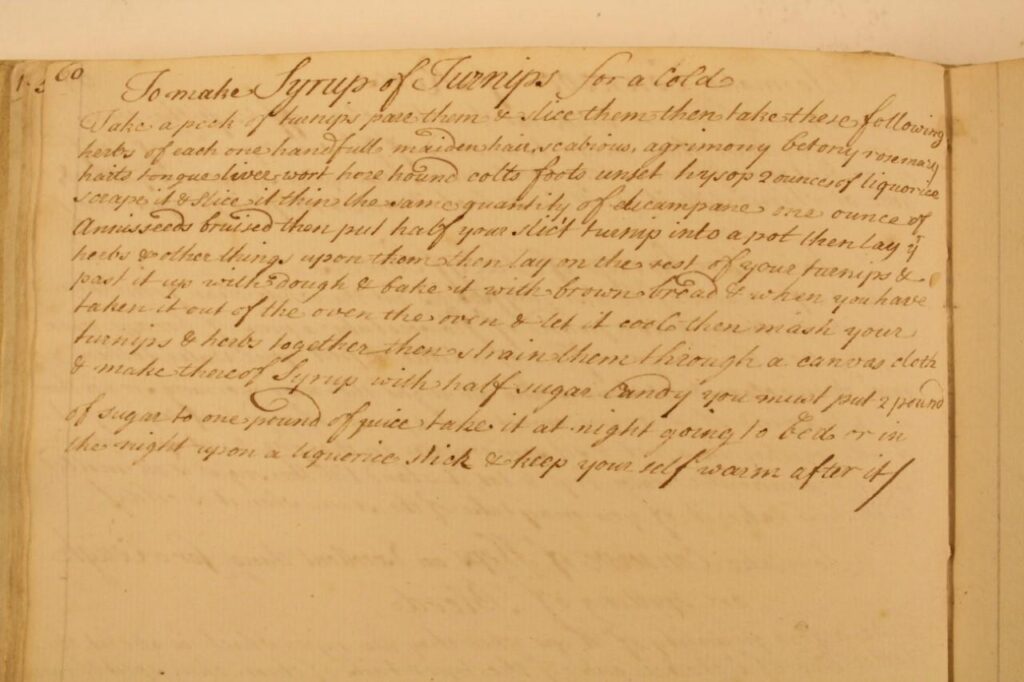
With winter approaching it seems a good opportunity to share Elizabeth Slany’s recipe for a ‘Syrup of Turnips for a cold’.
To make Syrup of Turnips for a Cold
Take a peck of turnips pare them & slice them then take these following herbs of each one handfull maidenhair, scabious, agrimony betony rosemary harts tongue liver wort hore hound colts foots unset hyssop 2 ounces of liquorice scrape it & slide it thin the same quantity of elicampane one ounce of Annisseeds bruised then put half your slic’t turnip into a pot then lay yr herbs & other things upon them then lay on the rest of your turnips & past it up with dough & bake it with brown bread & when you have taken it out of the oven the oven [sic] and let it cool then mash your turnips & herbs together then strain them through a canvas cloth & make thereof Syrup with half sugar candy you must put 2 pound of sugar to one pound of juice take it at night going to bed or in the night upon a liquorice stick & keep yourself warm after it.
Or, to restate it in a way that is perhaps easier for our modern eyes to read:
Peel and slice a peck (2 gallons) of turnips
Collect a handful each of the following herbs:
Maidenhair (maidenhair fern, which was still in use in cough syrups into the nineteenth century)
Scabious (a plant of the honeysuckle family of flowering plants, traditionally used as a folk medicine to treat scabies)
Agrimony (a plant which grows slender cones of small yellow flowers with a long history of medicinal use for treatment of a wide range of ailments)
Betony (a plant with purple flowers used as another ‘cure-all’)
Rosemary (this fragrant Mediterranean herb has traditionally been used to treat a variety of disorders)
Hart’s-tongue – also known as hart’s-tongue fern, has been used both internally (e.g. for dysentery) and externally (e.g. for burns)
Liverwort (a perennial herb with a long history of medicinal use, including for liver ailments, healing wounds, and bronchial conditions)
Horehound (this herbaceous plant with white flowers has appeared in numerous books on herbal remedies over several centuries, and modern scientific studies have investigated its antimicrobial and anticancer properties)
Coltsfoot (a member of the daisy family with yellow flowers and hoof-shaped leaves, coltsfoot has been used in herbal remedies for respiratory diseases for centuries, but today it is known to be potentially toxic)
Hyssop (a plant widely used in herbal remedies, especially as an anti-septic and cough reliever)
METHOD
Scrape and thinly slice 2 ounces of liquorice – the root of Glycyrrhiza glabra, which has been used in herbal medicines for sore throats and related illnesses, as well as a range of other conditions
Elizabeth’s instructions next call for 2 ounces of elicampane, another root. She doesn’t specify how it should be prepared, but it could either be turned into syrup or powdered (elicampane appears in The English Physician Enlarged, With Three Hundred and Sixty-Nine Medicines Made of English Herbs, by Nicholas Culpepper, Gentleman, Student in Physick and Astrology, 1770, which recommends that the roots of elicampane could be preserved with sugar into a syrup or conserve, or dried and powdered then mixed with sugar. Both were recommended for stomach complaints, and ‘to help the Cough, Shortness of Breath, and wheezing in the Lungs.’).
Bruise one ounce of aniseeds (seeds of the anise plant, used in herbal medicines for a range of complaints including a runny nose and as an expectorant)
Put half the sliced turnips in a pot, and cover them with the herbs and liquorice, then lay the rest of the turnips on top
Cover the whole mixture with pastry dough
Elizabeth's next instruction is to bake the mixture 'with brown bread' - perhaps this means it should stay in the oven for the time it takes a loaf of brown bread to cook but if anyone has any other ideas of the meaning of this do leave a comment
Remove from the oven – and presumably take off the pastry lid. Mash the turnip and herb mixture, then strain it through a cloth. To each 1lb of the resulting juice, add 2lb sugar to make a syrup. Take the syrup before bed, or during the night, on a stick of liquorice and keep yourself warm after taking it
With a total of 13 ingredients added to the turnip and then plenty of sugar added at the end, this sounds like an elaborate cold remedy, and would presumably have been out of reach of most ordinary people.
Published with the kind permission of the Essex Record Office.
Article 8 of 9
The Jubilees at Stanford Rivers
In Stanford Rivers, a public meeting was held to decide how the Jubilee should be commemorated. In March 1898, a local paper reported discontent.
“Bright-eyed, ruddy-faced and genial Mr. MUGLESTON of Littlebury Hall, Stanford Rivers, has given us a call to tell us of the woes of that parish. The tornado of the QUEEN’S Jubilee, it seems, is still blowing over it. When the Jubilee was in prospect a public meeting was held to consider what should be done. Plans were proposed in goodly variety. One wanted a hospital; another, a parish nurse; a third, a reading-room; a fourth, a bell to call the school children; a fifth, a fountain in the school yard, and so on.
When all these bewildering subjects had been threshed out, it was resolved on the motion of Mr. MUGLESTON, that the school bell should be provided, and that a tea should be given both to the adults and the children of the parish. Everything then promised to flourish like a field of goodly wheat; but some enemy went about and sowed tares . . ..”
A separate private meeting was then organised which reversed the decision, replacing the bell with a fountain and distribution of meat to the elderly. The local paper, perhaps tongue in cheek, proceeded:
“The news, we gathered from Mr. MUGLESTON, fell upon Stanford Rivers like a shower of sleet. Discontent reigned supreme, and on Jubilee-Day, when the rest of the world was merry with music and dancing, three black flags were exhibited – not out of any sort of disloyalty to our beloved Queen, but in disapproval to the exiguous nature of the local rejoicings.”
It was claimed by Mr. Mugleston that the splinter group, now in the course of building the fountain, had run short of money, despite, apparently, “availing themselves” of £16 from school funds. It was further stated that the supply of water to the school was quite satisfactory. Mr. Mugleston now refused to pay his share of the voluntary rate in aid of the schools. The paper concluded: “We can only hope that order will soon prevail at Stanford Rivers as at Warsaw”. Warsaw?
Old Nat Wilson replied by letter. Old Nat pointed out that the water supply to the school was inadequate. 200 “thirsty little souls” having to drink water from the ditch just as he himself had 40 years before. He further claimed that after three inconclusive public meetings, Mr. Mugleston had asked him to form a committee and carry out his own plans. A fountain or monument of York stone was suggested. Furthermore, a “substantial” tea was to be provided for the women and children of the parish, a medal for each child over 15, enhanced prizes for the school sports, and beef to the cottagers over 60. Old Nat, while on the one hand acknowledging the necessity to “cut our coat according to the cloth”, clearly believed he had an unfettered social mission in “sowing milk and honey for the dear little children” rather than erecting a bell “ting-tangling” in their ears.
Mr. Mugleston disagreed. The Government grant to the school was £150 and 15s for each child with any deficiency taken up by a rate. He observed that this rate was not paid by Old Nat, it being contributed by his landlord, Old Nat’s house being assessed at £4 p.a.. It was not right for the money for the fountain to be taken from these funds. “Will it be passed by the auditor?”, Mr. Mugleston queried.
The correspondence became precise but embittered. The sower of the tares was not Old Nat but Mr. Mugleston who had sought to disrupt the meeting himself. Old Nat surmised that Mr. Mugleston “has been among the aristocrats since last May, and so has greatly refined the word feed into high tea”. Mr. Mugleston was accused of only paying half his rate, about 30s a year, towards “our beautiful commodious school”. Old Nat, a ratepayer, stuck to his guns.
The fountain was opened by Lady Cunliffe Smith in front of the Stanford Rivers parishioners, assembled en masse, in September. Through the tap, water from the terra cotta fountain gushed forth “bright and clear”. Two gun metal cups, inscribed “V.R.”, were attached. The fountain was built by Messrs F. N. Noble and Sons, the architect being a Mr. F. Rowntree of Glasgow. The cost was £90 in all.
Article 9 of 9