
High Country History Group
Journal No. 66
Contents
December 2017
Article 1 of 12
Greensted rectors of the mid seventeenth century
The list of rectors in the last journal is certainly of interest, not least as it encourages questions about where these men came from, and how they survived in the uncertain times of Bishop Laud's Arminian purges, the puritan reversals of the Civil War and the interregnum, and then the return to orthodoxy after the restoration of Charles II in 1660. This article will look at what is known about the careers of just three of these men.
Firstly, Andrew Harwood who was born in Odiham, Hants, went to Eton on a scholarship, then to King's College, Cambridge. Surprisingly he appears to have been elected a fellow of the college before his graduation as BA in 1620, and he remained a fellow there until 1635. He was awarded the degree of Bachelor of Divinity in 1630, and his first living (which he may have held concurrently with his college fellowship, not an unusual practice) was in Tring, Herts.
He was rector of Greensted from 1641 till his resignation in 1647, and then a single record identifies him as the minister of St Alphage's in the City of London in 1650. Nothing else is known about his career in the Interregnum, but by 1660 he was vicar of Asholt in Somerset, and private chaplain to the earl of Montgomery. He died in 1662, probably before he would have been obliged to conform with the Act of Uniformity which led to so many clergy being expelled from their livings on grounds of conscience.
Secondly, Thomas Punter was born about 1614 in Royston, Herts, son of a gentleman of the same name. He went to Hertford School, then on to Caius College, Cambridge, where he graduated BA in 1636 and MA in 1639. He was ordained priest in 1639 and appointed as curate to the north Essex parishes of Heydon and Hadstock. In 1644 he was accused by his parishioners of being 'a common alehouse haunter, who refused to take the covenant, was negligent in keeping the Parliamentary fasts, observed illegal innovations, promised a parishioner a sermon at his wedding …' His further misdemeanors were deemed 'unfit for publication' by his Victorian biographer, almost certainly because they were of a sexual nature! In spite of all this, he was appointed to Greensted in 1646, though his living was sequestered at some point, possibly when his reputation caught up with him. In spite of this, he became vicar of Linton in Cambridgeshire in 1656, a living which he held till his death in 1684.
Like many of the clergy who were thrown out of their livings in the puritan Interregnum, he was restored to the Greensted rectory at the Restoration in 1660. Punter was clearly a controversial character, but perhaps one should not take the 1644 charges brought by his parishioners too seriously. Their grievances were probably liturgical, rather than moral, and most complaints about clergymen at this time threw in the accusation of them being an 'alehouse haunter'. Beer, of course, was the only safe drink, and taverns were the normal - indeed the only - place for everyday social intercourse in towns and villages. The other misdemeanours were probably thrown in to add weight to the parishioners' concerns about his laxity as a puritan minister
Thirdly, Nathan(iel) Lacy was the only local man, one of the sons of Avery Lacy of Chipping Ongar, born in 1626. He too was a Cambridge graduate (BA in 1646, MA in 1650) and appears to have acted as curate in Greensted, perhaps after the living was sequestered from Punter. Lacy was appointed as rector in 1649 and a year later was described by his Greensted parishioners as 'a constant preacher, and well approved of'. At the Restoration, his appointment was not recognized and the living was returned to Punter. Lacy, however, was retained as curate, presumably because Punter was by that time occupying a Cambridgeshire vicarage. As bishops had been abolished during the Interregnum, Lacy required formal ordination at Lincoln in 1662 before he could be re-appointed to the Greensted rectory. He then remained there till his death in 1700, adding the parish of Lambourne to his responsibilities in 1670.
Lacy has been claimed as the first minister of the non-conformist congregation in Ongar, but this is almost certainly an incorrect assumption based on the presence of his name on a copyhold lease for part of the site occupied by the non-conformist chapel in the High Street. It is clear from the lease that his portion excluded the chapel. In addition he is described on the lease as 'clericus', a term unlikely to be applied to a non-conformist minister.
Nothing else is known about these three men. Harward, we may assume, was puritan enough to be appointed to a London parish in 1650, and never had to face the challenge of subscribing to the Act of Uniformity in 1662. Numerous Essex clergy, whose consciences prevented them from doing so, faced real hardship when thrown out of their livings in the autumn of that year.
Punter was clearly a survivor, able to obtain another living in the puritan atmosphere of the 1640s in spite of being expelled from his previous living on grounds of liturgical and moral laxity. He was sufficiently puritan to obtain the Cambridgeshire living in 1665, and conformist enough to retain it in 1662.
Lacy managed a similar volte face, as well as being permitted to look after Greensted as curate for two years after the Restoration in spite of his lack of episcopal ordination. One can only imagine that he was popular in the parish (indeed, he was reported to be 'well approved of' in 1650). In addition the chaos caused by the sequestrations of 1660, and the significant loss of clergy through the enforcement of the Act of Uniformity in 1662, must have resulted in a serious lack of priests to fill vacant livings.
Sources:
Crisp, F A (ed), 1886 The Parish Registers of Ongar, printed privately
Davids, T W, 1863 Annals of Evangelical Nonconformity in Essex, London
Matthews, A G, 1988 Calamy Revised, Oxford
Smith, H, 1934 Ecclesiastical History of Essex, Colchester
Article 2 of 12
Sir Thomas Smith’s role in the Reformation
Thomas Smith, born in Saffron Walden on 23 December 1514, rose to hold one of the great offices of state, Secretary of State, first to King Edward VI and then to Queen Elizabeth 1. It was a turbulent world riven by religious disputes as Protestantism arose to challenge the pre-eminence of the Roman Catholic Church.
In the Tudor period religion was inextricably intermeshed with politics. People could not conceive how anybody who held heterodox views on religion could be anything but a subversive, threatening the established order. Thus as Secretary, Smith dealt not only with what we would regard as secular matters of diplomacy and trade but also with religious questions. Throughout 1548 Smith was actively involved with Archbishop Cranmer and others on the production of a new Prayer Book. Smith was a survivor who recognised that staying in public office depended on a keen awareness of current theological trends. For Smith had to learn to live with a country lurching within one generation from Henrician Catholicism, to Edwardian Protestantism, to Marian repression, to Elizabeth’s Anglican settlement. Protestants accused Smith of lukewarmness. Catholics accused him of fanaticism. It was said that Smith attacked the catholic doctrine of the eucharist ‘with a coarseness of expression which was deliberately offensive’. Probably the truth lies between the two extremes. Smith knew when to keep his head down, but there can be no doubt that he subscribed to a reformed view of Christianity. He certainly made it clear that he had no truck with the Roman doctrine of transubstantiation.
In 1549 Smith sat on a commission with the Archbishop of Canterbury and four other senior clergy in the examination of heretics, including Anabaptists and Arians, ‘that began to spring up apace and show themselves more openly’. Later in 1549 Smith together with Bishop Ridley of Rochester, Dean May of St Paul’s, Sir John Cheke and Dr Wendy, the King’s physician, conducted a visitation of the University of Cambridge to abolish such statutes and ordinances as ‘maintained papistry, superstition, blindness and ignorance, and to set forth such as might further God’s Word and good learning’. In the summer of 1549 Smith locked horns with Bishop Bonner of London. Bonner was imprisoned for his opposition to the new ecclesiastical visitation and for his questioning of the new political order. Smith examined Bonner, who claimed that it was outrageous that he as a bishop should be arrested for disregarding the orders of a mere secretary. Bonner, who was known for his temper, declared that Smith was a ‘notorious and manifest enemy’, and a thoroughly ‘incompetent, unmeet and suspect judge’. Smith told Bonner to make an end of these invented ‘oddities and quirks’, and ordered his committal to the Marshalsea.
In January 1551 Smith found himself thrust back into to the maelstrom of national affairs when he was summoned to give evidence in the trial of Bishop Gardiner for a sermon preached three years earlier which was alleged to be subversive. Smith largely shielded Gardiner by evading hostile questions, and his friendship with Gardiner was to bear fruit during Mary’s reign. He also found himself on a commission to punish those who opposed the new Prayer Book. On 20 July 1553 the Council proclaimed Mary as Queen. Smith found himself summoned ‘to make his undelayed repair to the court’. He was greeted by a mocking Bonner, reinstated as Bishop of London. He might well have found himself re-interned in the Tower (where he had previously been imprisoned in October 1549 at the time of Warwick’s coup), but it would appear that Stephen Gardiner spoke up for him, doubtless recalling how Smith had given favourable testimony when Gardiner himself had been in the dock.
Queen Mary was determined to restore England to the Roman Catholic faith and the authority of the Pope. After the death of the Lord Chancellor, Bishop Stephen Gardiner, in November 1555, and Mary’s failure to produce an heir, the pressure of persecution increased. Nearly 300 people were burnt at the stake. Amongst the Protestant martyrs was Robert Smith, a former servant of Sir Thomas Smith. Thomas Smith was vulnerable but kept his head down. He bided his time until the accession of Queen Elizabeth in November 1558 secured the Protestant succession.
In July 1559 Smith was appointed to a commission to look into heresies, seditions and other deviations, which might imperil the new religious settlement. Smith was also convenor of a distinguished group of clergy who met at his house in Canon Row to revise Edward’s Book of Common Prayer. The group included Matthew Parker, soon to become Archbishop of Canterbury and four future bishops. Later that year Smith sat on a commission in the dioceses of Ely and Norwich, overseeing the taking of oaths by the clergy to the new Acts of Supremacy and Uniformity.
After a long absence, Smith found himself recalled to Court in March 1571 as a member of the Privy Council Cecil, now Lord Burghley, needed assistance in the heavy duties of Secretary. Smith was appointed Secretary in July 1572. The Puritans were pressing for a more radical reform of the Church in a Calvinistic direction. Smith was thought to be well suited to act as a moderate intermediary with Parliament. There was much suspicion of internal plots and foreign interference in England’s affairs. Elizabeth had been excommunicated by the Pope in 1570 following the northern rebellions in 1569. A bill was introduced for the compulsory attendance at church to include communion. Parliament urged the reform of canon law ‘to have all things brought to the purity of the primitive church’. Smith, alarmed at these radical proposals, temporised by suggesting that the bill be considered first by the bishops.
The move for a more radical reform of the Church aroused no great enthusiasm in Smith. But he had no love for Catholics, whom he suspected of disloyalty. In 1573 he reported that ‘the commission to seek out conjurors and mass-mongers’ had done very well and uncovered ‘a foul knot of papistical justices of the peace and of massing priests’. But he did not favour more penal laws against Catholics. Instead, they should be sent to Italy and ‘let them live by sucking the Pope’s teats’, as he crudely put it. He disliked Puritan fanatics, and their ‘prophesyings’ seemed ignorant and seditious. When Parliament was prorogued on 30 June 1572, Smith was relieved and felt that he could get on with the business of government without parliamentary interference. But Smith was ageing and becoming more cautious with the years.
On 12 August 1577, at the age of 62 or 63 years, Sir Thomas Smith died at Hill Hall, his classical mansion at Theydon Mount.
This article appeared in the Saffron Walden Historical Journal in Spring 2017 (no 33), and is reproduced with the permission of the author. Jeremy Collingwood is the author of ‘ Sir Thomas Smith Scholar, Statesman and Son of Saffron Walden’ published in 2012.
Article 3 of 12
The Diary of an Ejected Minister
It is generally assumed that clergy who were ejected or deprived of their livings between 1660 and 1662 after the Restoration of Charles II were thrown into destitution. Not only were they banned from preaching or any other clerical activities, but also from that other resort of impoverished clergy – teaching. A surviving diary of the Reverend Francis Chandler, rector of Theydon Mount from 1656 to his ejection in 1661, provides an interesting and somewhat different insight.
Chandler was the son of a Bishop's Stortford silkweaver, and after ordination became rector of Danbury in 1645, moving to Woodham Ferrers in 1646 and Kelvedon in 1654. Though sufficiently puritan to meet with the approval of the authorities, he seems to have been a very lukewarm enthusiast for the parliamentary cause. He noted ' very desirous of King Charles restoration, and pray'd for him as rightful king some time before; and on May 29 1660 went to London with great joy to see his pompous entry.'
Nevertheless his parish was sequestrated in 1661 and he was replaced by the Reverend James Meggs. Curiously Meggs appointed Chandler as his curate, paying him what was for that time a generous salary of 20 shillings a week. However Chandler, clearly a man of conscience, gave notice to Meggs that he would be unable to conform with the Act of Uniformity. A year earlier, his diary had recorded Meggs' attempts to persuade him to conform – 'after dinner (he) took me into his little study, where with many words and in various manners he endeavoured to induce me to conformity.' He was allowed to continue with preaching and schoolmastering until 24 August 1662 when he gave his last sermon at Theydon on a rather obscure text from Deuteronomy xxx: 'I recall heaven and earth to record this day against you, that I have set before you life and death, blessing and cursing; therefore choose life, that both thou and thy seed may live.' He then joined the ranks of the very large number of deprived Essex clergy.
Chandler's diary shows how much he moved around before his deprivation – his aunt's funeral in Ongar, sermons in Theydon Garnon, Ongar, Romford and Brentwood, baptisms at Lambourne and visits to London. He was asked to intercede in a dispute between Meggs and his son who had caused his father great offence by marrying without his consent. In May 1662 he went to Epsom, presumably for his health as he drank the waters there – though not direct from the well, but after their conversion to beer made from that source! A few days after his deprivation he attended a meeting of 'ejected brethren' at Moulsham Hall in Chelmsford, and subsequently travelled widely over much of Essex, visiting former clergy in the same position as himself, both socially and to hold days of fasting and prayer. He also preached sermons in various private houses, including that of a close friend, Judge Archer of Coopersale House. Some of private congregations were sizeable – at the end of 1663, one numbered 60 people. Such activities would have been regarded most unfavourably by the authorities who would have been alarmed by the prospect of religious and political dissent.
Chandler clearly maintained an extensive correspondence. For example, he was summoned to London to see a colleague detained in the Fleet prison and, on another occasion, to visit someone who had accidentally taken 100 grains of opium (between one and three grains would have been the normal therapeutic dose; surprisingly the victim survived). He undertook the private tuition of two boys at £36 per annum, and in 1665 attended a prayer meeting and day long fast 'on account of the plague'. There was a similar meeting the following year at the time of the Great Fire of London.
Ejected ministers, unable to earn a living, often suffered from profound poverty. Chandler himself seems to have had some private income, though he would have lost the rent he received from the houses he rented out in London which were destroyed in the Great Fire. He also had several wealthy and sympathetic patrons, including Judge Archer of Coopersale, who could be approached for help. Other benefactors were supportive too – in 1666 Chandler received £10 from a general bequest to deprived ministers. What Chandler's diary makes very clear is that there was an extremely active network amongst these unfortunate clergy, and doubtless a great deal of mutual financial support between them.
Chandler died in 1667 in Bishop's Stortford where he had settled in 1666. His diary (written in Latin) appears to have been lost, but translated extracts have survived in a manuscript in the British Library, selected portions of which were published in the Congregational Historical Society Journal in 1916.
Article 4 of 12
Aircraft Accidents at Greensted in WW2
Following on from the article in our last newsletter (no. 65) concerning the collision of the two B26 Marauder aircraft over Tawney Common are details of two aircraft that crashed in Greensted.
3rd September 1940:
Three Hurricane aircraft of 46 Squadron intercepted three aircraft that they identified as German Junkers 88 bombers. They attacked and all three aircraft sustained damaged, one mortally. It was only after delivering the attack that it was realised that a mistake had been made in the heat of battle. The recipients of the attack had been friendly aircraft, three Bristol Blenheim’s from no. 25 Squadron based at North Weald.
One Blenheim (L1401) managed to return to North Weald with only slight damage. Another (L8650) managed to land at Hatfield Heath with heavy damage. It was Blenheim (L1512) that had borne the brunt of the attack. The crew of two were Pilot Officer Douglas William Hogg, RAFVR, aged 23 years, and Sergeant E. Powell, rear gunner.
The combat between friends had occurred over Ongar, and a number of the residents stood outside to watch the battle take place. Mr R
W. Wheelhouse who worked in the flour mill behind the High Street saw the crippled aircraft spin viciously towards the earth out of control. Sergeant Powell managed to escape from the Blenheim over Ongar, eventually landing safely at Castle Farm. Although the aircraft was apparently about to crash within the built up area, it appears that Hogg, in a last supreme effort, managed to wrest some control out of his machine and stop the spin. Although it recovered into a shallow glide it crashed between Ongar and Greensted killing P.O. Hogg.
Pilot Officer Hogg was born in 1917 the son of Thomas and Helen Hogg of Thornliebank, Glasgow. He must have already had some flying experience when he joined the RAF on 1st February 1940 with a direct-entry RAFVR commission as he joined 25 Squadron at Martlesham Heath ten days later.
He is buried in Glasgow (Eastwood) Old and New Cemetery.
23 September 1944
On 23/09/44 582 (PFF) Sqn Lancaster PB512 60-J Took off from Little Staughton airfield, Huntingdonshire, at 10.42., on a fighter affiliation exercise. It was reported to have lost control whilst making a diving turn at 8,000 feet over Ongar and dived into the ground and exploded at Greensted.
Six crew members and one member of the Ground crew were killed.
The crew were:
Flying Officer William Lawrence SHIRLEY, 424529. Royal New Zealand Air Force, aged 22 years.
Buried: Brookwood Military Cemetery, Surrey.
Sergeant Desmond Charles EVANS, 1836534. Flight Engineer, aged 22 years. Son of Illtyd & Blanche Evans of Llantwit Major; husband of Elsie Ellen Evans of Llantwit Major.
Buried: Llantwit Major (Tabernacle) Calvanistic Methodist Chapleyard, Glamorganshire.
Flying Officer Frank David HILL 132036. Navigator. 582 Squadron Royal Air Force Volunteer Reserve., aged 21 years. Son of Frank & Augusta Leticia Hill of West Park, Leeds, Yorkshire.
Buried: Brookwood Military Cemetery, Surrey.
Flight Sergeant Duncan Lewis Thomas SMITH 1389708. Air Bomber. 582 Sqdn., Royal Air Force Volunteer Reserve, aged 23 years. Son of William Thomas Smith and Nora Mary Smith, of Snaresbrook.
Buried: City of London Cemetery, Essex.
Flying Officer George John BURCH 159512. 582 Sqdn., Royal Air Force Volunteer Reserve. Aged 20 years. Husband of Margaret May Burch, of Tilbury.
Buried: Thurrock (Chadwell St Mary) Cemetery, Essex.
Flight Sergeant Colin James MITCHELL 417981. Royal Australian Air Force, aged 24years. He was a farmer before enlisting. Son of William and Una Myrtle Kerr Mitchell; husband of Aileen Elizabeth Mitchell, of Kyancutta, South Australia.
Buried: Brookwood Military Cemetery, Surrey. Reference to be found in the Australian War Memorials AWM148 Roll of Honour cards, 1939-1945 War, Air Force. Commemorated on the Kyancutta Roll of Honour.
Leading Aircraftman William Arthur George ALSTON 1509278. 582 Squadron Royal Air Force Volunteer Reserve. Aged 22 years. Son of Arthur William George & Florence Alston; husband of Norah Charlotte Florence Alston of Upper Holloway, London.
Buried: Brookwood Military Cemetery, Surrey.
A memorial has been placed in Greensted church to the memory of the crew.
Article 5 of 12
The Congregational Chapel, Stanford Rivers
In the year 1819 a generous and celebrated non-conformist benefactor, Thomas Wilson, gave a cottage on the main London Road at Little End and arranged for it to be fitted up and opened as a place of worship for dissenters. A Sunday school was attached to the chapel. At the opening service sermons were preached by the Rev. James Stratten of Paddington and the Rev. Edward Andrews of Walworth. Arrangements had been made for the supply of preachers from Hoxton Academy.
On 27 June 1820 a new chapel, specially built and seating for 300 people, was opened in place of the converted cottage. Stratten and Andrews were again the preachers at the opening. Two local residents had each contributed £100 towards the cost of the chapel.
In 1827 the site, chapel, and vestry, with a stable and outhouses, were conveyed to trustees, among whom were Stratten, then of Maida Vale, and Thomas Kingsbury of Stanford Rivers. The trust deed stipulated that the buildings should be used for
'a congregation of Protestant Dissenters usually denominated Calvinists of the Independent Denomination'.
Stanford Rivers - First Series Ordnance Survey Map 1805
The Essex Incorporate Congregational Union has in its possession a Deed of Lease dated 19th June 1827 “Thomas Wilson of the first part- Joshua Wilson, John Remington Mills, James Smitherman, Wm Eve, Daniel Dewdney of the second part”. The consideration was 5 shillings and the property consisted of “Chapel, Vestry, Stable, Outhouse and Land”.
In 1829 the congregation numbered 150 and the Minister was William Temple
In 1839 David Livingstone, then a student at Chipping Ongar, was requested to preach in the chapel, the minister of the chapel being taken suddenly ill. The young Scotsman was called upon to take the evening service, and all went well until the sermon, when Livingstone slowly read out his text - and paused. He said afterwards that it was as if midnight darkness had descended upon him. The sermon, so perfectly memorised until a moment before, had fled, and his mind was filled with blank terror. “Friends,” he haltingly said, “I have forgotten what I had to say,” and abruptly he left the pulpit, and fled.
From about 1854 the chapel was served mainly by ministers from Chipping Ongar. Isaac Jennings formerly the minister at Ongar had charge at Stanford Rivers during his retirement in 1863. A new trust was formed in 1877.In 1904 there were 34 Sunday School children with 2 teachers.
On Sunday, January 2nd, 1927, Mrs Howard Kenniford, who was to have conducted the service, accidentally overturned an oil lamp. Fire spread rapidly and destroyed the building, including a Bible which was originally the property of David Livingstone.
Prior to its destruction the Chapel had been a rectangular stucco building with a pedimented front. After the fire an ambitious scheme of world-wide appeal for funds was made with a view to rebuilding. The appeal for £3000 was not successful, less than £400 being received and the Church Authorities appointed the Charity Commissioners to be Trustees of the site and fund. No nucleus for a reasonable congregation could be found in the area and ultimately the funds were used for another Chapel in Essex.
The Ongar Congregational Church was formed in 1662 by the Minister and Worshippers ejected from St Martin’s church, Ongar under the Test Act at the end of the Civil War.
Article 6 of 12
The Will of Thomas Atwood of Stanford Rivers 1600
To my son Thomas the younger my laced coat, my riding cloak, my doublet of black rash, a pair of round cloth hose, and £20 to be paid to him by his brother John in discharge of a speciality made by me to Thomas the younger. To my son Thomas the elder my furred cloak, a coverlet that his wife made of stuff that her mother gave her, and £20 to be paid by John. To Edward my son my furred gown and £10 to be paid by John. To Richard my son my great chest in my chamber with all that is in it, my black satin doublet, my hose of velure, my cloak faced with taffeta, and £10 to be paid him at our Lady Day next, in full payment of £20 that I gave him. To William son of John Atwood, my godson my great ring of gold with the picture of death’s head on it. Whereas my son John is indebted to me in a bond of £100 whereof I give him £40 in consideration of a lease to Thomas the younger, £20 to William his son, £20 to Elizabeth his daughter, and the other £20 to Thomas the younger to discharge it. To Mary Redley 10s. at marriage; Susan 20s. and my hat of taffeta besides her wages; Wallis my hose of venetians; Howkins a pair of new stockings; William White a pair of new stockings and my new fustian doublet; Pepper 2 waistcoats; and every manservant and maidservant 12d. To 10 of the poorest householders in Stanford Rivers 10s.
The residue of my goods to John whom I make executor and Mr. Wright of Kelvedon [Hatch] overseer and for his pains 20s.
Witnesses: Richard Attwoode, William White.
Added: That which my executor shall have to pay to perform my will withal – my executor doth owe me which he must pay £38; of Poole of Abbess Hall [in Abbess Roding] in malt 23½ quarters which by estimation will amount to £20.
Proved 16 June 1600.
[Source Elizabethan Life – Wills of Essex Gentry and Yeoman. F.G. Emmison 1980.]
ERO Ref: D/AEW 17/31
Article 7 of 12
The Poor not Forgotten
The Poor not Forgotten.— Sir William and Lady Bowyer Smijth, being from Hill Hall this season, did not forget the poor of the parish of Theydon Mount and Stapleford Tawney, as each adult received 2 lb and each child 1lb of beef for their Christmas dinner. The worthy rector likewise added much to their creature comforts.
Source: Essex Herald 10 January 1865
Article 8 of 12
Seasonal Benevolence
EPPING: Seasonable Benevolence. Among the contributions in the neighbourhood of Epping to the wants of their poor the following have come under our notice:- The proprietors of the Hill Hall Estate made their usual annual distribution of beef on the 24th ult. Mr. John Fleming, the present occupier, on the 28th distributed 80lbs. of tea, and coals to the amount of £5, the poor of Theydon Garnon and Theydon Mount; also presenting each of his labourers with a serviceable suit of working clothes. Mr. J. H. Smee of Theydon Place, provided the poor of Ivy Chimneys to the number of 40 with a Christmas dinner of beef and plum pudding at their own homes. Mrs. Smee contributing a number of neatly-trimmed straw hats to the children of the same district. Mrs. Whiteman, of Theydon Grove, is one day in each week providing meat puddings to the poor of the town and neighbourhood.
The poor in and around the Copped Hall Estate have been generously thought of by the proprietor, Mr. Wythes. We may add as a sort of general contribution, the soup kitchen is in full operation, and its nourishing supplies are eagerly sought after, and fully appreciated by large numbers of poor people.
Source: Essex Herald - Tuesday 10 January 1871
Article 9 of 12
The late Sir Edward Bowyer Smyth
As the extensive sale of property belonging to the late Sir Edward Bowyer Smijth, will, no doubt, attract vast numbers to Hill Hall, perhaps to gaze its picturesque grounds, and its splendid collection of old family paintings, the following account of the mansion and its last possessor, which we copy from the Gentleman's Magazine, will be interesting:
He was the sixth in descent from Sir Thomas Smith, the first baronet of his family, and the eighth descent from George, younger brother of Sir Thomas Smith, Knight, who was highly distinguished both a scholar and statesman under King Edward VI. and Queen Elisabeth, and served both those sovereigns as secretary of state. The baronet now deceased was the fourth son of Sir William Smijth, the seventh Bart. Colonel of the West Essex Militia, by Anne, daughter and eventually heiress of John Windham Bowyer, Esq. of Woodmanstone and Camberwell, Surrey, and of Waghen, Yorkshire. Lady Smijth also inherited the Windham estates at Attleborough and elsewhere, in Norfolk. Her son Edward was born March 1, 1785. Being a younger brother, he was educated for the church, and entered of Trinity College, Cambridge. He took the degree of B.A. in 1807, second Junior Optime, and proceeded M.A. in 1811. In 1809 he was instituted to the vicarage of Camberwell, in Surrey, on the presentation of his maternal grandfather. He held that living until the year 1823, when he exchanged with the Rev. J. O. Storie. for the rectory of Stowmaries, Essex. This rectory he resigned in 1836. In the beginning of 1837 was he was instituted to the united rectories of Stapleford Tawney and Theydon Mount, which he resigned at the close of 1838, on succeeding to the family title and very considerable estates in Essex, Norfolk, and Surrey.
His oldest brother, William, died unmarried at the age of 23. The two following brothers, named respectively Thomas and John, both succeeded to the baronetcy, with the family properties Hill Hall and Horham Hall, Essex; Camberwell. Surrey; and Attleborough and Norton, Norfolk. Neither of these gentlemen married.
On the 15th of June, 1839, Sir Edward Smijth, in consideration of his maternal descent, obtained the royal license for himself and his issue to bear the surname of Bowyer in addition to and before that of Smijth.
The estate of Theydon Mount, in Essex, was the jointure of Philippa, widow of Sir John Hampden, knight, whom Sir Thomas Smith, the eminent statesman, married for his second wife. He bought the reversion of this property, and settled it upon his own family. The Manor house was close to the church, and some remains of it used as a farm-house and known as Mount Hall, existed no great distance of time. Sir Thomas Smith began new mansion on more elevated ground, and most of it was finished at his death in 1577. It is called Hill Hall, and is fine quadrangular pile of building, but its eastern side has been rebuilt in the Doric style. This new work was completed in 1716 by the second Sir Edward Smiith, whose arms impaling Hedges, the name of his first wife, are on the tympanum of the pediment. The family vault is under Theydon Mount church, which stands in the park. In the chancel are four noble monuments, with recumbent and other effigies; one to the memory of Sir Thomas Smith, Edward and Elizabeth's minister; another the memory of his nephew, Sir William Smyth, knight; third to the memory of that gentleman's son, also Sir Wm. Smith, knight: and fourth to the memory of another son, named Thomas, eventually heir of the family, and the first baronet. Mural tablets in the church and chancel commemorate all others of this family who have enjoyed its honours except the gentleman just deceased. By these monuments the family appears to have been ordinarily spelt Smith or Smyth until the letter part of the seventeenth century, but Smijth for the last 160 years or more.
The baronet. Sir Edward Bowyer Smijth came to reside at Hill Hall more than 20 year ago, and found irreligious habits very prevalent among his poorer neighbours. His influence and example soon wrought a salutary change. Sunday was duly observed, and schools were established for gratuitous instruction. These excellent institutions, with other measures for relieving poverty, continued upon scale befitting his abundant means after he had succeeded to the inheritance of his fathers. Nor did forget the good example, judicious control, generous hospitality, and high-minded liberality which are naturally expected from hereditary wealth and long established station.
Source: Essex Herald - Tuesday 29 October 1850
Article 10 of 12
A ‘Christmas’ Tree at Suttons
Prince Albert is usually credited with introducing the German tradition of the Christmas tree in Britain after his marriage to the young Queen Victoria in 1840. So I was intrigued to find a short reference to a decorated tree several years earlier, in 1832, in the diary of Lady Mary Smith of Suttons in Stapleford Tawney.
Mary, born in 1800, was the daughter of wealthy banker William Gosling. She married Sir Charles Joshua Smith in 1826 and moved to the Smith family’s country seat at Suttons. They had three children in fairly quick succession but in January 1831, when the youngest was just five months old, Charles fell ill and died. He was only 30.
Like many of their class at the time, both Mary and Charles kept diaries, some of which are at the Essex Record Office. They are only pocket diaries, so entries are all too brief and factual. At least Mary’s writing is fairly legible, unlike her husband’s.
She records visits to and from other families of her class in Essex and London, her frequent worries about her children’s health and her son’s education, which clergyman preached the sermon at Tawney church, the weather, the garden, family births and deaths. National events occasionally appear, like the death of King George IV in 1830, and the marriage of Queen Victoria and Prince Albert in 1840. In February 1839 she and her sister went to the House of Lords to hear the Queen’s speech at the opening of Parliament.
But London gave Mary headaches, and she was always happier at home in Stapleford Tawney with her beloved children. On Friday November 16th 1832, Mary wrote about a treat she had planned for them:
The children had a tea party consisting of coffee and 33 dishes filled with various kinds of cakes and sweetmeats, afterwards they went into an adjoining room where there was a green tree heavy with different little presents, it made them very happy and they thoroughly enjoyed it. In the evening we went to hear the children practice singing with the organ.
As always, brief entries tend to raise further questions. Thirty-three dishes sounds far too much for three children aged from two to five, and the singing practice was unlikely to be very harmonious at their age, so older visiting children must have been present too. Fuelling them all with caffeine and sugary foods apparently caused no special problems. Giving coffee to young children is nowadays quite common in a few countries but it is interesting to see that it was a treat in England in the 1800s.
Lady Smith’s [ever]green tree laden with little presents sounds very much like a Christmas tree, despite it being mid-November. So is the story of Prince Albert a myth? Not exactly, but the tradition first came to England much earlier with ‘good Queen Charlotte’, the German wife of George III, who set up the first known English tree at Queen’s Lodge, Windsor, in December 1800. Before that, she had followed the practice of her home region of bringing in a single bough of box or yew, putting it in a pot on the dining table and dressing it herself. In 1800, however, the Queen planned to hold a large Christmas party for the children of all the principal families in Windsor. As a special treat, she decided that instead of the customary yew bough, she would pot up an entire yew tree, cover it with baubles and fruit, load it with presents and stand it in the middle of the drawing-room floor at Queen’s Lodge. It caused a sensation at court, and the news soon spread.
Christmas trees then became all the rage in English upper-class circles, where they formed the focal point at countless children’s gatherings. As in Germany, any handy evergreen tree might be uprooted for the purpose; yews, box trees, pines or firs. But they were invariably candle-lit, adorned with trinkets and surrounded by piles of presents. Smaller trees or boughs placed on table tops usually also had either a Noah’s Ark or a model farm and numerous brightly-painted wooden animals set out among the presents beneath the branches to add extra child-appeal to the scene.
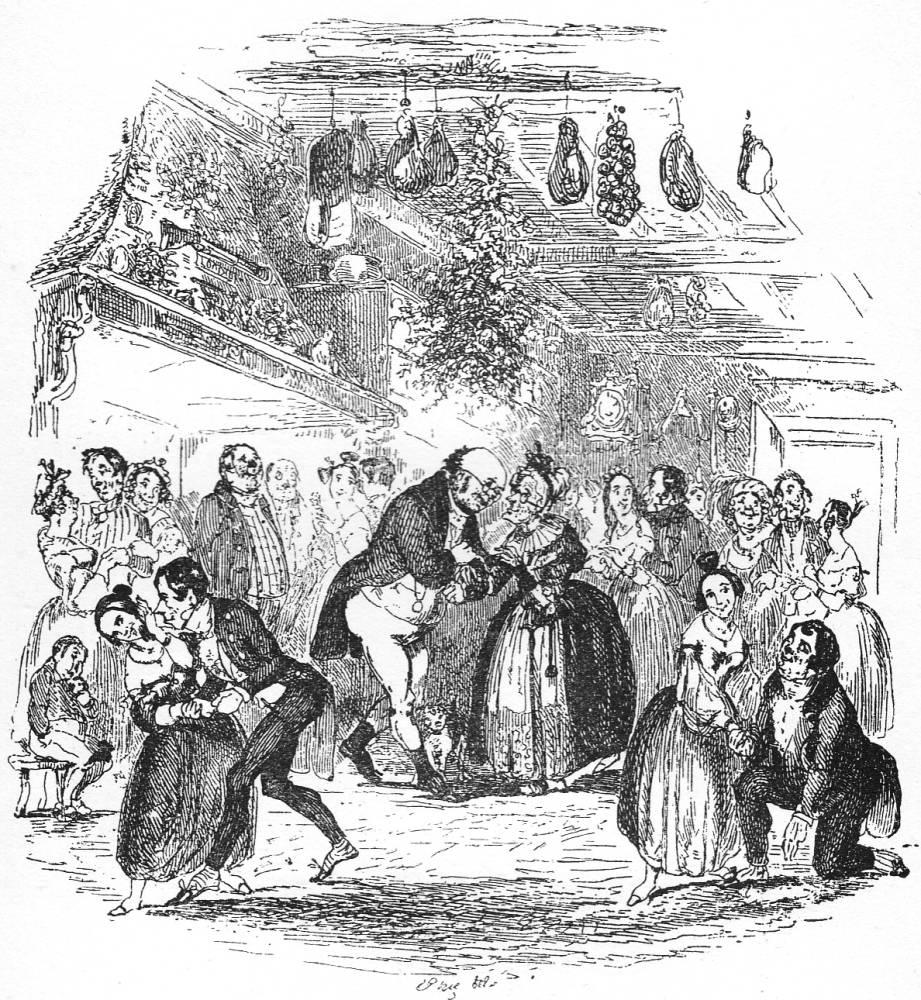
But the tradition was restricted to the upper classes. Middle and lower classes had the yule log and the mistletoe garland as their main Christmas decorations, as described by Charles Dickens in The Pickwick Papers.
There are no trees either in his Christmas Festivities (1835) or A Christmas Carol (1843). But in 1845 The Illustrated London News started to give detailed descriptions of Victoria and Albert’s family Christmas. In December 1848 they published a 16-page supplement including a woodcut entitled “Christmas Tree at Windsor Castle”. The illustration depicted Victoria, Albert, their five children and a governess gathered around a table-top evergreen, its branches cut into tiers, adorned with sweets and ornaments, illuminated by candles and topped by an angel. Unwrapped presents—dolls, mounted cavalrymen and a figure in a horse-drawn chariot—surround the base.
Once again it caused a sensation, but this time it was the ordinary public who wanted to copy the Queen. Dickens publicised the fashion in A Christmas Tree, published in 1850. From then on, Christmas trees appeared in every household and the great “British” tradition was born.
But Lady Smith never saw all this. Like her husband’s, her life was tragically short. Only ten years after the tea party treat, when the children were in their early teens, she wrote in her diary that she had a bad headache and the entries stop. On 3rd July 1842, she died, her last thoughts no doubt being for her beloved children.
Article 11 of 12
Assault in Church
In the Court of King’s Bench, on Saturday, the cause of Ballard v Bond, and another was tried. It was an action brought by the village schoolmaster and beadle of Stapleford Tawney church, against the Revd. Mr. Bond, the curate, for an assault committed in the church on Sunday, the 21st of May. Mr Watson stated the case, and proceeded to call the following witnesses:-
Elizabeth Thurnwood lived with Mr Bond in the month of May last; recollects Sacrament Sunday, the 29th May; knows the plaintiff Ballard, the plaintiff was standing by his scholars in the church. On that day Mr Bond called Mr Ballard into the vestry; Ballard went in, and she (witness) heard Bond say to the plaintiff, everyone in the parish has signed the paper against you; Ballard said that they had not all had signed it, and Mr Bond replied, “Do you mean to call me a liar?” Ballard said he did not and that was no place for such conversation. Bond then called in Tanner and told him to turn him out. Tanner called to Meredy to assist him; Meredy took hold of plaintiff by the right arm and he was put out; he fell in his struggle with Tanner, and his head came against a pew door. Witness gave Mr. Bond notice to quit his service the next day.
Cross examined by Mr. Platt. Herself and the housemaid gave warning the same time, has lived with her mother ever since she left Mr. Bond’s. Her mother keeps a chandlers shop in the country. She gave warning because Mr. Bond told the servants that he would discharge them if they ever entered Mr Ballard’s house ever again.
The witnesses differed a little in their statements, only one recollecting the orders of the clergyman to turn the plaintiff out, but all agreeing to the violence used by the other defendants.
Mr Platt for the defendants, dwelt upon the discrepancy of the evidence, and urged that it was impossible for him to call evidence, as the plaintiff had included all who alone could give the true state of the case in the action.
The Jury found a verdict for the plaintiff. Damages 40 shillings against each of the defendants.
Source: Essex Herald - Tuesday 06 December 1836.
Court King’s Bench, Thursday.— Ballard v. Bond and Another.—This was an action for assault and forcibly turning the plaintiff out of Church; was tried the last sittings for Westminster, before Mr. Justice Coleridge, when verdict was entered for plaintiff—damages, forty shillings.—- Mr. Thesiger now moved for a new trial, on the ground misdirection. The plaintiff was schoolmaster of the parish church of Stapleford Tawney, in Essex, of which the defendant Bond was curate: on the day of the alleged assault, the plaintiff was called into the vestry-room and told Mr. Bond, that in consequence of public remonstrance addressed to him of his irregularity be should resign his situation. An altercation ensued; plaintiff gave Bond the lie, and threatened to take all the scholars with him went; he was forthwith forcibly put out of the church.—Rule refused.
Source: Essex Herald - Tuesday 17 January 1837
What led up to the assault on Mr Ballard remains a mystery.
Article 12 of 12
Rationing
Winston Churchill. Air raids. Blackouts. People taking refuge in London in ‘tube’ stations. Food shortages. Rationing. All these things we associate with the Second World War but, in fact, apply also to the Great War 1914-18.
As an island nation we are not able to feed ourselves and have always relied on food imports. So the first thing that an enemy will do is to halt our food supply by blockading the seas to create a ‘siege’ situation. The Government’s response is to increase productivity and ration the amount of goods people can obtain. In February 1917, a Food-Comptroller was appointed, Lord Davenport.
Land was surveyed and farmers ordered to grow more. In January 1917, Essex County Council organised the sale of seed-potatoes at wholesale price to small-holders. 250 tons of seed was to be distributed throughout about 500 parishes in Essex.
Wheat was important. The Government brought forward and enacted proposals to guarantee a minimum price to farmers for wheat and oats: wheat, 60 shillings (£3) per quarter and oats, 38/6 (£1.88).
A shortage of wheat and flour was predicted in April 1917 and police officers made house-to-house enquiries in Stondon Massey and the neighbourhood to ascertain the number of farm and domestic animals owned in order to ensure that there was no unnecessary consumption of food suitable for human beings. On 6th May 1917 a proclamation from the King was read in Church urging people to abstain from unavoidable consumption of flour.
On 9th May 1917, Revd. Reeve, Rector of Stondon Massey, wrote:
“It becomes increasingly difficult for the wayfarer to get served in pastry cooks’ and refreshment houses. At Ongar the confectioners refuse to supply the traveller with a “sit-down” meal: and at Brentwood recently I was told that only between three and six o’clock in the afternoon may a cup of tea and light refreshment be supplied. Similarly at Chelmsford two or three weeks ago I found I went to a Restaurant at a pasty-cook’s the proprietor was only allowed to serve an individual customer up to the limit of one shilling and threepence for eatables”.
The Corn Production Act 1917 set minimum wages for agricultural labourers. A Committee (the Essex District Wages Committee) represented by 9 employers, 9 workmen and 5 independent members met and agreed “by a substantial majority upon a minimum wage of 30s for Essex” [ERO T/P 181/18/1B (Essex Chronicle. 28 May 1918)]. The Central Board though rejected this and imposed a rate of 32s (£1.60) much to the disgust of farmers. On 24 March 1919, the wage rose to 36s (£1.80) then 46s.6d. (£2.33) from 23 August 1920. Market gardeners received a higher rate, 50s.6d. (£2.53).
George Everett (Boxford, Suffolk) recalled that the minimum wage was not paid on every farm and that men were not unhappy to take work at reduced wages. As before, when there was no work there was little or no pay. When the Corn Production Act was repealed in 1921 wages immediately fell.
Ashley Cooper concludes his book ‘Our Mother Earth’ (1998) by observing that only in times of national crisis is the necessity for domestic crops supported by Government.
But wheat was required not only for bread but for use in munitions!! Reeve wrote on 19th December 1917: “Supplies of Horse-Chestnuts have been collected this autumn and sent to London, it being discovered that certain chemicals may be extracted from them for the manufacture of munitions which have hitherto been obtained from flour. The food-supply may be saved. A ton of Chestnuts is found to equal half a ton of grain. We have lately sent some 5 bushels to the “Director of Propellant Supplies” at Westminster”.
During the War the Government expressed the need to be thrifty: to invest money in war loans and be sparing with the use of woollen goods and paper. In April 1917, “The Times” rose to twopence (1p) with others – presumably the Daily Mail and Daily Express - previously sold for ½d increased to 1d. and “’Mr Punch’ from his long familiar threepence per week, has been raised to sixpence” [ERO T/P 188/3 f239].
The sugar ration was reduced from ¾lb (about 300g) to ½lb (200g) in April 1917. By September this was causing concern that a large quantity of fruit might be lost if not preserved (eg into jam). “The Government has now taken control, and by appointing agents in each district offices the public who make application within a given time a limited supply up to 28lbs for preserving fruit guaranteed to have been grown on their own premises. Each application must be countersigned by a Minister of Religion, a Justice of Peace or a householder of standing”. Reeve wrote that the harvest of soft fruit that year had been particularly heavy because of the absence of late frost. Large quantities of pears and peaches were sent from the Rectory to the Budworth Hospital in Ongar for the convalescent troops. Apples were stored and as much jam as possible was made from currants. The sugar ration was compulsorily enforced on 1st January 1918 and meat was reported as being scarce.
On 25th February 1918: “Today ushers in the “Rationing” System for London and the Home Counties in respect of Meat and of Butter and a compound known as “Margarine” a substitute for butter. These articles are only to be obtained from today on production of a coupon. The total allowed per week is 1lb of meat for adults and half the amount for children under ten years. Four ounces of butter is the limited allowance for such. A little allowance of dilution of honey was served to me yesterday at Chelmsford in lieu of sugar with a cup of Coffee”. The system was accepted without much complaint. In June the Revd. Reeve noted that he could not get a pot of Orange Marmalade from any grocer in Chelmsford High Street.
One of the major social changes in terms of rationing was the availability of alcohol. Concerned about drunkenness and inadequate production of munitions, the Government passed a law in 1916 restricting the opening hours of public houses. The law stayed in place almost intact until about 1986 with the final remnants repealed following the Queen’s Speech in 2002. Pubs used to close at 11.00pm during the week and 10.30pm on Sunday evenings. The ringing of the bell for last orders is a thing of the past in many of our nation’s pubs.
Bibliography
Cooper, Ashley. Our Mother Earth (Bulmer Historical Society, 1998)
Reeve ed. Smith. Chronicler of the Great War (2008)
Scott, Hardiman. Many A Summer (Richard Castell Publishing, 1991)