High Country History Group
Contents
See images from this issue
Images from this issue
Article 1 of 11
Unusual Times
The coronavirus pandemic and the necessary restrictions imposed present a challenge to our daily lives at this time and, for the vast majority, we feel that we are all in it together. As the lockdown of spring 2020 is eased there are new procedures for going to shops, pubs, and churches. Social distancing – staying at least two metres apart - from those who do not live is your household is expected. The wearing of face coverings is now compulsory is any enclosed public space. Who would have imagined that a law-abiding citizen would be expected to wear a mask to enter a Bank!
The High Country History Group is unable to meet as usual at the Village Hall but have resorted instead to monthly 40-minute meetings on Zoom which, although smaller in number, have been much appreciated by those who have attended from home.
At the June meeting, in ‘The Butcher, the Baker, and the Candlestick maker’ Martyn talked about the war graves on the First World War.
In July Andrew hosted an ‘Essex Quiz’ (see below).
We wish you and all those you care for health and safety during these unusual times, and remain determined to keep in contact.

Article 2 of 11
Essex Quiz
County Histories began just over a hundred years ago. Known by the acronym VCH (Victor, Charlie, Hotel) to which monarch is the series dedicated?
Published in 1956, Volume 4 of the Essex edition covers the High Country History area and surrounding parishes in the Hundred. But in which Hundred do our parishes appear?
We might expect Greensted Church to be dedicated to St Edmund. But instead, to which saint is it dedicated?
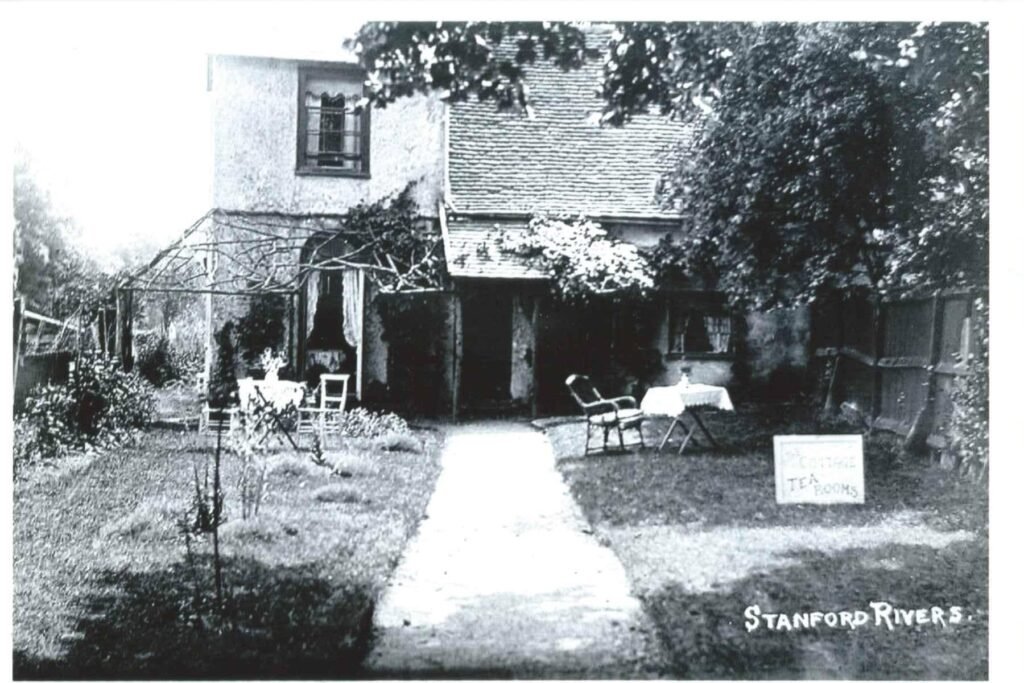
A quote from Volume 4: “The factory of Piggott Bros & Co, tent and tarpaulin makers, is on the east side of the main road at Little End”. What was the building in Stanford Rivers formerly used as?
Which river forms the southern end of the parish of Stapleford Tawney?
What is the name of the mansion in Theydon Mount used in 1956 as a women’s prison?
Marden Ash is part of which parish?
In which churchyard is Reginald Armitage, otherwise Noel Gay, buried?
Until 1981 what were the two intermediate stops on the Central Line between Epping and Ongar?
The Essex Way is an 81 mile walk ending at Harwich High Lighthouse. But where does the walk begin?
The waymark signs along the route of the Essex Way show the county flower. Which red flower is that?
The Essex Skipper, The Drinker Moth, The Small Copper are or were the names of public houses built in Harlow New Town. What were these new pubs named after?
Wilkin and Son, Tiptree make preserves. What jam would I be eating labelled Little Scarlet?
Which major cycling event came through Epping High Street on 7 July 2014?
Which Essex Town has as its anagram Bored Town?
(1) Victoria
(2) Ongar
(3) St Andrew
(4) Union Workhouse
(5) Roding
(6) Hill Hall
(7) High Ongar
(8) Stanford Rivers
(9) North Weald & Blake Hall
(10) Epping Station
(11) Poppy
(12) Butterflies
(13) Strawberry
(14) Tour De France
(15) Brentwood
Article 3 of 11
Rector Revealed
Close to the path leading to Tawney church porch is a prominent brick and stone chest tomb. Until recently, it was smothered by a decades-worth thatch of ivy.
In a happy consequence of the Coronavirus lockdown, a friendly neighbour in need of fresh air and exercise took a handsaw to the ivy and revealed the whole tomb.
The inscription on the top and side of the tomb is quite worn and entirely in Latin.
Translated into English, it reads:
Here lie the remains of
EDWARD TURNOUR
S.T.B.
For [24] years unworthy Rector of this parish church
This is written by order of the deceased
He died on 3rd July in the year of our
Lord 1691
at the age of 52
The aforesaid Edward Turnour took as his wife
Ann, daughter of Richard L - - - -
of the county of Wiltshire Esquire,
by whom he produced children
Anne, Edward and Elizabeth
Originally the inscription finished at this point. Later, more was added to commemorate Elizabeth’s family (although they are actually buried elsewhere):
She [ie Edward’s daughter Elizabeth] married in the year (…) Thomas Le[w]is
of Soberton in the county of Hampshire Esquire
whose only daughter Elizabeth married in the year 1730
the most distinguished Lord Other, Earl of Plymouth
who left one son, the most honourable
Lord Other Lewis Earl of Plymouth
Set into the north side of the tomb is a stone plaque with a Latin inscription, in memory of the Rector’s eldest daughter Anne, who had died years before her father as a 9-year-old child. This may be her original gravestone, reset on her father’s tomb, or the opportunity was taken to commemorate her when it was built in 1691.
Anne Turnour
Daughter of Ed[ward] Turnour
Rector of this church
Is buried here
A:D
1680
The solid construction of the tomb means that it has lasted longer than any other memorial in the churchyard. On the other side of the path is a ledger stone tomb, belonging to a later long-serving Tawney Rector, Lewis Prance. The two clergymen appear to stand guard over the approach to the church, silently observing those who come and go today. The convenient flat top of Turnour’s tomb has at times been used as a display table at Flower Festivals, a book rest at churchyard services and occasionally a seat for the weary. So in a way Edward Turnour is still serving his parish more than 300 years after his death.
Images
S.T.B. stands for the Latinised degree Bachelor of Sacred Theology, a term nowadays only used by the Roman Catholic church.
Edward’s family were keen to point out that the term ‘unworthy’ was not their choice, but Edward’s own display of Christian humility. Edward had become Rector in 1667, after the religious and political turbulence of the Civil War and Commonwealth period. Following the return of monarchy in 1660, there were three rectors who had died in quick succession. So Edward’s 24 years in Stapleford Tawney probably brought his parishioners some welcome stability.
From the parish records:
Anne was baptised 4th December 1670 and buried 27th May 1680
Elizabeth was baptised 14th April 1672
Edward was baptised 25th March 1677
The rector’s descendants were obviously very proud of their aristocratic connections. The curious Christian name Other is still used by the current Earls of Plymouth, though nowadays only as a middle name.
Article 4 of 11
Every Picture tells a Tale (1)Village scene, circa 1900
The old postcard of an “unnamed village” featured in the June 2020 issue of High Country History journal (p 37) is indeed Hatfield Broad Oak as suggested. The first clue is the brick building on the far left, with the hanging sign of a cockerel. On the opposite side of the street is a house with distinctive X-bracing on the front. And of course, there is the village pump. Anyone who knows Hatfield Broad Oak will recognise this as a view looking east along the High Street.
Today (July 2020) the Cock public house has just re-opened after lockdown. The pump is still in position, though not functioning, the lamp has been replaced by a flagpole, and the renewed finger-post is closer to the brick house on the right. Amazingly, all but one of the buildings depicted are still there, barely altered, at least on the outside. The people of the village in 1900 would still recognise this view today.
Looking more closely at the old photo, it must have been posed. Cameras needed quite long exposures at this time, and everyone would have had to keep still for several seconds to achieve clarity. Animals and children were notoriously difficult, so old photographs often show blurring of babies’ arms or dogs’ tails. The photographer may have composed the group of village boys in the foreground and asked the two people with bicycles to stand still. Other village people are watching, but much further away. Only the horse nearer the camera has caused blurring by swishing his fashionably docked tail.
The little girl with the bicycle is intriguing. She is not in everyday dress, with a white smock or pinafore over her clothes, like the girls in the far background. She seems to be in her Sunday best, with a lace collar and a brimmed hat decorated with a large flower. Her dress is longer and less full than expected for a child, so she looks like a miniature adult, apart from her loose hair. She must be from a wealthy family, especially as she has a child-sized bicycle. In 1897 a girl’s cycle was advertised in the newspapers for £10 – equivalent to about £1,000 today. The child in the advertisement is wearing the usual dress at this time for a girl.
But the main feature of this photograph, which sets it apart from the many other village street scenes of the era, is the presence of the two military gentlemen on horseback. Their slouch hats, with the left side of the brim pinned up, are characteristic of the Australian army and still used by them today. However, they were also worn by some British soldiers, often riflemen. The details of their uniforms are not clear enough to identify which regiment they come from, but the one nearest the camera carries a long stick, the mark of an officer. Behind his saddle flap is a light-coloured pouch. Its shape is a clue to its purpose. It contains spare horseshoes – one front and one back – and a set of nails. (Remember “For want of a nail the shoe was lost…”?)
What are these two smart military men doing in a sleepy country village? The date of 1900-ish is significant. Until 1899, slouch hats had the right brim pinned up, not the left, so this must be after that date. The Boer War broke out in the south of Africa in 1899 and lasted three years. At that time Britain had a well-trained but small regular army, and it soon became obvious as fighting proceeded that they urgently needed to recruit more men. There was no conscription, but recruiting officers would go round the country persuading young men to volunteer. The officers in the picture may well have been targeting the older brothers of the village boys around the pump. The agricultural depression in a corn-growing area like Hatfield Broad Oak meant that unemployment was high and wages were low. The offer of three meals a day and a chance of adventure would have appealed to many young men. But nationally, 30% to 40% of the volunteers failed the medical, mainly due to poor nutrition and lung disease. As anyone who has seen War Horse will know, the army also recruited farm horses for wars.
The Boer War was brutal on both sides. Twenty-two thousand soldiers from Britain and the Empire died, mostly of disease. 6,000 of them were killed in combat, and more died later of their wounds. Great cruelty was shown by the British to the civilian Afrikaner population, many of whom were deliberately starved in concentration camps. About 300,000 horses died: their average life expectancy in South Africa was just 6 weeks. 75,000 men were sent home sick or wounded. One of these was Major Harry Broke of Hatfield Heath, whose parents were so thankful for his survival that they donated the painted wooden reredos which is still in Hatfield Heath church. There are not many parish memorials to those who fought or died in the Boer War, only a few in large towns. The men of the Essex Regiment who lost their lives are all commemorated on an obelisk now in Bell Meadow Park, Chelmsford. In that class-conscious age, officers’ names are separate from and above those of other ranks.
Returning to the old photograph – it must have been a memorable day for the village. A travelling photographer appeared, with his cumbersome tripod and camera and mysterious blackout hood, and on the same day two dashing mounted recruiting officers turned up in time to be in his photograph. Occasionally major international events – wars or pandemics – sweep across a country, affecting even quiet rural villages like Hatfield Broad Oak. This photograph shows just such a moment in history, frozen in time.
Images
Article 5 of 11
Theydon Towers Red Cross Hospital, Theydon Bois
At the start of World War One VAD Hospitals sprung up throughout Essex to provide support for the Territorial Army training and for injuries to troops following fighting in Belgium and France.
Theydon Towers, Theydon Road, Theydon Bois, a large yellow brick 19th century mansion house was lent to the War Office by the Soper brothers for use as an auxiliary hospital.
The Hospital was opened in November 1914 with 36 beds. It was equipped with an operating theatre and an X-ray apparatus, and was staffed by the Essex/58 Voluntary Aid Detachment. The initial patients were wounded and sick Belgian soldiers. By December 1914 it had 40 beds, all of which were occupied. After one year some 256 patients from the Belgian Army and the British Expeditionary Force had been treated.
In 1917 the Hospital had 45 beds and was affiliated to Colchester Military Hospital.
After WW1 the South West Ham Committee (a branch of the West Ham Relief Committee, later renamed the West Ham Committee of the Charity Organisation Society) presented Theydon Towers to Queen Mary's Hospital for the East End for use as a children's convalescent home.
The Home, with 30 beds, was officially opened by Princess Mary in 1921 and the South West Ham Committee agreed to maintain the property.
An adjacent cottage was redecorated and furnished by Mrs C.E. Leo Lyle (later Lady Lyle), the wife of the Chairman of Queen Mary's Hospital. It became a Home of Rest for the nurses of the Hospital who needed a few days' break.
In 1924 the South West Ham Committee was disbanded and the cost of the upkeep of Theydon Towers became the responsibility of the Hospital.
The Convalescent Home closed in 1927 because of the difficulty in finding the money for its upkeep; there were also insufficient children in need of convalescence.
Later the house was sold and the proceeds invested as a fund for meeting the cost of children's convalescence.
Miss Blanche Emily Buxton, who resided at Birch Hall, Theydon Bois between 1914 to 1919 was the Lady Superintendent and assistant Commandant at Theydon Towers. She was made an Associate of the Royal Red Cross in October 1917 for her services.
Images
28 wounded Belgian soldiers arrived at the hospital on the 28 November 1914.
Except for a period when she worked at Devonshire House. Hospital, Buxton.
Sources
http://www.vad.redcross.org.uk/
http://www.essexregiment.co.uk/
Article 6 of 11
Ongar’s War Shrine Unveiled
The unveiling of the Ongar War Shrine' took place on Sunday. On it is inscribed nearly 250 names of men now serving, discharged, and dead from the Ongar district. The roll of honour was admirably inscribed Miss Hadler, of Marden Ash. Mrs. Charles Rose carried out the secretarial duties connection with the shrine. The proceedings were attended by members of the local detachment of the Essex Volunteer Regt., under Sergt. 0. H. Foster; also the Epping Platoon, under Lieut. Baddeley: Waltham Abbey, under Lieut. Trounce; and Harlow, under Lieut. F. Jones; Grammar School Cadet Corps, under Capt. Wildman.
23 Special Constables, under Sergt. Merchant; 24 Boy Scouts, under Assistant- Scoutmaster F. H. Smith. These, with some wounded soldiers, lined up in "the Market Place, where the Shrine has been fixed. The band of the Hackney Homes, under Mr. Dean, formed up in the square, and Col. C. H. F. Christie was in command of the whole parade. The unveiling ceremony was performed Capt. Howel J. J. Price D.L.
An impressive service was conducted by the Rev. E. E. Barber, the hymn "0 God, our help in ages past”, being accompanied by the band. The Rev. G. F. White, Congregational minister, took part in the service. Having unveiled the shrine, Capt. Howel J. J. Price referred in sympathetic terms those who had given their lives for their country. The Rector, the Rev. E. E. Barber, dedicated the shrine, which was handed over to the care of Sergt. C. H. Foster, as chairman of the Parish Council. Mr. Christie gave a short address.
Images
Source: Essex Newsman 19 May 1917
Article 7 of 11
St Michael the Archangel Theydon Mount – An appreciation: Historical & Architectural
The endless tides of history have washed the green hill-country of Theydon Mount a thousand years. Nothing more important in the life of the parish than the building of its church has happened there throughout that time. With Hill Hall, St. Michael's encompasses the whole history of the parish in its noblest and humblest dimensions. A great Elizabethan lies within it, adding lustre to the more prosaic memory of parishioners 'who, like him, worshipped there in the faith for which this pleasant little Essex church was built. We do not know if Godric, who farmed the lands of the Saxon manor, shared this privilege, or if the FitzWimarcs, the powerful Norman magnates who usurped his inheritance at the Conquest, raised a Norman church at the site.
In history there is no church at Theydon Mount until 1236 when, the Essex archives tell us Robert the parson was involved in a dispute about land. But the absence of a reference to one on the manor at the time of the Domesday Survey does not preclude the presence of a church in 1086. The parochial system was well established in Essex before the Normans came and it is at least possible that the first church at Theydon Mount had been built by the end of the twelfth century or even earlier. We have, unhappily, no information that would enable us to describe the earlier church. It is likely to have been largely of timber construction for there is little building stone available in Essex and such a precious commodity would almost certainly have been beyond the resources of such a sma1l community or, at any rate, not readily discarded when the present church was built. Oak on the other hand, stood in abundance on the clay slopes of the wooded ridge that still characterise the parish landscape. That too would explain the apparently complete loss of the old church by fire, as a result, it is said, of being struck by lightning in 1611.
The old church was dedicated to St. Michael and St. Stephen. It enjoyed, like its successor, the present church, the patronage of the lords of the manor who presided at the great houses on the Mount within the shadow of which it stood. Its destruction, like that of Hill Hall 350 years later, was a major event in the story of the parish. It made way, however, for the fine brick built church we now admire, and much, as the most famous of Essex historiographers, Philip Morant, wrote in 1763 'stands pleasantly' in the parkland around the ruined shell of Hill Hall. At the time a note of frustration and impatience, a not unfamiliar experience today, was sounded by the rector who, in the parish register, wrote: -.
'for Two yeeres we had none Christened in or Church because it-was so long building, after it was burnt‘
It was not until 1614, with Margaret Juby, the first of the rector's four children to be christened at the church, that the entries were resumed in the parish registers. At the time there appears to have been more than a little anxiety to disturb the tranquillity of this remote parish. In the year of the fire the Parochial Visitations note that George Mott, warden, tackled about his deteyning a chest in his custody belonging to the church …. alleged that the chest was broken open when the church was robde, and that it was cast broken into a field. ‘They want', it was said, ‘a strong chests or box for the almes for the poore'. No one could deny it! And again, the Visitation of 1638, the new church no doubt still lacking in any respects, reports the need to rail the communion table and provide plate, cloth, a book of homilies, a book of commons, a book for the fifth of November, a new chest for the ‘ornament of the church', an alms box for the poor with lock and keys, a new cover for the pulpit cushion and a font cover. The churchyard fence was to be ‘repayred and mended’. A new parchment register was to be provided for christenings.
The registers - to which we now return were, the rector was instructed, ‘to be kept in ye chest'. The whole spectrum of parish life is exposed in the fading mundane pages of these documents. Mingled with entries recording the baptisms, marriages and deaths of the great folk of Hill Hall are such as the 'vagrant's child' buried in 1638 and Jane Anderson, 'Daughter of a trauelling straunger' baptised in June 1642. There is poignant tragedy too. Willyan Doucet had a little son baptised and 'next day dyed and buried'. And the continuity of family life within the ambit of the parish church was set do\m for posterity. Thomas Winter and his sweetheart, An Weldon, married in the church in May 1626, brought Thomas and Rebecca their 'Twines sonne & daughter' to the font in 1629.
Pre-eminent is the name of Sir Thomas Smith whose burial in the chancel was recorded in the register on 5th September 1571, with an unique verbal flourish in contrast to the normal economy of the rector's clerical routines:
'Thomas Smith miles et principalis secretar' nobilissime pricipis Elizabethe Regine Anglie.
This great man's name dominates the history of Theydon Mount and Hill Hall. Essex-born, and an intellectual of the first rank in Tudor England, Sir Thomas, after a life of achievement and tribulation, ended his days at Hill Hall the architectural conception of which sprang largely from his fertile inspiration and experience. His tomb in the chancel, elaborate and impressive, he is believed to have designed himself. It forms part of a luxuriantly incongruous array of monuments to the Smith family whose members were for more than three centuries closely associated with the church as patrons and rectors. But if St. Michael's has today outlived its role as a family sepulchre for the Smiths, their stony presence still transcends the otherwise simple piety of this modest church, as if reluctant to relinquish the status they once enjoyed.
The new building was one of fifteen pre-Victorian parish churches in Essex dedicated to St. Michael the Archangel, thus symbolising the triumph of virtue and the church in its militant aspect. It is interesting that this dedication is not infrequently found attached to churches with hill-top sites like that at Theydon Mount. The dedication was made when the new church was consecrated by John Lang, the Bishop of London, in 1614. Not large, the church is none-the-less an unusually complete example of its period which was not prolific in church building in Essex or indeed elsewhere. But for the fire, Theydon Mount is unlikely to have had a new church before the Gothic Revival of the nineteenth century.
We may, perhaps, appropriately pause here to consider the church in its architectural aspects. There is much good brick building in Essex and the church stands comparison with the best although it has not the striking external diaper work of Ingatestone or the scale or elaboration of the towers at East Horndon, Rochford or Layer Marney. Its agreeable red-brick textures harmonise well with its immediate environment. Probably the bricks were made in the kilns which, according to the Chapman and Andre map, still operated in the fields to the north of the church in the eighteenth century. Certainly, it is the homogenise of this medium and the sepulchral edifices which crowd the chancel, that are the most significant feature of the building. I like the proportions of the neatly recessed and shingled spirelet that satisfied but refuses to compete with the sturdy battlemented three-stage tower on which it rests. The fenestration is fittingly simple with moulded labels and unsophisticated intersecting tracery.
Conversely, the porch, with curvilinear sable and classical decoration; is slightly fussy and inconsistent with the architectural idiom as a whole. The Smith memorials divert attention from a plain but well contrived arch-braced roof of the nave and such details as the elegant and unusual marble font reputedly of Italian origin, and apparently contemporary with the main fabric. The benches too must be survivals from the early seventeenth century.
In 1791 Humphry Repton, the famous landscape gardener, was concerned to exploit the aesthetic qualities of the church, its tower 'imbosomed high in tufted trees’ for the benefit of the vistas from Hill Hall. A glimpse of the church at that time is thus afforded by his brief descriptive reference and the little water-colour with which he illustrates his proposals in the Red Book prospectus I he prepared for the Smiths:
‘The church which I now suppose….. is of red brick, in which there is less harm than in the attempt to ornament it by white windows and a white spire….’
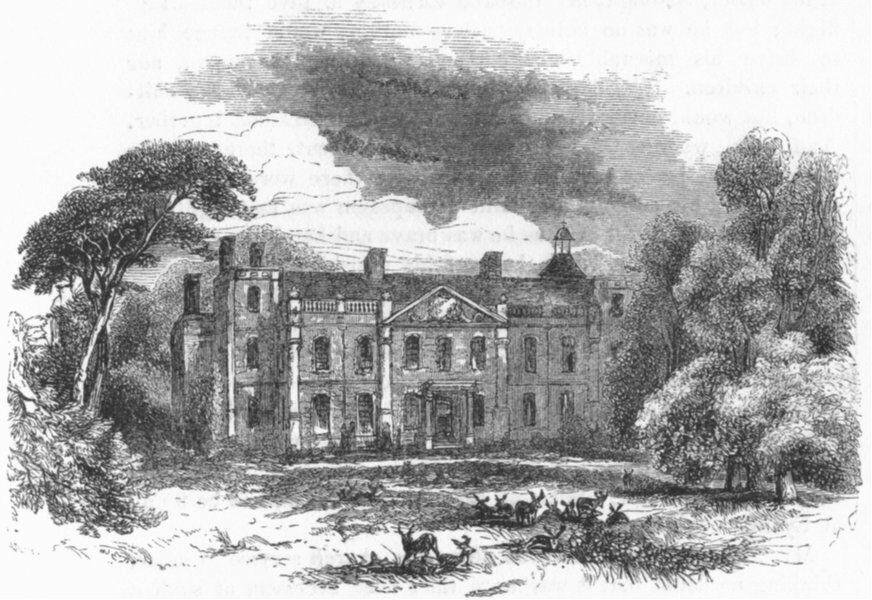
Less harm indeed: It is the use of this sturdy and pleasant medium, characteristic of an Essex building tradition of the period, that we now find so attractive. A less sophisticated view was taken in 1845 in an article in The Penny Magazine describing Hill Hall and the park, then well-stocked with deer, which called it 'a neat little church'. A present authority, Sir Nikolaus Pevsner acknowledges its architectural quality and rarity in his monumental modern Domesdey Book of buildings in England. For the external elevations are suitably described in a lapidary reference to Dr. John Dod whose memorial of 1762 is in the churchyard. Like him, the church was endowed with ‘A simplicity of manners which would have done honour to a better Age’. For the time in which it was built in fact heralded a decline from the cultural and intellectual standards of Tudor England and a period in which the vicissitudes in the affairs of church and state did little honour to either.
Theydon Mount did not escape the pressures of the doctrinal confusion and political turmoil of the seventeenth century. Its rectors, Daniel Whitby, accorded the dignity of appointment by the Crown in 1637 as the patron was still in his minority, suffered, along with many of his contemporaries in Essex, the indignity of ejection during the Civil War and the Commonwealth. 'Since my Returne to Mount' as he wrote in the register in 1661, he was faced with restoring the diminished prestige and flagging morale of his church and the pastoral life of the parish. Whitby's place had been taken in 1643 by Walter Wells. The parochial records bear witness to the supportive role of the parish church, despite the stresses of that time, in buttressing the social fabric of the community. It was thus in the corporate life of the parish that the people of Theydon Mount eventually compounded their political and religious problems under the spiritual aegis of their restored rector and his successors. Not until modern times was the church again faced with a social challenge of the same order as that which confronted Daniel Whitby and his tiny rural community at the Restoration.
Always there were matters of general and local status to attend to. The churchwarden' s accounts express the church' s concern in secular affairs and its own house-keeping. The petty cash was available for assistance to the indigent or for needy travellers. So, typically, we find sixpence provided in August 1752 'To several sailors in their passage to Sussex'. In January 1753 to shillings was offered as a ‘thanksgiving for the ceasing of the Contagious Distemper amongst the Cattle’. Half that sum was produced in 1813, according to the Apparitor at the following Easter, for the fee for the ‘Proclamation for General Thanksgiving on the Victories of the Allied Armies’ over Napoleon. A proper sense of local priorities one might think, and, returning to matters of more immediate concern, 10s.6d. was spent by the churchwardens on painting the 'stiple' in 1828 and, in 1834, it cost three shillings to mow the churchyard. Such is the pecuniary reality of collective philanthropy, gratitude, and necessity at the parochial level.
In 1755 the rectory of Theydon Mount was joined with that of St. Mary's at Stapleford Tawney. In the year of Victoria's accession, during "the incumbency of the Rev Sir Edward Bowyer Smijth, the church was considerably restored after over 200 years of service. In addition to repairing the fabric a gallery was erected at the west end for the use of the musicians who supported the singing and the servants from Hill Hall who could not, with propriety, sit among their masters below. This, the most significant work on the church since it was re-built in 1614, was noted by an inscription on the string-boarding underneath the gallery. Also in late-Victorian times was received, by gift, additions to the church furniture, including the chancel chair, the pulpit, reading desk, and credence table.
In 1926 a Faculty was granted. by the Bishop of Chelmsford for changes that left the church in appearance much as it is today. The plastered ceiling was opened up to reveal the timbered roof and the ‘existing unsightly gallery’, which, as we have seen, had been erected in 1837, was removed. Three years later the church was honoured, as is rarely the experience of our remote country churches, by the visit of the reigning monarch's Queen. Not since 1400, when Pope Boniface IX, who was liberal with such benevolence, granted a ‘Relaxation of Penance’ for three years and 120 days to pilgrims visiting the church at Theydon Mount on certain days, had the church received notice by such an eminent personality.
On 29th June 1926 Her Majesty Queen Mary travelled by road from Buckingham Palace to Hill Hall where she was entertained by Sir Robert and Lady Hudson. During the visit she was received at the church by the rector the Rev. S.J. Stanley and her royal name thus lends distinction to the annals of this secluded and unpretentious church in the pretty Essex countryside on the slopes above the Roding-. . It has thus had its moments of conspicuous glory. A royal visit, a Papal Indulgence and the memory of a great Tudor statesman and scholar embellish the story of the secular and pastoral life of this little parish church. But much as we may value its personal associations with the gracious Queen and the illustrious Sir Thomas Smith it is, nevertheless, in its parochial role that its
enduring significance lies. St. Michael the Archangel still ‘stands pleasantly’ at Theydon Mount" cherished by all who know it. Thus, it continues to sanctify and enrich the lives of the parishioners it serves, quietly and agreeably, in character with the restraint and spiritual qualities of. its architecture.
Article 8 of 11
Every Picture tells a Tale (2)
Or in this case a postcard. Below is a postcard showing the post office in The Street, High Ongar. Taken in around 1910 it portrays a blissful scene. The post office is now a private house, but many of the buildings still remain.
The postcard is in my collection.
But turn the postcard over and often you find interesting facts in the message sent to a loved one. This one was sent by a son to his mother who lived in Nottingham and is dated 9th February 1915. The son Arthur Gurner is a soldier serving in the 2nd 7th Battalion Sherwood Foresters, who it would seem were stationed in the area at this time.
The message reads,
Dear Mother,
We have arrived here alright and it is a rum show no lights at night for fear of Zeppelins. We are only 22 miles from London and about 50(?) from the coast. I hope you are getting alright as we are having it a bit rough now but we shall get through. I will drop you a letter when I have a bit more time.
Arthur.
The 2/7th (Robin Hood) Battalion Territorial Force
The 2/7th were formed at Nottingham in 1914 as part of the Notts & Derby Brigade of the North Midland Division and then moved to Harpenden (Herts) and then Braintree in Essex.
On the 25th February 1915 they were mobilised for war and landed in France. The Robin Hoods formed three battalions during the First World War (1/7th, 2/7th and 3/7th Battalions). More than 4000 officers and men served with honour on the Western Front from 1915 to 1919, and in Dublin during the Irish Rebellion of 1916; over 1000 men died in service.
I wonder whether he survived the war and returned home?
Images
Article 9 of 11
Ongar Grammar School
On the 11 January 1811, an advertisement appeared in the Chelmsford Chronicle:
“EDUCATION: CHIPPING ONGAR, ESSEX. R. STOKES respectively acquaints his Friends and the Public, that his Academy for the Board and Education of twenty young Gentlemen, will open on Monday, 21st instant. Terms, Twenty Guineas per Annum.”
Among the pupils in 1846-47 were Nathaniel and Walter Barlow, sons of Dr. Nathaniel Barlow of Blackmore. In September 1847 Walter wrote to an elder brother Alfred,
“Tomorrow and the following day we are going to have two lectures on Electricity and Galvanism by Mr Thornthwaite, a lecturer from London. We have 41 young gentlemen, 3 of which are day boarders and I weekly boarder…”
In 1878 William Clark was the headmaster, There were 130 boarders. In 1899 the headmaster was Oswald Clark, M.A. At the 1911 census there were 164 children at the school. In the following year the principals were O.W. Clark, M.A., and Benjamin Brucesmith, LL.D. In 1926 the principal was Percival H. Bingley. By 1937 P.H. Bingley and Thomas A. Owen were joint principals.
Ongar Grammar School closed in 1940. In 1936 Essex County Council opened a secondary school in Fyfield Road.
There is an excellent history of the school in the ‘Aspects of the History of Ongar’, published in 1999.
Images
Article 10 of 11
The Diary of Mary (Dida) Hastings (b.1863–d. 1947). (Part 1)
Mary was the daughter of Sir William Bowyer Smyth (11th Baronet) and Eliza Fechnie Malcolm, his second wife. They were to have 14 children, 12 before they were married on the 2nd September 1890 in London. Sir William was 28 years old than Eliza. She referred to her father as ‘Papa’ and her mother as ‘Mama’.
The diary was written in 1944 by Mary, who was also known as ‘Dida’. She talks about her early life and the houses that the family lived in Morlaix, France, Cheltenham and Hill Hall.
It is the time the family spent at Hill Hall I will quote from the diary.
Then the time came when Papa was able to go and live in the ancestral home, as the tenant, a Mr. Payne, did not wish to renew the lease. So the house in Cheltenham, "Atholl" the Park, was given up and the whole family transferred to our beautiful true home, "Hill Hall" near Epping, which opened its arms to receive us as if rejoicing that we had come at last! How happy papa must have been to return to his own home, having had to let it for financial reasons after his mother died. How beautiful it was, and the dear old furniture, and all our ancestors looking down at us from the walls in every room, beginning with Sir Thomas Smith, and others all down the centuries, looking as friendly as if they were so pleased to have us there and not strangers. In some of them we saw the likeness to ourselves. One was called "Jessie" and one "Toodie" and another "Me"- quite distinct features handed down. What happy days we spent there, the house, gardens and park, just a paradise for a large family, which is seen in the album from "Country Life" and other photographs.
The dear little church stands in the park with its famous monuments of departed ancestors. The family pew was a large square space with cushioned seats all round, entered by a door and divided from the rest of the congregation by a wooden partition which we could see over only by standing up! Mr Prance was our clergyman – lived at Stapleford Tawney where he had another church about a mile away across the fields. We were in the parish of Theydon Mount, a village about one mile away.
There were two entrance gates and lodges. The East gate was the principal one and led straight up to the front door between a lovely avenue of old elms and banks of rhododendrons and sometimes gorse. The drive branched off to the left leading to the West lodge which stood near a small lake with an island in the centre; a favoured spot for moorhens. A boat was kept there with which we amused ourselves, and one day Willie (William) was baling the water out of it when he asked Toodie (Eliza) to take care of his signet ring which Mama had given him. It was too big for Toodie but she put it on her finger and it soon slipped off into the water and was never seen again. We were very distressed about it and did all we could to find it, but when we told Papa, he said, "oh well, it has come home"!
There were days, too, when we were allowed to go fishing in a small river nearby, but only if the gamekeeper could be free to come with us, in case any of us fell in. So off we went with rods and jar full of worms, and caught eels and a few roach, On one occasion, in my excitement to land my fish I gave such a strong heave that the line caught onto a bough of a tree. How we laughed to see the eel wriggling up in the air. The gamekeeper came in useful here! Papa was very fond of eels, which we carried home in a pail, and stood it in an outside shed. Once, to our surprise, we found next morning all the eels had disappeared, and we were told they had got out and gone back to the river!! I Wonder?!
As there was plenty of room for archery, we were given bows and arrows and two lovely targets: red, white, blue, black, and a grand gold centre. To begin with Papa gave us a shilling when we hit the gold, but as we were so good at it, he said it was too expensive. But he was very pleased we were so good at it, for when he was a young man, he was Champion Archer of England and won the President's prize at the Toxophilite meetings four years running. I have one of the gold medals.
Tennis then came into fashion, so a net was bought and racquets for the e1der ones. We were never allowed to call the game anything but Lawn Tennis as papa had in his younger days played the real tennis. Then we all had stilts made for us by the estate carpenter, and we only felt we were proficient on them when we could go up and down the steps leading from the terrace onto the lawn. At each end of the terrace were two grand magnolia trees which the artist Sargent painted a picture in oils when the Hunters were in possession!!
In the winter, if a severe one, we skated on the various ponds about the grounds. At all times, wandering in the woods in the park, there was always something of interest to be met with: wild flowers, birds, squirrels, rabbits and game. How many times we were made to jump, when a hen pheasant suddenly swooped of her nest, uttering a loud scream of fright. One day a squirrel jumping from branch to branch lost its hold and came spinning down to the ground. We ran forward to pick it up, but before we could get to it, it went up the tree again as fast as it could, and we delighted that it was not injured! We often found bats stretched out flat against the boles of the oaks and elms, and one day two leverets were found alone in their grass bed. We thought perhaps their mother had deserted them, so they were taken to the stables, put in the hay manager and fed with milk through the babies bottles, a little silk ribbon of blue on one and pink on the other, we could tell which one had been fed!
Some days we would wander down to the estate carpenter and he good-naturedly would let us try using his tools. We loved to see him use his lathe and make curls which were promptly stuck behind our ears. Other days would go and watch the smithy shoeing the horses and see the sparks flying about, and felt sorry for the poor horse to undergo such a performance. But they did not seem to mind, and the music of the hammer on the anvil reminded us of the "Village Blacksmith" Jessie used to play.
The brickyard was not far away, and a delight to watch the men making bricks by hand from the clay a pony had mixed by turning a machine round and round it. How bored it must have been! What fun it was to be given a lump of clay to do what we liked with it. The men helped us to make little models of a cottage and they were really quite good. After they were baked, they were presented to Mama, who cherished them for years.
A visit to the gamekeeper was always exciting. The two lovely red setters were always kept there, "Don" and "Checker", as our parents
Would not allow a dog or cat inside the house! The keeper’s house stood on a mound just on the edge of a wood. There was a beautiful view from it, looking upon miles of lovely fields and woods, and not a building in sight. The keeper raised pheasants under a hen; he fed the young ones with handfuls of ants' eggs. We thought it so brave of him dipping his hand into a pail full of ants' nests. We didn't 1ike seeing the poor little dead moles stuck on the bushes all round the place, also stoats which of course are vermin.
To get to the kitchen garden, we branched off from the drive down a
pathway of shrubs and lovely old elm trees until we got to a high red brick wall, and, opening a heavy oak door, walked into our lovely garden. I think it was some acres, divided by paths, and in the centre was a round pond, surrounded by an iron paling up which grew the red japonica. The south wall was devoted to the peach and nectarine houses, and two more leading out of them devoted to flowers only. Mama was devoted to flowers, so the old hall had to be kept supplied. The pot plants stood in a large white marble font in one of the windows, and in another was a dark oak stand with a lead lining. It was my delight to arrange the vases standing about. It must have annoyed the gardener to see his pet flowers gathered for that purpose, but Mama never said anything but, "Oh! How lovely!" when she came into the hall.
But back to our garden. Did any children ever enjoy one as much! Three sides of the high wall were well trained fruit trees with a border of violets at their roots, then each square of the garden were borders apple, pear and plum trees, the vegetables in the centres. A long perennial flower border faced the glass houses, and from seats along the path one could enjoy the view. Mama often sat there doing her cross-stitch fancy work, One square was full of currant and gooseberry bushes, and as they were ripening we each we each "bagged"one, and it says much for our sense of honour that no one poached on each other's preserves!! There was another big door leading out into the north aspect where the raspberries and Morella cherries qrew, and then further on through another door were the marrows and cucumbers grown. Best of all, here were the vineries, one house all the perfect Muscats and the other large blue grapes. The gardener, West by name, was allowed to cut us bunches as we passed by!! He was a splendid man and did all the work except the digging and rough things, which was done by the two woodman, when they weren’t felling and sawing up the trees for burning in the Hall. Sometimes the gas lent a hand at weeding the paths. He made the gas in a building out of sight behind the stables where we were never allowed to go, it being such a dirty, smelly spot.
From the vineries a path led up the side of the orchard, a joy in the
spring and autumn. I was nearly forgetting about the strawberries, what feasts the whole household had, and the jam that was made. After that the village people came and took what they could find, also of the currants etc. The jam making must have been a tremendous task. The hogshead of sugar was too big to get into the kitchen door, so had to be emptied from the outside, using coal scuttles to shovel the sugar into the huge bins standing in the kitchen, in which was kept also sacks of flour and oatmeal.
To be continued in our December Journal.
Article 11 of 11
High Country Programme for 2021
We meet on the following dates
25 Feb
25 Mar
22 Apr
27 May
24 Jun
22 Jul
21 Oct
25 Nov.
Meetings are held in Toot Hill Village Hall.
Meetings start at 8.00pm.
Members £1 ~ Visitors £3.
Refreshments
The talks scheduled for this year which we have to postpone due to Covid 19 will be held in 2021.