High Country History Group
Contents
See images from this issue
Images from this issue
Article 1 of 7
Every picture tells a tale – A sequel
In our September Newsletter I related the story of a postcard in my collection, written by a soldier who was billeted in High Ongar, to his mother during the Great War. I posed the question as to whether he survived the war. Well thanks to Anne Padfield (and Ancestry) we can complete the story.
His name was Arthur Garner (not Gurner as it appeared on the postcard). A Mrs Jane Garner (mother) lived at 34 Cremorne St, Nottingham, which was the address on the postcard - so we have the right person.
The website Ancestry holds many military records and Anne had no difficulty in tracing Arthur’s record, which gives us lots of details about him. He was described as being 5ft 9 and a quarter inches, 9 and a half stone, and prior to enlistment was a machine fitter.
His parents were William and Jane Garner, Arthur being the youngest of nine children.
He enlisted in the Territorials on the 14 Oct 1914 aged 23, in the 1st/7th Battalion Sherwood Foresters, the Notts and Derby Regiment, (regimental number 3057). The regiment were sent to Rouen, France on the 28th June 1915. He was killed in action on the 13th October 1915 in Flanders, and is buried in the British Cemetery, at Vermelles. His headstone bears the inscription
A NOBLE LIFE LAID DOWN EVER IN OUR THOUGHTS FROM ALL AT HOME
The cost of the inscription (paid by the family was 14/-.
His personal effects were eventually sent back to his family and included: a broken wristwatch, 3 notebooks, a souvenir cartridge, 3 photos, a letter, 2 looking glasses 1 broken, postcards and a devotional book.
His mother received his 1914-15 Star in January 1921 and his British War and Victory medals in 1922.
An older brother in the Army Service Corps survived the war.
Vermelles is a village 10 kilometres north-west of Lens.

Article 2 of 7
Life in Loughton during World War II.
Journal No 76 (June 2020) included transcripts of letters from my mother’s family immediately before and after the Occupation of Jersey by the Germans during the Second World War. These letters gave graphic accounts of what life was like “Under the Jackboot”. The Jersey family expressed their concern about what life had been like for us in Loughton and on May 23rd, 1945 my father wrote about our experiences: -
It has been wonderful hearing from you again after these many years, and particularly to know that you are all fit. The reports which we have had from time to time have been very gloomy, and during this winter we have pictured you in a very bad way. Inez has worried about you a great deal. I have always tried to comfort her by saying that I was sure the British Government knew what the conditions were actually like and if they were as bad as they were painted then obviously we should re-take the Islands by force. Thank God you were spared that ordeal. It is, as I say, a great relief to know how well you have managed, and we feel an unbounded admiration for what you have achieved. Although you have managed to keep yourselves properly fed, we can realise the worries and anxieties with which you have had to contend. Life must have been very grim for you, particularly this last winter. It seemed last autumn that the liberation of the Islands must come almost daily and you must have felt terrible disappointment at the prolongation of the war.
I think probably you will be interested to know how we have fared. Obviously when we meet there will be a tremendous lot to talk about, but in the meantime I thought that I would write you this letter to supplement the information Inez has already given you and to add to the picture of our lives here during the war. We do not think that we have had as bad a time as you have had. In fact if we were given the choice we would certainly choose bombs rather than occupation.
The bombing has certainly been unpleasant. In retrospect, the original 1940/41 Blitz was not as trying as the V Weapon attacks. I think the reason for this may be partly that we were much fresher at that time. Indeed the raids were in some respects stimulating and exciting. Jerry came over regularly every night as soon as it got dark and stayed until it got light the next morning. Before the night raids we had had very heavy day attacks in which, however, Jerry so got the pants taken off him that he had to give up. The bombing was very scattered and latterly the anti-aircraft fire was so terrific that unless a bomb was fairly close you could not distinguish it from the gunfire. There was, too, always the feeling that gradually, and as eventually happened, the defences were getting on top of the attack. People got very used to the bombing and were almost blasé about it. Up to the time in November 1940, when we were “bombed out” at Kettering we were sleeping upstairs in our beds and behaving as far as possible normally. After that we realised very acutely the danger of flying glass. There was glass all over our bed and the ceiling was down in Patrick’s nursery where but for the fact that this was a particularly severe attack he would have been sleeping. The house was uninhabitable and so we had to go home anyway and decided then that in future we would sleep in the cellar. We had a trap door made in the drawing room floor down to the cellar and put Patrick down there every night and ourselves slept there. The night bombing ceased in the spring of 1941, the last really heavy attack being on 10th May. On that particular night I was on night exercise with the Home Guard and so had a grandstand view of the fires which started in London. The City suffered badly in that attack and the top half of Lime Street, where my office is, was completely demolished. In our own building we have throughout been extremely fortunate with only minor damage. We never again had concentrated attacks by aircraft.
We had sporadic attacks from time to time usually in phases and rarely lasting more than a few hours. These were quite exciting in their way.
Air attacks did not really get going again until the Flying Bombs started in June of last year. We saw one of the first of these projectiles which flew over Loughton but fortunately did not stop. The flying bombs were undoubtedly very trying. We returned to sleeping in the cellar, and after a bit Inez decided to keep Patrick away from school. When the attacks persisted, and in fact got rather worse so far as we were concerned, she took Patrick away to Much Hadham to stay with the Wilsons. Even there they got a few over, but not enough to worry about. When we thought the attacks on London were over as a result of the capture of the launching sites we found that they could still send flying bombs apparently launched from aircraft over the sea, and the rocket attacks started. We were in the worst area both for these later flying bomb attacks and also for the rockets. Eventually we decided that Inez must take Patrick away again, and so this time they went to Sussex where they stayed for a couple of months. I think from a general point of view the flying bombs were reckoned more trying than the rockets, but from our point of view having a child to think about the rockets were definitely worse. With the flying bombs you got a warning and you could hear them coming a minute or so before they arrived. You could therefore take measures to get your child to safety. The rockets, however, arrived without warning and at any time. They were very noisy, so much so that I have sat in my office in the City and heard the explosion of rockets which have fallen at home. They did about as much damage as the flying bombs. Patrick was entirely unmoved by the ordinary raids, and in fact appeared rather to enjoy them. Neither did he seem to worry in the least about the rockets. The flying bombs however did affect him, but only for this reason, that when one was heard approaching he had to be sent down to the cellar. In this way he got a sense of apprehension about them and realised that they were dangerous. Inez stood up extremely well to the bombing. Undoubtedly it has been a help having a child about and realising that the last thing to do was to show any sign of fear oneself.
Speaking generally Loughton has been extremely fortunate, having had quite its share of bombs. I read in the local paper the other day that up to last October, that is to say before the rockets started, there had fallen in the area of the Urban District Council approximately 800 high explosive bombs of all sorts and 14,000 incendiaries. With all this I think there were only 80 casualties in Loughton. The forest and the surrounding fields are full of holes and a great many houses have been damaged but very few destroyed. Our house has come out of it very well. We had the front door blown in in 1940 and more recently the roof appears to have been lifted by blast. Fortunately it went back in the right place. The only present visible signs of damage are various cracks in roof and walls. My father’s house has not been so fortunate, as apart from the damage in 1940 it has since sustained various minor damages and generally is a bit dilapidated.
I think that is a general picture of the bombing so far as we are concerned, although there are many minor incidents which will in due course be amusing to recall. I should perhaps say this, that once or twice we were without gas, water and electricity for short periods, but the repair organisations in regard to these services and also the railways have worked magnificently.
The next thing that will interest you probably is the subject of food. We have always had enough to eat, and the management of the food situation has been magnificent. We have always been able to get our rations, although I should think when the full story is told it has probably been touch and go from time to time. As Inez has told you, we have kept chickens and rabbits and have found them a great standby. Inez has made the best of whatever food was available, and certainly I do not think that we have suffered from any shortage.
About people, my father is very well, although he is suffering from trouble with one of his legs which makes it difficult for him to walk. He had a duodenal ulcer I think it was in 1941, and was in hospital for 6 weeks, but he seems quite to have recovered from that. He has apparently been quite unmoved by the bombing and has gone up to bed at his usual time and as far as I know has slept soundly every night throughout the war. I do not think there are many people who have equalled his record in this respect. For the last year Aunt Ethel has been living with him. Her house was very badly damaged by a flying bomb in the early days of the attack and made uninhabitable. The bomb actually fell on a house two or three doors away where she had been in the habit of sleeping regularly. The occupants of course were killed. Aunt Ethel just happened not to be sleeping there that night.
Molly and Nancy are both in the WAAF, Molly being a Senior Officer and having a very interesting war. Nancy is at an R.A.F. hospital in Wales as a Sergeant Masseuse. Peggy is a Captain A.T.S. at S.H.A.E.F. and is now in Paris. Kittyis a Lieut. in the A.T.S. and does catering.
Michael was taken prisoner at Tobruk and recently returned from Germany in a somewhat rocky state. He had lost three stone and seemed somewhat unbalanced. He has gone up to Scotland and I hear that he is better.
Tony has only just gone into the Army, having been deferred as a student.
Dick Stevens was very badly wounded in the head at Anzio and has been discharged from the army as a result. He was commanding a Battalion at the time and so has done very well. He is trying to get back to work but is finding concentration very difficult.
You might be interested in my activities as a part time soldier in the Home Guard! At the time when the Home Guard was formed we were staying in Theydon Bois and so I joined there. It was great fun in the early days. We used to do dawn and dusk patrols and got a lot of amusement out of it. The original force in Theydon was about 100 strong and we only had 10 rifles and 10 uniforms. Whoever was on duty therefore, had to have what was going. The weather was very hot at the time, and you can imagine the uniforms were not fit to wear for very long. In due course, however, proper clothing and equipment came through, and in the end the Home Guard was well armed and in fact became as it was, a very efficient force. When we returned to Loughton I stayed with the Theydon Bois Platoon. Our headquarters there were the local pub which appealed to me, and I have spent many nights in the Bull sleeping in the Public Bar when off duty. I was first a Corporal, then Sergeant and then a Sergeant Major. This latter was by far the best rank I ever held. In 1942 I was commissioned and given a specialist job on the Battalion staff at Harlow. I did this for a year and was then transferred to Epping where I commanded a Platoon and subsequently a Battle Company. In this latter respect I was very lucky because I had all the young men in the Company. In fact I think I was about the oldest member. About half the young men were agricultural labourers and the other half factory workers. I got on very well with them and enjoyed a great deal of it. It was, however, really a whole time job which one tried to do in one’s spare time, with the result that I very nearly knocked myself up last summer. Before D-Day I took a contingent down to the coast for a week for patrol duties, and we had a very good time although it was somewhat strenuous.
We are longing to see you again, but present information is that ordinary passenger services will not be resumed for some time.
However, it is possible that I shall be able to make arrangements to come over myself in a few weeks’ time, and if it can be managed I will certainly do so. I am afraid there is not much chance of Inez and Patrick being able to get over just yet.
This is a long letter, and I hope you will excuse it being type-written, but I should not have time to write it out by hand.
Images
My mother.
After the D-Day landings in Normandy in June 1944 the Channel Islands were cut off from supplies from France. The Islands were not liberated until May 9th, 1945 – nearly one year later.
The house where my grandfather lived on Upper Park, Loughton which was badly damaged by a land mine.
The Oaks. Connaught Avenue in Loughton.
At that time my father was member of a Home guard platoon which had its headquarters at the Bull public house near the station in Theydon Bois.
My father, who was 32 years old at the outbreak of war, joined the RAF but was demobbed and seconded to the Foreign Office to deal with Spanish Civil War Prize cases. He was a Solicitor specialising in maritime law and continued to drive up to his City office throughout the war.
The V I or “Doodlebug”.
The V 2.
The elder of his two younger sisters.
The younger of his sisters.
Womens’ Auxilliary Air Force.
A cousin.
Another cousin.
A cousin.
Yet another cousin
The Bull by Theydon Bois station.
The photograph must be of the Epping Platoon which my father commanded – he is in the middle of the seated row. Note the smart uniforms.
What he does not mention is that several of the soldiers in Theydon Bois and Epping were part-time poachers which meant that our wartime diet was frequently augmented by wild rabbit, hare and the odd pheasant. He remained in touch with several of these characters after the war and when I was old enough to go into pubs I would accompany him to the Fox and Hounds at the Wake Arms (sadly long gone) for a pint and a game of darts and was introduced to some of his wartime colleagues.
Article 3 of 7
Escape from Justice!
Colchester June 30.
Last week two highwaymen were apprehended at a public house at Ongar, and being carried before one of his Majesty’s Justices of the Peace for the said County and examined they were committed to Chelmsford gaol; but in their passage thither one of them found means to escape from the officers who had him in custody, by flinging himself over a gate and running down a field, at the end of which was a river, which he jumped into and swam to the other side, notwithstanding his hands were pinioned, and got clear off. The other was carried to gaol and has since impeached his companions and given an account of the robberies committed by them; so that tis hoped they will soon be brought to justice.
Stamford Mercury 6 July 1738
Article 4 of 7
The Diary of Mary (Dida) Hastings (b.1863 – d. 1947) (Part Two).
The diary entry covers the period 1880 to 1883 when the family resided at Hill Hall.
[Continued]
It was a huge kitchen – the ceiling reaching above the first floor, along which ran a passage where there was a window opening into it, so that the Lady of bygone days could give her orders
without having to move far from her boudoir. Just below the window was a shelf upon which stood every conceivable utensil in shining copper, some of which I possess. There was as cook, kitchen maid and scullery maid to keep all in order, and very necessary as we sat down every day to our mid-day meal not less than 20 in our dining-room. Papa and Mama had their dining-room for their breakfast and dinner on the other side of the house, a lovely room with a large bow window looking over the Weald of Essex between large elm trees From the kitchen was the scullery and then the larder, and one especially for game only. The gun room was just next to our parents' dining-room, and further along the passage led to the dairy. The pictures in my album out of “Country Life” and photos give a very good illustration of the "Hall" etc
From the lawn, on which stood lovely old cedar trees, a path led on one side to the “Rookery”, carpeted in spring with bluebells, and on the other side first came a large pond. which supplied the house with all the water for domestic purposes, and past this was a dear little wood where the primroses, anemones and violets grew. Here were our swings, and also a lovely seesaw, made with strong upright posts with several bars across for the tinies and older ones. whose delight it was to bump each other off, if they could, and roars of laughter when they did! It was all great fun.
All round these small woods was a path, surrounded by high iron railings which used to keep the deer out that ran about the park, and in our day the cattle. The drinking water was brought in a horse drawn water cart from a well just above the churchyard and stood in an archway leading from the stable yard. brought into the house in cans, and then into filters all about the place. In the beautiful old hall we burnt great logs of wood resting on iron dogs. How I love the smell of burning wood! Old Summers was the odd job man who kept it going. He also cleaned all the household boots and he 1iked telling me he always knew which were my boots, as I was such a clean walker, "just like your Pa!" Sometimes just to tease him, the boys would jump up and down in a muddy puddle, and other times when he brought in logs for the fire, they would lay in wait for him behind the pillars, then pounce out and lasso him! But as he was devoted to us all, he took it in good part.
The hall, of course, was the chief meeting room when the weather was bad and in the winter evenings, when we played games – chess, backgammon and draughts, but only “Snap” with cards, or build houses. Then there was the piano, which gave us so much pleasure, sometimes dancing, and other times stand round Jessie and sing the choruses of all the musical comedies of the day, the Gilbert and Sullivan being our favourites. Sometimes friends and cousins staying with us would sing solos. We were too young and nervous to attempt it then.
The grand staircase led out of the east side of the hall, but we never
used it and the door on the landing was kept locked. It opened into the Chinese room, so called as the walls were papered with hand-painted Chinese paper. The 4 boys al1 slept in this big room. To get to our rooms we all used a small staircase which led from the west passage up to the first floor; some turned to the right and others to the left and along the gallery which looked down into the hall, and on the other side windows opened onto the courtyard. At the end of the gallery was the Chinese room on the right and on the left was my room which Toodie shared with me. With me. Then came a dressing-room and then Queen Elizabeth’s room it was always called, with its beautiful four-posted bed, the curtains, valance, carpet, chair seats and wall-hangings in lovely hand needlework wall-flower shades on cream linen. Then came another dressing-room. All these rooms opened one into the other. Then the door from Queen E's room opened into the north passage, then came on the left the Letter ‘L’ room, so called because of its shape. Then the servants’ staircase which led to the attics and where the clock works were for the clock in the tower over the front door, which was kept in order by a man who came weekly to wind all the clocks in the house. There was a lovely grandfather one which played lovely chimes every quarter of an hour in the hall, but we enjoyed going up with Papa to the attic to listen to the "Tick Tack" and it gave the villagers the correct time every hour!
In the letter "L" room was a huge fireplace of stone left from the olden days, part of a large banqueting hall which ran the whole length of the passage, where there was another grand staircase for that side of the house. On the right was a room with a painting on the walls of the destruction of Sennacherib's army! Further along this passage several bedrooms and the nurseries. The family dining-room led off from the hall on the east side, then a drawing-room and then our schoolroom, with our ancestors, men and women, looking down on us sitting at a table which was a curio, made from a lovely oak tree, which had blown down in a gale: the table was a solid piece of
oak, the whole length and width of the tree and several inches thick.
Family group showing 13 of the 14 children. Mary is sitting on the chair on the far right.
In the drawing room a French window opened out into the rose garden. Above the door near the roof was a large carving in stone of the family coat of arms, and for years bees had settled behind it and had made pounds of honey! But Papa would not have them disturbed. One door of the schoolroom opened into the north passage, and just opposite was the library, and then several small rooms, butler's pantry and storerooms, till one came to the front door. All the windows along all the passages looked out onto the square courtyard
were glazed with very old, coloured glass of the Bowyer-Smyth crests and arms. A conservatory ran right across the yard from the front door to the hall, to spare people having to walk round the long passages.
And now there came a great break in our happy lives. Willie went to an agricultural college in Aspatria, Cumberland, as our parents thought he could then have one of the farms, but he never took to it. His one wish was to go into the army. The dear of Auntie Gyll came to stay with us and no doubt she saw that we girls and boys needed higher education (quite true), so the governesses left. Fee-fee was sent to the mercantile training ship, the "Worcester", as Papa loved the sea and sailors, and the three younger boys went to a good preparatory school in Spikernells, I think. Then Jessie, Toodie, Beatrice and I went to a boarding school in Sussex Square, Brighton. So Kitty and Leila, who never liked lessons stayed at home. So from that time we were only all together again in the holidays. Such a joy!
I forgot to say just before we broke up the happy childhood circle, the four elder girls were prepared for confirmation by our much liked and good Mr. Prance, our vicar. He lived in the village of Stapleford Tawney where his other church was. We had to walk across the fields about a mile to get to the vicarage for instruction. Mr Prance drove us to St. Albans where the confirmation took place. The ceremony made little impression on us, but we felt important, being all in white and long veils over our heads! Our parents and governesses never spoke about religion, but we learnt the commandments and read the bible before lessons every day and were trained in very high principles, which guided us all for our good in after life.
The Rectory at Stapleford Tawney, with the Revd. Prance and family (photo courtesy of Anne Padfield)
The children of Sir William Bowyer Smyth and Eliza Fechnie (nee Malcolm)
Nickname
William Baird born 1859 Willie.
Catherine born 1861 Kittie
Jessie born 1862 Jessie
Mary (author) born 1863 Dida
Eliza born 1864 Toodie
Leila born 1866 Leila
Beatrice born 1867 Beatty } twins
Edward born 1867 Fee-fee }
David Malcolm born 1869 Dee-dee/David
Henry born 1870 Witty/Henry
Frederick born 1871 Dick
Cicely born 1872 Cissy
Wilhelmina born 1875 Minnie/Vilma
Adela born 1878 Wee-wee.
[Mary married William Thomas Hastings on the 9th August 1947. She is buried in the churchyard at Theydon Mount.]
Images
Mary (Dida) is dressed up as a Breton fisher-girl for a studio portrait, probably taken when the family lived in Morlaix, France.
Article 5 of 7
A Farm called Arnolds
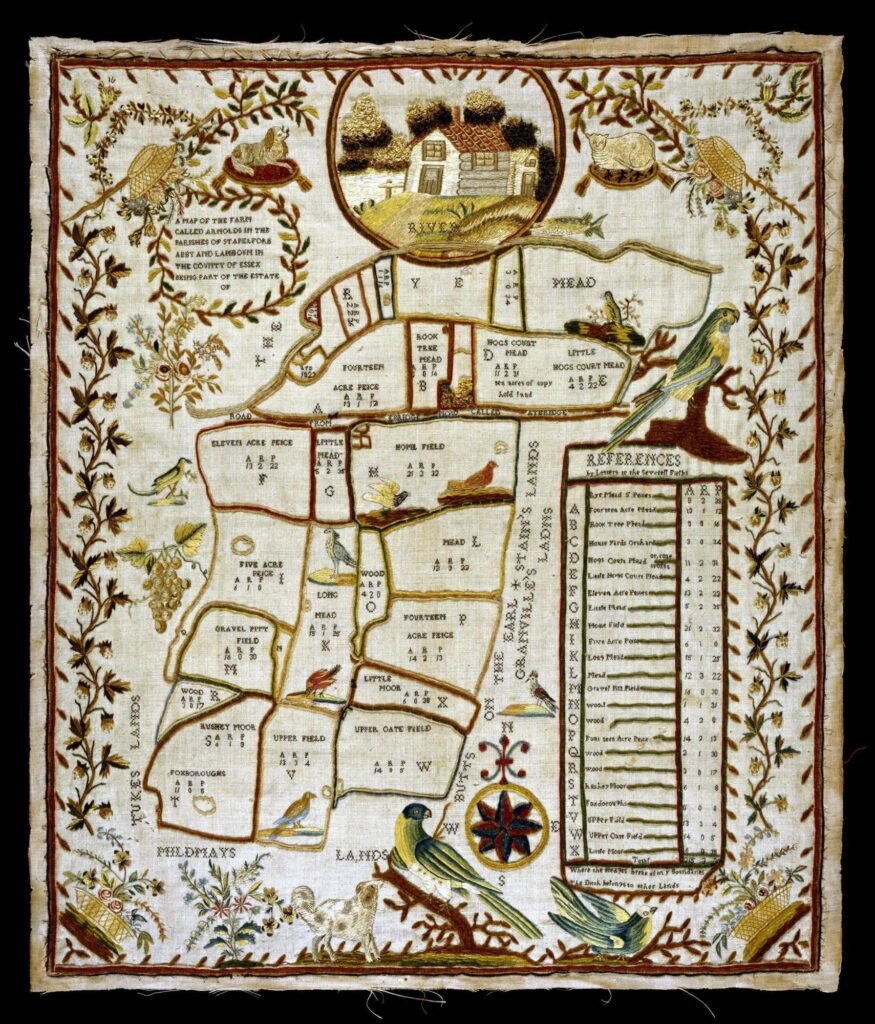
Whilst carrying out some research on the internet I came across a picture of a sampler, entitled
‘A Map of The Farm Called Arnolds in The Parish of Stapelforth Abby & Lambourn in the County of Essex, being part of the estate of…’
There was no indication of who had made the sampler or a date when it was done, although it is estimated it was made circa 1760. The sampler shows each field and the acreage of each. The total acreage of the farm was 215 acres.
According to the Victoria County History, Arneways/Arnolds is a lesser manor of Lambourne. It probably took its name from Adam Arneway, who is said to have held land in Lambourne 'about the reign of Henry VI' under the Earl of Oxford, who held the neighbouring manor of Battles in Stapleford Abbots .
In 1525 Arneways was among the possessions of Sir William Fitzwilliam of Milton (Northants.) and was settled in that year to the uses of his will. He also owned the manor of Hunts (see below), and his property descended on his death in 1534 to his son and heir Sir William. In a list of owners drawn up about 1543-6 Anthony Browne is given under Arneways. By 1556, however, Arneways and Hunts had come to Robert Taverner, lord of the manors of Pryors (see below) and Lambourne-and-Abridge (see above) who died in that year. Arneways remained in the possession of Thomas, son of Robert Taverner, after Lambourne-and-Abridge had been sold, and descended on Thomas's death in 1610 to his son Robert. In 1625 Robert Taverner sold Arneways and Pryors to Robert Draper, merchant tailor of London. Taverner evidently remained tenant of the estate. Draper died in 1635 and was succeeded by his younger son William. At its fullest extent the Taverner estate probably comprised about 500 acres.
In 1641 William Draper of Oxford sold Arneways to Robert Broomfield of Stratford. The estate descended to John Broomfield, son of John, son of Robert, who in 1681 assigned the lease of Arneways 'heretofore in the occupation of Robert Taverner', to John Todd of Walthamstow. In 1687 this estate 'once in the occupation of Robert Taverner and afterwards of Lance Nash' was sold to John Todd. Todd is said to have given half the estate to William Church, who married his daughter; their daughter and heir married Peter Searle who sold Arneways to Thomas Scott (d. 1733) of Woolston in Chigwell (q.v.).
The estate passed to Thomas's son George Scott who was holding it in 1746. A map of the farm was drawn for George Scott in that year by Josiah Taylor. Arnolds then consisted of 215 acres in Lambourne, most of which lay opposite the farmhouse to the south of the main road.
A reference to the Victoria History says there is a photo of the map in the E.R.O., ref T/M 227, (now T/M 227/1). Look at it online and it's the same map! There are also two photos of the sampler (T/M 227/A and B) not online. They've dated it 1746-1801, when Sarah Sewell died.
George Scott still held the farm in 1771, but by 1782 it was owned by Edward Sewell. He was returned as the owner until 1788 when the farm belonged to Mrs. Sarah Sewell, probably his widow. After Mrs. Sewell's death about 1801 Arneways came to Samuel Sewell who still held it in 1841. In the latter year the farm consisted of 203 acres in Lambourne. It was occupied by Mrs. Kitty Collyer and Philip B. Collyer. The Collyer family had been tenants since 1788.
Arnolds Farm was advertised for sale in 1843. It was then stated to contain 203 acres freehold in Lambourne and a further 10 acres copyhold of the manor of Stapleford Abbots. It was bought by Samuel Crane, whose family continued to farm it until about 1916 when it was sold to Mr. Jacob Saward. In 1925 the farm was bought by Mr. A. Clarke, whose son, Mr. H. E. Clarke, eventually took over the farm.
Sadly (and mysteriously after several failed planning applications) it burned down c 1970.
The Josiah Taylor map has the 1746 owner's name filled in, and details of the house and farmyard. The embroiderer has added the alternative name for Ebridge/Aybridge, and all the decorative pictures.
The identity of the person who made this elaborate and precise depiction in embroidery of Arnolds Farm. It may have been worked as a sophisticated exercise during a young girl's education, combining needlework skills with a lesson in geography and rural economy.
Images
The sampler is in the Victoria and Albert Museum.
Article 6 of 7
The Ongar Union – the role of the Relieving Officer
In 1834 following the Poor Law Amendment Act, 26 parishes were grouped together to form the Ongar Union and to establish a workhouse. One of their first tasks of the Guardians was to appoint Relieving Officers
Among the main duties of a Relieving Officer were:
To receive applications for relief, and forthwith to examine into the circumstances of every case by visiting the house of the applicant, and making all necessary inquiries into the state of health, the ability to work, the condition and family, and the means of such applicant, and to report the results of his inquiries to the Guardians at their next meeting, and also to visit from time to time, all paupers receiving relief.
In any case of sickness or accident requiring relief by medical attendance, to procure such attendance from the District Medical Officer.
An advertisement was placed in the Chelmsford Chronicle for Relieving Officers on the 15th and 22nd April 1836
The Board of Guardians of the Ongar Union hereby give notice that they have divided the Union into TWO DISTRICTS for RELIEVING OFFICERS, as under-mentioned, viz.
Stanford Rivers District
Bobbingworth
Doddinghurst
Greensted
Kelvedon Hatch
Lambourne
Navestock
Chipping Ongar
Stanford Rivers
Stapleford Tawney
Stapleford Abbotts
Stondon Massey
Theydon Mount
Fyfield District
Blackmore
Fyfield
Little Laver
High Laver
Moreton
Norton Mandeville
High Ongar
Berners Roothing
Abbotts Roothing
Beauchamp Roding
Shellow Bowells
Shelley
Willingale Spain
Willingale Doe
The Board of Guardians also give further notice, that they will hold a meeting at the Town Hall, in Chipping Ongar, on Tuesday the 16th day of April instant, at 10 0’ clock in the forenoon at which meeting they will receive testimonials from candidates for the situation of Relieving Officers for the two districts, and (if found expedient) proceed to the election of the said officers.
Every person who shall be chosen such officer, must undertake to reside in such one of the parishes of the district for which he shall be appointed, as the Board of Guardians shall require of him, and to devote his whole time and attention to the duties of the office, as explained and set forth in the annexed extract for the Rules and Regulations of the Poor Law Commissioners, not following any other trade or profession whatsoever.
The salary will be £80 per annum, and each Relieving Officer will be required to give security himself in £100, and two sureties in the same amount.
Any person desirous of becoming a candidate for either of the Districts, must, previous to the 25th day of April instant, send or deliver to me, at my office, at Chipping Ongar, testimonials in writing under seal of his character, qualifications as to writing and keeping accounts, and general fitness to execute the duties of the said office.
All letters must be post paid
By order of the Board of Guardians
W. BAKER, Clerk to the Board.
Chipping Ongar, 13 April 1836.
Duties of the Relieving Officers:
The following shall be the duties of each Relieving Officer: -
Firstly. To attend all weekly meetings of the guardians, and all other meeting when summoned for that purpose.
Secondly. To receive all applications for relief, and TO EXAMINE INTO THE MERITS AND CIRCUMSTANCES OF EACH CASE and report the same to the board at their next weekly meeting.
Thirdly. In cases of sudden and urgent necessity, to give such temporary relief as each case shall require, either by placing the pauper in the workhouse, or affording relief out of the house, in articles of absolute necessity, but not in money; whether the applicant for relief be settled in any parish or place comprised in the Union or not.
Fourthly. As soon as he shall have had notice of the sickness of, or any injury received by, any pauper in any of the parishes or places for which he may be appointed to act, he shall notify the fact to the medical officer, and in the meantime furnish such relief as the emergency of the case may call for; and shall also furnish such further relief in or out of the workhouse as the case upon the certificate of the medical officer may appear to require.
Fifthly. To keep a separate, full and true account of all monies received and disbursed by him for or on account of the relief of the poor of each parish for which he shall be appointed to act, and also of all articles received and given out by him for the relief of the out-door poor, and to balance such account weekly, and present the same for inspection and approval at the meeting of the guardians.
Sixthly. To report to the board of guardians, at their weekly meeting, all cases in which relief shall have been given by the churchwardens or overseers of the poor of any parish or place for which he shall be appointed to act.
Seventhly. To keep a book in which he shall enter the name of, and other particulars relating to, the paupers relieved out of the workhouse, and the amount of relief afforded to them respectively; and to produce such book for the inspection of the guardians at every weekly meeting of the board.
Eighthly. Once in every quarter of a year, as soon as conveniently may be after the respective days following, namely – Lady day, Midsummer day, Michaelmas day, and Christmas day, he shall make out a list, for each of the parishes or places foe which he may be appointed to act, of the paupers who have received relief during the previous quarter, and of the relief afforded them in or out of the workhouse, and shall affix copies of such lists respectively upon the principle door of the parish churches of the parishes or places for which such lists are made; which copies shall remain so affixed for three successive Sundays.
Ninthly. Generally, to observe and fulfil all lawful orders and directions of the board of guardians, and likewise the rules, orders, and regulations already or to be hereafter issued by the Poor Law Commissioners.
At the first weekly meeting of the Board of Guardians (26th April 1836), Robert Eve was appointed R.O. for the Fyfield District and John Palmer for the Stanford Rivers District. It was further resolved that each R.O. should enter into a Bond of £200 each and also two sureties of £100 to the Guardians for the proper discharge of their duties.
In July 1839, Porter resigned as R.O. and Eve was appointed on a temporary basis to cover both districts. In August of that year Thomas Thompson from Stapleford Tawney was appointed to the vacancy. August 1846 – Robert Warner of Cannons Green, Fyfield is now the R.O. [in place of Eve].
[Sources: Chelmsford Chronicle and Minutes of the Board of Guardians]
Article 7 of 7
High Country Programme for 2021
We meet on the following dates
(subject to Covid Restrictions
25 Feb
25 Mar
22 Apr
27 May
24 Jun
22 Jul
21 Oct
25 Nov.
Meetings are held in Toot Hill Village Hall.
Meetings start at 8.00pm.
Members £1 ~ Visitors £3.
Refreshments
OFFICERS of the SOCIETY
2020/21