High Country History Group
Contents
Article 1 of 11
The Reverend Richard Beadon (1737 – 1824)
Richard Beadon was born and baptized on the 15th April 1737, at Pinkworthy, Devon, the son of Richard and Mary Beadon. He was educated at Blundell's School and St John's College, Cambridge. He married Rachel Gooch and they had one son (Captain) Richard Beadon, who was born in Stanford Rivers on the 2nd August 1779.
He was rector of Stanford Rivers from 1775 until 1802. He became a Doctor of Divinity in 1780.
The following newspaper items relate to his career with the church.
The Right Hon. Lord Hyde, Chancellor of the Duchy of Lancaster, has presented the Rev. Mr. Beadon, Public Orator of Cambridge University, to the valuable living of Stanford Rivers, in the County of Essex.
From the Salisbury and Winchester Journal 10th July 1775.
Beadon was Archdeacon of London, from 1775–1789
Friday last, a dispensation passed the great seal to the Rev. R. Beadon, B.D. enabling him to hold the rectory of Little Burstead, in this county, together with the rectory of Stanford Rivers, in the same county, worth £520 per annum.
From the Ipswich Journal 9th September 1775
Chelmsford October 6th 1775.
Yesterday passed the great seal, a dispensation to the Rev. Rich. Beadon, B.D. enabling him to hold together with the rectory of Stanford Rivers, the rectory of Orsett, both in this county, worth £750 per ann.
From the Ipswich Journal 7th October 1775.
The Rev. Richard Beadon, D.D. late fellow of St John’s college and public orator of the University of Cambridge is appointed by the Bishop of Ely, to the Mastership of Jesus College, in the room of the Rev. Dr. Caryl.
From the Newcastle Courant 7th July 1781
The King has been pleased to order a Congé d'élire to pass the Great Seal empowering the Dean and Chapter of the Cathedral Church of Gloucester to cleft a Bishop of that See, void by the translation of the Right Reverend Father in God Samuel, late Bishop thereof, to the See of St. Asaph; and his Majesty has also been pleased, by his Royal Sign Manual, to recommend the Rev. Richard Beadon, Doctor in Divinity, to be chosen, by the said Dean and Chapter, Bishop of the said see of Gloucester .
From the Derby Mercury 28th May 1789
Dr. Beadon, the new Bishop of Gloucester, will retain, by commendum, the rectories of Stanford Rivers and Orsett, which he holds in Essex, value £800 per annum.
From the Stamford Mercury 29th May 1789.
Beadon remained Bishop Gloucester until 1802, when he was translated to the see of Bath and Wells, 1802. He died at Bath on the 21st April 1824, and is buried in Gloucester Cathedral.
He was kindly and hospitable to his clergy and his neighbours. For the last few years of his life he was rendered incapable of discharging his episcopal duties by the infirmities of age. He did not neglect the opportunities which his bishopric afforded him of forwarding the interests of his family. He made his son Richard the chancellor of the diocese, and when the rich episcopal manor of Wiveliscombe fell in also granted it to him on a lease for three lives.
His only published works are two sermons, one preached before the House of Lords on a public fast-day, 19th April 1798, and the other before the Society for the Propagation of the Gospel.
Images
Richard Beadon, (1737-1824)
The Reverend Richard Beadon (1737 – 1824)
Baptised at Stanford Rivers on the 2nd September.
Congé d'élire is a licence from the Crown in England issued under the great seal to the dean and chapter of the cathedral church of a diocese, authorizing them to elect a bishop or archbishop, as the case may be, upon the vacancy of any episcopal see in England

Article 2 of 11
Attempted Murder of a Police Officer at Stanford Rivers in 1881
ONGAR PETTY SESSIONS, August 6
Magistrates present: Captain Budworth, chairman, and the Rev. E. J. Reeve
A Serious Charge of Assaulting the Police. — William Flack, of Stanford Rivers, labourer, was brought up in custody charged with having, the 5th August, violently assaulted P.c. Gibbons, 47, with intent to do him grievous bodily harm, at Stanford Rivers. The prisoner, powerfully-built and active man, bore indications of having been recently engaged in a desperate conflict. His clothes were torn and his shirt smeared with blood. One of his arms was apparently disabled, being firmly bandaged, so that he was not able to wear his coat, which was thrown over his shoulders. — It appeared that the constable visited a house in the parish of Stanford Rivers, when the prisoner made a determined resistance. Both men were considerably injured in the affray. The constable was incapacitated from doing his duty, and is not likely to be able to appear for several days. — Mr. Supt. Simpson applied for a remand for a week, he had been supplied with surgeon's certificate to the effect that the constable had sustained severe contusions about the head and body, which had been apparently inflicted by some heavy instrument. The wounds assumed so severe an aspect that he was not in a fit condition to attend the court, and erysipelas might intervene if the patient were not very careful of himself.
The bench, under the circumstances, intimated that the prisoner would be remanded for a week.
Chelmsford Chronicle 12th August 1881
ONGAR, Aug. 13. Magistrates present, Captain P. J. Budworth, chairman; J. L. Newall, Esq., and the Rev. E. J. Reeve.
The Ferocious Attack on a Police-Constable by a poacher. William Flack, a determined looking and inveterate poacher, about 30 years of age, of Stanford Rivers, was charged on remand from the previous Saturday with having feloniously, with intent to do grievous bodily harm, wounded P.c. Geo. Gibbon, at Stanford Rivers, on the 5th inst. It will be remembered that on the previous Saturday the prisoner was brought up in custody on the above charge, but remanded, owing to the serious state the constable was in through the murderous assault, a surgeon's certificate describing him as being in a very critical condition. The constable was to-day in attendance, accompanied by Dr. Grattan, his medical adviser. He appeared exceedingly pale, and was evidently very much exhausted in consequence of the fearful injuries he had sustained, his head being enveloped in bandages. The bench ordered him be accommodated with a chair when giving his evidence. The prisoner had his arm still in a sling, having himself been somewhat injured during the conflict, as the officer had compelled in self defence to use his staff pretty vigorously. The affair took place on arresting the prisoner in the house of a man named Benton, also of Stanford Rivers.
The prisoner had been convicted at the Ongar Petty Session on the 30th ult. in the penalty of 40s. and 9s. 6d. costs for trespassing in pursuit of game on the 18th of July on a farm in the occupation of Mr. David Christy, at Stanford Rivers. The case was heard in his absence, as he neglected to appear. The case was clearly proved by David Worskett, who had seen him in company with another man and two dogs committing the offence. In default of paying the fine and costs a warrant had been issued against him and placed in the hands of P.c. Gibbon to execute, with the serious results deposed to in the evidence taken to-day. George Gibbon said: I am a police constable, stationed at Stanford Rivers; about a quarter to nine p.m. on the 5th instant I proceeded to the residence of the prisoner for the purpose of executing the warrant which I now produce; the prisoner was not at home; I then, from information received, went to the house of another man, named George Bentley, about 150 yards distant from prisoner's house; I knocked at the dour, and some one replied to my demand for admission “Who is there?” I think it was the daughter's voice; I said that I had heard that Flack was there; I asked them to open the door; the wife, daughter, and three sons were present; I asked if Flack was in the next room; I took a lighted candle and went to search; I saw him beneath the stairs: I said to him, “Flack, I want you;” he walked to the front room and said, “What do you want me for?" I said, “You know what I want you for” I put the candlestick down and when placing my hand in my pocket for the warrant I received on the back of my head, near the left ear, a severe blow with the heavy weapon I now produce (a thick blackthorn stick with large knob); I fell to the ground and was partly struck insensible; I was in the act of rising when he struck another blow on the temple and two or three on the shoulders; I cannot exactly say how many I received; he then ran upstairs I ran into the yard to prevent him escaping through the window; I saw that he had partly removed the window; said, “Come on now,” but he retreated to the room; knowing that David Worskett, gamekeeper to Mr. Christy, was near, in the fields, I shouted to him to come and stand at the window to prevent Flack escaping; I had asked him previously to come down with me; I then took a candle and went upstairs to the room; I met Flack in the middle of the room; he immediately struck my candle out my hand, and he also struck me with the same weapon that I produce, on the head, but I caught the blow partially on my arm; I was not then hurt very much by the blow; I then knocked him down; Mr. Southern, schoolmaster, then came to my assistance, after I had just knocked the prisoner down with my truncheon; with Mr. Southern's assistance I handcuffed the prisoner, and I became afterwards quite insensible from loss of blood. Mr. Southern obtained a conveyance and accompanied me in it to Stanford Hall; Worskett also accompanied me; the blood from my head “smothered” the prisoner with blood; on the evening of the 5th the prisoner was taken to the police-station; I have been under medical treatment since. By the Bench: I asked George Bentley on entering the house to stop the Prisoner before he went upstairs, but he did not stop him, nor did any of the family offer to assist me in securing the prisoner. (During the latter part of his evidence the prosecutor was very faint, and Dr. Grattan had to consult him as to whether he felt able to proceed with his evidence. He stated that he preferred finishing it.) The constable’s hat was also produced. It was battered in on the top of the crown, and saturated with blood.
D. Worskett deposed: I am keeper to Mr. David Christy; on the 6th of this month I saw Pc Gibbon, and told him him Flack was home, as I knew there was a warrant out for his apprehension; Gibbons said he should apprehend him at once, and he went towards Bentley’s house; heard him then call for assistance; he was standing outside the house, between the door and the window; the officer asked me to watch that the prisoner did not escape through the window; he again tried to come out the window; I told him that if he came out of the window I would knock his head in; he had taken the window out; I saw the prisoner stoop down and pick up something, as Gibbon entered the room to arrest him; saw Mr. Southern enter the room ; the officer was so much exhausted that he could scarcely stand; I then accompanied the prisoner and the policeman to Stanford Hall, and then the latter was taken to the police-station.
Mr. R. Southern said: On the evening of the 5th inst., while taking a walk, I saw P.c. Gibbon and David Worskett going towards Flack's house; I asked the officer if he was going to apprehend Flack; he replied that he was; I saw the constable go into the house and afterwards saw Worskett near the house; I heard the smashing of glass or cracking of crockery; I then went into the house and upstairs after the officer; saw prisoner strike the candle out of the officer's hand, and strike him with something on the forehead and the top of the head; Gibbon then knocked him down; I assisted Gibbon in handcuffing the prisoner and in arresting him, Gibbon being evidently exhausted; I took charge of the prisoner and took him outside, asking the keeper David Worskett to assist Gibbon, and we went to Stanford Hall; the prisoner was very violent when we were handcuffing him; his hands were covered with blood as were his wrists also, but the blood trickled from the officer's head and not from the prisoner. The Chairman, addressing the witness, stated that the bench were of the opinion that the courageous conduct of Mr. Southern rendering such effectual aid to the constable was creditable to him, and most commendable.
Nathan Wilson, of Stanford Rivers, was next examined. He said: I am a labourer; I know the prisoner Flack, and have seen him on several occasions in possession of the stick produced after he came out of gaol for poaching; I have heard him on many occasions threatening Gibbon and Worskett; on the Friday named I met him with the stick produced as I was leaving my work; I said him, “Not gone yet;” He said, “No one man will take me, or we shall have fight for it;” He added, “I will knock Gibbon's head off if he tries, if I were to hung for it;” I have heard the prisoner as many as three times of an evening state that he would do for Gibbon and Worskett. Mr. Matthew H. Grattan said: I am a physician and surgeon; on the 5th instant I was sent for by Inspector Robinson to attend to Constable Gibbon's wounds at the police-station; I found he had been bleeding very profusely from an incised wound near the left ear; he also had a contused wound behind the ear; the incised wound doubtless opened one of the small temporal arteries, which was supposed to account for the excessive haemorrhage; he was much exhausted, and he still remains in very weak state from loss of blood; I do not yet think the officer is out of danger; he complained much to-day of violent throbbing of the wounds, and as suppuration had resulted, I should as a medical man advise that the case be again adjourned to ascertain how he may progress.
Chairman, then addressing the prisoner, said he had heard the opinion of the medical gentleman. It might his duty to tell the prisoner that from the evidence adduced there did not appear to be much doubt but that if anything yet more serious happened to the constable the prisoner would be called upon to answer a still more serious charge, and if so there could be hardly a doubt, especially considering his previous character, as to the result of the trial.
The prisoner, who declined stating anything in his defence, was then remanded for week.
From the Chelmsford Chronicle 19th August 1881
AN INADEQUATE SENTENCE
The sentence which the Ongar Bench of Magistrates passed upon William Flack on Saturday seems to be quite out of proportion to the gravity of the offence of which he was convicted. Flack having failed to pay a fine of 40s. and the costs for game trespass, a warrant was issued for his apprehension, the alternative to the fine being two months' hard labour, and P.c. Gibbon received instructions to execute the warrant.
These facts, standing alone, one would think, should have been sufficient to induce the magistrates to commit Flack for trial, in order that he might receive the full punishment which he had earned; but there were other facts which strengthened the case and showed beyond a doubt that the assault was not only a brutal one, but that it was also premeditated.
Thus, a clear case of wounding, with intent to do grievous bodily harm, was made out, and, especially as Flack was a notoriously bad character and had been convicted of 16 various offences, the sentence of six months' hard labour, although the most severe the magistrates could pass upon him, appears to be utterly inadequate. The proper course for the bench to have taken would, in our opinion, have been to commit the prisoner for trial and to leave it open for him to be sentenced to what he richly deserves, a term of penal servitude. Perfect justice would thus have been done, and the neighbourhood of Ongar might have been relieved of pest for a considerable time. Justices of the Peace are sometimes charged with acting too harshly towards defendants, but in this case we think the Ongar Bench erred on the side of leniency. Although we cannot concur in the fitness of the sentence, we quite agree with everything the Chairman said regard to the courageous conduct of Gibbon. The Constable acted very properly, and did not use his staff until he was positively compelled to do so. As the Chairman said, he should, in prudence, have taken somebody to assist him arresting such a desperate follow, and it is to be hoped that when the next warrant issue against Flack the constable who may be called upon to execute it will discharge his duly, not with less courage, but with more caution.
From the Chelmsford Chronicle 26th August 1881
CAST:
William Flack, aged 21 years, resided with his father Joshua and brother and sister at Brook Cottages, Stanford Rivers.
Police Constable Noah Gibbons, aged 30 years, lived with his wife and two small children at Clatterford End, Stanford Rivers.
David Worskett, 33 years, gamekeeper, lived at New Hall, Stanford Rivers with his wife and children.
Ralph Southern, 28 years, schoolmaster, lived with his wife and sister at the schoolhouse, Stanford Rivers.
George Bentley. There is no trace of him in the 1881 census at Stanford Rivers.
Magistrates:
Captain Budworth. Resided at Greensted Hall.
Revd. Edward Reeve. Rector of Stondon Massey.
J. L. Newell. Resided at Forest Hall, High Ongar.
Article 3 of 11
Local Bus Services – A Potted History
For much of the C.20th our local area was served by a number of London Transport-operated bus routes. The formation of London Transport in 1933 was by the amalgamation of a host of minor operators to create a unified service. Its huge territory stretched from Hitchin (in the north) to Horsham (south) and from Aylesbury (west) to Gravesend (east). The operator’s remit even included Green Line Coach services that enabled one to travel, for instance, between Epping and Windsor without changing vehicles. London Transport bus services were divided into two operating divisions, Central Area (red) buses and Country Area (green) buses, and both types operated in the High-Country area. Consequent to a huge increase in private motoring after the war, few of these services remain.
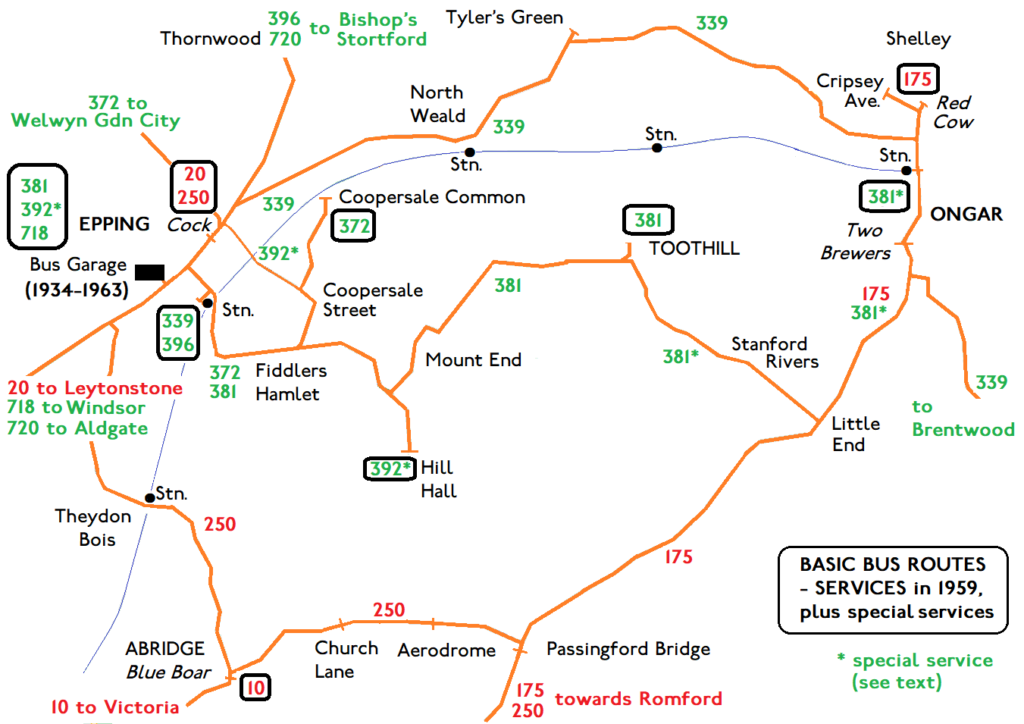
Our pocket in the northeast segment contained few rural traffic objectives, resulting in a ring of routes on the periphery. In broad terms, these comprised green, country area buses on the north side (route 339, Ongar & Epping via North Weald) and red, central area buses on the other three sides (routes 250, Epping & Romford, and 123/175, Romford & Ongar) which between them served Ivy Chimneys, Theydon Bois, Abridge, Stapleford Aerodrome, Passingford Bridge, Stanford Rivers and Marden Ash. Route 381 (initially Epping & Toothill, with an offshoot to Coopersale) was the only enduring service to penetrate the scattered and sparsely populated rural interior.
Taking the peripheral, central area routes first, the Ongar – Romford service is best remembered as double-deck route 123, later renumbered 175, whilst the Epping service was single-deck route 250. A number of short-working turns were made over the years, usually early morning or late evening, together with an unusual works’ service turn at Stapleford Aerodrome(1941 to 1950; routes 123/175 and 250). Other turns that affected residents locally occurred at Abridge Blue Boar (route 250, from the Epping end), and at Passingford Bridge. The last departure from Ongar was typically around 9.20pm after the war, but in the ‘fifties a special late journey was added to the timetable, when the last northbound 123 turned short at Stanford Rivers White Bear around 11.30pm, a matter of consequence to local revellers.
Services peaked in 1950 but thereafter a decline set in as motor car ownership increased. Frequent tinkering with services occurred, starting in the late 1970s, as London Transport sought economies of operation but invariably with an incremental and sustained reduction in the levels of service operated. The decline was slow but terminal, with the Epping service ceasing to operate in July 1981 and the Ongar service following suit just 17 months later in December 1982. Subsequent provision dwindled to next to nothing.
Locally, two services were inaugurated by London Transport: route 250 (Romford and Epping) and 250A (Romford & Ongar). Both routes operated daily, including Sunday. Indeed, trade tended to be heavier on Sundays than on weekdays, since it was the day of the week for ‘going out’ or visiting family. The 250 varied little down the years, the biggest change occurring after thirty years’ operation when, on 18th November 1964, the route was converted to one-person operation having previously employed both driver and conductor. At the same time, these single-deck buses were fitted with doors and saloon heating. After more than forty years, starting 8th January 1977, the route number was changed to 247, but the Epping-Collier Row element of ‘new’ service was withdrawn by London Transport just 4½ years later on 25th July 1981.
The story of the Ongar service is much more convoluted. Previously route G6 (details of operation are unknown), route 250A (Ongar, Four Wantz & Romford, Rainham Road) was instigated on 3rd October 1934. It employed single-deckers, operating daily out of Hornchurch Garage.
It was relatively short-lived in this guise, being renumbered route 123 with effect from 9th December 1936 and converted to double-deck operation. It kept the 123 number for nearly 22 years. Although not much affecting the High Country area, the route saw changes in termini down the years, being extended to Shelley, Red Cow (from 13.12.39) in the north and to various destinations at the south end of the route. Trade increased steadily down the years. Service intervals on the 123 varied between hourly and two-hourly after the war, depending on the time of day and day of the week.
Also in early London Transport days, and by 3rd October 1934, a third route, number 175 operated locally, from the Romford direction to Stapleford Abbotts Royal Oak, with odd journeys extended to Shelley, Red Cow. More pertinent was a Monday-Saturdays wartime origin (23rd July 1941 until 12th July 1950) prolongation northwards from the Royal Oak to serve Stapleford Aerodrome, where buses terminated by reversing from Ongar Road into Church Lane, Lambourne. Perhaps to disguise the true purpose of these journeys, destination blinds showed ‘ONGAR RD. CHURCH LANE’. Later, post-war, this changed to ‘ONGAR ROAD FACTORY SITE’ and turns in later years actually terminated and turned on the aerodrome site. On 26th November 1958, route 175, previously Stapleford Abbotts Royal Oak & Dagenham Chequers (or Fords Factory weekday peaks) was projected to Shelley Red Cow to fully cover route 123 which was withdrawn. A final northwards extension from the Red Cow to Cripsey Avenue started on 9th October 1963, marking the maximum extent of the 175 through the district.
Starting on 18th July 1970, the Ongar part of the service was cut back to Passingford Bridge, resulting in a ‘new’ Ongar (Cripsey Avenue) & Romford Station route, the 175A. Sadly, for those reliant on the service, its new incarnation was accompanied by a significant reduction in service which comprised a mere six journeys each way, Monday to Friday, only five on Saturday and none on Sunday. The route was withdrawn fewer than 3½ years later when it was renumbered 247B starting 8th January 1977. It was converted from crew-operated double decker to one-man single deck operation at the same time, and the service reduced yet further. It ran Mondays to Saturdays only consisting four MF return journeys (the first of which turned at Passingford Bridge) and five on Saturdays (an afternoon journey of which turned at Passingford Bridge). Strangely, the route converted to one-man double deck operation on 31st January 1981 though six months later it was reduced to a Wednesday, Friday and Saturdays only service. It was a case of death-by-a-thousand-cuts, and the service finally ceased on 4th December 1982.
The northern peripheral route, nominally Epping & Ongar and, at times, to Brentwood and Warley has operated in two main guises. Under London Transport auspices the extremities of route 339 were once Epping & Warley, but in 1963 it was extended from Epping to Harlow. Short working journeys were quite numerous; Tyler’s Green Talbot and Ongar Two Brewers at the western end, and Pilgrims Hatch Rose & Crown, Coxtie Green White Horse and Ongar Station at the eastern end of the route. This arrangement pertained until at least 1975. A peculiarity meant that route 339, operationally, was deemed by reasons of geography to be a special case, and fares were actually set by the Eastern National Omnibus Company which operated competing route 260 in the Brentwood area. Later operation of the eastern section of route was transferred to Eastern National (whose former garage site in Brentwood is now occupied by the Sainsbury superstore), and thereafter Ongar Two Brewers formed the eastern limit of the 339.
Until the late C.20th, all routes were operated as commercial services, with no outside financial support. As a result, passenger reductions (lost to car ownership) led to service reductions and the virtual loss of all routes except along the Epping-North Weald-Ongar corridor.
Starting 4th January 1982, the former 339 route became the 201 (Ongar & Buckhurst Hill, via Epping). This was in association with the decimation of the Epping-Ongar tube line that was reduced to a peak hours only service, and railway season tickets were valid on the Epping-Ongar section of bus route. This arrangement only lasted about 3½ years, until 24 May 1986, when, as part of the Essex County Council tendering process, the route was takeover by West’s Coaches. In modern times, the Harlow & Ongar Two Brewers via Epping route has been operated as route 420 by Trustybus with generally alternate buses operating a truncated Harlow & Tyler’s Green Talbot service, route 420A
A remarkable service, double-deck route 392, once operated between Epping & Theydon Mount. The route ran from Epping Garage, along High Street to Epping Green, thence via Stonard’s Hill and Fiddlers Hamlet to serve Hill Hall. Its Theydon Mount terminus is presently unknown; it may have terminated at North Lodge, leaving passengers a footslog of over half a mile to reach Hill Hall, or the service may indeed have traversed the estate’s private road to deposit its passengers on the doorstep. The service was established to suit war needs, though the dates of introduction and cessation are not known.
Finally, route 381 – the only bus route to truly penetrate the rural hinterland, had a chequered existence in its twenty-odd year period of operation. On Tuesday, 30th August 1950 (the previous day being a Bank Holiday), following several years’ lobbying by Theydon Mount parish council and perhaps others, London Transport established a single-deck bus route running between Epping Garage and Toothill, via Mount End. Monday – Saturday, five return journeys were operated, two in the morning for schools and shoppers, one around midday (shoppers) and two in the afternoon (shoppers and schools). The bus used was a 20-seater single-decker in red livery. The bus was repainted green in May 1953 but in October the same year it was replaced by a bus of larger, 26-seat capacity. From this time (if not before) no conductor was carried, it being the driver who was responsible for collecting fares and issuing tickets. Bus stops were notable by their absence, at least between Epping and Toothill. Intending passengers simply hailed the driver anywhere along the route. The 381 route was well patronised in its late ’fifties heyday with full loads and standing passengers. This justified, for a while, the type of bus used later still, in the ’sixties, which had even greater capacity, and it was this type which saw service to the end.
A companion service was an offshoot of the Toothill route, diverting at Fiddler’s Hamlet to Coopersale Street, where it terminated at the Theydon Oak, being later extended to Coopersale Common Garnon Bushes. This original ran as a 399,(Coopersale Street & Hertford) later briefly re-routed and renumbered 372, (Coopersale Common & Welwyn Garden City) before being integrated with route 381 (or 381A; there were permutations in its later years). Coopersale patrons enjoyed a reasonably good level of service; the last bus arrived after 10pm (in 1959) and there were even a handful of Sunday journeys.
In an attempt to maintain viability in an era of declining patronage, the operator experimented with route variations down the years. This resulted in the Toothill and Coopersale routes being extended beyond Epping variously to Roydon, St Margaret’s and Harlow. A remarkable experiment took place in the winter of 1957/58 (October to January) when on Saturdays, two journeys were extended from Toothill via Stanford Rivers, Little End to Ongar Station. Sadly, it was not a success, and the experiment ceased after only fourteen Saturdays.
In its final years, patronage dwindled to virtually nothing, with the Toothill bus, especially, trundling around the country lanes almost always empty. It was no surprise, then, when the last London Transport-operated 381 ran on Friday, 7th August 1971. Thereafter, the 381 led a fitful existence with a number of different companies operating various permutations of services. The last Toothill service ran in 2018, when the 381 which operated between Harlow and Toothill via Coopersale and Blake Hall was cut back to operate between Harlow and Coopersale Piazza. This service is operated by Ugobus at time of writing, and it is heartening to note the level of service is not far short of London Transport levels of fifty years ago (though there is no service on Sundays).
Also, in modern times, some small semblance of former route 381 has been resurrected as part of a heritage bus service associated with and complementary to the Epping-Ongar preserved railway. When operating, usually at weekends, this route now embraces North Weald and Blake Hall before joining its former line of route at Toothill. It operates via Banks Lane instead of Mount End, this being the only deviation from the original route.
Images
Local Bus Services – A Potted History
381 bus terminating at Ongar Station
Bus movements at termini, Toothill
Local Bus Services
Article 4 of 11
The War Memorials Trust
Did you realise there are over 100,000 war memorials across the UK? They commemorate the sacrifices of those impacted by conflict and act as a reminder of the consequences of war. Two thirds of the war memorials in the UK were erected after World War I, the majority paid for by local fundraising, and the family and friends of those remembered creating a lasting tribute. The locations selected for memorials often had local significance.
Whilst many of the war memorials are kept in good condition, some 1 in 20 may need work due to neglect, ageing, weathering or occasionally vandalism.
In 1997 the War Memorials Trust was formed, its objects being:
To improve the condition of war memorials, in their historic design and setting, to support their long-term preservation in-line with best conservation practice
To increase the understanding of best conservation practice including how to maintain, protect, repair and conserve war memorials appropriately as well as raise awareness of the support available from War Memorials Trust
To enhance public engagement with, and the recognition of local responsibility for, war memorials
To sustain access to grant funding to support repair and conservation works in-line with best conservation practice
To increase the money raised by the charity to deliver its vision to protect and conserve war memorials
The patron of the trust is HRH Duchess of Cornwall.
All war memorials are eligible for help from the Trust, and they offer practical advice on technical conservation, day to day care of war memorials as well as addressing a range of questions on war memorials and associated issues from planning to legislation. Grants can be made available and a number of war memorials in Essex have benefitted. An example is the war memorial clock on the church of St Mary’s, Sheering, (near Harlow), which had been dedicated in 1949 in memory of those of the village of Sheering who died in WWII. (see below)
It is important to spread the word about the existence of the War Memorials Trust and ensure that all those caring for war memorials are aware the charity can help.
Further details of the charity can be obtained at:
www.warmemorialsonline.org.uk
Images
The War Memorials Trust
Memorial clock on the church of St Mary’s, Sheering
Article 5 of 11
Hatchments
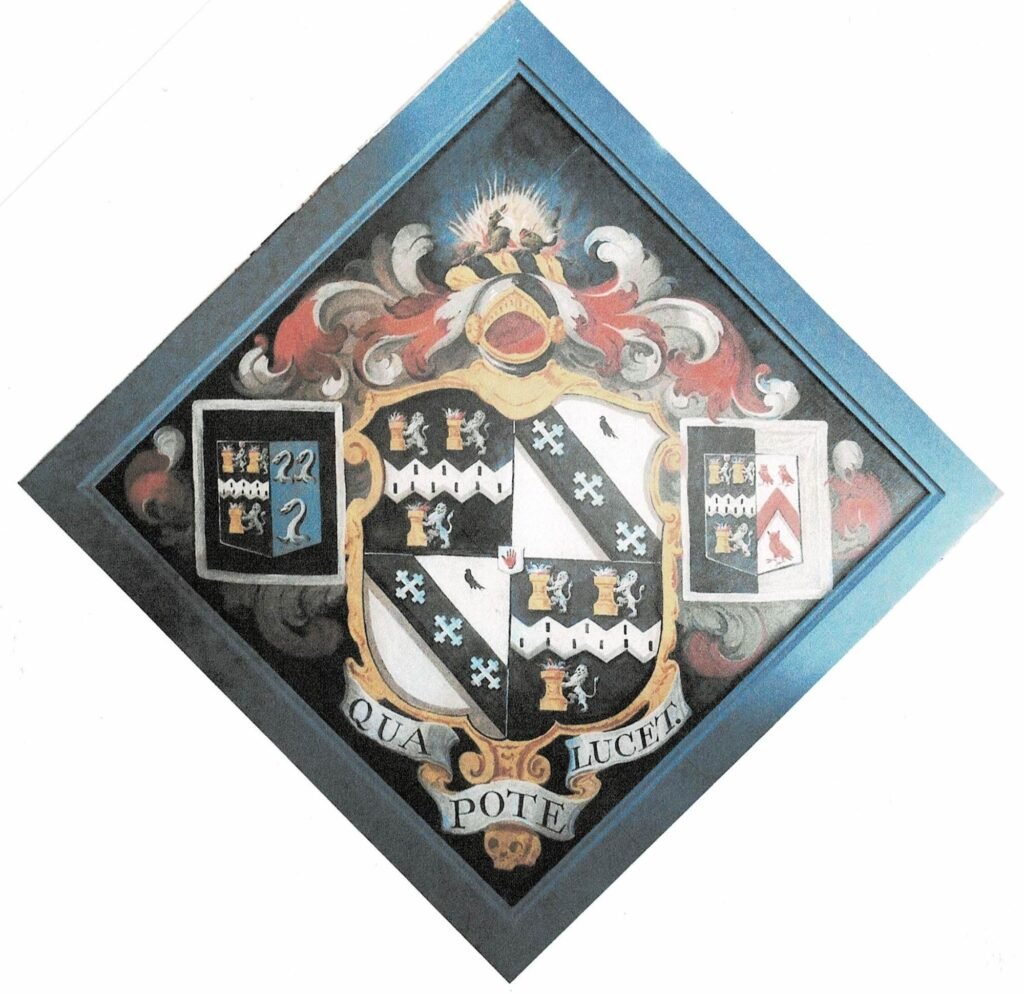
Hatchments are armorial shields painted onto a square- or ‘lozenge’-shaped frame. (In heraldry, the term ‘lozenge’ describes a diamond or rhomboid; its four sides are all equal but its angles are not square.) The background is painted sombrely in black.
The tradition of hanging these armorial shields or escutcheons in churches goes back to the 17th century and its roots extend further back still to the time when the family of a dead knight would display his helmet and shield in the church or family chapel. In those days, when a nobleman died his heraldic shield would be carried before the coffin.
From the early 17th century the practice of creating a funeral banner developed. The arms, helmet and crest of the deceased nobleman would be painted on rough canvas, hessian or calico, usually about three to four feet square and this was sometimes carried during the funeral procession. Smaller hatchments were sometimes painted on wood panels.
The Hatchments in situ before removal for conservation work
The hatchment might bear the family motto but more commonly it spoke of resurrection in the afterlife, bearing the legend Resurgam (‘I will rise again’).
The painted fabric would be tacked to a flat wooden frame, usually black, and displayed outside the family home. Following a suitable period of mourning, probably lasting up to 12 months, the hatchment would be removed and hung inside a church with which the family were likely to have had some connection, either as parishioners or benefactors.
The workmanship of these paintings varies considerably. Some were probably the work of local artists.
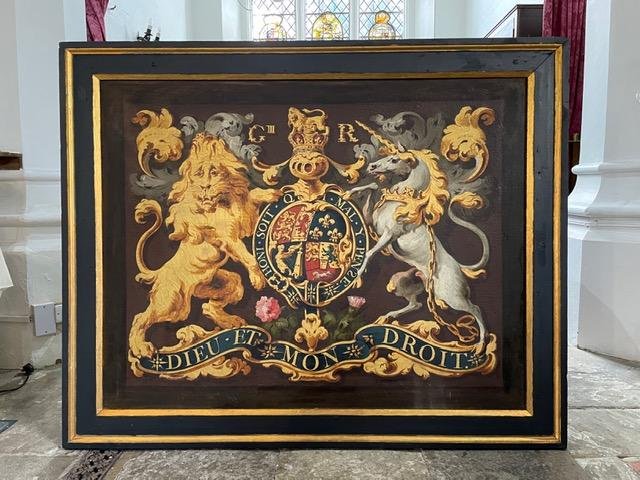
Not to be confused with hatchments are the rectangular paintings of the Royal Arms which were for the most part placed in churches at the Restoration, and this was compulsory. The Royal Arms were introduced into church decoration during Henry VIII’s reign when the Pope’s jurisdiction was repudiated by that monarch, who then made himself head of the Church of England. The coat of arms in St Michael’s are those of George III (see cover).
[In St Mary’s church Theydon Bois the coat of arms are James I, one of only four examples in the country.]
St Michael’s has one of the most important groups of Georgian funeral hatchments in Essex, and a George III Royal Coat of Arms.
Until recently, they were in poor condition and in some cases near collapse, so an appeal was launched to save them. Thanks to the generosity of many donors and grant-giving bodies, they have now been magnificently restored.
Images
Hatchments
Hatchment of Sir William Smith, 7th Bt., who died 1823, and which is in Theydon Mount Church.
George III Coat of Arms from St Michael’s church Theydon Mount, after Restoration
Hatchment
Article 6 of 11
Theydon Mount Church of England School
In 1818 there was no school in the parish, although the poor were said to desire schooling for their children. In 1826 Mrs. Letitia (later Lady) Bowyer Smijth set up a girls' school in some cottages, paying the fees of needy children and taking an active interest in the work. It is possible that these cottages were situated at the brickfield near Hill Hall.
In 1836 Sir John Smijth established a boys' school, which the Smijth family largely maintained in the years following. In 1839 the rector, besides making financial contributions, carried out most of the detailed administration at both schools. There were 33 boys and 42 girls in attendance, the fee evidently being 1d. per week. The textbooks of the National Society were used but neither school was a National School.
About 1846 a new mixed school was built, apparently on the site of the boys' school of 1836. Members of the Smijth family seem to have paid most, if not all of the cost, and to have remained for many years the owners and chief source of income; in 1846-7 Sir E. Bowyer-Smijth was stated to be the only contributor. Children attended the school from Stapleford Tawney as well as from Theydon Mount. After a successful start the school seems to have declined. In 1846-7 there were about 70 pupils under a master and a mistress who were paid £40 and £14 a year respectively.
By 1871 there were only some 36 pupils and the building was in poor condition, despite continued support from the Smijths. The government declared that it could not be considered an efficient school for the 31 children from Theydon Mount and the 30 from Stapleford Tawney needing elementary schooling unless it was thoroughly repaired. Theydon Mount parishioners were now prepared to accept responsibility for the school and in February 1873 the Smijth family transferred ownership to the rector and churchwardens as trustees. The building was repaired so as to accommodate up to 50 pupils, the building of a new school at Stapleford Tawney making greater accommodation unnecessary.
In 1880 the school seems to have been reorganized and officially reopened as Theydon Mount Church of England school. In 1881 the first government grant was received, one of £12, and this amount rose slowly to an average of about £44 in 1890-1900. Other income came from 'school pence' and from a voluntary rate which in 1880 yielded some £33. The master was paid £36 in 1877 and £52 in 1886. In 1887 he was replaced by a mistress who also received £52.
The population of the village was declining and average attendance at the school was only 27 in 1893 and 23 in 1899. Under the Education Act of 1902 the school passed under the administration of the Essex Education Committee, Ongar District, as a non provided, mixed elementary school. Its average attendance was 37 in 1900, 45 in 1910, 36 in 1929, and only 24 in 1938. In 1939 it was reorganized for mixed juniors and infants and in 1942 it was closed because of the insufficient number of pupils. The children were transferred to Theydon Garnon school.
The following extracts are from the Minutes of the Proceedings of the Managers of the School.
1905 – March: Mrs Latchford appointed Caretaker at a salary of 1s. 3d per week, or £3. 5s. per annum subject to the approval of the Education Committee.
1905 – August: Mrs Evelyn Darby late of Addington Parish School and St. Mary’s, Lewisham, having produced very good testimonials and having been to see the Managers and the school is hereby appointed Mistress of the School at a salary of £66. £9 for the rent of the school-house, furnished; to commence her duties September 1 subject to the approval of the Education Committee.
1916 – March: On the advice of Dr David, the Medical Officer of Health, the school had been closed from 10 January to 24 January on account of mumps.
1916 - May: Letter from Mr Ball (Gaynes Park) with reference to some of the boys and girls learning how to milk, that two girls had signified their wish to join a class for this purpose – to be held at Coopersale School.
1917 – October: It was considered there was no need to let boys off school for potato picking.
1924 – July: HMI Report had been received – “Very intelligent and earnest work continues to be done by the Head Teacher of this small school. The infants are in kindly hands, but it cannot be said that they are making much progress. Their written work was poor and ineffectively corrected, their reading was very halting and slow. Much more intelligence and activity should be called for at this stage.”
1931 – August: Lady Hudson had given the children a most enjoyable summer party at Hill Hall on July 14. Unfortunately it rained, but a conjuror kept everyone happily amused in the Hut.
1937 – September: The school had been closed for the Coronation festivities and the children, with the rest of the village had been entertained by Lord and Lady Edward Hay at Hill Hall. Tea, sports and an entertainment formed the programme, and in spite of the weather, it was carried out to the enjoyment of everyone.
1938 – November: Mrs Darby resigns as Head Teacher. Served for 33 years.
1939 – February: On 11 small children at the school and it will be carried on as a ‘One Teacher School’ in charge of Miss Olive Grace Lock, who has been the Assistant Teacher since September 1937.
1939 – May: Stapleford Tawney School to close and to be amalgamated with Theydon Mount. Miss Jenkins a Head Mistress of Stapleford Tawney school to be transferred to Theydon Mount and that Miss Lock should continue as Assistant Mistress.
1940 – February: School closed for a fortnight owing to deep snow.
1940 – August: 37 children on books (including 6 evacuees)
1942 – April: Letter suggesting the school be closed as number of children reduced to 20.
From: 'Theydon Mount: Schools', A History of the County of Essex: Volume 4: Ongar Hundred (1956).
Minutes of the Proceedings of the Managers of the Theydon Mount Church of England School. ERO Ref D/P 142/28/6
Article 7 of 11
Awful Tempest in Chipping Ongar
From the Times Newspaper Sept 19, 1840
The town and neighbourhood of Chipping Ongar were on Wednesday afternoon about half past 1, visited by an awful tempest. The electric fluid, followed by a tremendous crash, entered the roof of a malting occupied by Mr. Fordham, corn-factor, which, with the house at the south end, occupied by Mr. Reynolds, cooper, embraced a considerable frontage of the High-street. The interior of the malting, in which straw and wood were stowed, was soon in flames, which rapidly extended to a detached granary towards the north, and the Red Lion Inn, occupied by Mr. Sturdy, towards the south. A small engine kept in the town was soon at work, and by the exertions of the inhabitants the flames were prevented extending to a row of houses occupied by Mr. E. Carter, butcher, and others near the granary. It was, however, considered necessary to pull down parts of the Lion Inn and outbuildings, to stay the progress of the raging element. The malting which was the property of Mr. Abraham Offin, of Hutton, cottage and granary, were wholly destroyed, and the Lion Inn and malt-kiln much injured; the whole of the furniture and stock in trade at the Inn (amongst which was a hogshead of gin), were removed to the opposite houses, but considerable damage was done by breaking of the furniture, bottles, &c. The constabulary force stationed in the town and vicinity, aided by a party of the Epping force and firemen, who accompanied the Epping subscription engine, under the direction of Superintendent McInnes, rendered great service and encountered considerable risk of personal injury. Mr. Forster, plumber, and several other persons received injuries by the falling of timber, &c., but not of a dangerous nature. The property destroyed and injured was chiefly insured in the Notwithstanding this awful visitation, it is consolatory to reflect that no lives were lost.
Whilst Mr. McInnes was superintending the ruins in the evening, some diabolical villain threw a brickbat at him, and it struck his hat with violence, but he escaped personal injury
- Essex Herald.
Royal Exchange office.
Article 8 of 11
From the Essex Review 1906
‘Jane Luther bequeathed a sum of 5 shillings annually, to be paid to the clerk of the parish, for weeding the gravel path from the high road to the church-porch at Stapleford Tawney.’
[Editor – there is no date for the bequest mentioned in the article but it is believed it was made around 1750]
Article 9 of 11
Stanford Rivers Charities
Four charities existed or the benefit of those living in the parish. They are:
Thomas Petit who died before 1602) left 5shillings a year each for the poor and 'poor folk's marriages' to the parishes of Stanford Rivers and Greenstead. It issued from lands in Stanford Rivers. In 1834 the money had not been paid for at least twenty-three years. The owner of the land was apparently willing to pay the charge in future but there is no later record of the charity.
2. William Green, by his will dated 1554, devised a rent charge of £2 to twelve poor inhabitants of Stanford Rivers and £1 to six poor of Chipping Ongar. In 1786 it had not been paid since 1739.
3. Mary Rayner of Greenstead, by her will proved in 1873, left £400 for the upkeep of her family tomb and for the provision of clothing for the most deserving poor of Stanford Rivers. Although the primary trust was void by the rule against perpetuities, small sums were spent on the tombstone at various times. In 1950 the income was £10 1s. 2d. which, together with the last year's balance was enough to give 27 parishioners 10s. each for clothing.
Jessie Matilda Berkeley of Mere (Wilts.), by her will proved in 1930, left £500 in trust for the upkeep of the graveyard of the parish church and for the benefit of the poor provided that her family vault was maintained in good repair. The income in 1950 was £20 8s. 4d. and all of this was spent on the upkeep of the churchyard.
Source: A History of the County of Essex: Volume IV, W. R. Powell (Editor) (1956).
Article 10 of 11
Wife for Sale
From the Times, March 18th, 1833.
On Friday last, being market day at Epping, about the middle of the day, a good looking woman, about 30 years of age, was led into the market place with a rope around her neck and waist, by her husband, Thomas Bruce, an hostler, the magistrates sitting in petty sessions at the time in the town. In a few minutes the market place was crowded, and the master of the parochial workhouse, undertaking the office of auctioneer, endeavoured to amuse the multitude by his ludicrous imitation of the professional addresses of these often impressive public orators, in offering the woman for sale, and expariating on her qualifications. She was put up at 1s 6d., and after a bidding which could not be characterised as spirited, knocked down at 2s.6d, to a labourer named James Bradley, who immediately paid down the purchase money, and 6d for duty &c., and carried of his purchase to a public house amidst the shoutings of the assembled multitude. Their noise having reached the bench of justices, an officer was despatched for the husband, who was brought before them in a state of intoxication, having already spent the half-crown in gin. It was proved by the parish officer that he had deserted his wife. He said in his defence, that he had been compelled to marry her six years ago by the parish officers, in consequence of her having sworn a child to him; that he had never since lived with her, and that she had lived in open adultery with the man Bradley, by whom she had been purchased; and that he had been told that by publicly selling her in the market he could get rid of any charge by the parish for the maintenance of her or her children. The magistrates strongly reprobated his conduct, and committed him to prison for having deserted his wife. Our correspondent does not say how they acted towards the parish authority who officiated as auctioneer.
Article 11 of 11
High Country Programme for 2021
Meetings will be held on the following dates
Thursday 23 September
The New River - supplying London's water
Patrick Griggs
Thursday 28 Oct
William Morris and the Arts and Crafts Movement.
Mark Lewis
Thursday 25 Nov.
Life and Death in the Workhouse
Mark Carroll
Meetings are held in Toot Hill Village Hall.
Meetings start at 8.00pm.
Members £1 ~ Visitors £3.
Refreshments