High Country History Group
Contents
See images from this issue
Images from this issue
Article 1 of 9
Joshua Gooday and the Runaway Coffin.
The following story appeared in the Essex Weekly News on the 11th September 1908.
The inhabitants of the usually quiet little village of Norton Heath, which lies about mid-way between Ongar and Chelmsford, are just recovering from the effects of an episode which will not be forgotten for many a day.
In a neat little cottage adjoining the smithy, lives an old man named Joshua Gooday, who has reached the age of 91, and who being a widower, is looked after by a house-keeper.
Gooday, who occupies his time principally in hurdle making some years ago decided to make his own coffin, purchasing oak planks for the purpose. But for some reason the old man did not proceed with his work until a few weeks back, and then discovered that he was unequal to the task.
Accordingly he sought the assistance of several men in the village to shape the coffin for him and eventually secured the services of a man at Roxwell, but he from the first to the last directed the operation personally.
Three times it is stated that the assistant from Roxwell threw down his tools and refused to be dictated to, but eventually about a fortnight ago the coffin was made. But to the old man’s chagrin when he endeavoured to lie in it he found that not only was it too short but that one shoulder had been rounded off while the other had been squared.
STORED THE COFFIN
So great was Gooday’s rage when he made this discovery that his assistant was actually frightened into a fit and was afterwards very grateful to take his departure. The old man stored the coffin in a shed adjoining his cottage placing it on specially made trestles, and the door of the shed was secured by a special kind of padlock. But, mystery of mysteries despite these precautions, one night recently the coffin was spirited away and no-one knew how.
THE SEARCH
Gooday, who was genuinely alarmed called in the police and informed them of what had happened, and Pc Vale, of Blackmore, obtained assistance and proceeded to search for the missing coffin. A thorough examination of the shed satisfied both the police and Mr. A. Smith, the owner of the shed, that the latter had not been tampered with, while it was equally certain that no-one could have opened the padlock, because there was no other key in the village to fit it.
Failing to solve the puzzle how the coffin, which weighed 1½ cwt. Was spirited away the police, assisted by the villagers, at once commenced to search the neighbourhood. The heath was scoured and numerous ponds dragged, but all to no purpose. No coffin could be discovered. Consoling himself a little with the reflection that the coffin being too small would not be of any service to him even if found, Gooday went to Chelmsford and purchased planks for a new one.
A day or so afterwards information was received that the coffin had been discovered in Mill Hill pond and Gooday and his housekeeper hurried to the spot, only to discover that what had been taken for the missing coffin was a bath turned side upwards. After this the police, the old man, and the rest if the villagers, had become reconciled to the fact that the coffin had indeed been spirited away.
On Tuesday of last week, however, news was carried to the Smithy that the coffin had been seen standing in afield of maize not far away; and a little latter before any steps could be taken to recover it the mysterious thing had “moved” from the maize field to the village, where it was found standing upright in the main road. No-one appears to know how it arrived there, but there it undoubtedly was.
Motorists and cyclists came across the coffin before they were aware of it, and some appeared too superstitious to pass it. Several cyclists, it is averred pushed their machines by in fear and trembling.
Eventually Pc Vale and Mr. Maryon of Norton Mandeville, caried the coffin home to the old man and with some difficulty set it again on the trestles in the shed and locked it up. How the coffin moved from the shed remains a mystery.
BETTER FIT
Although Gooday has got his coffin back, he is still making a new one which he hopes will be a better fit, and he has offered to give the old one to any friend.
The old man, who spent many years in South Africa and India as a ganger, is a native of Broxted, and came to Norton Heath eight years ago. In addition to making his own coffin he has made various preparations for his funeral. He has deposited five shillings each for his bearers and five shillings for a woman whom he has “chosen to lay him out”. He also it is understood, paid for a trolley to convey his mortal remains to their last resting place – a spot in the churchyard which he has selected himself.
Joshua Gooday died on the 2nd March 1915 at the grand old age of 96 and is buried in All Saints, Norton Mandeville.
It also appeared in numerous other newspapers across the country.

Article 2 of 9
Air Raid Precautions in World War I
The following instructions were issued by the Essex County Constabulary in 1915 as to the precautions to be taken and work carried out in the event of hostile aircraft appearing over Essex.
HEADQUARTERS
Telephone to Home Office for transmission to Kent and Surrey.
Supt. Smith, Epping, to be informed for the information of the Epping Fire Brigade.
Telegraph to the Chief Constables of Birmingham and Northamptonshire.
Notify Superintendents of Divisions concerned, and all others if necessary.
Warn the following Chief Constable if hostile aircraft is known to be travelling in their direction: East Suffolk, Nottinghamshire, Buckinghamshire, Bedfordshire, Kings Lynn and Luton.
Telegraph to Home Office the morning following the raid giving as full particulars possible respecting locality, number of bombs dropped, persons injured, &c. The particulars to reach the Home Office before 11 a.m.
SUPERINTENDENTS IN CHARGE OF DIVISIONS.
Warn all munition factories, &c, in their area of the approach of hostile aircraft.
Notify all Gas Works, Fire Stations and any other works in their Divisions.
Telephone particulars to Head Quarters, Essex County Constabulary, and Headquarters, 61st (South Midland Division).
See that all arrangements previously made to keep the main roads clear of traffic are carried out.
Arrange that all street lamps and lights in shops &c., are turned out, if necessary.
Inform the Managers of Places of Amusement.
Reports received from neighbouring Police Forces to be at once transmitted to Head Quarters.
Telephone full particulars to Head Quarters early on the morning following the raid, giving number of bombs dropped, persons injured, locality &c.
POLICE AND SPECIAL CONSTABLES ON ACTUAL DUTY
Telephone to Anti-Aircraft, London, Headquarters, Essex County Constabulary, Chelmsford, Headquarters 61st (South Midland) Division, Chelmsford, also the local Superintendent giving as full particulars as possible.
The nearest Military Officer is to be informed.
Keep all main roads clear by stopping all vehicles (with exceptions) and placing them in prearranged positions.
Pay particular attention to all lighting, both in houses and on vehicles.
Be prepared for any emergency that may arise.
A written report is to be sent to Superintendent on first available opportunity.
OTHER POLICE AND SPECIAL CONSTABLES.
Parade at the nearest Police Station or any other place previously appointed and carry out any instructions that may be given to them.
WARNING OTHERS
Superintendents are responsible for the warning of the various people affected in the respective Divisions.
The Home Office and various Chief Constables are warned from Head Quarters.
The Head Quarters, 61st Division (South Midland) Division is warned by the officer affected as soon as possible after the hostile aircrafts is seen or heard.
WORKS.
The Managers of Works on Munitions, &c., Railway and Dock Officials to have early information of the approach of hostile aircraft but the actual reduction of light is to be left to their discretion.
In other works information is to be given to them of the approach of hostile aircraft and the lights are extinguished.
All are to be notified when the danger is apparently passed.
THEATRES AND PLACES OF AMUSEMENT
If a performance is proceeding the manager or some responsible person is to be informed and if necessary they inform the audience and ask them to proceed quietly home.
PLACES OF WORSHIP.
The persons responsible are to be informed if a service is in progress and it is left to their discretion to tell the congregation and close the service. (These instructions have only been issued to the Chelmsford Police up to the present).
AIRCRAFT BROUGHT TO EARTH
If the Police are on the spot first, the nearest Military Station is to be informed as soon as possible (in addition to notifying the Admiralty by telephone) and energetic measures taken to pr3vent the public approaching the aircraft pending the arrival of the Military Guard.
BOMBS
In the event of bombs being dropped in the locality the nearest Military Authorities are to be notified at once.
The public are to be denied access to places where bombs have been dropped.
The nearest local troops should be called upon for assistance if the Police are unable to effectively control the public.
All fragments are to be collected and Superintendents are to inform the nearest Military Authorities.
The public are not to be permitted to acquire fragments of bombs.
Particular care must be taken to prevent unauthorised persons touching the unexploded bombs.
ANTI-AIRCRAFT MOTOR CARS
The lighting restrictions do not apply to these motor cars and they are on no account to be hindered when carrying special lights.
The 61st (2nd South Midland) Division was an infantry division of the British Army raised in 1915 during the Great War as a second-line reserve for the first-line battalions of the 48th (South Midland) Division. However, the division was sent to the Western Front in May 1916 and served there for the duration of the First World War.
Article 3 of 9
Education in Greensted
1792
The rector of Greensted, the Revd. John Harris opened a Sunday school in Greensted. Only one child attended from the parish the remainder came from Chipping Ongar. When the Chipping Ongar Sunday school was started, the Greensted school was discontinue.
1807
There was no school in the parish.
1818
Population 147. A Sunday school supported by the rector and Craven Ord, Esq., containing 10 boys and 12 girls. The poor are without sufficient means of education.
Source: Digest of Parochial Returns. Select Committee on Education of the Poor, 1818
1833
Population 134. No School in the parish.
Source: House of Commons papers, Volume 41. Abstract of Education Returns 1833
1839
The rector, the Revd. Philip Ray began to collect subscriptions for a parish school.
1846/7
The school was being attended by some 34 children. The schoolmistress received a salary of £30 per annum. About this time a new building was erected, evidently by subscription on a site at Greensted Green, presented by the Revd. Philip Budworth, lord of the manor.
The Revd Ray exercised close supervision of the school. It provided 33 places ‘abundant accommodation’ for the small and declining population of Greensted.
1851
The schoolmistress was Rebecca French, aged 26 years.
Source: 1851 Census
1861 - 1871
Mr. St. George. A. Sargant and Mrs Phepe Sargant are master and mistress. They were living at the schoolhouse. In the 1871 Census he is described as a ‘Scripture Reader.’
Sources: 1861and 1871 Census and the Essex Almanack for 1865
1870
About 23 pupils attended the school.
Between 1878 and 1882 the school was closed and the children in the parish attended the schools at Chipping Ongar or Stanford Rivers.
Images
Lord of the manor.
Article 4 of 9
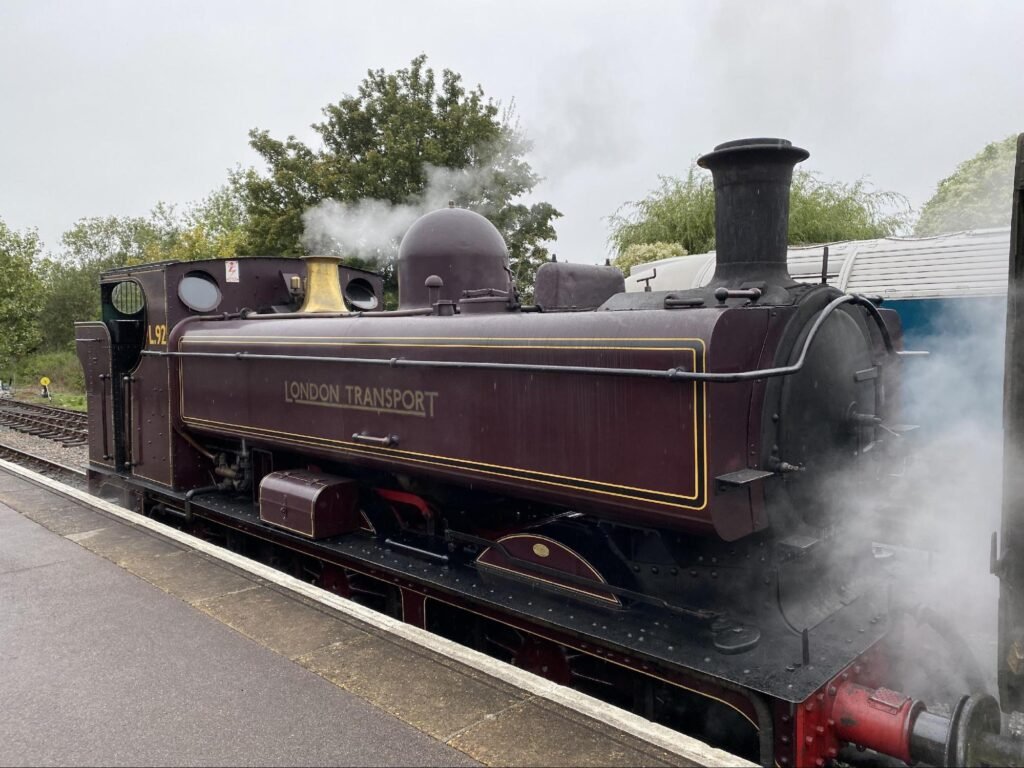
London Transport Steam Locomotive L92
5786 was built by the Great Western Railway in 1930 and, unlike many of its siblings, didn't get scrapped by British Railways, but was sold on to The London Transport Passenger Board.
It was one of over 800 57xx Pannier Tank locomotives built. They were used mainly for heavy shunting, short distance goods and branch line passenger duties. Built at Swindon, 5786 entered service in January 1930 at Aberdare shed. 5786 remained in South Wales throughout its life with the GWR and BR(W). Its last depot was Cardiff Canton.
In 1958 it was overhauled at Swindon and transferred to London Transport where it was painted Maroon and numbered L92.
The next eleven years were spent working maintenance trains, goods traffic and shunting from Lille Bridge and Neasdon Depots.
In the autumn of 1969 5786 was bought by the Worcester Locomotive Society and spent many years at Hereford before that site closed and the Society moved its base to the South Devon Railway. The engine had a major overhaul at Buckfastleigh and is in regular service on the line.
In 2013 the major rebuild of 5786 culminated in it being painted in its former London Transport livery again to mark 150 years since the world’s first underground train pulled out of Paddington station to make the first passenger journey – 3½ miles under the streets of London from Paddington to Farringdon and into the record books.
Images
Article 5 of 9
Ongar Union Guardians Minute Books
The minutes of the meeting of the Guardians of the Ongar Union are held at the Essex Record Office at Chelmsford. They commence in 1836 and continue to 1930, when the Workhouse was closed. They are not a complete record, but offer an interesting insight into the workings of the workhouse. There were also numerous reports in the local papers regarding events at the workhouse.
Just some examples of what is recorded.
17th January 1837
It was ordered that William Hall, a pauper in the High Ongar workhouse be dieted for 3 days with bread and water for absconding from the workhouse and returning in a state of intoxication.
18th April 1837
It was resolved that no person infected with any infectious or loathsome disease be admitted to the workhouse of this union.
6th June 1837
Resolved that certain families being paupers in the parish of Stanford Rivers and residing in several cottages belonging to Mr. Ray be forthwith vaccinated by Messrs Potter, Medical Officers at the expense of the Union in consequence of some of the inmates of such cottages having caught the smallpox.
Proceedings against Edmund Blowes of Willingale Doe for failing to support his family.
From the Essex Standard 12th January 1838
James Eve, twenty-one day’s hard labour for a misdemeanour in Stanford Rivers workhouse.
From the Chelmsford Chronicle 26th February 1841
ONGAR UNION.
The Guardians are desirous of engaging competent Married Persons, not less than 30 nor more than 45 years age, as SCHOOLMASTER and SCHOOLMISTRESS at the Workhouse. The Salary of the former will be £24 and of the latter £16 per annum, with double rations (subject to the approval of the Poor Law Commissioners). The average weekly number children maintained in such Workhouse during the last year was 45.
The Schoolmaster will be required to teach the Boys in Reading and some useful Employment; to assist the Master receiving Goods and Provisions, and to attend the Workhouse during his occasional absence or illness; and the Schoolmistress will be required to teach the Girls Reading and making their Apparel, and generally to assist the Matron in the performance of her duties.—Testimonials of Character and Ability must be sent (postage paid) to me, previous to 9th March, and Candidates must attend the Board on TUESDAY, 16th March, at One o'Clock, at the Town Hall, in this Town.
By Order of the Board,
W. BAKER, Clerk.
Chipping Ongar, 24th Feb. 1841.
From the Essex Standard 14th April 1843
Ongar Union. — On the 21st ult a numerous party of gentlemen assembled at a dinner given at the King's Head Inn, Ongar, to Capel Cure, Esq., and Mr. Horner, of Fyfield Hall, in acknowledgment of their valuable services as chairman and deputy-chairman of the Ongar Board of Guardians. W. Bowyer Smyth, Esq., presided on the occasion.
15th September 1846
One of the old men to be placed with the idiot child of George Franks, to attend on him constantly.
16th March 1847
Alteration to the able-bodied men’s’ dietaries.
6oz of suet pudding in place of 12oz of potatoes.
1/2 lb rice pudding for 16oz of potatoes.
Soup or broth with rice in place of same with potatoes.
Other categories dietaries pro rata.
To be adopted at such time as potatoes are not supplied for the use of the workhouse.
From the Essex Standard, 18th June 1847
Henry Andrews and John Wilkins, each one month’s hard labour, for destroying their clothes at the Ongar Union.
21st March 1848
Ann Turner, nurse for the past eight years is unable to read written directions upon medicines. She is being helped by the Master and Matron – allowed to continue as the nurse.
14th October 1853
ONGAR PETTY SESSION
Ann Baker, of Fyfield, widow, was charged with having deserted her two children on the 9th ult., and left them chargeable to the Ongar Union. — Defendant refused either to take the children out of the house or to go into the house herself; and as she appeared to be quite willing to spend a little of her time in gaol: the Bench committed her for six weeks.
From the Hertford Mercury and Reformer 18 December 1858
CHESHUNT PETTY SESSIONS
The relieving officer of this parish applied for an order to remove Ann Surridge, a woman with four illegitimate children and another child from Edmonton to Ongar Union. It appeared that Surridge has been living with a man named Yardley, formerly of Stortford, afterwards of Hertford, and that they came into this place as man and wife, with one child by a former wife. Being afterwards reduced in circumstances the woman received out-door relief for me time, but the relieving officer having reason to think they were not married, he ascertained such was the case, the man being in prison for debt, the woman and the five children wero removed to Edmonton Union. — The order was granted by the Magistrates, but suspended for the present, she being too ill to be removed, and on the eve of being confined with her fifth illegitimate child.
From the Essex Standard 15th August 1862
Ongar Union School Treat. — Through the liberality of J. F. Wright, Esq., of Kelvedon Hall, Sir C. C. Smith, Bart., of Suttons, W. C. Gellibrand, Esq., of Albyn's, and other kind friends, the children of the Ongar Union, upwards of 50 in number, had their annual treat, on Monday, the 4th inst., when they were conveyed by the excursion train to Harwich. The weather was delightfully fine, and after amusing themselves for some hours on the beach they partook of tea, cake, and biscuits. Highly pleased with their trip they returned home quite safely. Many thanks are due to the Rev. F. A. S, Fane, of Priors, the Chairman of the Union, who kindly exerted himself in arranging for the treat.
Herts and Essex Observer 10th January 1863
Sir C. C. SMITH, Bart., has kindly presented to the boys of the Ongar Union a gymnastic swing complete. The eagerness with which they avail themselves of the recreation it affords proves that they thoroughly appreciate the gift of the noble donor. Mr. Low, the master of this union, to commemorate the event, decided upon giving the children a treat, which he did on New Year's Day in good style at his own expense. By the aid of the magic lantern and a few friends the evening's amusement from beginning to end were never allowed to flag. It was a pleasing sight to witness with what delight and uncontrollable hilarity these poor little orphans enjoyed the treat. Cake and wine were supplied to each before retiring to rest.
From the Chelmsford Chronicle 9th October 1863
ONGAR.
Union Picnic. — On Saturday last all the school children of the union were invited Sir C. C. Smith, Bart., to spend the day at his mansion and grounds, and it hardly necessary to say how joyfully the kind invitation was accepted. Between 40 and 50 boys and girls, with the master and schoolmistress, arrived at Suttons between one and two o'clock. The morning was anything but pleasant, but, although the rain kept falling, it did not damp their spirits. On their arrival each child was supplied with a mug of prime soup, and the afternoon proving fine they entered upon their frolics in good earnest. Sir Charles and Lady Smith were among them and gave them free permission to do as they liked and go where they pleased. Of this liberty they freely availed themselves, each one imagining himself for the time a modern Robinson Crusoe, monarch of all he surveyed. Fruit, &c, were given them in abundance, and an excellent tea was provided, including apple tarts, bread and butter, tea, &c, to which they did ample justice. They then returned to their home most grateful for the treat, and their kind master, Mr. Low, expressed himself well satisfied with their behaviour.
From the Chelmsford Chronicle 14th September 1877
Ongar Petty Sessions
Neglecting his Wife and Family.— Jonathan Oddy, labourer, High Ongar, was charged with deserting his wife and six children, and leaving them chargeable to the common fund of the Ongar Union.— Herbert Holsey, relieving officer, said that on the 21st of August defendant's wife applied to the guardians for relief, and on the 23rd he relieved them; on the 25th he called, found defendant home, and asked him why he did not supply his family with necessaries, but he gave no reason; on the 27th he absconded, and his wife and family had been, and were still, chargeable. Defendant said he could not get any work, and in reply to the bench, added that Mr. Lambert discharged him because he was unwell and could not go to work. —
Two prior convictions for felony and one for deserting his wife were proved against him, and he was sentenced 21 days' hard labour.
Article 6 of 9
Hill Hall Estate in the News in 1948/49
As far as Theydon Mount was concerned the big story of 1949 was the news that Hill Hall was to become a ‘prison without bars,’ and the story received wide-spread coverage in the papers. However there were other stories from Theydon Mount.
By order of the Trustees.
Part of the Hill Hall Estate
THEYDON MOUNT
EPPING
3 miles from Epping and 20 miles from London.
COLEMAN'S FARM
An exceptionally well-equipped DAIRY AND MIXED FARM with Brick-built Farmhouse, Modernised Farm Buildings including Accommodation for 67 cows, and about 297 Acres of Arable and Pasture Land, Let at £375 per annum.
PEAK'S FARM
A Fertile Small Mixed Farm of 139 Acres, let at £174 per annum.
Also
184 ACRES OF WOODLAND
containing a large number of small and medium clean straight coppice grown Oaks as well as a considerable number of sizeable Ash and other Trees. and
A SMALLHOLDING AND 7 COTTAGES
which
KEMSLEYS
WILL OFFER FOR SALE BY AUCTION IN LOTS
(unless previously sold)
AT THE COCK HOTEL, EPPING
On MONDAY, 10th OCTOBER, 1949, at 3.30 p.m.
Particulars, Plans and Conditions of Sale may be obtained from the Solicitors, Messrs. LAWRENCE GRAHAM & Co., 6, New Square, Lincoln. Inn, W.C.2; or from the Auctioneers, 164, Bishopsgate, E.C.2, and 10, Western Road. Romford. Essex.
From the Herts and Essex Observer - Friday 30 September 1949
Dawn search caught two
By dawn to-day squads of police using torches and co-ordinated by wireless had recaptured two of the three good conduct prisoners who escaped from the prison without bars at Theydon Mount. They were Harold Pryte and Jack Josephs. Pryte was recaptured when police closed in on a copse near Epping just before midnight. He was serving a two-year sentence for theft. Josephs, who was caught later, was sentenced for shopbreaking and theft.
Police and wood choppers were watching copses and thickets as the search for the third man. William Henry King, in prison for receiving, was continued by daylight.
All three escaped yesterday from Hill Hall Farm. They had originally been in Chelmsford Gaol, but had become members of the working party at Epping because of their good conduct.
Essex Newsman - Tuesday 05 April 1949
The Good Conduct Ghost of Hill Hall
By Maurice Fagence
THEYDON MOUNT, Essex. Friday.
It’s all very well for the Home Office to turn Hill Hall - hilltop Elizabethan mansion dominating 200 square miles of bleakest, loneliest Essex - into a prison without bars for Chelmsford Jail's good conduct men.
But what is the ghost of the Grey Lady going to do about it?
That is what the stolid yeomen of this scattered hamlet, many of whom have seen the sad gentle figure, want to know.
Let the Home Office dismiss local village opposition to the scheme with a wave of the hand if it likes. No community. say the villagers. likes the idea of having a prison, even a prison without bars, planted in its midst.
But the Grey Lady, with her unbroken history 350 years of haunting and who probably merits the title of Britain's Premier Ghost, is another matter. She even haunted the nurses' bedrooms when London Hospital's maternity section was evacuated here during the war.
Mrs. Bingham, the mansion's lodge-keeper said to me.
“The matron saw her time and again, and if she sees a ghost there is a ghost.
For centuries the Grey Lady has walked round the bloodstains on the floor where seven men. all brothers, died in a fight to win her favours.
Countless people have seen the ghost of Hill Hall, my own husband among them. Something forced him out of his bed one night, made him walk to a window in far-away part of the mansion to light a cigarette.
The ghost walked by. Next morning there was a half-smoked cigarette on the window-ledge to show it was not a dream.”
May be women
Mrs. Bingham, her husband, the chief gardener Mr. Prior, and north county Mr. Chapman, one of the oldest and most hard-headed workers on the estate all ask: “And what are Chelmsford prisoners even good conduct prisoners, going to do about a ghost?”
To which Mr. Prior adds: “And what is the ghost to do about finding herself the only un-convicted person, except the officers in a prison establishment”
Especially if, as Mr. Chapman believes the prisoners will all be women.
When I reached the mansion, grey-uniformed male prisoners were clearing up the grounds – wearing red stars of good conduct men, and I thought very worried looks.
They had already heard the full story of the ghost.
Both on looks and history Hill Hall deserves a good ghost.
With daggers
It was built around about 1500, presented to a Royal Standard bearer, Henry de Essex, and taken away again when the worthy ran away from the enemy.
It was enlarged by Sir Thomas Smith, Secretary of State to Queen Elizabeth – who visited it regularly, and whose bed, carpets and curtains still remain.
Then came the ghost.
Sir Thomas’s seven sons all wanted the same little lady in Grey, fought with daggers till everyone was dead.
Their bloodstains are said to appear on the floor of the room in which they fought. All the local people I have quoted so far claim to see them, although hard-headed Mr. Chapman says, “It might well have been damp.”
And the ghost – “gentle, sad” – wanders regularly a’nights.
From the Daily Herald - Saturday 08 January 1949
Stole from Employer
German P.o.W. Sentenced
for Theft of Chickens
A German prisoner-of-war who pleaded guilty, to stealing four hens from his employer at Royden, was sentenced to two months' imprisonment at Harlow Petty Sessions, on Saturday. He was Heinz Plaumann, 22, of 116 P.o.W. Camp, Theydon Mount.
Det.con. Steward said that on January 27 he was driving a police car through Epping Upland and in the headlights saw Naumann standing in the gateway of the church. Nearby was a bicycle with a bag over the handlebars. On examining the bag witness found it contained four dead hens, Plaumann admitted having taken from Mr. E. Camp's farm at Roydon where he worked.
Captain Gray, officer in charge of 116 Camp, said Plaumann had not been in trouble before and, to the ' best of witness’s knowledge, his conduct had been good. "But," said Captain Gray. "My commanding officer takes a serious view of this and asks the Bench not to be too lenient as order has to he kept in the camp. If the prisoner had been dealt with by the military authorities it would probably have meant a court martial.”
It was stated that Plaumann joined the German Army in 1943 and was taken prisoner in September, 1944. He had been in England since April 1946.
Mt Plaumann had nothing to say, but the German interpreter asked for leniency and stated that as Plaumann was due for repatriation he could not understand why he had done it, for he was "not a bad chap."
Herts and Essex Observer - Saturday 07 February 1948
Article 7 of 9
Churchyard Digital Mapping Project
THE Church of England has formalised an agreement with a digital-mapping company, Atlantic Geomatics, to record all 19,000 of its churchyards.
The process, piloted last year involves the use of a specialised backpack, which takes thousands of measurements each second as its wearer walks through the churchyard. It also stores photographs of gravestones.
The results will be available online for those seeking the graves of forebears. Atlantic Geomatics must sign a memorandum of understanding with each diocese, and gain permission from each parish, before it starts surveying. There is no charge for the survey, nor for a basic search facility. Additional services will be available for a subscription.
External funding for the project has been provided by Historic England, the National Lottery Heritage Fund, and Caring for God’s Acre, as well as from online genealogy research companies, who will be able to offer their services through the search platform.
The Bishop of Ramsbury, Dr Andrew Rumsey, who is a joint lead bishop for church and cathedral buildings, said: “This impressive national project will make a huge difference to those researching family history, as well as easing the administrative burden on parishes. It will improve management of burial grounds, and make information more fully accessible than ever before, supported by additional services by subscription for those wishing to go further.
“It will soon be possible to visit almost any Anglican burial ground in the country and see in real time the location of burial plots. For those researching at distance in the UK or overseas, the digital records will place detailed information from churchyards at their fingertips.”
Images
Article 8 of 9
1921 Census
The 1921 Census will be made available to the public from the 6th January 2022. Taken between two world wars, during a period of economic turmoil and at a time when women had just won the right to vote, the 1921 Census will provide some fascinating insights about society and how it has evolved over the past 100 years.
The 1921 Census will offer us a glimpse into the lives of individuals and communities between the wars, recovering from a great influenza pandemic, and embarking on a new era where everyday rights and roles were changing.
What makes the 1921 Census even more vital is that it will be the last census release for England and Wales for 30 years, with the 1931 Census lost in a fire and the 1941 Census never taken.
The 1921 census is more detailed than any previous one taken, as it asked people about their place of work, employer and industry for the first time, as well as whether they were in full-time or part-time education.
Unlike in earlier surveys, respondents could select “Divorced” as an option for marital status.
The census also asked whether children were orphaned, revealing the impact of the First World War, with 730,000 children recorded with “Father dead” compared with 260,000 with “Mother dead”.
The documents can only be opened to the public next year because under the Census Act of 1920 they must remain secret for 100 years.
Images
Article 9 of 9
High Country Programme for 2022
High Country Programme for 2022
24th February
Essex Churches – Then and Now
Andrew Smith
24th March
Annual General Meeting
28th April
The Life and Times of Admiral Sir Eliab Harvey
Martyn Lockwood
26th May
The History of Copped Hall
Vic Knope
23rd June
Supplying the Army: The Contribution of Essex to Provisioning the Forces of Edward III, c.1337
Neil Wiffen
28th June
To be confirmed
27th October
The Plant Hunters
Maggie Piper
24th November
The World of Art Deco
Mark Lewis
Meetings are held in Toot Hill Village Hall.
Meetings start at 8.00pm.
Members £1 ~ Visitors £3.
Refreshments