High Country History Group
Contents
See images from this issue
Images from this issue
Article 1 of 8
The Charrington Family at Marden Ash
Nicholas Edward Charrington and his wife Isabella were living at Marden Ash House, Marden Ash, Ongar, at the time of the 1881 Census. They had three children, Edward born in 1876, Evelyn, born in 1877 and Eleanor, born in 1880. In addition they had the following servants living in:
Cook – Ellen Bartlett
Housemaid – Sophia Cook
Head Nurse – Sarah Thomas
Under Nurse – Hannah Robinson
Coachman – Thomas Glover
Groom – Richard Westwood.
(only Westwood was local – born in Shelley)
Nicholas and Isabella were married in 1874 in Surrey. He gives his occupation at that time as a Brewer. In fact he was part of Charrington Brewery a company founded in Bethnal Green, London in the early 18th century, and to which John Harrington in 1766 became a partner. Nicholas’s father, grandfather and great grandfather were also connected with the brewery.
We are not certain how long Nicholas and Isabella remained at Marden Ash House. His father Edward died in 1888 in Surrey, and it is assumed that the family moved then to Surrey as they are shown as living in Bures Manor, Reigate, Surrey at the time of the 1891 census. Nicholas died in 1894
Arthur Craven Charrington
On the 17th May 1882 at Marden Ash House, Isabella gave birth to another son who was named Arthur Craven. He was educated at Eton College and afterwards enlisted in the King’s Royal Rifle Militia in 1902, being transferred to the 1st (Royal) Dragoons in 1903, and obtaining his troop in April, 1910.
In India he served on the staff of the Viceroy, Lord Minto, and the Commander-in-Chief Sir O’Moore Creagh.
Captain Charrington – who was known to his friends as ‘Kid’ – was a fine horseman; he won many races in India, rode the winner of the Army Cup in 1909 and 1910, of the Grand Annual in 1910 and the Indian Grand National in 1911. He made a wonderful record at Simla in 1909, where he rode in twenty races in four days, winning thirteen, coming in second in three and third in one.
Arthur Craven Charrington was killed on the 20th October 1914 near Ypres, aged 32 years and was buried at Ypres Town Cemetery. He is also remembered at
Images

Article 2 of 8
Kelvedon Hall, Kelvedon Hatch
The first mention of the estate occurs in the Domesday Book. The estate became the principal manor of the parish of Kelvedon Hatch. In 1538 the manor was sold to John Wright for £493. For nearly the next 400 years the estate remained in the hands of the Wright family. Tradition was clearly important in the family for there were to be thirteen successive John Wrights. The present hall was built in 1743 for John Wright, replacing the original manor house.
The house is a very good example of a small country seat of a 18th century land-owner. The hall is built of red brick to a U-plan, with a three-storey, seven-bay central block linked to two-storey pavilions at either side. There is a red brick stable block and an orangery.
Next to the manor house was St.Nicholas' Church which had been on the site since at least 1372, and there may even have been a Saxon church before that. The first three John Wrights were Protestants, but early in the 17th century the next John Wright converted to Roman Catholicism. He encouraged to do this by William Byrd, the famous composer, who lived in nearby Stondon Massey. The Wrights were to remain devout Roman Catholics for their remaining time in Kelvedon Hall. In the new house a chapel was built, the existence of which was kept secret during the time Catholics were being persecuted. In 1753 the church was rebuilt, but in 1895 it was abandoned for a new church built in the village.
In 1837 the Kelvedon estate consisted of 880 acres which included the Hall and grounds and several other farms and cottages. The estate continued in the Wright family until the death of John Francis Wright in 1865 and the estate passed to his nephew Edward Carington Wright, who in turn left it to his own nephew Sir Henry J. Lawson. The house was advertised to rent in 1865, the advert for which described the Hall as being ‘seated in a beautifully timbered park…….the pleasure grounds and gardens are laid out with great taste in lawns, flower-beds and adorned with clumps of evergreens and shrubs and a fine sheet of water stocked with fish; walled kitchen gardens sloping to the south, fully cropped and planted with choice fruit trees, vinery green-house, melon-ground, etc., - the whole about 12 acres’. In Rush’s 1897 Seats in Essex Kelvedon Hall grounds are described as being ‘well laid out and ornamented by plantations and a piece of water of above two acres in extent’. From 1891 the house was occupied by a tenant, John Algernon Jones, a wealthy city stockbroker, and on his death in 1916 the estate was purchased from Sir Henry in 1922 by Jones’s widow. The 1920 sales particulars for the 885 acres site describe the grounds as being ‘well laid out grounds and adorned by some forest timber and well grown ornamental trees and shrubs, including araucaria, cupressus, weeping ash, beech, stately chestnut, and fine magnolias’. Also described were the tennis court, sloping lawns adorned by numerous rose beds and herb borders.
These beds were intersected by winding gravel walks, bordered by fine box hedges whilst adjoining a ‘capital’ aviary. There was also a walled kitchen garden that was well cultivated and stocked with a variety of wall and bush fruit. To the front of the house was a large sheet of ornamental water with shady wilderness walks from the grounds to Park Wood.
In 1923 a large portion of the Kelvedon Hall Estate was sold: this included several cottages, woodlands, and five plots of land ‘suitable for developing as a small holding’. Upon the death of Mrs Jones the house was sold in 1932 to St Michael’s Roman Catholic School but the school closed in 1937. Much of the timber in the grounds was felled during this time. The 1932 sales document descries the house as being ‘approached by a long carriage drive, mostly of fine oaks. After skirting the lake the drive sweeps round a wide lawn, flanked by projecting wings of the house to the columned entrance porch’. The description of the gardens included information on the walled kitchen garden with tomato house, vinery, plant house and frames. There were also standard and bush fruit, including old mulberry and fig trees, plus a newly planted orchard of apples, plums, and quince. The particulars also mention the walled and enclosed peacock garden and the ha-ha separating the pleasure grounds from the undulating well-timbered eighty acre park. The estate covered 147 acres at this time.
St Michael's Roman Catholic School.
Below is the text of a prospectus issued by the school
Kelvedon Hall is a beautiful Georgian Mansion, situated in its own grounds of nearly 150 acres of undulating park and woodland.
The house is admirably suited to its use as a school, having many fine examples of the work of the Adams Brothers and other features, all of which tend to increase the children's love and appreciation of real art.
The main staircase, of stone, leads to the main staircase hall, which is one of the chief beauties of the house.
The classrooms and dormitories, all in the Adam style, are pleasant, lofty and lit by large windows.
Electricity, and the new bathrooms and hot water system have been newly installed for the purposes of the school, and the chapel, a relic of penal times, has been re-roofed and renovated, all at very considerable cost.
The school is run by the Secular Oblates of St. Benedict, and its aim is to educate the girls on modern lines in accordance with the best traditional principles.
Curriculum.
It is expected that all those who are capable of doing so will terminate their school career by passing either School Certificate or London Matriculation.
Highly qualified specialists are engaged to teach their own subjects, viz.: music, Elocution, Dancing, and Art.
Games.
The spacious grounds afford ample opportunities for games, and the girls play tennis in summer and netball in winter.
The health of the pupils has always been remarkably good, cases of serious illness being almost unknown.
1 lb. of good sweets may be sent by parents at the beginning and middle of each term. Birthday cakes may also be sent, but apart from this, pupils are not allowed to receive hampers.
Pupils are not allowed to bring or receive books, newspapers or magazines.
Pocket money, as supplied at the beginning of each term, is deposited at the School Bank, and pupils are supplied with cheque books at nominal cost.
It is earnestly requested that fees be paid at least one week before the opening of each term. Fees will be collected by Barcaly's Bank Ltd., Ongar.
At the beginning of each term every pupil should bring a small case containing all that is necessary for the first night.
A full term's notice in writing is required before the removal of a pupil, otherwise a term's fee will be charged in lieu of notice.
The Uniform special to the school must be obtained at the school outfitters: details of this and other uniform ill be supplied on application.
Fees:-
22 guineas per term for pupils under 10 years.
30 guineas per term for pupils over 10 years.
Day Scholars:
3½ guineas per term for pupils under 10 years.
5 guineas per term for pupils over 10 and under 12.
7 guineas per term for pupils over 12."
Their occupancy of Kelvedon Hall was short lived as there were a number of unfortunate accidents which resulted in a number of deaths. The school closed in 1937.
Henry Chips Channon (see below) who was negotiating to buy the hall at this time, wrote about this period of the use of Kelvedon Hall in his diary:
“..the story of the strange nuns who have inhabited it. The Superior is a Miss Alton, who must be half-mad; she is a tyrant, given to moods and mental excesses. For a time she had a flock of seventeen nuns under her, ‘Benedictine Oblates’ they were called, but the Roman Catholic church has denied all relations with them, although for some years a RC priest was paid £2 per week to go to Kelvedon and administer religious instruction to the unhappy females. The money soon ran out, and the order became impoverished, and they took in mental patients, ‘border cases’ and the like, and lived on the proceeds. But trouble overcame them; one nun, the gardener told me and he knew her well, was so unhappy that she drowned herself in the lake, after threatening many times to do so. And two years ago there was a serious scandal, for one of the patients, a perfectly sane woman, jumped out of the window and was found dead. A few hours before, earlier in the night, she had escaped, only in her nightdress (as the nuns had hidden all her clothes) to a nearby farmer’s house. He had led her back in tears to the nuns who locked her up for a fortnight….and she killed herself.”
Newspaper Reports about St Michael's Roman Catholic School
NUN DROWNED IN A LAKE Sister May Primavcsi (57), a nun, was found drowned in the lake of the Convent at Kelvedon Hall, Ongar, Essex. Sister Primavesi belonged to the Convent of the Good Shepherd at East Finchley. She went to Kelvedon Hall about week ago from a home In Manchester, with the intention of staying about a fortnight.
WOMAN'S DEATH AT KELVEDON HALL CONVENT Mrs. Cathleen Gallivan, 53, wife of Mr. John Gallivan, a businessman, High Street, Walthamstow, died on Thursday morning at the Kelvedon Hall Convent, Kelvedon Hatch, where she had been staying as a paying guest undergoing a rest cure. The previous evening, at about 11.30, Mrs. Gallivan was found by Sister Hughes lying in her nightdress seriously injured on the lawn of the convent. Sister Hughes called assistance, and Dr. J. D. Fiddes, of Brentwood, was summoned. Mrs. Gallivan lived in a room of her own in the front of the house on the third floor. A few days ago she caught cold, and was advised to stay in her room. The floor of her bedroom is polished. She was apparently sitting at the window—which has a low frame and is about feet above the ground—for the book she had been reading lay on a chair the sill. It is possible the chair slipped and she overbalanced and fell out. She was popular with other guests at the convent. She had left the convent to visit her husband and two sons at Walthamstow twice since she came to Kelvedon Hall last November. The inquest Mrs. Gallivan will be held at Ongar Police Station at 12 noon to-day (Saturday).
CONVENT TRAGEDIES Attributed by Sister Superior to “Evil Influence” Sister Mary Frances D'Alton, Sister Superior the Kelvedon Hall Convent, near Ongar (Essex), stated last night that owing to the misfortunes that had befallen the secular oblats St. Benedict’s since they came to the centuries old hall she had decided to sell the house without delay.
In the four years they had been Kelvedon Hall they had been dogged ill-fortune. The latest several tragedies was on Wednesday, when Mrs. Catherine Gallivan, of High Street, Walthamstow, resident at the convent, was found beneath her window dying.
"We are unanimous,” she said, "in the feeling there is something terrible about the place, and we feel should all leave soon as possible. Stood the day we came have never felt happy The convent seems to have some evil influence over us. It is uncanny to the last degree.”
The convent, which was built in 1542, belonged to a famous Roman Catholic family for centuries. It contains many examples of the work the Adams brothers, and the rooms, all in the Adam style, are very large.
______________________
Despite the rumours that the house was haunted, it was purchased by Henry (Chips) Channon M.P. Channon who had been elected as a Conservative Member of Parliament (MP) in 1935. He failed to achieve ministerial office and was unsuccessful in his pursuit of a peerage, but he is remembered as one of the most famous political and social diarists of the 20th century. He was responsible for the restoration of the hall to its former elegance.
During World War II the house was used as a Red Cross convalescent home from 1941 to 1945.
Henry’s son Paul, succeeded his father as Conservative MP for Southend West for 38 years, from 1959 until 1997. He served in various ministerial offices, and was a Cabinet minister for 3½ years, as President of the Board of Trade and Secretary of State for Trade and Industry from January 1986 to June 1987, and then as Secretary of State for Transport to July 1989.
He retired from Parliament at the 1997 general election and was created a life peer as Baron Kelvedon, of Ongar. He died at his home in on 27 January 2007, at the age of 71.
Images
Sources:
Essex Garden Trust - British History Online - History House - Romford Recorder
Article 3 of 8
The Shipwreck of Greensted’s Stained Glass
This is a curious and unverifiable story. In about 1870, Jonathan Lewis of Water End Farm, Bobbingworth emigrated to Nelson in New Zealand, taking with him two small stained-glass panels. According to their previous owner, they had been removed from Greensted church some time before the Rev. Phillip Ray’s restoration of 1848. Mr Lewis’s original intention had been to present these to a church in New Zealand but, after an exchange of correspondence with the Rev G. F. Barlow of Chelmsford, it was agreed that the two panels should be returned to Greensted church. The package containing the glass began its repatriation from Nelson in October 1870 on the Challenger, but unfortunately the ship failed to reach its destination in London. A report from the Scilly Isles indicated that the Challenger of London, coming from Malden Island in the Pacific, had sunk at latitude 48N, longitude 13W, on 14 May 1871 and, though all her crew were saved, her entire cargo, including the package containing the stained glass, had been lost.
Before their dispatch from New Zealand, photographs of the two panels had been sent to the Rev. Barlow. Drawings were made from these by the Chelmsford architect Wykeham Chancellor and published in the Essex Review in 1894. A somewhat fanciful Anglo-Saxon date was attached to them by the New Zealand correspondent but Chancellor’s opinion was that the panels were from a sixteenth century German or Flemish workshop. One carried the inscription ‘Ohne Jhu, esto nucht’ (derived from St John xv, 5: ‘for without me you can do nothing’), the other the letters ‘TE’ linked with an intertwining cord.
If the coordinates of the sinking are correct, the ship foundered far out to sea in the Atlantic and these two small panels stained glass must be permanently lost. It also remains an open question whether the oral tradition that they had come from Greensted church was correct.
Essex Review, Volume 3, page 135 (1894)
Essex Review , Volume 23, pages 45-46 (1913)
The Cross of Tau, named after the Greek letter it resembles, is suspected to have originated with the Egyptians. It has been a symbol to many cultures before Christianity, including a mention in the Old Testament book of Ezekiel. It has been adopted by Christianity as a representation of the Cross.
Postscript:
Following on from Michael’s article, the Essex Review published a further article regarding the stained glass.
Greensted Church. In vol.iii, p.135, of the Essex Review for 1894, are two illustrations of old stained glass from Greensted Church, carried to New Zealand and lost at sea. One of these has a roundel encircling a Tau Cross (T) bearing an inscribed label round its stem, said to be ‘Ohne itm, Esto nucht,’ which means, says the writer, ‘Without it (i.e. without Him who suffered thereon), is nothing, to be done or effected (S. John xv.5.) The motto is Anglo Saxon….G.H.J.
Surely there was never a wider guess.
More than 20 years ago, when the Essex Archaeological Society met at Greensted church, a coloured drawing of this glass was handed round, but nobody present could interpret its meaning. I did get an opportunity of seeing it till the company was dispersed from the very small sacristy, but I saw in a moment what the whole meant, and was greatly amused at the wild guessing. Some said that it appeared to be German, for there was the word ‘ohne’ (without), and I suppose that the ‘nucht’ was taken to stand for ‘nichts,’ for the ‘nothing.’
This is the interpretation thereof, unless I am greatly mistaken. ‘Bone Jhu Esto mihi (or michi) Jhu.’ (O good Jesus, be Thou a Saviour to me.) The capital B, not very clearly painted, looked somewhat like a rosette. I had forgotten all about this incident till the E. R. brought it back to my mind.
In the north-east chapel of the magnificent church of St. Mary, Bury St Edmunds, lies a slab (c. A.D. 1500), bearing a brass shield that I have copied many times, and of which I have a rubbing. This shield displays a Tau Cross with this same inscribed label adorning it, similar to the E.R. sketch, which I think proves my case and appears to draw Greensted and Bury St Edmunds still closer together.
Arthur H. Brown, Brentwood.
Article 4 of 8
The Passingford Bridge Sparrow Club
From the Essex Times, 5th February, 1870
The annual meeting of this old re-established club took place at the Talbot Inn, on Thursday last. Established more than 30 years since, at a time when the destruction of small birds was encouraged, fines were inflicted on members who failed to send in a certain number of heads yearly. The fact that fines are paid by a large majority of the members, speaks well for their higher intelligence.
These fines go towards providing the annual dinner of the members, which is preceded by trap shooting of pigeons. On this occasion sides were chosen by Messrs. Hicks and Amos, the conditions being 18 yards rise, two birds each, any bore guns, and load as you like. Rather free and easy conditions, but the sport was doubtless as much enjoyed as if under the stringent regulations of the Gun Club.
Mr. Amos’s side won one match only out of four shots.
The shooting concluded, the company adjourned to the house, where an excellent and abundant spread was provided by Host Cooper. The chair was occupied by Mr. Taylor, familiarly called “Uncle.” By most of the members present. The vice-chair was taken by Mr. Palmer, who is the secretary, and one of the oldest members. Amongst the upwards of 40 gentlemen who sat down to dinner were Messrs. Smith, Noble, and Drake, from Ongar; Basham, Hills, and Fitch from Epping; John, Jas., Wm., and R. Smith, Crawley, Palmer, junr., &c. The Chairman gave the usual loyal and patriotic toast. To that of the “Army, Navy, and Volunteers,” Priv. Smith (18th E.V.R.) returned thanks. “Success to the chase,” proposed by Mr. Taylor, to which Mr. Fitch replied.
The Chairman then proposed “The better health of Mr. Sworder,” the chairman of the club, who regretted was not able, through illness, to occupy his accustomed place on that occasion. (Drank amidst loud cheers and musical honours.) “The Chairman,” and “Vice-chairman,” “The better health of Mr. Arkwright,” and other toasts followed. Songs were sung by Messrs. Drake, F. Basham, sen. and jun., Taylor, Wederell, Nunn, Smith, Eastleigh, Noble, and the Chairman.
Altogether a pleasant day and evening were spent.
Albert Edward Godsafe of
Stapleford Tawney
Albert Edward Godsafe was born in Latchingdon, Essex in 1884, to Thomas and Eliza. Thomas was a farm labourer. At the time of the 1891 Census they were living at Little End, Stanford Rivers. Six children, including Albert are shown and it would appear from the birth places of the children that the family moved around seeking work. At the time of 1901 Census the family were living at Widford, near Chelmsford. Albert is shown as ‘working on farm.’
On the 23rd March 1907, Albert married Alice Porter at Stapleford Tawney, Essex and they were to have seven children over the next eight years:
Alice Mary (1907)
Albert Charles (1908)
Thomas Charles (1909)
William George (1911)
Beatrice Maud (1912)
Albert John (1914), and
Ethel Frances (1915).
At the 1911 Census Albert and family were living at 2 Bells Cottages, Stapleford Tawney. His occupation is shown as a domestic groom and gardener.
In January 1915, with Alice expecting their seventh child, Albert volunteered to join the army. Aged 30 years and six months, he attested on the 15th January 1915 and joined at the Grenadier Guards depot in Caterham four days later. In June that year, his daughter, Ethel Frances, was born, and the following month, possibly as a result of complications during the birth of her child, Alice, aged just 30 years, died at the Stanford Rivers infirmary.
With Albert in the army, care of the children appears to have been handed to Albert's mother, Eliza. In November 1915 Albert sailed for France and this was almost certainly the last time that he saw his family and that they saw him because on the 25th September 1916, aged 32, he was killed on the Somme whilst serving with the 4th Battalion, Grenadier Guards.
Albert has no known grave.
In November 1916, Eliza Godsafe completed Army Form B.104-77 which was the "Declaration to be made by the Guardian of the Motherless child or children of a deceased soldier in support of a claim to Pension". In it, Eliza - living at Shalesmere Cottage, Stapleford Tawney - acknowledged that she was the guardian of the six orphaned children, although it is not clear what the final award amounted to. In March 1917, Ethel died, aged 21 months,.
Eliza Godsafe received £5, 7 shillings and 10 pence as money owing to her son at the time of his death, and later a war gratuity of £7 and 10 shillings. She died in 1948 aged 96, having seen her surviving grandchildren make it to adulthood. Sadly her grandson Albert John like his father before him, was killed serving his country in 1941.
Albert Edward Godsafe's name appears on the Thiepval Memorial and is also recorded on a memorial tablet at St Mary’s church Stapleford Tawney.
Images
The Talbot Inn closed in the early 1870’s
Died May 1909 aged 1 year.
The Infirmary was situated at the Ongar Union Workhouse at Stanford Rivers.
Article 5 of 8
Albert Godsafe of Stapleford Tawney
Article 6 of 8
A Jubilee Evening of Reminiscences of the 1950s
At a meeting of the High Country History Group held on the 29th March, 2002, members were requested to bring to the meeting some object which to them was reminiscent of the 1950s. Members were encouraged to record their thoughts in a few words. These thoughts are recorded here together with more observations on the decade.
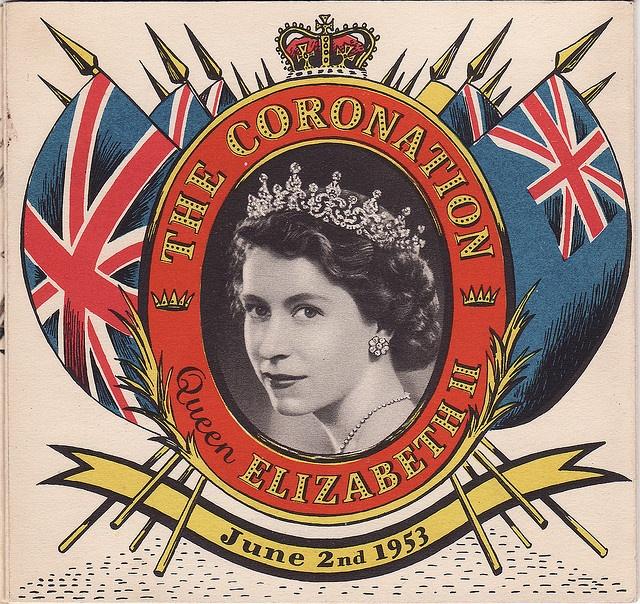
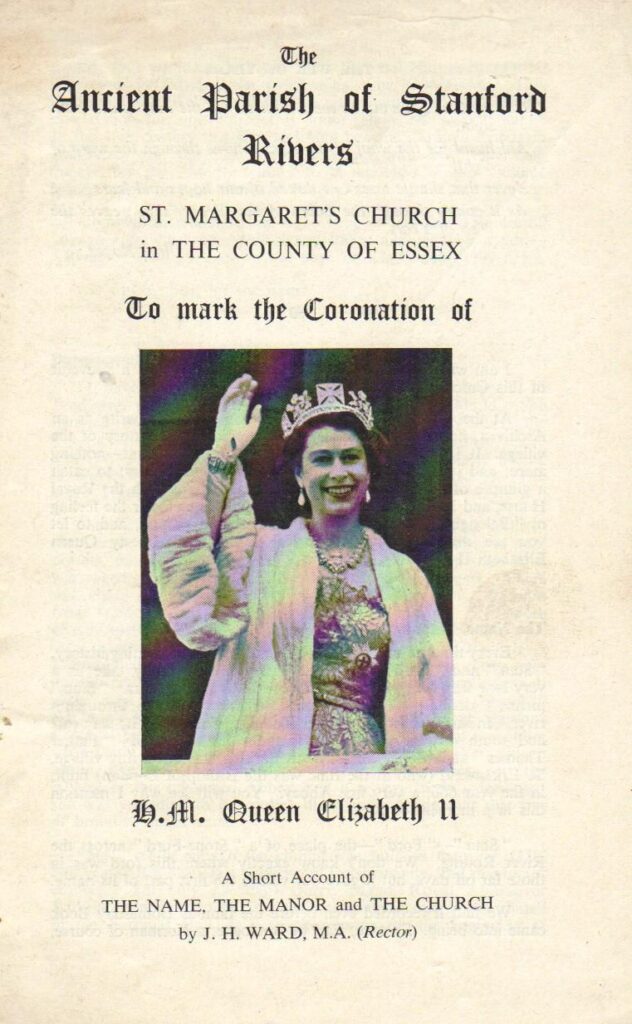
The Coronation of Queen Elizabeth II
For many, the Coronation of Elizabeth II provided that first memorable television experience. Despite a developing network of transmitters, reception was variable. Pictures were often poor, characteristically snowy and, viewed in the company of invited neighbours, at best the 12 inch (or today, 30.48 cm!) tube, meant that much had to be left to the imagination. It rained and Queen Salote of Tonga remained the memory of a persistent triumph over the inclement weather.
Loving Cup from the Coronation
“The loving cup from the Queen’s Coronation, and I remember watching it on TV. I was most impressed by the Queen’s dress which was embroidered with the emblems of all her Commonwealth countries around the world, plus England, Scotland, Wales and Ireland.” – Margaret Padfield
Mementoes of the event survive and are still plentiful.
Coronation Teaspoon and Postage Stamps
“The coronation teaspoon has been in daily use, so much so that the silver plate has nearly all work off. The stamps of Great Britain provide reminders of the age:
1948 75th Anniversary of the Universal Postal Union
1951 The Festival of Britain
1952 The Definitve Stamps of Great Britain, designed by Dorothy Wilding
1953 Coronation and the commemorative stamps of the 62 Colonies
1957 50 Year Anniversary of World Scouts
1958 6th British Empire and Commonwealth Games at Cardiff.
Commemorative stamps were produced much less frequently than they are today.” David and Wendy Thompson
Some mementoes carry special and personal significance.
Hand woven silk velvet for the Queen’s Coronation and Parliamentary Robes, Coronation Medal and citation for William Doe, my father
“In 1952 and early 1953, my father William Doe, a director of Warner & Sons Ltd, was responsible for the contract to weave on the hand looms at Braintree the silk velvet for the Coronation robe and crown, and the parliamentary robe worn today by Her Majesty the Queen to open Parliament. Warners also supplied all the other vestments and hangings for Westminster Abbey. My parents were at Buckingham Palace to watch the Queen leave for Westminster Abbey and return after the ceremony. My father was also responsible for the silk supplied by Warners for Princess Elizabeth’s wedding dress in 1948.” – Peter Doe
Building Society Share Pass Book
“My wife and I began to save when we became engaged, so the original entry includes her maiden name. The only large deposit was a wedding present. The biggest withdrawal was to deposit on our first house. The passbook pages are interleaved with blotting paper; all entries are in ink and are pre-decimal. Thirty years later, I took the book for the nearly-forgotten rump of the money to be updated. The girl at the counter blanched when she saw the £.s.d.. The book had to go to Head Office to be calculated.” – Jack Stewart
Premium Savings Bonds were introduced in 1957.
“My wife and I got married in 1958. I had a new suit for the wedding. As I paid for it in cash, I was given a £1 premium savings bond. Needless to say, we have won nothing on it.” - J. Wood
Living
Everyday living in the 1950s was coloured by austerity and household economy. Rationing, introduced during the war, was progressively relaxed until 1954, but coal was still rationed until 1958. Devices such as the wire mesh soap-saver, which enabled a bar of soap to be used up completely in the interest of that additional wash, was typical of careful attention to household expenditure.
Ration Book from 1952
“I can remember coupons being exchanged at the grocery store run by Mr Liddel. This ration book still has the majority of stamps inside. Only the ones for Mr Liddel’s food have been removed.
My mother saved clothing coupons for a pair of new red shoes for me. These were duly purchased. I can then remember my mother being furious with our Labrador puppy, Trixie, for chewing the shoes.” – Anne Brooks
The 1950s brought innovation in the home; labour-saving devices; new materials; new food options. Numerous examples of these have become accepted as indispensable to modern living, whether liked or not! Terylene clothes were introduced into the UK in 1951. One year later the telephone answering machine was invented. The first electric kettle was developed in 1954. Convenience food took mouth-watering steps forward with the development of the fish finger. The appearance on the High Street of the first outlets of the Wimpy hamburger chain followed one year later. The Tetley tea bag was first introduced to the teapot or teacup in 1952.
The Government had introduced measures to improve the diet of young people.
Coupons
“In 1958, we had our son, Richard, and I was given orange juice coupons and cod liver oil coupons.” – Margaret Padfield
Education
The 1939-45 World War had restricted developments in education. The attention of authorities was diverted to matters at least as pressing and education was disrupted, through the evacuation of children, and the partial destruction of the fabric of education.
Letter dated 8th June, 1946, from King George VI
“All children of school age received a letter from the King shortly after the end of the war in which the King spoke of the “shared hardship and dangers of total War”. As a small boy growing up in London, I well recall the air raids. I slept for several months in a cellar under our house, partly in a gas tent. I was evacuated to Much Hadham for a period where I slept in an Anderson shelter with the mice. My school in Loughton was hit
by a Doodlebug – a cause for some rejoicing!” – Patrick Griggs
Essex was keen to present a memento of the Coronation to children.
Book, “Royalty in Essex”
“All the children in Essex were presented with this book in 1953 on the occasion of the Coronation of Queen Elizabeth II.” – Anne Cook
“We also have the “Royalty in Essex” book that was given to all Essex school children by County Education in commemoration of the Coronation.” – Phillipa Giles
Perhaps strangely, much official data on education only dates from the 1960s. Generally, education in the 1950s followed a succession from infant, through primary to secondary schools. Secondary education was selective based on an examination, the 11 Plus Exam, to determine whether attendance at a grammar school was appropriate, or whether the secondary modern school was better suited. For those considered more able, the ‘Grammar’ held the promise of education leading to A levels and possibly university, whereas the alternative would often result in an early exit from the education system at the age of 15, unfortunately.
School satchel, leather
“I passed “The Scholarship” in 1952, the year of the Queen’s accession. This is the satchel that was bought for me. It was used throughout the rest of my schooldays.
My daughter used it when she started school and used it until holdalls became fashionable.” – June Wood
Hospital Nursing Certificate
“Training for the nursing profession was strict, regimental and exhausting. Patients were segregated in fifty bedded wards and drugs were limited, so strict hygiene was essential. Everything was sterilised by hand.
We worked shifts of eight hours by day and twelve at night with one day off a week. All breakages had to be paid for. Each year, we were required to pass both a hospital and a State examination.
Today I recognise the enormous responsibility we carried for the care of our patients, with limited resources, but the training offered then has been acknowledged today as second to none.” – Anne Stewart
The family holiday of the 1950s still carries enduring memories. Most families afforded one annual holiday, which was usually spent in the UK at holiday camps, hotels or guesthouses at seaside resorts. The first National Park, the Peak District, was designated in 1951. Today, the majority of holidays are taken abroad. Holiday photos from the 1950s, usually black and white, do survive in corners but sometimes the memento is more notable.
Charcoal Sketch of Shirley Fisher
“I was on holiday in Devon with my family and encountered an artist sketching the scenery. My father asked him if he did portraits, He did, and for a cost of 1/6d each, he sketched my parents, my sister and myself.” – Shirley Fisher
Again, a present from a typical holiday -
1951 Necklace and Earring Set
“My best friend, Margaret, gave these to me on returning from a holiday in Llandudno. However, we often had holidays together, with parents, and thoroughly enjoyed them despite the fact we didn’t go far from our homes in Yorkshire, but to Scarborough, Skegness etc. We played tennis, swam, sunbathed and went for cliff top walks, once almost missing lunch as my watch had stopped and we’d no idea of the time. We are still good friends and recently had a wonderful day as guests at her son’s wedding.” – Maureen Meddows
and a coincidence, left at a holiday cottage -
The Illustrated London News magazine
“We discovered this copy of The London Illustrated News magazine in Cornwall in a holiday cottage that we had rented in the 1970s. The date on its cover, 25/4/59, was the date of our marriage and, inexplicably, we found it in one of our suitcases when we arrived home in Essex!” – Joan White
Transport
In 1952, there was no motorway in Great Britain. With just 3 million cars, both the bus and the train, and the bicycle, provided alternative ways of travelling even for short journeys. Less than one in six households had access to a car. More use was made of public transport, the train, and a combination of the two, the trolleybus.
A Trolleyhead
“Essex once had trolleybuses. These were electrically powered passenger vehicles and were used to replace trams in the ‘thirties and ‘forties. Their great attribute was quietness of operation.
Trolleybuses were to be found in Southend-on-Sea, and on London Transport system at places like Woodford, Leytonstone, Barkingside and Ilford. As a youngster, I often caught the 661 at the ‘Green Man”, Leytonstone, to travel to London. Regrettably though, I never sampled the delights of a Southend trolleybus ride, along the seafront to the Kursaal. Trolleybuses disappeared from Southend in 1954 and from Ilford in 1959.
The artefact here is a trolleyhead. It is one of a pair, fixed to long poles mounted on top of the vehicle, that pressed up on the overhead wires to collect the electric current that powered the vehicle.” – Keith Farrow
Entertainment
LP “Rock Around the Clock” by Bill Haley
“Bill Haley was the first rock n’roll star. In February, 1977, Bill Haley came to the UK. He crossed the Atlantic by transatlantic liner, docking at Southampton. The big sister of a friend of mine travelled to London on one of the four or five trains that were laid on to carry all the fans. Bill Haley must have been one of the last touring stars to travel by sea. The passenger traffic at Southampton docks remained steady but eventually declined under competition from cheaper, faster and more convenient air transport. The formerly grand and busy transatlantic passenger facilities, for example, the Great Western Hotel, with its associations with the Titanic, Mauretania, Queen Mary and Queen Elizabeth liners, slowly succumbed during the 1960’s to the airlines.” – Rob Brooks
Collection of bird’s eggs and “The Observers Book of Birds Eggs”
“As a country schoolboy, born in 1950, I spent many happy hours scrambling around the hedgerows of Stapleford Tawney, collecting bird’s eggs. I would ‘blow’ the contents, making holes with a pin at each end, and identify them using the Observer book. At the time considered an innocent and healthy hobby. It is now a criminal offence!” – Duncan Padfield
78 rpm “Hound Dog”, Elvis Presley
“This was my first love. The record label still retains traces of lipstick. Was the lipstick Lucky Pink?” – Christine Marchant
Hound Dog reached number two, spending 16 weeks in the charts. Blue jeans were also part of this teenage revolution in spending habits. They first sold in the UK in 1955. They were different, fashionable and comparatively cheap.
My Mother’s Dress
“I am wearing my mother’s dress, one of those she wore when courting my father. It is white cotton with mauve roses, shoestring straps, a ruched bodice, which was originally boned, and a small skirt that would cover a net underskirt. There is a contrasting wrap to go with it. At some time it was in our dressing up box and I have worn it to dances. I will keep it and pass it on to my daughter for dressing up in fancy dress in the future!” – Phillipa Giles
The formality of the dance or the ball of the 1950s has largely passed.
Dance Card
“In 1955, I went to the Scotch Bachelor’s Ball, where we were given cards. As the first half hour before the dancing began, you filled it in to arrange you dancing partner.
In 1956, we got married. We met at the Young Farmer’s Club. Maurice belonged to “Harlow” and I belonged to “Ongar”. It was known as the Marriage Bureau for the Young Farmers.” – Margaret Padfield
The 55th Aldeburgh Festival takes place this year.
Programme, Aldeburgh Festival, June 14th to 22nd, 1952
“In the early days of the Festival, before Snape Maltings, concerts were heard in the Jubilee Hall and the Parish Church. Lectures were held in the Church Hall, Baptist Chapel and the Cinema. It was all very informal and friendly.
I went to the Kathleen Ferrier recital in the Parish Church. When a concert was due there, streams of folk would be heading in that direction carrying cushions as the pews were very uncomfortable.
Tickets on sale at the Festival Office were priced at 3 shillings each. The complete programme book was 6 shillings.” – Jean Millbank
The festival, founded by Benjamin Britten in 1948 lost some of its importance following his death in 1976. The auditorium at the Maltings was burnt down on its first night in 1969 but was rebuilt in time for the festival the following year. Alas, Kathleen Ferrier died tragically in the year following the date of the programme. Was the programme book a bargain at 3 bob?
Sport
F.A. Cup Final programme and ticket from 1950
“This was my granddad’s programme and ticket from the 1950 F.A. Cup Final between Liverpool and Arsenal. Arsenal won 2-0 in very wet and muddy conditions. Joe Mercer captained Arsenal and Phil Taylor captained Liverpool. Denis Compton, the England cricketer, played for Arsenal. At half-time, Denis, flagging in the conditions, was given a glass of brandy to revive him.” – Robin Fisher
The Wimbledon Lawn Tennis Championships were strictly amateur throughout the decade. A professional circus, led by Jack Kramer, toured extensively providing spectacular entertainment throughout the decade. Kramer, having won Wimbledon in 1947, joined Bobby Riggs, the winner of all three male Wimbledon titles in 1939, in the circus. In the 1950s, Frank Sedgeman and Lew Hoad, both Wimbledon singles winners, among several others, turned professional, leaving the amateur game poorer for their absence. The major tennis tournaments were only opened to professionals in 1968.
Wimbledon programmes from the 1950s
“I played at Wimbledon during the amateur days when professional tennis took the form of a travelling circus. The programmes recorded most of the results. I played Rod Laver at Wimbledon but prefer to forget the score. The amateur days were reflected by the home players travelling to the courts by bus, and players getting to the third round earned themselves a player a meal ticket.” – John Ward
Acknowledgements in the preparation of this article are also due to the Internet, and in particular the National Office of Statistics and the St Osyth Parish Magazine for July 2001. among many others.
Images
Albert John – 1st Battalion Essex Regiment killed in action in Iraq 14 June 1941, aged 27 years. His name appears on the war memorial at Stapleford Abbotts.
Article 7 of 8
The News in Brief – Items from The Times Newspaper
The Times Newspaper 23rd July 1825.
Chelmsford Assizes: James Mallet was indicted for stealing at Stanford Rivers on the 25th March, a horse the property of Edward Rayner. It appeared in evidence that in the night of the 25th of March, the prosecutor, a farmer of Ongar, had his stable and cart-ledge broken open, and robbed of a horse, cart, and four sets of harness. On the 27th, Hall, the officer of Union-hall police office, apprehended the prisoner at some stables in the borough of Southwark; and on searching his person found a key which opened the stable in which was the horse in question. The prisoner then directed the officer to another stable in the same neighbourhood, in which were found three other stolen horses, and a regular set of housebreaking implements. One of the witnesses examined for the prosecution, proved that he was coming to London early on the morning of the 26th March and was overtaken by the prisoner and another man, riding in a cart. The prisoner offered to give him a lift, but he declined. He swore positively to the prisoner’s identity.
The prisoner declared his innocence but called no witnesses.
The Jury, under the learned Judge’s directions, immediately found the prisoner guilty.
The LORD CHIEF JUSTICE then proceeded to pass the awful sentence of death upon this and two other prisoners, who had been convicted of a similar offence during the assizes. His Lordship told the unhappy culprit, that the crime of horse stealing had now become so common in every part of the kingdom, that it became absolutely necessary, for the protection of such property, that the dreadful sentence of the law should take its course.
The prisoners were all deeply affected and were with difficulty removed from the dock.
The Times Newspaper 1st June 1850.
DARING BURGLARY. – On Thursday, between the hours of 1 and 2 am., a most daring outrage was committed in the dwelling house of Mrs. Christiana Waters, in the parish of Stanford Rivers, in this county. It appears that at the hour above named Mr. Charles Clarke, brother to Mrs. Waters, and residing with her, was awakened by hearing some person in his bedroom; on asking who was there he received no reply, and on attempting to get out of bed he saw a man standing in the room in the act of pointing a gun at him, at the same time saying, “If you don’t lie still I will blow your brains out.” The fellow almost immediately fired, severely wounding Mr. Clarke in the left arm and face, the shot tearing away a large portion of the flesh on the upper part of the arm. Notwithstanding this, Mr. Clarke courageously grappled with the ruffian, and held him till the arrival of his two nephews, who slept in another part of the house, and had been aroused by the report of the gun.
The robber proved to be a young man named William Green, a loose character from Ongar, who was convicted of felony at the quarter sessions in January last and sentenced to three month’s imprisonment. The gun used by Green was the property of Mr. Clarke and had been placed in one of the lower room through which the fellow passed on his way upstairs.
The prisoner was shortly after given into the custody of Superintendent Flood, by whom he was taken before Mr. J. F. Wright, and, Mr. Clarke being unable to appear against him, he was remanded to Epping till Saturday next.
The Times Newspaper 27th October 1931.
Lady Hudson recommends her Under Chauffeur, leaving after five years’ service: married: running repairs: some knowledge London. – Apply Walter West. 43. Theydon Mount, Epping.
The Times Newspaper 5th October 1953.
POLICE SEARCHING FOR CATTLE POISONER. Epping Criminal Investigation Department are investigating a case of cattle poisoning on glebeland at Stapleford Abbots, near Romford, Essex, the second which has occurred on the same land. Several Friesian heifers belonging to Mr. F. Padfield. of Pinner's Farm, Stapleford Tawney, which had been put out to graze on the glebeland, were killed last year. Mr. Padfield recently received an anonymous letter which said that if he continued to cultivate the land at Stapleford Abbots more heifers would die. Several more have since been poisoned. Five died and two are recovering.
“There were 18 heifers in the field.” Mr. Padfield said, “and enough poison had been put down to kill 400. My father farmed the glebeland in question for 37 years and I have farmed it myself since 1946.”
The Times Newspaper 19th December 1955.
SIR D. HAMILTON-SPENCER-SMITH, Sir Drummond Hamilton-Spencer Smith, Bt., O.B.E., died yesterday at his home at Stapleford Tawney, Essex, at the age of 79. Drummond Cospatric Hamilton-Spencer Smith was born on November 4, 1876, the son of the Rev. Spencer Compton Hamilton Spencer-Smith, vicar of Kingston, Dorset, and Mary, daughter of Admiral. Cospatric Baillie-Hamilton. He was educated at Eton and New College, Oxford, and in 1900 he was gazetted to the Royal Artillery, in which he was to serve for 24 years. From 1910 to 1913 he was Military Secretary and Staff Officer, R.A., to the G.O.C., New Zealand Forces, and during the 1914-18 War he served as Brigade-Major, R.A., 4th Division, in France, being mentioned in dispatches: as commandant of the 4th. Army Artillery School during 1916-17, as commandant of the RA. Officers Cadet School at Exeter during 1917-18, and in command of the 14th R.H.A. Brigade in France during 1918. From 1920 to 1924, when he retired with the rank of lieutenant-colonel, he served on the International Commission of Control in Berlin. He was made an O.B.E. in 1923 and succeeded his cousin Sir Drummond Cunliffe Smith as fifth baronet in 1947.
He married in 1915 Roma, daughter of Arthur Hope, of Timaru, New Zealand. She died in 1918, leaving him with one son. He married secondly, in 1923, Mary Aurora, widow of Colonel Ridley Boileau, R.E., of Heavitree, Exeter, and daughter of Canon H. Tudor. The baronetcy devolves upon his son. Captain Thomas Cospatric Hamilton Spencer-Smith.
Article 8 of 8
Programme for 2022
High Country Programme
2022
24th March
Annual General Meeting
28th April
Chimneys, hearths & fireplaces. Aspects of domestic architecture in timber-framed buildings
Anne Padfield
26th May
The History of Copped Hall
Vic Knope
23rd June
Supplying the Army: The Contribution of Essex to Provisioning the Forces of Edward III, c.1337
Neil Wiffen
28th July
The Life and Times of Admiral Sir Eliab Harvey
Martyn Lockwood
27th October
The Plant Hunters
Maggie Piper
24th November
The World of Art Deco
Mark Lewis
Meetings are held in Toot Hill Village Hall.
Meetings start at 8.00pm.
Members £1 ~ Visitors £3.
Refreshments