High Country History Group
Contents
Article 1 of 10
Visit to Copped Hall, Epping
On the 11th May a party of us went to Copped Hall, Epping, on a private visit organised by the Copped Hall Trust. Our guide for the afternoon was Vic Knope, who is one of the trustees. We had a full tour of the house and the kitchen garden, lasting 3 hours. Tea and delicious home-made cakes were provided. Vic was not only an enthusiastic guide but very knowledgeable on the history of Copped Hall.
Having not visited the house for some years I was amazed to see the amount of work that has been carried out in bringing the house back to its glory days. Much is still to be done and the work is slowly progressing, much being undertaken by professional builders as funds are available.
There are a number of open days and other events, including concerts held to raise funds. Check out their website for further information.
www.coppedhalltrsut.org.uk
Images
Visit to Copped Hall
Copped Hall, Epping

Article 2 of 10
A Visit to Ongar Fair
During the past few months Ongar fair has attained great notoriety throughout the county, owing to the hard struggle it has had to maintain its existence. In order that the leading facts of the matter may clearly present themselves to your readers’ eyes I will with your permission briefly recapitulate the history of the agitation for and against the fair.
By an ancient charter a statute fair for hiring servants has been held for several hundred years in the High-street of Ongar on the 12th October. Formerly the labourers and lasses anxious for a ‘change’ stood in a row on the footpath and the farmers and their wives reviewed the troop and made their selection. This portion of the fair has of late years become ‘fine by degrees and beautifully less,’ and what is known as a ‘pleasure fair’ has formed the main characteristic of the day,
In April last a public meeting was held at the Town Hall, when the desirability of abolishing the fair was considered. A committee was formed to secure the result, and a petition praying for its abolition was submitted to the householders of the town and numerously signed. Meanwhile a strong feeling was aroused in Ongar against the abolition, and a counter memorial was widely circulated throughout the district. The town became divided into two parties. The abolition party denounced the fair as incentive to drunkenness and immorality and appealed to all to aid in removing temptation from the labourers' path. The supporters of the fair denied these sweeping charges in toto and begged of the townsfolk not to rob the poor man of an innocent amusement. The abolitionists applied to the magistrates in July to make a representation to the Secretary of State that it would be to the advantage and convenience of the town if the fair was abolished. After hearing both sides at great length the bench adjourned the case to ascertain what recreations could be provided in lieu of the fair. The question was again argued within a month afterwards, when the memorialists submitted their scheme, which was to establish rural fetes in each of the adjacent parishes on the fair day. In the end, the majority of the bench decided to recommend the abolition of the fair. The upholders of the fair then proposed to hold a meeting, but the Town Hall and the Trust School could not be obtained for that purpose, and a torchlight-gathering was held in Mr. Christie's courtyard.
A counter memorial was numerously signed; a deputation waited upon the Home Secretary on the 19th of September, and Mr. Bruce eventually decided that there were no grounds for the abolition of the fair. Subscriptions were immediately opened for the improvement of the fair, and the appeal was responded to to the extent of about £20. A prize list for athletic sports was formed, and circuses, bands, menageries, and other amusements advertised for. But although the committee had saved the fair, the course of their labours on behalf of ‘the poor’ did not run smooth, and the procuring of additional amusement did not prove so easy as might have been expected. Mr. Youen's, the aeronaut, promised to give a balloon ascent, but it being found that a sufficient supply of gas could not be obtained, the project had to be relinquished. The local rifle band was requested to play for the enlivenment of the proceedings, but was not permitted to attend, somewhat to the chagrin of a certain portion of the members.
Negotiations were commenced for a military band, but they fell through at the last moment. Eventually Mr. Payne's band, of Bethnal-green-road, was secured. The committee finding that the fair whenever it had fallen on Saturday the past had been postponed until the Monday, issued a second programme stating that in order that nothing might interfere with the Sunday which intervened between the fair days, the sports would be held on Monday.
On Saturday morning I went over to Ongar to see and judge of the fair for myself. In the irregular High-street were pitched a number of booths, while a roundabout was in process of manufacture in a courtyard nearby. A few labourers were sauntering up and down the town with their hands in their pockets. There was no appearance of a flourishing business being done; in fact the chief end and aim of the stall keepers was the dressing and re-arranging of the boards. Before eleven a cold drizzling rain set in, chilling the energies of sightseers and damping the prospects-of a good day for the stall keepers. At three o'clock the weather became clearer, and there was a gradual increase in the attendance.
The principal attraction in the earlier part of the day was an oblong inclosure dedicated to Aunt Sally. The targets were cocoa nuts, set upon poles within capacious sacks, and became the property of the person sufficiently dexterous to knock them down beyond the cordon of the sack. The playing was exceedingly wild, threatening more danger to the heads of the bystanders than to the cocoanuts within. In nearly every case, moreover, where a nut was knocked off its perch it fell the most provoking manner into the sack's mouth. As the white fog crept up from the river, and the scene became more dusky and indistinct, this sport failed to sustain its attractions, and the very shaky structure enclosing it was the first booth to move from the ground. The crowd in the street from mere groups of twos and threes gradually increased into compact masses opposite the various tents. For powerful digestive organs and capacity for accommodating diverse compounds commend me to the visitors to Ongar fair. They hung in knots around the curly, dark-haired, swarthy gipsies, in whose creed the display of ear and finger rings taken precedence of cleanliness, and eagerly purchased platesful of shelled whelks, having a depressingly vermicular appearance, stewed prunes, handsful of shrimps, tough sausage rolls, dubious saveloys, sticky and fragrant pieces of ‘rock,’ and other delicacies, indiscriminately and in rapid succession.
Perhaps I ought to have ascertained from closer scrutiny the condition of the exceedingly fine ‘natives,’ that required such a lavish expenditure of pepper and vinegar before being raised to the widespread jaws waiting to entomb them, but the iridescent colours and certain pungent aroma hanging over the stall caused courage to evaporate on approaching the sticking point. The light shed by the streetlamps, the flare of the pendant paraffin lamps, and the clear sickly light of the moon, afford striking contrasts in colour and shadow, the net result being, if I may use the expression, a somewhat grotesque picturesqueness.
The stalls which an element of chance is imported into the bargain are by far the most popular. Children of eight and ten indulge their gambling proclivities by investing halfpence on the turn of an arrow suspended over sundry packets of their favourite ‘rock.’ I watched the laudable endeavours of one professional gentleman to earn an honest livelihood for some time, his stock-in-trade consisted of a small table divided into four numerated compartments and having the usual revolving arrow; he staked 4d. to 1d. on the compartment at which the arrow should stop. The game proceeded merrily, but it was obvious that the man could not afford to play fairly at this rate, as no margin was left for profit. Closer inspection revealed the fact that the arrow very quickly slackened its speed when leaned towards the table, and a small button projecting by his hand clearly was part of a ‘break’ that regulated the arrow in its course. A man standing by who answered the description of a ‘sporting’ man — given an undersized man, close shaved three days since — appeared to be successful in carrying off the stakes about three times out of four but played stolidly on without note or comment. The foolish fellows surrounding the table allowed themselves to lose in almost every case without suspecting any trickery. Close to him stands a man with a board on which some knives are set up, to be earned by casting ring over them, a penny being charged for each four throws. The feat looked very easy, but none are able to so throw the ring to secure a knife. To speak candidly, I should consider them dearly bought did each throw successful. This stall, partaking more of the character of test of skill, not so well patronised as many of the others. Many mothers of families hover around the booths set apart to the sale of the cheap china ornaments and picture frames that form such a well-known feature on cottage mantelpieces, and are pestered by their olive branches into purchasing various useless knicknacks and small toys as ‘fairings.’
Two men are pattering songs without any attempt at tune, and I fear from the bursts of laughter that come from the ring of lads and servant girls that surround them that sweethearting is a prominent and broad feature of the ditties. A tremendous noise has been maintained throughout the evening on a gong and drum and a wheezy cornet by two small boys and man attached to ‘gymnastic entertainment by Miss Sylvester,’ and occasionally a brawny one-eyed man parades the street on stilts, followed by the lads beforenamed, the trio shivering in faded tights nearly denuded of their spangles. They invariably return to their booth with large number of sightseers, and the very short performance at once begins, the object being to pass as many through in the time possible. A velocipede circus attract constant succession of lads and few girls, and is in full swing throughout the evening. A swinging boat and roundabout stand together, and constant succession of screams and shouts enlivened the neighbourhood. As the evening wore on the wind became keener and the sightseers adjourned to the public-houses to enjoy the solace of a little music with an occasional song. A harp, several violins, concertinas, and a stray cornet are pressed into the service, and now and then some excited labourers break out into an uncouth dance.
At eleven o'clock the dozen policemen whose sentry duty up and down the fair has been almost a sinecure, intimate to the boothkeepers that they must close once, in accordance with the Licensing Act. The notice is met with good deal of grumbling, for the police just visited and cleared the public-houses, and the greater part the crowd is anxious to spend its money as quickly as possible.
The packing up, however, is hastened by the fact that small pilferings are briskly being carried on by the loafers and hobbledehoys hanging round the stalls. The utility of the Licensing Act is well shown, for in the past the fair was carried on for a considerable distance into the small hours. I observe very few people at all ‘fresh;’ one man certainly has just fallen helpless to the ground, and asks ‘boots’ if he has anyone he can send to see him home. That functionary explains to onlookers that the gentleman is subject to fits and accept the statement in all charity. I am informed by the older inhabitants that the fair has not come up to the average of former years, but they confidently look forward to Monday to revive the glorious memories of the past. ‘Wait till Monday’ is the general cry. Speaking impartially, I have seen very little yet of the drunkenness said to be attendant on this fair and can glean no positive evidence of grosser immorality. I fear that some of the gipsy women who are so attentive to the young labourers, and ready to be treated, are very little better than they should be. The fair will compare favourably with numbers of the most select horse races, but unquestionably there must be a certain amount of annoyance to the quieter inhabitants from the shouting and singing that attend it, and I am inclined to doubt whether the pleasure will balance the heavy outlay on the part of the labourers who attend it in such numbers. Scores and bills will have to run for a long time while to-day's amusement being paid off. But I have not yet seen the fun of the fair. That is reserved for Monday.
MONDAY. The street yesterday was very quiet, and but for the unusual influx into the licensed houses during open hours, and the closed booths in the street, from whence occasional quarrelsome sounds pitched in a high key were wafted on the breeze, no one would have been aware of the fact that we were enjoying an interregnum in the much-dreaded fair. At Greensted church and the Congregational chapel the existence of the fair was deprecated, and the congregations were urged not to lend it their presence. No allusion was made to it at the other places of worship in the neighbourhood. It was remarked that the congregations were in eachcase unusually scanty.
The weather was anxiously speculated upon last night, many fearing that the day would prove wet. However, the morning proved one of those delightful October days, when the bright sun makes all cheery without oppressing by its heat. Again more shooting galleries, gipsies' vans laden with brushes, mats, gingerbread, and tawdry jewellery arrived during the morning, but there was but little business transacted before noon. The town was gaily decorated with strings of flags crossing the street opposite the Red Lion, the Post-office, the Grammar school, and one or two other places. Party feeling ran very high with regard to these decorations, and in several cases, permission was refused to fastening the line to a chimney. At half-past eleven a large crowd assembled at the railway station to meet the band, which played through the town, followed by many persons. At two o'clock the athletic sports were commenced, the course being that portion of the High-street between the Post-office and the town bridge from the upper end of the street an animated scene was presented, the roadway being densely thronged from end to end with an excited, ever-moving crowd, who frantically cheered the band and the favourite competitors. The traditionary ‘oldest inhabitant’ could not recollect such a sight in Ongar before.
The first event on the programme was a Walking Match, course about a mile; five started. Charles J. Lacey kept the lead the greater part of the way and came in first; George Prentice and A. Prentice were close behind, and came a dead heat for second place.
The Long Jump came off near the bridge. About a dozen contested—W. Smith, 1st; Robert Hart, 2nd.
Bicycle Race — Only three started. A. J. Prentice came in at a tremendous pace a long way ahead of his competitors; and W. R. Charge was second. This race, from its novel character, attracted great interest.
Quarter-mile Flat Race — Nine started but had great difficulty in forcing their way through the crowd, which closed and hemmed them in; W. Oakley came first, C.J. Lacey second.
Donkey Race — Three started. This was a very amusing race the men having some difficulty in urging their steeds up the hill; Taylor and Tolson came dead heat. They ran again when Taylor won by a length.
A Quarter-mile Flat Race was substituted for the egg and spoon race. Five started. 1, J. Penson; 2, W. Millson.
At this stage of the proceedings Captain Budworth, who was warmly received, addressed the assembled crowd from a doorway, and begged of them be as quiet and orderly possible. There were many watching them who objected to the fair, but he believed that it would be more firmly established than ever. Three hearty cheers were then given for the Captain, and the concourse re-assembled on a field by the Town Bridge to witness a pony race, followed by climbing a high greased pole for leg of mutton. The leg of mutton fell to the lot of a youth named Hammond, of Epping, amid cheers, and he was afterwards carried round the town in triumphal fashion.
DINNER OF THE UPHOLDERS OF THE FAIR.
Between five and six o'clock the same evening the friends and supporters of the fair dined together at the Lion Inn to celebrate their success retaining the fair. Mr. E. C. Wright was advertised to preside, but in his absence the chair was occupied by Mr. Wm. King, farmer, of High Ongar. Covers were laid for about 60 guests and the room was well filled. Among those present were. Father Pare, Roman Catholic Priest; the Rev. T. M. R. Barnard; Dr. Clark, the Chairman, Messrs. Young, Scruby, Clarkson, Hogg, Caton, Brown, R. Amos, Littlechild, James French, sen., Robert French, James French, G. Dixey, C. J. Rowden, Rose, Thomas Brooks, Josling, G. Richardson, Robert Amos, Win. Caton, Fogg, Littlechild, Cooper, R. Brittain, Philip Pain, James Smith, Hunt, Mott, sen., Cooper, Lemon, Mills, H. Pain, Brown, Smith, Sanders, Livermore, Dyson, Jackson, Pearce, Maulraine, Lacey, Wederell, &c.
A band took its position in front of the inn, and as the company sat down, played ‘The roast beef of old England.’
A grand display of fireworks closed the programme of the day, and in a short time the streets were comparatively deserted.
Source: The Chelmsford Chronicle 18th October, 1872.
Article 3 of 10
Annual High Ongar Fair
Members familiar with the Chipping Ongar annual hiring fair will remember that this event had been established by statute, and could only be suppressed by the Home Secretary after a petition from local residents via the justices of the peace. Having lost its original farm servant hiring function by the early nineteenth century, the fair had degenerated (in the view of some of Ongar’s killjoy citizens) into an occasion for drunkenness, general debauchery and noisy inconvenience to the more strait-laced inhabitants.
Another annual fair took place regularly at the end of May at Norton Heath and by the beginning of the twentieth century had led to confrontations between temporary van dwellers and some of the local residents who hitched up the horses and attempted to drag the travellers onto the public road. Ongar Rural District Council, which had assumed responsibility for this area of common land, applied to the Home Secretary for the abolition of the fair, and permission was granted in July 1908, though for a number of years afterwards vans continued to turn up to be confronted by the heavy-handed local blacksmith. The heath is now densely covered with young oak trees as well as being heavily scarred with gravel extraction pits, and today it is impossible to imagine it as the site of a fair!
Other annual fairs seem to have arisen spontaneously without statutory establishment, and one such was the short-lived example held at High Ongar in the middle years of the seventeenth century. This came to the attention of the Essex Quarter Sessions in July 1657 after a series of complaints that ‘divers disorderly persons about the beginning of September yearly meete together in the Streete of High Ongar aforesaid, and under pretence of keeping a Faire there divers Disorders of quarrelling and Drunkeness are committed, to the great Dishonor of God, Disturbance of the publique Peace and Disquiett of the Neighbors thereabouts’ – apart from the distinctly puritan claim that God was being disrespected, these were much the same grounds for abolition that the residents of Ongar were to put to the Home Secretary over two hundred years later.
It is interesting that the earl of Warwick (as the relevant lord of the manor) confirmed that this fair had no statutory backing. The court reached the decision that it was ‘of noe benefit to the County’, and that it was ‘only kept and attended by some few Pedlers and idle persons’. Free of any requirement to apply to the Home Secretary (or his seventeenth century equivalent), the court duly issued instructions to the local constables to apprehend anyone attempting to attend the next fair. It went further by requiring that public notice should be given in nearby towns (presumably via the town criers), that the minister of High Ongar should proclaim the court’s order from the pulpit, and that no inhabitant of the village should brew beer ‘under colour of a faire to be kept there, upon paine of being punished as unlicensed Alehousekeepers … and further as disturbers of the publique Peace.’
These somewhat draconian measures seem to have been effective, and nothing more is heard of the High Ongar fair.
Sources: Allen D H (1974) Essex Quarter Sessions Order Book 1652-1661, ERO
Sharp P & Leach M (2022) unpublished account of Norton Heath and its tumulus
Article 4 of 10
Traditional Medicine in 18th Century Essex
Even by the eighteenth century, illness was not regarded as a circumstance which necessarily required much positive action. There remained the notion that it was imposed by God, and it was largely a matter of waiting until the affliction was removed.
Self help was the first resort, and the main care of the sick came from within the family circle. Treatment was based on traditional home-made remedies passed down from mother to daughter. The houses of the wealthy still maintained physic gardens, and Flora Thompson tells us that as late as the 1870s, the village women of Juniper Hill cultivated corners of their gardens with herbs and made their own therapeutic drinks:
'Peppermint, pennyroyal, horehound, camomile, tansy, balm, and rue for physic. They made a great deal of camomile tea which they drank to ward off colds, to soothe the nerves, and as a general tonic. The horehound was used with honey in a preparation for sore throats, and colds on the chest...and the women had a private use for pennyroyal. As well as garden herbs, still in general use, some of the older women used wild ones, which they gathered in their season and dried. But the knowledge and use of them was dying out.'
Country law and recipes for cures were part of everyday conversation. In Dagenham, in 1822, John Prior asked the Overseers for relief as his arches (of his feet) were so bad and was told by Mr Britain that he had heard that threshing with nettles would cure rheumatism.
Old medical recipes often appeared in parish registers such as the one left by Thomas Gilbey, vicar of St Mildred's, Tenterden, in Kent (1701-51) as a prophylactic against the plague. Private receipt books were compiled by the literate, and medicinal remedies were part of a body of household knowledge which included cures relating to both human and animal diseases. Bassom, an Essex plumber, even wrote them down at the end of his account books for 1807-11. Documents relating to the Convent of the Holy Sepulchre, at Boreham, include a specific medical book with general cures, and medicines prescribed at various times for the community.
Physick (1741) and Buchan's Domestic Medicine (1769) ran into many editions.
For those who chose to use them, mainly the poor, there were supernatural aids to be invoked. Belief in the curative power of the Medieval Church had survived the break with Rome, and alongside petitionary prayer, debased versions of Catholic prayers were used as charms, and the invocation of the Divine was incorporated into the incantations of 'cunning' men and women. Faith in magical cures lingered on into the nineteenth century (and probably beyond). In 1856, it was noted that in Lincolnshire:
'Those who are not in daily intercourse with the peasantry can hardly be made to believe or comprehend the hold that charms, witchcraft, wise men and other like relics of heathendom have upon the people.'
A wide range of innovative patent and proprietary medicines and prescriptions were to be had from the chemists and druggists, and there were few aids to 'health' that could not be furnished by quacks selling their wares at fairs and markets, or by public advertisement.
Apart from the rich who could afford the services of a physician from a town, medical care was available from men and women who had learned their skills from their forebears and who practised medicine alongside their usual daily occupations – apothecaries, herbalists, bonesetters, blood-letters, cutters of the (kidney) stone, and the like – and who had had no formal education. Some had no medical training at all. A Presbyterian minister, John Clegg (1679-1755), practised medicine to feed his family, and a farmer. George Winter who, by chance inheritance of his uncle's medical manuscripts and textbooks, treated the poor free of charge three days a week and bore a remarkable similarity to Mary Russell Mitford's village 'doctor' of the 1820s, Dr Chubb:
'Inventor and compounder of medicines, bleeder, shaver, and physician of man and beast...His skill he had...inherited from his aunt Bridget, who was herself the first practitioner of the day, the wise woman of the village, and bequeathed to this her favourite nephew her blessing, Culpeper's herbal, a famous salve for chilblains, and a still.'
Women were traditionally the backbone of medical care. They were the 'wise women' who were called in to assist in childbirth, illness, and the last stages of life. Although increasing displaced by professional practitioners, many men and women versed in traditional remedies continued to practise, like Elizabeth Gaskell's country-born Alice Wilson, who:
'In addition to her invaluable qualities as a sick nurse...added a considerable knowledge of hedge and field simples much used by the poor.'
A scathing observation by William Farr, the Registrar General, in 1877, suggests that despite the inroads of 'orthodox' medicine, traditional medicine was alive and well, and had many takers:
'A considerable number of people die without the attention of a qualified medical man...and hundreds and thousands are treated by quacks, ignorant midwives, unqualified attendants, and chemists and druggists.'
The fact that most professional medical men could offer little better hope of a cure than the traditionalists is another story.
Article 5 of 10
Rochetts, South Weald & John Jervis the Earl of St. Vincent
Sir Thomas Parker, (1695 – 1785) was a wealthy Privy Councillor and Chief Baron of the English Exchequer. He lived at Rochetts, South Weald in Essex. He was married twice and had two sons and a daughter, Martha, by his second marriage.
Parker died at his home on the 29th December 1784.
His daughter, Martha married her cousin John Jervis on the 5th June 1783 and on the death of her father they lived at Rochetts.
John had been born in 1735 at Meaford, Staffordshire and he joined the Royal Navy on January 4, 1748, with the rating of Able-Seaman on the vessel Gloucester bound for Jamaica. He stayed with his ship until June 25, 1752, when be joined the Severn as a midshipman.
With no money, he once bitterly remembered:
‘My equipment was what would now be called grotesque. My coat was made for me to grow up to; it reached down to my heels, and was full large in the sleeves. I had a dirk, and a gold laced hat, but my father had a large family, with limited means. He gave me twenty pounds at the start — that was all he ever gave me.
I had to change my mode of living; quitting my mess, living alone and took up the ship allowance which I found sufficient, but I washed and mended my own clothes, made a pair of trousers out of my bed-ticking, and having, by these means, saved as much money as would redeem my honour. From those times, I have taken care to keep within my means.’
With great determination, the young man set himself on a path that would change his future life. He worked non-stop, studying. Eventually, on passing his examination as lieutenant on January 22, 1757, John took temporary command of the Royal George, later becoming attached to the Channel Squadron in 1760 commanding the 44-gunner Gosport, under Rear-Admiral Rodney.
Martha and John managed to meet occasionally at Chelmsford balls, when the young sailor was on leave, but John wrote to his sister, Mary: ‘My clothes are all in tatters, too shabby to go among genteel people.’
Although time was passing and they desperately wanted to wed, the situation was impossible. John had very little money and was certainly not in a position to propose marriage in those class-ridden times.
As Sir Thomas’ heiress, Martha held high social rank in the Essex upper classes and her prospective wealth was considerable. John was poor, and on half-pay as England was then at peace. A miracle was needed if they were ever to marry.
In 1782, England was again at war with France. Jervis was now Captain of the Foudroyant, one of the largest two-decker ships in the English Navy and fought a brilliant sea-battle to capture the French ship, Pegase.
He returned home, triumphant. Prize money and a knighthood followed. At long last, he was now considered to be an acceptable husband for Martha, who had waited for him for over 20 years. Their wedding took place on June 5, 1783. This date, he reckoned, was his year of destiny and he often commented with mock heavy humour:
‘I committed three great faults about this time – I got knighted; I got married; I got into Parliament!’
Upon the death of her father in 1784, Martha received her inheritance. She was now exceedingly rich and Rochetts became the couple’s home, although sadly, it was too late for the couple to have a family.
However, John’s career soared. From Vice-Admiral in 1795 he became Commander-in-Chief of the Mediterranean fleet within two years. By then, the war with Spain was raging. Always a superb judge of men, it was John who interviewed and later promoted a young unknown officer by the name of Horatio Nelson.
Early in 1797, England received news that a large Spanish fleet had set sail to join the French to invade England. At dawn on February 14, John’s flagship Victory, along with 14 other ships, engaged the enemy in a mighty battle off Cape St Vincent, capturing four Spanish ships.
Honours and money were heaped on John, along with a peerage. There is now a monument to him in St Paul’s Cathedral and numerous portraits of him at different periods of his life.
‘I do not say, my Lords that the French will not come. I say only that they will not come by sea,’ began his address to the House of Lords as First Lord of the Admiralty in 1801. He was now the Earl of St Vincent.
Around the turn of that century, John gave up his Mediterranean command and returned to Rochetts at Brentwood, where he lived peacefully until his death aged 88 on March 14, 1823. He had requested to be buried in his native parish, Stone in Staffordshire, and not in St Paul’s or Westminster Abbey as had been assumed.
Images
Rochetts, South Weald
Sir Thomas Parker
Sir Thomas Parker (1695 – 1785)
Article 6 of 10
William Byrd
If you saw the Coronation of King Charles III then you will have heard two pieces of music by the great Elizabethan composer William Byrd.
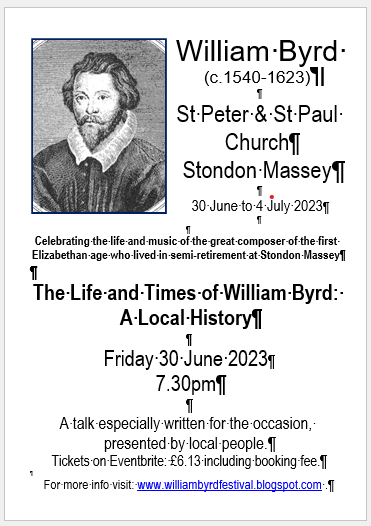
William Byrd’s life and music will be celebrated at Stondon Massey Church this summer.
These are short extracts from the book which will be published alongside a talk to be given at Stondon Massey Church on 30th June 2023.
On the south wall of St Peter & St Paul Church, Stondon Massey, there is a memorial to one of England’s greatest composers.
Titled: “A Father of Mvsick”
Inscribed: “To the Glory of God and Memory of William Byrd
Who lived at Stondon Place In this Parish for the last Thirty Years of His life.
He died 4 July 1623 Aged Eighty
This Tablet was erected in 1923 in Celebration of the Tercentenary of His Death”.
The memorial was placed due to the efforts Reverend Canon Edward Henry Lisle Reeve who was the Rector of Stondon Massey from 1893 to 1935. Reeve was a keen local historian and “great supporter as well as a sterling advocate of Byrd’s music”. He wrote copiously and published a parish history, and a published article in ‘The Essex Review’ to mark the tercentenary of Byrd’s death.
Memorial in Stondon Massey Church commemorating the
Tercentenary of Byrd’s death
The Byrd Memorial was funded from money raised from the London Tercentenary celebrations. The Gentleman of the Chapel Royal attended the Dedication Service in 1924.
Reeve also received a copy of Byrd’s will, which still is in the Vestry. It reads:
“In the name of the moste glorious and undevided Triniyte Father sonne holy Gost three distinct persons and one eternall God Amen
I William Byrde of Stondon Place in the p[ar]ish of Stondon in the Countye of Essex gentleman doe nowe in the 80th yeare of myne age ….
… my body to be honnestly buryed in that p[ar]ish … of Stondon wheire my dwellynge is: And then to be buried neare unto the place where my wife lyest buryed. …
In wittnes theirof I the sayd william Byrd have sett my hand & seale the Fifteenth day of November … 1622”.
William Byrd’s signature on his Last Will and Testament
Byrd’s death in 1623 is recorded in the Chapel Royal Cheque Book: “Will[ia]m Bird, a Father of Musick died the iiiith of July, And John Croker, a co[u]nter ten[o]r of Westminster was admitted [th]e 24th of December following”. He probably died at Stondon Place or at the Earl of Worcester’s house in London and is thought to have been buried in Stondon Massey churchyard”.
Stondon Massey’s Parish Registers before 1708 have been lost. “Surviving parish records do not record that “any objection was raised to the burial of a Catholic in the churchyard at Stondon”.
“We can claim Byrd for a Stondon man”.
William Byrd was about 82 years old when he died. His family moved in Stondon Massey around 1594.
Byrd was a recusant Catholic who refused to attend the Services of the Church of England. While living at Stondon Massey, Byrd composed two books of illegal Latin religious music known as the ‘Gradualia’.
The first set of 1605 was dedicated to the Earl of Northampton, and the second set dated 1607 was dedicated to Byrd’s great friend and patron, Lord Petre of Writtle who lived nearby at Ingatestone Hall.
According to a household inventory dated 1608, the Petre family possessed “2 sets of Mr Byrd’s books intituled Gradualia, the first and second set”, as well as other books containing “songs” by the composer.
All the pieces were probably tried out at Ingatestone Hall before publication.
Byrd’s story is fascinating. Do come to the talk presented by several local people (including half-time refreshments). There will also be a Service on Sunday 2nd July starting at 3.00pm which will include Byrd’s music performed by the Stondon Singers. Then on Tuesday 4th July at 8.00pm, on Byrd’s commemoration day, book tickets for the Stondon Singers Special 400th Anniversary Concert.
Images
William Byrd
William Byrd’s signature on his Last Will and Testament
Memorial to Sir John, 1st Lord Petre of Writtle (d.1613),
William Byrd Memorial
Turbet, 2012, 229
John Harley (1997) believes that there was a delay between the drafting and signing of the Will. William Byrd was probably in the 82nd year of his age when he signed the document in 1622. Testimony, in his own hand, submitted to the Court of Star Chamber on 2nd October 1598, indicates that Byrd is ‘of Stonden in the Conty of Essex, gent age of 58 yeares or ther aboutes’.
Harley, 1997, 154
The Earl of Worcester was a supporter of William Byrd, and it seems, according to Byrd’s will, he had lodgings at a house owned by the Earl in The Strand.
Harley, 2010, 165
Harley, 2010, 165
ERO T/P 188/1/1 f309. The manuscript, now at the Essex Record Office, is ‘Notes for a Parish History’ written by Reeve. There are in total three volumes.
Edwards, 1975, 138
Bibliography:
Edwards, A C. John Petre (1975)
Harley, John. William Byrd: Gentleman of the Chapel Royal (1997)
Harley, John. William Byrd: Musicians, Merchants, and Magnates (2010)
Turbet, Richard. ‘William Byrd. A Research and Information Guide. Third Edition’ (2012)
Article 7 of 10
Award for Bravery
Charles William Dunn joined the Essex Constabulary in April 1892 (as Constable 286) and during his short service he was stationed for a time at both Ongar and Epping. On the 15 June 1899 he was presented by HRH Duke of York (George V) with a Royal Humane Society Award for saving the life of one George Bridge from drowning at Ongar, on the 18 May 1899.
Dunn resigned from the police in 1902 and for a while was the licensee of the Merry Fiddlers Public House at Coopersale, and later a shopkeeper on Bell Common, Epping, where he died in 1946, aged 73.
Article 8 of 10
Dates of Essex Censuses 1801-1831
It is widely believed by many family historians and local historians that the first census of England and Wales took place on the night of 6th June 1841. It did not.
The first census took place on Tuesday 10 March 1801 - following the previous year's Census Act of 1800. Censuses then took place at 10-yearly intervals. The only break when a census did not take place was during the Second World War - in 1941.
The first four censuses (1801, 1811, 1821, and 1831) were concerned
with the country's statistics and population. But not so important to
the powers-that-be in these years were the names/occupations and
precise addresses of individuals. Details of a place were collected
locally by the parish. Each parish using its own variation of methods
for the collation. Then the official information was sent off by the
parish.
Leaving behind much of their working documents (often just rough
drafts, schedules and lists). These working documents were then
often destroyed by the parish. However, in some places, this very
early census information was kept - normally in the parish chest.
Over the years, surviving early census information has been
deposited in county archives and record offices
. 1801. Census took place Tuesday 10 March 1801. Background to this census here
https://www.thegazette.co.uk/all-notices/content/162.
Full details - including the six questions asked of each parish - is detailed here
http://www.1911census.org.uk/1801.htm.
. 1811. Census taken on Monday 27 May. Individuals not recorded
in official census returns. More information about the 1811 census
questions
http://www.1911census.org.uk/1811.htm.
. 1821. Census taken on Monday 28 May. This was the first to
measure the population's age using a 5-year banding system. This
system was also used in the well-known 1841 census. More
information here
http://www.1911census.org.uk/1821.htm.
. 1831. This took place on the night of Monday 30 May. This was the
last time details of individuals were not recorded on the official
census returns. By the time of this census, 16 questions were asked of
each parish, ten more questions than the original six asked in 1801.
More details here
http://www.1911census.org.uk/1831.htm.
Essex's early censuses are now (in the main) held by Essex Record Office (ERO) in Chelmsford.
Copyright Kate J Cole | Essex Voices Past 2019-2020
www.EssexVoicesPast.com
Article 9 of 10
The Ongar Hundred Workhouse
[Report from the Poor Law Commission in 1838]
“The Governor is a retired supervisor of excise; his former occupation has accustomed him to accuracy in accounts, and his services on the Kent and Sussex coast have inured him to the firmness required in his present situation; and the most refractory have given way to the discipline of the house.
The building is in general judiciously planned. The Governors apartments in the centre, between the male and female wards, and overlooking the two yards.
The number of inmates at present is 62, principally aged, deserted children, and a few children of parents who are unable to maintain them.
The able bodied, who are sometimes sent in are soon induced by the order, the cleanliness, the abstinence of fermented liquor, and the general restraint, to quit as soon as possible and seek work for themselves. Nearly 200 persons are sent into the house in the course of the year.
The able bodied are employed in raising and drawing gravel and in the repair of roads. The cheapness at which they can be maintained is a material object; for the charge is heavy. Some obstinate paupers frequently use that as a means of wearying out their parish and obtaining their own way.
As children can be maintained here for 1/6d per week, the parishes avoid the evil of the large allowances usually made for bastards which operate as a premium on immorality.”
[Report from the Poor Law Commission in 1838]
Article 10 of 10
The Rodings
If you ever venture north from Ongar towards Dunmow, you pass through a group of parishes all bearing the same name., Roding. In fact they are a group of eight villages in the upper part of the River Roding, the largest group in the country to bear a common name.
An alternative arcane name, linked to the Middle English Essex
dialect, was The Roothings, a name you will occasionally see still in
The Rodings, the remnants of a single Anglo-Saxon community
known as the Hrodingas, were led by Hroda; who sailed up the River
Thames and along a tributary, to settle in the area in the sixth
century.
The eight Rodings (or is it nine?) are:
1. Abbess Roding
2. Aythorpe Roding
3. Beauchamp Roding
4. Berners Roding
5. High Roding
6. Leaden Roding
7. Margaret Roding
8. White Roding
9. Morell Roding (previously centred on Cammas Hall, the hamlet was absorbed by White Roding; today is non existent although a defined area of land!
Abbess - property of the Abbess of Barking.
Aythorpe - Aitrop son of Hugh made donations of land here to Colne
Priory in the C12th.
Beauchamp - from the family of William de Beauchamp of Bedford.
Berners Roding - held in 1086 by Hugh de Berners.
High Roding - high from its position.
Leaden Roding -said to be called Leaden because the church was the
first in the district to be roofed with lead.
Margaret Roding - church of St Margaret.
White Roding - from the whiteness of the church walls.
Morrel Roding - family of Ralph de Morel.