High Country History Group

Contents
Article 1 of 11
Greensted Church – A mystery photograph
I recently purchased the photograph of Greensted church, which according to the writing at the bottom was taken on the 7th August 1879. We do not know the identity of the two gentlemen standing by the chancel, but their clothing tends to confirm a date of the late Victorian period. An interesting photograph which has turned up an interesting dilemma.
Where is the missing dormer window?
The engraving below which was taken shortly after the alterations carried out at the behest of the Revd. Philip Ray, shows clearly three dormer windows on the south side of the nave.
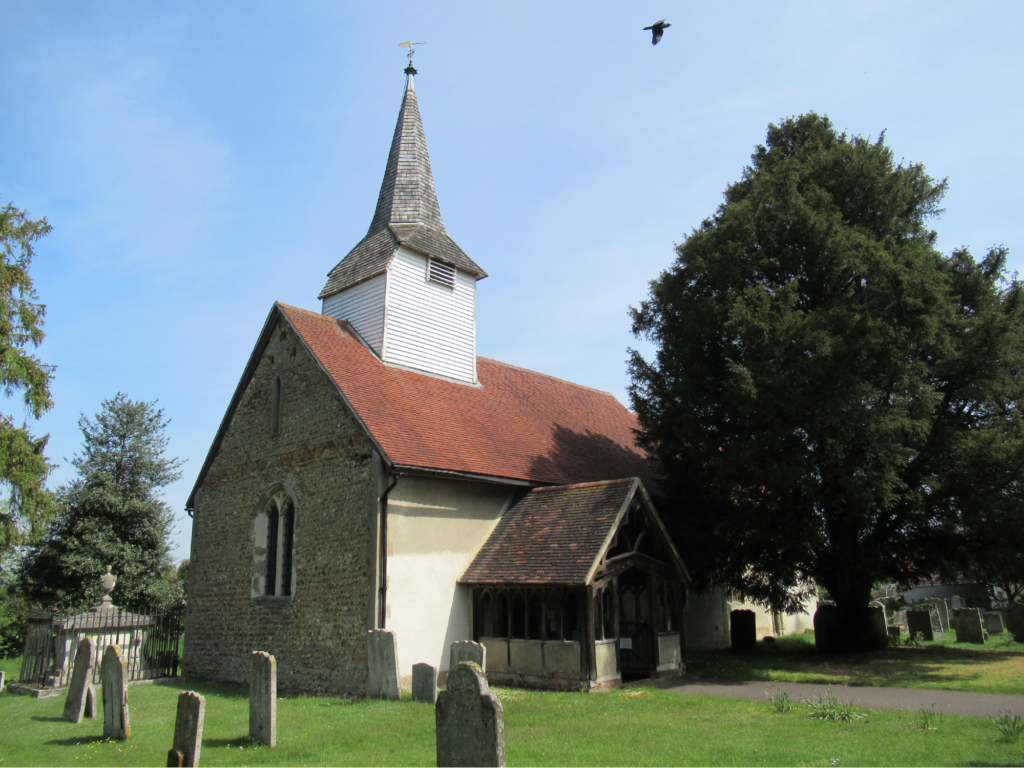
However take another look at the photograph of 1879 and you will see there are only two dormer windows. Now look at a modern photograph of the church and you will see the third dormer window has mysteriously returned.
What happened to the missing window?
I sought the advice of Michael Leach who had just published an article on Greensted church in the Essex Journal. He said this;
How intriguing! The nave roof was a completely new construction at the 1849 restoration, and is definitely shown with three dormers on the south side in the engraving published that year in The Builder magazine - and your 1879 photo only shows two! Either one was removed between 1849 and 1892 when Chancellor did the second nave roof reconstruction (a pretty improbable notion!) or The Builder engraving was incorrect, perhaps made from a sketch provided by the architect who had subsequently decided to insert only two dormers. Chancellor is said to have copied the 1849 roof but unfortunately he didn't draw it as found before reconstructing it.
The mystery continues……..
Images
Engraving of Greensted church, 1849
Greensted Church
Greensted Church
Greensted Church, 1979

Article 2 of 11
Essex Place names
The Essex Place-names database contains names of fields, roads, inns, houses, farms, manors, places, rivers, streams, woods, etc, and names of owners, tenants, landlords, parties to agreements etc, recorded from historic documents such as Tithe Awards, Rental Agreements, Surveys, Maps, Rolls, Inquisitions, Deeds, Charters.
The database is therefore of use to historians, genealogists, linguists, archaeologists and philologists. It is hoped its use will lead to identification and distribution of archaeolgical sites and historic buildings, will enable analysis of place-names as an indicator of early settlement, landholding and agricultural practices, will refine more precisely descriptive words and word-elements given by early settlers to topgraphical features, enable family historians to trace back owners and occupiers of land.
The Essex Place-names Project has been supported by Council for British Archaeology, Essex County Council, Essex Heritage Trust, Essex Society for Archaeology & History, 'Awards for All: Lottery Grants for Local Groups' and the Friends of Historic Essex.
It is interesting to see some of the field names, some of which give a clue as to their use, e.g. ‘lower ten acres’, ‘three cornered field’, ‘orchard’, ‘arable field’, ‘sawpit field’. Some names are less clear.
Lets look at some of the field names in the four parishes.
Greensted:
Quashey Lea
Canal
Cockshotts
Walk by Canal
Easy Bottom
Starve Goose Field
Night Leys
Stanford Rivers
Pig Riddon
Hither Ribbon
Hilly Wardens
Further Hilly Wardens
Botany Bay
Small Gains
Nooking Field
The Slipe
First Hither Shots
Old Tory
Stapleford Tawney
Blaze meadow
Nooking Field
South Liquorish Field
North Liquorish Field
Night Leaze
Theydon Mount
Little Fulwells Bottom
Further Fulwells
Gallows Croft
Hunger Down Wood
Further details of the names, including the location within the parish and who the owner was etc., can be accessed via the website
www.esah1852.org.uk
Article 3 of 11
From the Papers
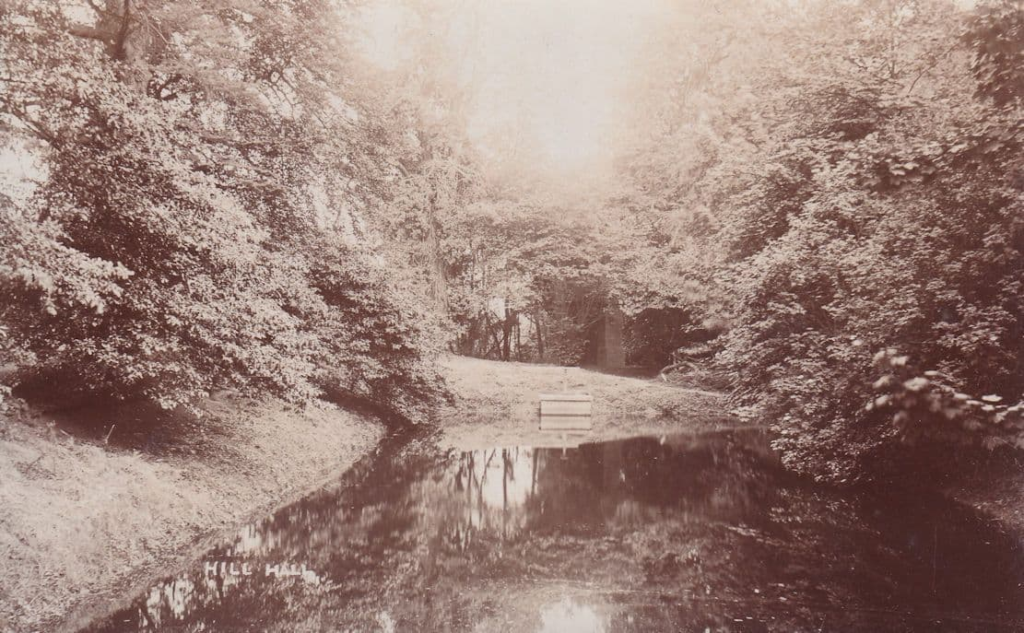
Hill Hall, an experimental prison for first offenders at Theydon Mount, Essex. At Hill Hall, a red brick Elizabethan mansion standing in its own grounds, are thirty women prisoners with nothing between them and freedom. There are no bars or locks and the prisoners are not even put on their honour to stay. The prisoners wear gingham dresses—they have five colours to choose from —and lipstick.
They are issued with hair curlers On Sundays the women are allowed to attend service at the village -church. The women get up at 6.45 a.m. and at 8.30 the day's work begins washing, gardening, cooking, and cleaning for a weekly wage of from 10d. to 2s. 3d, There are evening classes, and talks on such subjects as home-making and baby welfare.
From the Daily Mirror 14th October, 1954
ESSEX QUARTER SESSIONS
Sarah Twights was convicted of stealing from the person of George Flack labourer of Stanford Rivers, a purse containing a sovereign and 7s 6d in silver. Prosecutor was drinking in the tap-room of the Two Brewers Public House, High Ongar, when the prisoner who sat on the settle by the side of him, put her hand into his pocket and took out his purse. Being detected she threw the purse across the table to two men, one of whom emptied it of its contents, threw the purse back and ran out.
Sentence – 7 years transportation.
Source: Chelmsford Chronicle 24 Ocvtober, 1834.
SHEEP STEALING
So numerous have been the depredations upon sheep belonging to farmers in the neighbourhood of Chipping Ongar, that as many as 50 have been stolen within a very short period. Mr Jonathan Lewis of Water End Farm, is one of the principal sufferers.
Source Chelmsford Chronicle 14th March, 1834
Article 4 of 11
A Land fit for Heroes
The two photographs below show a family who were living in a modest hut circa 1920. We know there surname- Hilder and the picture shows a husband, wife and three children, who were named Vivian, Victor and Audrey. The father fought in the Great War,
The photograph was taken on January 28, 1920, outside their canvas hut at Greensted.
I have been unable to date to find any reference to the family in local sources. Sadly we do not know the names of the parents. Why were the pictures taken? Was it for an article on poverty or homelessness?
Images
A Land Fit For Heroes
A Land Fit For Heroes, circa 1920.
Article 5 of 11
The Society for the Promotion of Industry in the Hundreds of Ongar and Harlow and the Half Hundred of Waltham
Towards the end of the eighteenth century, there were increasing concerns about both the working and the expense of the parish system for looking after the poor. The parish overseer had an invidious task, caught between the resentment of the better-off about rising poor law rates, and the demands from those out of work and unable to feed their families. In the final decade of the century (particularly in its final years), this was aggravated by poor harvests and substantial increases in the cost of basic foodstuffs due to the war with France. After numerous delays, statistical surveys and select committee reports, these problems were ultimately addressed by the Poor Law Reform Act of 1834.
During the long wait for new legislation, there were a considerable number of local initiatives motivated by concerns about the rising number of destitute families, as well as the strong desire of individuals to reduce the increasingly onerous tax burden of the poor rate, and to improve the ‘moral status’ of paupers. One such initiative in West Essex was the establishment of a society for the promotion of industry in the three local hundreds in November 1794. John Conyers of Copped Hall was the driving force, inspired by similar schemes which were already operating in Lincolnshire and Rutland. Lacking any new legislative backing, these schemes relied on encouraging parishes to take a new approach to pauper children by using those powers that were still on the statute book from the poor law legislation of 1601, as well as devising a number of voluntary initiatives.
By January 1795 Conyers could report that 14 parishes, including Theydon Mount and Stapleford Tawney, had agreed to join the Society. By the end of the year, another 12 parishes had joined. Funds were raised from a mixture of charitable donations from benefactors, and subscriptions of five shillings per annum (or sometimes less) from private individuals. In addition, those parishes who had joined the scheme agreed to contribute 1% of the total of the preceding year’s poor rate. John Conyers was elected chairman, with the Rev T. A. Adby of Theydon Garnon as treasurer, and Mr J. Jessopp (a Waltham Holy Cross attorney) as secretary.
The Society’s focus was to encourage pauper children into out-work, mainly (or exclusively) spinning, knitting men’s stockings, and the needlework required for making men’s shirts. These activities were organised on a parish basis, and Chipping Ongar - for example – bought in and stored the raw materials in its poorhouse, thereby cutting out the factors who had been milking hefty profits from their rôle as middle men. Instruction seems to have been provided ‘in house’ for children with no previous experience - some of whom were as young as 6 years old - and their attendance, their behaviour and the amount of the work done was recorded on specially printed cards. The Society’s other focus was on a reward system, with printed certificates for good behaviour, and satisfactory standards of productivity and workmanship. These were linked to a ‘premium’ award which seems to have taken the form of clothing rather than cash. There was also a reward scheme for parents who had brought up four children (provided that they were born in wedlock) to the age of fourteen without receiving any parish relief. This was a cash payment of between one to two guineas, with those who were members of an established friendly society receiving a higher share.
Most of the information about this Society has been gleaned from a pamphlet compiled for the Society in 1797 by the Rev William Herringham, curate of Chipping Ongar. No newspaper reports have been found about any of the Society’s activities, so it is not clear if its work across the parishes continued, or failed shortly afterwards – possibly the latter, as the summary accounts show that the Society’s income in 1796 was substantially less than in the previous year, and that the number of contributing parishes had declined. However, other reports written by Herringham suggest that, in Chipping Ongar at least, he was successful in continuing to promote schemes for providing work to the poor in this parish until he left in 1805.
Images
William Herringham
Sources:
Herringham, W, 1797 An Account of the Origin and Progress of the Society for the Promotion of Industry in the Hundreds of Ongar & Harlow …, London 1797
Herringham, W, 1808 & 1811 ‘An Account of a Society, or Promotion of Industry, in the County of Essex, by John Conyers’ The Report of the Society for the Bettering of the Condition … of the Poor
Article 6 of 11
Composer of the Week – William Byrd
Introduction
The Vicar of Blackmore and Stondon Massey, Revd. Sam Brazier-Gibbs, received an unexpected call from BBC Network Radio in early May. The producer of ‘Composer of the Week’ would like to visit Stondon Massey with its presenter, Donald Macleod, and wondered whether there was any local person who they could interview about Byrd’s life in the village. I was nominated since I was researching the composer for a talk locally, and so it was that on 7 June the recording took place ‘on location’. This is the transcript of the segments of the programme in which I participated.
A Man of Many Parts
Recorded on 7 June 2023 at Stondon Massey Church. First broadcast, BBC Radio 3, Monday 3 July 2023
Donald Macleod (DM): Hello and welcome to a week celebrating the 400th anniversary of the death of the English composer William Byrd. Here on ‘Composer of the Week’ I am going to be marking the occasion by exploring his life, his character and of course lots of his music across the next few days. We will be seeing how music brought him within the orbit of royalty, politicians, and other great composers I will be talking to the Byrd expert Kerry McCarthy, and I will also be exploring some of the places Byrd knew very well.
DM: This year we are seeing William Byrd celebrated not just on Radio 3 but all over the country and I am sure around the world. It is four hundred years since his death. I have brought you to the village of Stondon Massey not far from Brentwood, and this Church of Saint Peter and Saint Paul dates from the 12th century. The Church has a pretty little tower. It begins as a square white painted square section of weatherboarding which accommodates the bells and then moves through a series of angular shifts until it becomes an octagonal spire of wooden shingles. The Church interior is very plain and simple with whitewashed walls. Well last time we were making a big Byrd anniversary back in 1923 they put up this very elegant monument on the wall under the heading of ‘Father of Musick’. The tablet reads ‘To the glory of God and memory of William Byrd lived at Stondon Place in this parish for the last 30 years of his life. He died 4th July 1623 aged 80. This tablet was erected in 1923 in celebration of the tercentenary of his death’. Well, that is why I am starting here this week in the Essex village where Byrd lived and worked for a significant part of his life. Before he came here, he dazzled congregations at Lincoln cathedral and in performances with the Royal Chapel. But we will also discover this week that Byrd was something of an outsider. It is telling that he chose this relatively isolated rural place thirty miles from the court of its concerns to spend his later decades. Let us establish right at the outset that Byrd was not a regular attender at the Church of Saint Peter and Saint Paul. His relationship with this church was never an easy one. We know that in 1612 he was asked to contribute to the upkeep of the bells. He flatly refused and will find out later that he had good reason.
DM: I am sitting here inside the Church of St Peter and St Paul in Stondon Massey in Essex a building Byrd knew well but his very literal cost did not often frequent. It is a great pleasure to meet here local historian Andrew Smith who is wearing a very smart William Byrd tie: I rather covet that I have to say. We are sharing this space with a very active insect of some kind. Andrew, 400 years ago as church attenders here we might have been met by the churchwarden of this parish a man called Denis Lolly and probably in Byrd’s case not met very cordially.
Andrew Smith (AS): No, that is true. He was a tenant of Stondon Place where William Byrd actually lived so as the churchwarden, and he would have noticed that William Byrd did not leave his home to come to the church here at Stondon Massey. At that time there was a requirement that church attendance be compulsory. It was an obligation of the clergy at the time to list and name those residents of the parish that were not attending Church. William Byrd was a recusant Catholic, someone who refused to attend the worship of the Church of England and could face very heavy fines for non-attendance; and there is a little quote here by the Revd. Reeve who 100 years ago was the Rector of Stondon Massey. He writes in his book ‘by direction of the Canons of 1603-04 the parson and churchwardens were to present to the Bishop Ordinary every year the names of any who should be found to be favourers of any usurped or foreign power or defenders of popish and erroneous doctrine. The Byrd family of course were regular reporting for papistical leanings’.
DM: It does seem kind of brazen of Byrd who is living next door to the churchwarden to think well to hell with you I'm just not going to church because inevitably, and especially because they are in this antagonistic relationship where Byrd is actually trying to have the man evicted, it seems extraordinary obtuse of him not to think that he's going to get into trouble.
AS: And yet he avoided trouble because he kept company with some of the most influential people in England but equally some of the most wanted people in England such as the Jesuit priests.
DM: Well, we will be taking about the plight of Catholics at this time like Byrd later in the week but these regular reports from the churchwardens have left an interesting legacy for historians they give us a clear picture of the size and make up of Byrd’s quite extensive household here in Stondon Massey. So, we have William and his wife Julian, their eldest son Christopher gradually took over the running of the farm. The house came with two hundred acres of land with a plentiful supply of timber. Byrd’s daughters Elizabeth, Rachel and Mary all married local lads. Their husbands were all yeomen and shepherds rather than gentlemen. Despite his quarrelsome relationship with his neighbours and his conspicuous recusancy we get a picture of Byrd not perhaps so much an isolated figure as fully embedded in the local society.
Stondon Massey; Byrd and the Shelley Family
Recorded on 7 June 2023 at Stondon Massey Church. First broadcast, BBC Radio 3, Friday 7 July 2023
Donald Macleod (DM): I began the week in the village of Stondon Massey and I am back here again. William Byrd lived in this hamlet in Essex from around 1594 until his death just short of 30 years later. By the time he made that very carefully considered move to this rural retreat Byrd had pretty much retired from his official duties connected with Queen Elizabeth's Chapel Royal. But that did not mean that he'd withdrawn from an active musical life. Around me visible from the churchyard there isn't really very much I think that Byrd would recognise. There are rolling fields, but I imagine they are very much larger than they would have been in Tudor times and farming activities going on around us. We've been dodging a man with a chainsaw all afternoon. I'm sure that 400 years on there are houses here that Londoners have bought themselves as country retreats within a convenient distance of the capital but far enough away from all the tensions, rivalries, political dramas and in Byrd’s time religious furore of his then public life as a gentleman of the Chapel Royal. But as we're going to discover Byrd was never one to shy away from conflict. Even here, he created it wherever he went. Stondon rather than a haven of peace and rural tranquilly was to prove a place of energy and activity much of it fractious and abrasive.
DM: I am talking here to local history expert Andrew Smith. Andrew, the Tudor house where William Byrd lived in the village of Stondon no longer stands. It is difficult coming through the village today to get any sense of what Byrd might have seen as he walked along the same road. The church is oddly separate from the village.
Andrew Smith (AS): Yes, it is probably getting on for one and half miles from the centre of the population of Stondon Massey around what is a green and a pub these days. Byrd’s home at Stondon Place was about half a mile from here and has been rebuilt actually twice since Byrd lived in that particular house. The Times has an advert, from 1972, that says that ‘Stondon Place at Stondon Massey is a house with an unusual background. Apparently there had been a house on the site since the sixteenth century and one of the earlier properties was occupied by William Byrd the composer’.
DM: It’s great that the Estate Agent thought of putting William Byrd in as a selling point for that. So why did Byrd come to live in Stondon Massey in the first place? He is really benefiting from another man's misfortune.
AS: Yes, William Shelley is a gentleman from Sussex, and he was detained in the Tower of London for his involvement in the Throckmorton Plot in the 1580s. Now we know that William Shelley had, shall we say, previous recusancy – he was confined as a close prisoner in the Fleet because of his intransigence to the religion - and his wife Jane Shelley complained that during her husband's long imprisonment much of the property had been distrained and she petitioned for return of her share. You move forward then to William Byrd coming to Stondon Massey in, shall I say, semi-retirement in 1594 and we find him occupying one of the homes that Shelley inherits from his grandmother in the 1520s. Now he has been confiscated of all his property and it is the Crown who grants a short lease to William Byrd and his family at Stondon Place.
DM: When you say the Crown, we are talking here about Queen Elizabeth I.
AS: Yes, Queen Elizabeth I.
DM: So, the tables are kind of turned because when he came here first of all he tried to get the churchwarden Lolly evicted from Stondon Place and now Shelley's wife starts that doing that the same to him.
AS: Much the same. Jane Shelley claimed that the property was in her ownership. William Shelley actually dies in 1597 but there continues at a long running dispute over the ownership of Stondon Place, and Reverend Reeve who was the Rector of Stondon Massey a 100 years ago and very keen local historian quotes this: ‘Both Mrs Shelley and Byrd were evidently born litigants and never so happy as when they were giving work to the judge and counsel. Suits of Shelley v. Byrd being varied by countersuits of Byrd v. Shelley. She encloses eight grievances against her tenant: the said William Byrd did vile and bitter words and when told he had no right to the property Byrd replied that if he could not hold it by right, he would hold in my might’. And the legal wrangling continued for over a decade.
DM: Essentially even when the court finds against Mrs Shelley and allows Byrd to go on living there the thing just rumbles on disputatiously forever so there are disputes over Byrd’s right to cut the wood on the estate and at one point, he's taken to court for blocking the road to nearby Kelvedon Hatch.
AS: Yes, that is correct.
Stondon Massey; Byrd’s Will and Burial
Recorded on 7 June 2023 at Stondon Massey Church. First broadcast, BBC Radio 3, Friday 7 July 2023
Donald Macleod (DM): Well now I am back where I began this week in the Church of Saint Peter and Paul in the Essex village of Stondon Massey with the local historian Andrew Smith. This Church was somewhere we know Byrd generally tried to avoid. As a Catholic he was frequently fined for not attending services. But here in the vestry on the wall is a fascinating document connected with Byrd. It is a facsimile of a sheet of parchment covered in very elegant positively calligraphic handwriting, stems of a Ds all sloping backwards and the text is in English. Andrew what are we looking at?
Andrew Smith (AS): This is a photograph copy William Byrd’s will signed in November 1622. He says that he was in his 80th year. Recent evidence suggests that he was older than eighty which suggests to me that that this Last Will and Testament had been, shall we say, hanging around for a while before being signed. The Will refers to his wish to be buried in the churchyard at Stondon Massey: ‘my body to be honestly buried in that parish near unto to the place where my wife liest buried’. Julian Byrd was buried around 1608 after 40 years of marriage to William Byrd.
DM: Do you think Byrd got his way in the end, that he got his wish to be buried here?
AS: I would like to think he did. Unfortunately, the burial registers prior to 1708 don't exist at Stondon Massey so we do not know with any certainty that he's buried here. However, historians such as John Harley say there are no records to say that his was refused burial here, so I'd like to think on the balance of probability he is buried here.
DM: He said, and you quoted his words from the Will, that he wanted to be honestly buried by which we presume he meant according to Catholic rite. Do you think that this is likely?
AS: I think was possible. He may have had a quiet funeral maybe in the evening or night within the churchyard, but he probably was not allowed an Anglican rite of burial.
DM: Andrew Smith. Thank you so much for being my guide this week.
DM: Well, I have come out of the church into the churchyard. Byrd died at Stondon Massey on 4th July 1623 at the exceptional age for the time of eighty-three. Among the gravestones here around me I cannot see any bearing Byrd’s name, so we have no way of knowing that the wish of his to be buried here stated in his will was actually honoured. It is possible that as a Catholic in the eyes of the Anglican Church at the time he died excommunicate, so his grave was not part of the official consecrated ground. The churchwardens probably wouldn’t have allowed a Catholic to be buried in the graveyard with an inscription over his head, not even a famous Catholic like Byrd. What hasn’t been lost of course is Byrd’s remarkably rich musical legacy which continues to inspire performers and resonates strongly with us today four hundred years after his death wherever it is performed, in churches, concert halls and homes around the world, including here in Stondon this month and on Radio 3 of course.
Article 7 of 11
Stanford Rivers Vestry – Appointment of Constables & Overseers for the Poor for the years 1815 –1830
Stanford Rivers Vestry
Appointment of Constables & Overseers for the Poor for the years 1815 –1830
Year Constables Overseers
27.3.1815 Henry Mott Henry Mott
Samuel Marten Thomas Mansfield
William Phillips
Fishpool Neville
28.3.1816 Henry Mott Henry Mott
John Playle William Phillips
Fishpool Neville
Charles Andrews
Edward Rayner
27.3.1817 Henry Mott Henry Mott
John Thomas William Phillips
Charles Andrews
Fishpool Neville
26.3.1818 Ditto Henry Mott
Charles Andrews
Jonathan Stokes
Edward Rayner
25.3.1819 Henry Mott Henry Mott
John Thomas Jonathan Stokes
Edward Rayner
Edward Luck
28.3.1820 Henry Mott Henry Mott
William Smith Edward Rayner
Edward Luck
Fishpool Neville
27.3.1821 Ditto Henry Mott
Edward Luck
Fishpool Neville
Timothy Phillips
26.3.1822 Ditto Timothy Phillips
Edward Rayner
Charles Andrews
John Pavitt
25.3.1823 Ditto Charles Andrews
John Pavitt
George Hummerstone
Frederick Stallibrass
25.3.1824 Ditto George Hummerstone
Benjamin Lewis
William Phillips
Frederick Stallibrass
29.3.1825 Henry Mott William Phillips
John Ray
John Stallibrass
William Frost
John Bailey
28.3.1826 Ditto William Frost
John Bailey
John Palmer
William Wilson
27.3.1827 Ditto John Palmer
William Wilson
Edward Luck
George Dellar
1.4.1828 John Ray John Gingell
James Lane
George Dellar
John Smithiman
W.H. Randle
26.3.1829 Ditto John Smithiman
William Henry Randle
Henry Mott
John Mumford
25.3.1830 Ditto Henry Mott
John Mott
Edward Luck
John Pavitt
Source: ERO D/P 140/8/4
Article 8 of 11
The Epping & Ongar Highway Trust
The first meeting of the joint Epping Highway Trust took place at Epping Place inn on 2nd May 1769. The Trustees consisted of 49 gentlemen including John Conyers Esq. (Treasurer), Jacob Houblon esq. (Junior) from Coopersale house and seven Reverends. The first order was for a board to be painted with tolls & hung at the gates when the Epping & Ongar Turnpike Act came into force. Tolls were to be taken at the gate near Epping Place for the 1st month, then at the Thornwood Common gate (lower gate) 2nd month etc., the other to be left open.
Another proposal was removing the turnpike at the west end of town to 'that side of the windmill belonging to John Conyers, Esq. near Epping Place, which is nearest to the town of Epping'. It was also proposed that a new gate & rails should be fixed across the road & common from 'John Bishop's house to Peter White's house, as being the shortest & least expensive route & nearest the town'. A counter proposal was for 'a new gate & rails to be fixed across from the hedge near the corner of Hornfield, in the possession of John Tanner, to a large elm tree near William Robert's house, nearest the windmill'. The latter won by 24 to 22 votes.
The fence ran along the road down to Hawcock lane (now Ivy Chimneys). It was later discovered that people were managing to avoid the turnpike by passing behind the windmill, and a fence was built across the lane with a gate, left unlocked for foot passengers to and from Theydon Bois. Today it is still remembered by the Forest Gate Inn. The Turnpike house itself was erected on the right-hand side of the road going to London in brick work, with a lean-to but no cellar. A high railing was also to be made 20 yards from the gate and a double ditch with posts & two rails on the bank at a cost of £234 14s 3d. The house is still there today, now known as Bell Vue, by the Bell traffic lights.
The people in Thornwood had a major grievance with the turnpike, with good reason; they were being charged to go to church. In 1793 a new act decreed that inhabitants of Thornwood were not to be asked for tolls for going to church and back, and any tolls previously taken for this reason were to be repaid to them. They weren't the only ones with a grievance. Clergymen visiting parishioners and the sick or dying were also being charged. A series of exemptions were laid out to rectify this. People did not have to pay when going to or returning from their place of worship on any day when 'divine service is ordered by the authority to be celebrated, nor when attending the funeral of a person dying and to be buried by either of the parishes through which the road passes'.
Also included were clergymen visiting the sick or performing their parochial or ministerial duties on the day mentioned and carts carrying manure or gravel for mending roads. On January 5th 1829
'in consequence of the representation of Mr. Henry Gilby, the proprietor of the Stortford coach, stage coaches were in future to be relieved from payment of the original tolls, taken 3 days before and 3 days after the fairs in the neighbourhood, at which time both gates were shut and tolls taken'.
Many people passed through the turnpike quite frequently, not just on Sundays or Market days. They could, if they wished, buy a season ticket. Inhabitants of parishes were allowed to compound all their trips under a single sum per annum. In 1769 John Conyers paid one guinea, a year in advance, for his horses, carriages & family, and servants. The Rev. Mr Salt, resident minister of Epping chapel, paid 2s per annum, Joseph Doubleday the grocer 10/6d.
Toll Charges in 1816
If drawn by more than two horses 1s 0d
For every waggon or wain drawn by six horses or less 1s 6d
For every waggon or wain drawn by more than six horses 2s 0d
For every limber carriage drawn by three or more horses or mules 2s 0d
And if with less … 1s 6d
For every mare, gelding, mule, horse or ass not drawing 0s 1d
For neat cattle by the score 0s 10d
For calves, swine, sheep or lambs by the score 0s 5d
Commercial and Mail Coach's calling at Epping in Essex ...
To London
The Stortford Coach at 5 o'clock p.m.
The Fakenham at 8 o'clock a.m.
The Norwich Coach at 9 o'clock a.m.
The Cambridge "Times" at 10 o'clock a.m.
The Cambridge Coach at 2 o'clock p.m.
The Bury Coach at 11 o'clock p.m.
The Swaffham Coach at 8 o'clock p.m.
The "Magnet" from Norwich at 4 o'clock a.m.
The Norwich Mail at 5 o'clock a.m.
The Walden Coach at 2 o'clock p.m.
The Harlow Coach at 9 o'clock a.m.
The Thetford Coach at 9 o'clock a.m.
The Dunmow Coach at 9 o'clock a.m.
From London
The Thetford Coach at 9 o'clock a.m.
The Fakenham at 8 o'clock a.m.
The Cambridge Coach at 12 o'clock a.m.
The Bury Coach at 4 o'clock p.m.
The Cambridge "Times" at 5 o'clock p.m.
The Norwich Coach at 6 o'clock p.m.
The "Magnet" to Norwich at 8 o'clock p.m.
The Swaffham Coach at 8 o'clock p.m.
The Norwich Mail at 10 o'clock p.m.
The Walden Coach at 12 o'clock p.m.
The Harlow Coach at 6 o'clock p.m.
The Stortford Coach at 5 o'clock p.m.
The Dunmow Coach at 9 o'clock a.m.
(From an Almanac published by Mr Griffith, printer & stationer of Epping. Essex)
In 1750 a coach ran through Chipping Ongar 3 times weekly and in 1764 the Ongar 'Crown' landlord sponsored a 'New Machine' to run from Fyfield through Ongar to London. One of these 2 coaches soon ceased, the other continued for nearly the rest of the century.
In addition, there were 2 Epping coaches, each performing 2 journeys a day, making the total number of coaches to and from Epping 25 a day. Each coach was driven by four horses, and each called at a particular inn, where the horses would be stabled.
The coach guard played a series of particular calling notes when arriving at the inn. There were also post horses, many of them used by travellers to ride to the Newmarket races.
Other horses were required for the yellow post chaises then in use, as well as for the coaches kept by a number of local county families. These were usually equipped to carry the family and their luggage long distances, so would be drawn by a four-in-hand. Epping by the 1790's was served by coaches making 46 journeys a week.
Purely local services did not develop until end of 18th Century and then only on a small scale.
Without a horse, local people relied on their feet or a carriers cart.
Images
The Epping & Ongar Highway Trust
The Epping & Ongar Highway Trust
Article 9 of 11
The queen visits Ongar 1924
The Queen visited the Mary Macarthur Holiday Home at Ongar on Saturday afternoon to receive purses for the endowment of the Home so as to put it on a sound financial basis. About £1,270 was subscribed, in addition to a legacy of £1,000 from the late Mr. Teichmann, and of this apart from several substantial cheques, a great part was subscribed by working women belonging to the various organizations, in which Miss Macarthur was interested in her life time.
Women in various walks of life, who had known and loved Mary Macarthur, assembled to greet the Queen, and it was as one of their number that the Queen came among them. From the moment of her arrival she made that quite clear, and the afternoon was spent as a friendly party and not as a formal gathering. The Queen was wearing a long white cloky silk wrap trimmed with white marabout; her gown was of pale mauve embroidered in crystal, with touches of blue on the bodice, and she had a swathed toque in mauve colourings. In attendance were Lady Ampthill, Lady Cynthia Colville, and Sir Edward Wallington. Lord Lambourne, Lord- Lieutenant of the County of Essex, met them outside the Home and inside Her Majesty was received by:
Lady Crewe (Chairman) and members of the committee. Lady Roxburgh. Miss Gertrude Tuckwell, Mrs. H. S. Tennant, Miss Madeleine Symons, Dr. Marion Phillips, Miss I. M. Cowell, Miss R. E. Lawrence, Miss Michelmore, Miss Rose E. Squire, Mrs. Sanderson Furniss, and Mrs. Westley, (Miss Macarthur's sister).
A bouquet of pink and mauve malmaisons grown in Mrs. Tennant's gardens at Maythem was presented by NANCY ANDERSON, Mary Macarthur's small daughter.
Miss GERTRUDE TUCKWELL, in a short address of welcome, said it was a great happiness to welcome the Queen to this Home, knowing the interest and sympathy she had given to the work of the woman whom it commemorated. Again and again Mary Macarthur had used as her text the verse of the Koran: " Let any of you having a loaf of bread sell half and buy with it the flowers of the narcissus, for as bread nourisheth the body, so do the flowers of the narcissus nourish the soul," and she would dwell upon the need of bringing the flowers of the narcissus within the reach of those who had nothing with which to buy all that made for true life, for knowledge and for joy. This idea had been at the-back of her fight for better conditions, fair wages and room to live. Her short life burnt itself out because she denied herself the rest and leisure, she tried to obtain for others - she had died before their eyes of the work she had done for working women.
"From early days," Miss Tuckwell continued, "Your Majesty was associated with this work. when, as Princess of Wales, you came back from India, tired and, needing rest yourself, you graciously came to the Exhibition of Sweated Industries which Mary Macarthur had worked hard to promote, in order to show your interest and sympathy in the toil of the poorest of your people. Then when there was grave danger of unemployment for working women in the early days of the war, Mary Macarthur was associated with many others with your Majesty in the work of the Queen's Fund and the Central Committee for Women's Employment. From then until the end she experienced your gracious friendship and deeply valued it. You by your presence to-day have shown that the three years which have elapsed since her death have not blurred her memory and that faithful public service has its undying record."
PURSES PRESENTED
The short ceremony of presenting the purses, of which there were 50, took place in the garden. The first was Miss Nancy Anderson, followed by the Hon. Michael Astor (who presented £100 from his mother, Lady Astor). There were many purses from Labour representatives and working women. Mrs. Bramley (wife of the secretary to the General Council of the Trades Union Congress) presented a purse of £50 collected from the Half Circle Club. Miss Flowers, who formerly worked at Eley’s, Edmonton, and one of the original members of the National Federation of Women Workers organized by Mary Macarthur, presented a purse from the head office staff and former colleagues of Miss Macarthur. Miss Rose Squire (Home Office) presented a purse including contributions from a large number of women factory inspectors. Others presenting purses were:-
Miss Gertrude Tuckwell, J.P. (from London women magistrates, of whom Miss Macarthur was one of the first); Miss Constance Smith (purse collected by the staff of the International Labour Office Geneva); Miss Gardner (purse collected by the Ministry of Labour), Lady Roxburgh Mrs. Tennant. Miss R. E. Lawrence, Mrs. A. Christy, Miss Lilian Barker, Miss Betty Barker, Miss Tyas (from the Central Committee on Women's Training and Employment): Mrs. Samuel Courtauld (£100) Lady Ryan (from girls of Birklands Girls' School, St. Albans), Miss E. Towler, Miss K. Hunt, Mrs. Joan Calver, Miss Mead, Miss Brenda Ashdown, Mrs. Dodd, Mrs. G. Fane, Miss Frances W. Head, Miss Lavender, Mrs. Sankins. Mrs. Baker, Miss Craig, Mrs. W. Nelson Wyles, Miss Capel Cure, Miss Silley, Miss Newell, Mrs. Barker, Miss Noble, Mrs. Bingley, Master Peter Wild, Miss Jackson, Miss Audrey Child, Mrs. Furse, Mrs. Padfield, Mrs. Alfred Arnold, and Miss Hilda Giblett.
Lady Crewe, who introduced those presenting purses, had a further promise of an additional subscription from Lord Derby; and Lord Beaverbrook had sent £100. The house, which is an attractive old country house, pleased the Queen. In particular the vistas from the windows, the lawn in front, the grounds of about 41 acres with kitchen garden supplying all vegetables, chicken run, and tennis courts, and the bed rooms with bright coloured walls and little balconies, attracted the Queen's attention, especially the room which bears the name of Mary Macarthur and is kept for some girl or woman connected with one of the associations with which Mary Macarthur was especially interested. In going over the house the Queen was looking for some want which she could supply and noticed that bedroom mats were needed. Later she asked how they were off for pictures, and before leaving said she would not forget to send both. The bedrooms are quite large and there is accommodation for about 25 guests.
THE QUEEN AND WOMEN WORKERS
The Queen had tea with the members of the committee, and with them were also Mr. and Mrs. Fred Bramley. Later all those who had presented purses came in and were presented and talked with the Queen. The cook was among them, and all the women and girls staying in the house came in, at the Queen's special request, and told her something of their work' and lives. There was a cigar-maker from Houndsditch, a tired old office cleaner, a trouser finisher from Hackney convalescing for four weeks, a girl clerk, a laundry worker, a machinist, a warehouse forewoman, and some domestic workers, and all were enjoying to the full the kindly atmosphere of the place. Mrs. Burrell, hostess and “house-mother,” was present also and was specially complimented by the Queen on the way in which the house was managed. When the Queen left she was greeted along the country roads by people from Ongar and the neighbouring villages, and both coming and going she met many signs of appreciation both of herself and of the nature of her visit.
Source: The Times, July 28, 1924
Article 10 of 11
Trouble at Theydon Garnon
All Saints Church. 1522.
Mr Browne gets upset when, after mass, the clerk Richard Pond does not come to him first with the pax to kiss, so he ‘took it, kissed it and then broke it in two pieces over the head of the said R.P., causing streams of blood to run to the ground.’
What happened to Mr. Browne we are not told.
Source: Old Parish Life – A guide for the curious. [2022]
a tablet decorated with a sacred figure (as of Christ) and sometimes ceremonially kissed by participants at mass
Article 11 of 11
Programme for 2023/24
High Country Programme 2023/24
26 October
The Prison at Hill Hall
Anne Padfield
23 November
The Bauhaus
Mark Lewis
Meeting Dates in 2024
22 February
28 March (AGM)
25 April
23 May
27 June
25 July
24 October
28 November.
Meetings are held in Toot Hill Village Hall.
Meetings start at 8.00pm.
Members £2 ~ Visitors £5.
Refreshments