High Country History Group
Contents
Article 1 of 9
Editorial
As many of you know I was admitted to hospital in February suffering from multi myloma and kidney failure. After three months in the Lister Hospital, Stevenage, I came home and I am now receiving dialysis at Harlow Hospital and also Chemotherapy.
Unfortunately, this meant the March edition of the Journal could not be completed and the June edition has been delayed as I struggled to complete it. I am grateful to those who have sent in items for inclusion.
This Journal is shorter than normal for which I apologise. The September edition will return to normal.

Article 2 of 9
Miss Ashley, Mixed Race Governess (1803 – 1874)
Eliza Ann Ashley arrived at Suttons in Stapleford Tawney, household of the widowed Augusta Smith and her family, in May 1824. Eliza came as the 21-year-old governess to the youngest girls, Eliza and Maria. There were nine children altogether, six girls and three boys, and she seems to have become a companion to the older girls. She stayed at Suttons for eight years until Maria, the youngest, turned 18 in 1832. She then worked for the Duchess of Sutherland, but the Smith family continued to stay in touch for many years. Miss Ashley was a witness at two of the Smith girls’ marriages – Fanny’s in 1834 and Eliza’s in 1835 – even though she was no longer employed by the family. That same year she attended Fanny’s first confinement, which ended sadly with the death of the baby after just a few days. Miss Ashley was back at Suttons in 1840, teaching music and drawing to the next generation of Smith children. When Augusta’s eldest son and his wife both died young, in 1830 and 1842, Miss Ashley was again hired as full-time governess to their three orphaned children. In the 1851 census she was a visitor at Suttons, where the now grown-up children still lived.
The many letters written by the family referring to Miss Ashley never mention the fact that she was of mixed race. She was born in Demerara, part of what was then British Guiana (now Guyana) in South America. Her grandmother was the legendary Dolly Thomas, a former slave, who by several judicious liaisons with wealthy plantation-owners and businessmen, managed to buy her own and her family’s freedom, establish several successful businesses of her own, employ her own slaves (!) and become the richest resident woman in Demerara. Dolly paid for many of her numerous children and grandchildren to be educated in England, including perhaps Eliza and her sister. She was anxious that they should be respectable, accomplished and well-mannered. She probably hoped they would find husbands who could support them, which never happened. Eliza’s education, however, would have stood her in good stead when looking for employment. Being a governess was one of the few respectable options for an unmarried woman. It was a strange in-between existence, though, being not quite family and not quite servant.
Eliza had a younger sister, Sarah Edmonstone Ashley, who visited Suttons several times and stayed with other Smith family members. They always distinguished “Miss Ashley” from “Miss Sarah Ashley” in their letters and diaries. Sarah seems to have led a less settled life than Eliza, and gave herself a different age at every census. She disappears from the censuses a few times. Did she sometimes revisit Demerara? Like Eliza, she never married. Both sisters were buried in Thorpe, Surrey, where they must have had some connection.
Was colour or race an issue at the time? It’s difficult to trace the Ashley sisters’ exact ancestry, and Dolly Thomas may actually have been their great-grandmother. Eliza and Sarah could have been 62½% white, meaning they may not have looked too different from the Smith girls. In any case, it was fairly common for wealthy people to employ servants from the colonies.
An insight into near-contemporary attitudes may be gleaned from the novels of Jane Austen. In Mansfield Park (1814), the subject of slavery is raised, but not explored. Sir Thomas Bertram, who is presented as strict but kindly, travels to Antigua to sort out some problems on his estate. On his return, his niece Fanny longs to discuss the subject of slavery with him, but stays silent as no one else seems interested.
In Sanditon (1817), Austen’s last novel, unfinished at her death, one of the main characters is the West Indian heiress Miss Christina Lambe, daughter of a white plantation owner and a black slave. Other characters value and respect Miss Lambe’s wealth and eligibility for marriage, but her colour doesn’t appear to be of any interest to them.
Interestingly, there is a later link between Jane Austen and the Smith family. Jane’s favourite nephew and biographer, James Austen Leigh, married Emma, one of the older Smith daughters, in 1828. Miss Ashley was probably at the wedding.
The older girls’ governess had been Miss (Maria) Ramsay, who had died in 1819, aged only 28.
See Wikipedia entry “Dorothy Thomas, entrepreneur”
Article 3 of 9
Local Links with the Slave Trade
In recent times the issue of historic racism has been highlighted, especially by the Black Lives Matter movement. Organisations like English Heritage and the National Trust have updated their guides to record, in particular, any links with slavery, and some statues and memorials have been taken down. Admittedly it would be difficult for any wealthy family in the Georgian and Regency period to avoid at least an indirect link through their consumption of sugar, rum, cotton, tobacco and coffee. But were any of our local landed families involved with the actual slave trade?
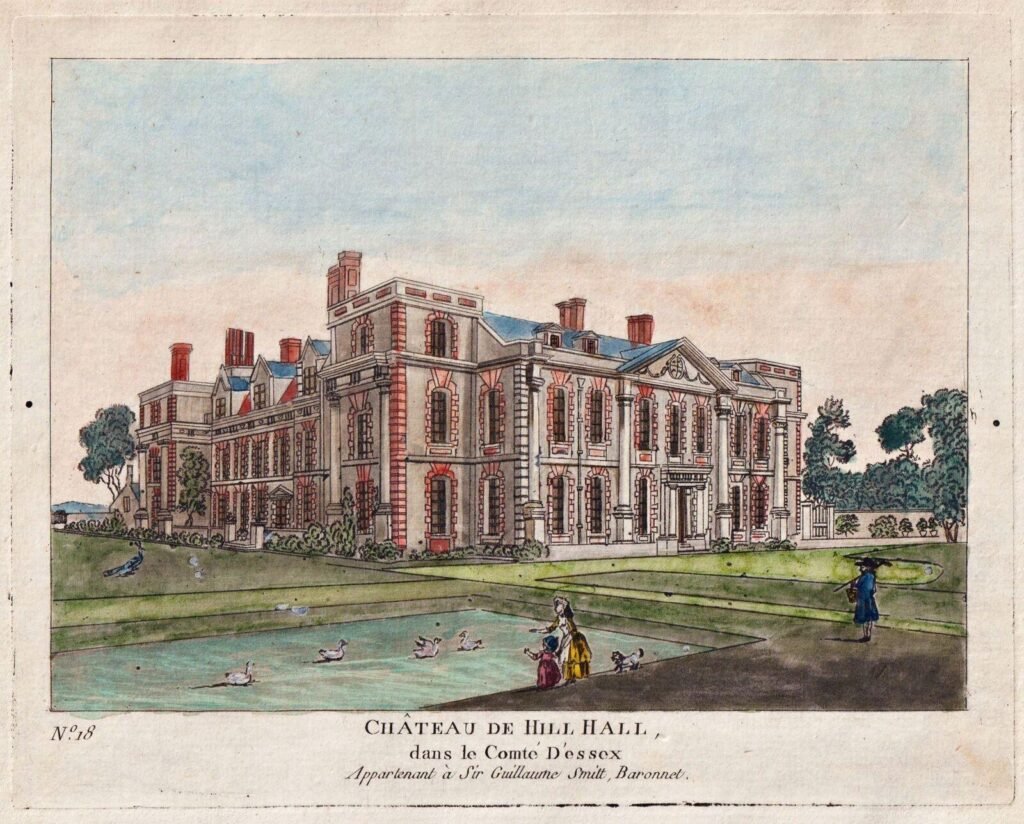
The Slave Registers of former British Colonial Dependencies is the main source of information, although they only survive from 1813 until 1834, the year when slavery was finally abolished. I was relieved to find no Smijths of Hill Hall, no Abdys of Albyns, and no Budworths or Petres on the list. In fact west Essex was the home of two important campaigners for the abolition of the trade in slaves. William Smith MP, of Parndon Hall near Harlow, supported by his neighbour Montagu Burgoyne at Mark Hall, helped to get the 1807 act abolishing slave-trading (but not ownership) through Parliament.
However, there were also slave-owners from this area. Capel Cure of Blake Hall Bobbingworth inherited from his brother-in-law the role of trustee of the Belvidere estate in Jamaica, and it was his son, also Capel Cure, and another trustee who received compensation for the loss of their 378 slaves at emancipation. It is not known whether either of them ever visited Jamaica.
There was a similar link in the family of Augusta Smith, wife of Charles Smith of Suttons, Stapleford Tawney. Augusta, confusingly, was a Smith before she married, though neither she nor Charles was related to the campaigning MP William Smith. Augusta had an uncle, Thomas Smith “of Jamaica”. Thomas owned two plantations and several hundred slaves. When he died, his will stipulated that Augusta should choose one of her sons to inherit them. She chose her middle son Spencer (born 1806), who owned it from 1831 to 1838. Although his great-uncle Thomas had evidently lived in Jamaica, the day-to-day running of the plantations would have been in the hands of overseers, and many owners were absentees. When he first inherited, at the age of 25, Spencer sailed alone from Bristol to Jamaica to visit his property. He returned safe and well about six weeks later, and probably never revisited.
Two years after he inherited, the Emancipation Act was passed. As with Capel Cure, the government paid compensation to the slave owners (nothing to the slaves) for the loss of their “chattels”. In 1836, Spencer received over £10,000 for his 540 slaves, worth over a million pounds in today’s money. The estates had produced sugar, rum and coffee, but after the loss of free slave labour they switched to rearing cattle, which required less labour. Spencer’s newly-acquired wealth, just a year after his marriage, enabled him to live on an estate in Hampshire as a leisured country gentleman for the rest of his life, despite being a younger son. The Smith family left many letters and diaries, but no specific reference to slavery – approval or disapproval – has so far been found.
www.ancestry.co.uk/search/collections/1129/
Progress by Persuasion, Jenny Handley and Hazel Lake, 2007)
Article 4 of 9
Memorial to an American Air Crew
For some time I had been curious about a small war memorial outside a house at Hatfield Heath. Eventually curiosity took over and I stopped to investigate.
The memorial is dedicated to the crew of a Martin B-26 Marauder of the 391st Bombardment Group, USAAF, which came to earth in bad weather, crashing into the house where the memorial stands outside.
The crew of 3 all perished.
The Marauder had flown a transport mission to Normandy and was returning to its base at Matching Airfield, in the company of five other aircraft. In total three crashed, with 11 airmen killed.
The three men were
2nd Lt. Howard Nolan
S Sgt Jacob E. Crider
Cpl. Warren Terrian
The memorial to the men was unveiled on the 24 September 2021.
Images
Memorial on the Chelmsford Road, Hatfield Heath
Article 5 of 9
Johnny Cooper – SAS
If you watched the recent television series on BBC about the Special Air Service you may recall a chap called Johnny Cooper, who aged 18 years of age volunteered for the SAS in 1941and became one of the “The Originals” raised by David Stirling to conduct operations behind enemy lines.
Driver to David Stirling in North Africa, he was awarded the Distinguished Conduct Medal on November 26, 1942. During a raid in January 1943, David Stirling was captured and the then Sergeant Cooper managed to reach the Allied lines.
He was posted in September 1943 in the Green Howards after a cadet course. Cooper served again in the 1st Regiment of the SAS, from April 1944 to December 1945. On June 6 1944, D-Day he was parachuted into France and returned to England in September 1944. As Temporary Captain, he served in Germany from March 1945 to 4 April 1946.
The SAS were finally disbanded at Hylands House, Chelmsford.
After the war, he served in Cyprus in the Green Howards, from January 1947. He retired from the army in 1947. Appointed officer of the Territorial Army, he served in the SAS until 1962.As a Lieutenant, he served in Malaysia in 1952, with the 22nd SAS. Promoted to Commander in 1955, he remained in Malaysia. He was appointed member of the British Empire (MBE) on April 28, 1959 for operations between July 1st and December 31st 1958.As 22nd SAS Commander, he operated in Oman as head of the squadron of November 1958 to February 1959, which included the assault of the Jebel Akhdar, coordinated by Colonel David Smiley, then military adviser to the Sultan of Oman and Muscat. He retired in 1962 and became Lieutenant-Colonel of the Omani armed forces (Muscat Regiment) until 1966. From 1963 to early 1966, it was in Yemen where he ensured implementation of the British plan of assistance to the royalist tribes loyal to the Imam El Badr. Johnny took part in various raids in North Africa`, collaborated with mission of the war came in the summer of 1945 in Norway when they disarmed a German garrison days after the war had ended.
Cooper appeared on This is Your Life in 1995 with Michael Aspel.
Cooper died 12th July 2002, aged 80 and is buried in St. Mary’s church Moreton, where he had lived for many years. His son Graeme still lives in the village.
Distinguished Conduct Medal : Feb 1942 On returning from the 2nd raid against Buerat aerodrome the raiding party was ambushed by a strong and well-armed enemy force. This force was aligned along the road in an ideal position to throw grenades and to open fire with automatic weapons.
The ambush was a complete surprise but so quick was Sgt Cooper in getting his gun into action and so accurate was his aim in the face of intense fire from the automatic weapons of the enemy that the ambushers were seriously disconcerted. At least five of them were killed at point blank range by his fire. His quickness and courage on this occasion undoubtedly saved his companions. This NCO has taken part in 13 raids and performed many acts of gallantry comparable to the one described.
Images
Grave of Johnny Cooper and his wife in St. Mary’s church Moreton
Article 6 of 9
Stapleford Tawney -Benefactions to the Poor of the Parish
A rent charge of £5 left by Thomas Luther to be paid out of the estate of Mr. Jones. A moiety of this estate has bbeeen sold to Sir. W. Bowyer Smijth Bt., who has redeemed half of the above rent charge by transferring to the official trustees of charitable funds the sum of £83.12.8 cons. £3 per cent annuities. The remainder of the above estate was left to Mr. Mark Lavender of Brentwood who pays to the Churchwardens the yearly sum of £2.10.0.
A rent charge of £2.17.6 Left by Mr. Luther to be given away in Bread by the proprietors of Suttons and five shillings per annum to be paid to the church clerk out of the same estate for keeping the gravel walk clean.
A piece of ground called Church lands left by a person unknown in extent nearly 5 acres in 1869 this piece of ground was sold to Sir. W, Bowyer Smijth, Bt. For the sum of £495 which was invested in the purchase of £533.13.10 Const. £3 per cent annuities and invested in the names of the official trustees of charitable funds. Sir John Smijth, Bt. in 1840 gave the sum of £50 in augmentation of his late brothers legacy and invested the joint sums of the purchase of £109 Const. £3per cent annuities in order that the interest arising from it should be expended in coals, clothing, or food to be distributed yearly among the poor inhabitants of the parish at the discretion of the rector for the time being.
The above mentioned £109 Consol. £3 per cent annuities has been transferred to the account of and now stands in the name of the official trustees of charitable funds.
Charles Cunliffe Smijth } Churchwardens.
Wm. Sworder }
Article 7 of 9
Odds and Ends
Hue and Cry
By the Statute of Winchester of 1285, it was provided that anyone either a constable or a private citizen, who witnessed a crime shall make hu and cry, and that the hue and cry must be kept up against the fleeing criminal from town to town and from county to county until the felon is apprehended and delivered to the sheriff.
All able-bodied men, upon hearing the shouts were obliged to assist in the pursuit of the criminal, which makes it comparable to the posse comitatus.
It was moreover provided that ‘the whole hundred….shall be answerable for the theft or robbery committed, in effect a form of collective punishment. Those who raised a hue and cry falsely were themselves guilty of a crime.
Greensted Rectory
Description of all the Buildings, Glebe Land and Profits of Rights belonging to the Rectory of Greensted in the County of Essex and Diocese of London, taken this 25th day of June 1810 and exhibited at the primary visitation of John, Lord Bishop of London, Dr John Randolph.
Imprimas, House built of lath and plaster, ti’ld, Coach House, Stable, Barn and Cowhouse, wood and thatched; they stand with Garden and Hoppett upon 1 acre, 3 rood and 24 pole of ground west of Mr. Ord’s Estate, South Ongar Road, East of North Glebe.
Glebe Land, 30 acres, Abutments west by garden, South Ongar Road. East Mrs Toll’s field and of late Mrs Boodle’s Meadow. North Mr. Ord’s Estate.
Fences, no Buildings. Timber 12 Elms, 2 Ash, 4 Oaks. None in the churchyards.
Tythes – Great and Small. No other Profits or Pensions, no modus custom or claim. Right of Common on Greensted Green. No Pension, Stipend or Charge payable by Law or any custom out of the Living. No Land, Houses or Money belonging to the Church. Communion Plate, 1 Silver Cup, 1 Damask Cloth, 1 Do. Napkin.
The Parish repair the Church, the Rector the Chancel. The Fences of the Church Yard kept up b the different owners of the Estates in the Parish
Signature of W.H. Warren, Rector.
Christenings, Weddings and Burials
In 1538 Thomas Cromwell, the King’s Vicar General issued an order that Registers should thenceforth be kept in every parish.
In 1559 Queen Elizabeth issued an injunction of a similar character, which ordains-
“that the Parson, Vicar or Curate and Parishioners of every parish in this Realme shall in theire Churches and Chappelles keepe one booke or Register wherein they shall write the daye and yeeer of every wedding Christeninge and Burryall made within the pishe for their time, and so everye man succeeding them likewise, andalso therein shall write everye person’s name that shalbe so wedded, christened and buryed. And for the safe keeping of the same book the pishe shalbe bound to provide of their comon charges one sure Coffer with two lockes and keys, whereof the one to remayne with the Parson, Vicar or Curate, and the other with the Wardens of every Pishe Church or Chapelle, wherein the said booke shalle be laid up.
Article 8 of 9
Greensted Rectors of the mid Seventeenth century
The list of rectors in the last journal is certainly of interest, not least as it encourages questions about where these men came from, and how they survived in the uncertain times of Bishop Laud's Arminian purges, the puritan reversals of the Civil War and the interregnum, and then the return to orthodoxy after the restoration of Charles II in 1660. This article will look at what is known about the careers of just three
of these men.
Firstly, Andrew Harwood who was born in Odiham, Hants, went to Eton on a scholarship, then to King's College, Cambridge. Surprisingly he appears to have been elected a fellow of the college before his graduation as BA in 1620, and he remained a fellow there until 1635. He was awarded the degree of Bachelor of Divinity in 1630, and his first living (which he may have held concurrently with his college fellowship, not an unusual practice) was in Tring, Herts. He was rector of Greensted from 1641 till his resignation in 1647, and then a single record identifies him as the minister of St Alphage's in the City of London in 1650. Nothing else is known about his career in the Interregnum, but by 1660 he was vicar of Asholt in Somerset, and private chaplain to the earl of Montgomery. He died in 1662, probably before he would have been obliged to conform with the Act of Uniformity which led to so many clergy being expelled from their livings on grounds of conscience.
Secondly, Thomas Punter was born about 1614 in Royston, Herts, son of a gentleman of the same name. He went to Hertford School, then on to Caius College, Cambridge, where he graduated BA in 1636 and MA in 1639. He was ordained priest in 1639 and appointed as curate to the north Essex parishes of Heydon and Hadstock. In 1644 he was accused by his parishioners of being 'a common alehouse haunter, who refused to take the covenant, was negligent in keeping the Parliamentary fasts, observed illegal innovations, promised a parishioner a sermon at his wedding …' His further misdemeanors were deemed 'unfit for publication' by his Victorian biographer, almost certainly because they were of a sexual nature! In spite of all this, he was appointed to Greensted in 1646, though his living was sequestered at some point, possibly when his reputation caught up with him. In spite of this, he became vicar of Linton in Cambridgeshire in 1656, a living which he held till his death in 1684. Like many of the clergy who were thrown out of their livings in the puritan Interregnum, he was restored to the Greensted rectory at the Restoration in 1660. Punter was clearly a controversial character, but perhaps one should not take the 1644 charges brought by his parishioners too seriously. Their grievances were probably liturgical, rather than moral, and most complaints about clergymen at this time threw in the accusation of them being an 'alehouse haunter'. Beer, of course, was the only safe drink, and taverns were the normal - indeed the only - place for everyday social intercourse in towns and villages. The other misdemeanours were probably thrown in to add weight to the parishioners' concerns about his laxity as a puritan minister.
Thirdly, Nathan(iel) Lacy was the only local man, one of the sons of Avery Lacy of Chipping Ongar, born in 1626. He too was a Cambridge graduate (BA in 1646, MA in 1650) and appears to have acted as curate in Greensted, perhaps after the living was sequestered from Punter. Lacy was appointed as rector in 1649 and a year later was described by his Greensted parishioners as 'a constant preacher, and well approved of'. At the Restoration, his appointment was not recognized and the living was returned to Punter. Lacy, however, was retained as curate, presumably because Punter was by that time occupying a Cambridgeshire vicarage. As bishops had been abolished during the Interregnum, Lacy required formal ordination at Lincoln in 1662 before he could be re-appointed to the Greensted rectory. He then remained there till his death in 1700, adding the parish of Lambourne to his responsibilities in 1670.
Lacy has been claimed as the first minister of the non-conformist congregation in Ongar, but this is almost certainly an incorrect assumption based on the presence of his name on a copyhold lease for part of the site occupied by the non-conformist chapel in the High Street. It is clear from the lease that his portion excluded the chapel. In addition he is described on the lease as 'clericus', a term unlikely to be applied to a non-conformist minister.
Nothing else is known about these three men. Harward, we may assume, was puritan enough to be appointed to a London parish in 1650, and never had to face the challenge of subscribing to the Act of Uniformity in 1662. Numerous Essex clergy, whose consciences prevented them from doing so, faced real hardship when thrown out of their livings in the autumn of that year.
Punter was clearly a survivor, able to obtain another living in the puritan atmosphere of the 1640s in spite of being expelled from his previous living on grounds of liturgical and moral laxity. He was sufficiently puritan to obtain the Cambridgeshire living in 1665, and conformist enough to retain it in 1662.
Sources:
Crisp, F A (ed), 1886 The Parish Registers of Ongar, printed privately
Matthews, A G, 1988 Calamy Revised, Oxford
Smith, H, 1934 Ecclesiastical History of Essex, Colchester
Article 9 of 9
John Ray
John Ray (1629-1707)
“When I was forced, following an illness that affected me both physically and mentally, to rest from more serious studies, and to spend my time in riding and walking, I had leisure in the course of my journeys to contemplate the varied beauty of plants and the cunning craftsmanship of Nature that was constantly before my eyes…..I became inspired with a passion for Botany, and I conceived a burning desire to become proficient in that study…” 1
This small book, now very rare, was the first book written on plants by John Ray who was a fellow at Trinity College, Cambridge University. He had become ill, probably through overwork and began to take walks in the countryside around Cambridge. It was on these walks that he began to conceive a project that would alter the course of his life. As a child it was the wonder of the plant world that had so fascinated him when his mother, a respected herbalist, had taken him out to collect plants for medicinal purposes. It was this interest that was rekindled by these walks around Cambridge.
He decided to take on the responsibility for the study of Botany at the University, both for his own pleasure and for the advancement of the University. However as it was not considered an important aspect of scientific study, he could not find anyone to assist him in this field of study. He therefore took it upon himself to further the study of Botany and to make himself proficient in that subject of research.
It was the way in which he went about the writing of the Cambridge Catalogue which makes him stand out in the area of Natural Sciences. He began with a study of all the relevant literature of the time and found the previous botanical writings to be both confusing, and inaccurate. He began to read and study the writings of Jean and Gaspard Bauhin, John Gerard, and John Parkinson, who was Botanist to Charles I. He conducted experiments to learn about plants` physiology and growth using both the descriptive and scientific aspects of the methodology. He began to develop a small garden of simple medicinal plants at the College.
He spent six years exploring the area around Cambridge, collecting plants and making notes, followed by a further three years of revising and writing. He was anxious to avoid making mistakes but he also wanted to promote the almost extinct study of Botany for the University. He enlisted the help of friends and students – Sir Francis Willoughby,John Nidd, Phillip Skippon and Peter Courthope. They would accompany him on his travels around Britain and across the English Channel to Europe.
In 1660 the Cambridge Catalogue (Catalogus Plantarum circa Cantibrigiam nascentium) was published at the price of 2s. 6d. It contained eight sections: Preface (16 pages), Bibliography (12 pages) of about 50 works, Catalogue (182 pages) lists alphabetically 671 plants. He used names taken from Jean and Gaspard Bauhin, Gerard and Parkinson. If an early description is not clear, he used synonyms, each followed by an abbreviated author`s name. The entries are in Latin but the names and localities are in English. Where a species had either not been described before or where the description was confused or obscure, he added his own observations, accurate details of Morphology, habit, annual or perennial, time of flowering and medical uses where relevant. English names and their Latin equivalents are given in an index (29 pages) which has its own sub-title page
and numbering. Then there was a summary of the major plants and their localities e.g. Madingley, `In the Wood`, `In the lanes` and `Close about the town`.
The Etymology of the Latin names of plants was covered in 48 pages and the Terminorum or explanation of Latin terms is next, followed by the Capita (3 pages) or outline classification of plants. He did not regard Bauhin`s method of classification as satisfactory and used other means of classification to identify and classify plants e.g. flowers, seeds and leaves.
This book was the first significant work on Local Flora of any county to be published. He hoped it would encourage others to become interested in the field of Botany and to undertake similar surveys of their own localities so that a complete Flora of Britain (Phytologica Britannica) would be published.
He wanted to bring order out of chaos. He established that there had to be a means of accurate identification by fixing species names and descriptions. He did this by sifting through data, sorting multiple names used by different authors for the same plant and producing accurate descriptions-many from his own observations. In so doing he laid the foundations for the study of scientific botany, plant distribution and geography in contrast to Astrology, Alchemy and superstition.
In the same year as the publication of the Cambridge Catalogue, he reluctantly agreed to ordination as a priest. This must have caused him some anxiety as he believed that the priesthood was a vocational calling and not a post that was required to fulfil through necessity. It was a requirement in order to remain at Cambridge University.
From 1658 he began travelling around Britain to study the flora of different counties. He travelled with his friends-Willoughby, Skippon, Courthope and Nidd. This period of Jon Ray`s life was the beginning of a new career which took his life and achievements in a new direction, albeit one for which his earlier career at Cambridge had prepared him. These journeys must have been very difficult as there was not a plentiful supply of maps and plans, and they had to ask local people wherever they went for the locations of species. During this time John Ray also collected material for his book on Proverbs and studied local dialects.
In 1662 tragedy occurred which was to completely alter Ray`s life and work. Following his restoration King Charles II reinstated the Act of Uniformity. Within the Act, it stated that all who bore any office must make a solemn declaration that those who had sworn an oath under the solemn League and Covenant were not obliged to keep to that oath. Although he had not sworn that oath, he felt that to swear an oath was binding and he had a crisis of conscience. Therefore in August 1662 he had to resign from his post at Cambridge and cast himself adrift from the University without any means of support and income. As great as John Ray`s achievements were in the field of Botany, one can only speculate as to how much greater they would have been with the great libraries and resources of Cambridge University at his disposal.
At this low point in his life, it was the help and financial support of his friend, Sir Francis Willoughby that enabled him to carry on his research from 1662 for the next ten years travelling in Britain, and from 1663-66 making trips to the continent to study foreign flora, and for Willoughby to study fish. In 1670 he published the Catalogus Plantarum Angliae or the English Catalogue, extending the Cambridge Catalogue to include the plants studied on the trips around the British Isles. He improved
the arrangement and content from his experiences and became more accurate in defining plants. He produced and important section devoted to the definition of species and detecting the unique medicinal qualities of each plant e.g. epilepsy he gives six plants, and for diuretics he gives forty-seven!
In 1688 he published a Fascicule of British Plants as a supplement to the Catalogue of English plants. A Fascicule is a part of a book published in instalments. The Flora of Britain was republished in 1690. It contained the previous work of the Cambridge catalogue to the first two volumes of the History of Plants. It sold out in four years; the second edition was published in 1696 and the third edition published posthumously in 1724.
Following his foreign trips with Sir Francis Willoughby (1663-66) he published, in 1673, the Catalogus Stirpiumin Exteris Regionibus or the Catalogue of Foreign Plants. It is an alphabetical list with eight synonyms from major authors with a remarkable number of new European finds which he named and described. It was printed in Latin with its own numbering. The sub-title page was not printed as a separate entity but was bound in with an account in English of other observations made on tour. He made a remarkable number of new finds which he also named and described. A second edition was published in 1678 and a revised edition was published in 1694.
His greatest achievement to Botany was the science of plant classification. The first major work in this area was Methodus Plantarum Nova or the New Method of Plants, published in 1682. He realised that it was necessary to use the whole structure of the plant (Lobelius used leaves, Cesalpino used the fruit and the seed). He conducted experiments on plants 1) covering the motion of the sap in trees for the Royal Society 2) on the seeds of plants he showed have one seed leaf with the seed undivided while other seeds have a leaf coming from each of the lobes of the seed 3) on the specific differences of plants he established the precise criteria for determining what was and what was not a species (this also applied to Zoology). He listed the accidental characteristics – size, colour, smell, taste, shape and variegation. Although he did not use the terms monocotyledon and di-cotyledon, it is now recognised as one of the fundamental divisions in the plant world.
Following the death of his mother in 1679, John and his wife Margaret moved to his mother`s house, Dewlands in Black Notley. It was in this house that John Ray was to live and work, producing many important scientific publications on Botany, Fish, Insects, Fossils, and Birds. His main interests were Botany but it can be stated that his achievements in Zoology were all the more remarkable as they were not his main interest and had to be fitted in around his botanical studies. John Ray and Francis Willoughby had collaborated on the Ornithologiae, or Ornithology as a tribute to his friend. In 1676 the book was published in Latin. Classifications were practical and designed to help beginners identify the different species.
Following completion of the Ornithology, John Ray began work on the Hiistoria Piscium, or History of Fishes. He used a similar method to the previous book in that he examined the previous literature and, although he was not able to access Willoughby`s notes he called upon his many friends and completed the work. In 1685 his friend Dr Tancred Robinson persuaded the Royal Society to publish his book in 1686. Other scientists, including John Evelyn, Elias Ashmole and Christopher Wren, as well as Samuel Pepys (who contributed fifty pounds) paid for the plates of illustrations.
In the same year, the first volume of John Ray`s greatest work, the Historia Plantarum was published. The second and third volumes were published in 1688 and 1704. It is 2,600 pages of small type, each page measuring 45cm x 28cm. It contains descriptions of all the known plants of the world, arranged in an updated and expanded version of his Method. It is spread over 125 sections of which may correspond to modern families. Volume 1 is a test book of botanical science and covered all that was known on Anatomy, Physiology, reproduction, morphology and Classification. A flower was defined more precisely and it laid the foundations for future studies in plant physiology. He gives details of the movement of water as a major feature of transpiration in plants. He explained that leaves make food for plants and the fruit, from the sap rising through the roots, and from rain, air and dew through the leaves. He distinguishes between flowering and non-flowering plants – Dicotyledons and Monocotyledons. He indicates differences between plants with enclosed seeds (Angiosperms) and those with naked seeds (Gynosperms). All these categories have major (taxonomic) significance in Botany today. He divided Ferns and Fungi into groups e.g. the fern is based on the position and the type of leaf. He also provides synonyms, details of habitat, locality, gross morphology and notes on related species. He gives methods of propagation, collecting and drying plants and the medicinal properties, chemistry of plants and plant diseases. He introduced the word `petal` to distinguish a floral leaf from an ordinary leaf and the word `pollen` for small globules produced by the anthers of flowers.
In Volume 2 he introduces Dendrologia, or the study of trees and gives a commentary on products from plants, and on wines. In the Third Volume he lists 10, 000 new entries for plants from many parts of the world – America, Africa, the Far East, The Philippines and the West Indies.
In 1703 he published his Methodus Plantarum Emendata et Aucta as a response to any weaknesses in the Historia Plantarum.
He also wrote books on Proverbs, the Little Dictionary published in English, Latin and Greek in 1675. His last great work was The Wisdom of God, published in 1691 in English. It differed from his other work in that instead of bringing order out of chaos through observing, describing, identifying and classifying it was mainly concerned with interpretations of these findings. It covered the whole of the known world including the Solar System, Geology, animals, plants and human Anatomy. It was his most widely-read and popular book.
John Ray died on 17 January 1705 and was buried in Black Notley church yard. A memorial was built in his honour and there is a statue of him in the garden at the Braintree Museum.
His great achievements were to bring order out of chaos, which had existed before, bringing order and logic so that the modern science of Botany can be studied today. He invented a taxonomic system based on physiology, morphology and anatomy, thus paving the way for the works of Linnaeus and Gilbert White.
Despite his frailty at the end of his life he managed to complete the life cycles of 47 species of butterfly from egg to imago. These words describe the relationship between his religious beliefs and his life`s dedicated study of the natural world. He said “You ask what is the use of butterflies? I reply to adorn the world and delight he eyes of men: to brighten the countryside like so many golden jewels. To contemplate their exquisite beauty and variety is to experience the truest pleasure.
To gaze inquiringly at such elegance of colour and form designed by the ingenuity of nature and painted by her artist`s pencil, is to acknowledge and adore the imprint of the art of God.
Images
John Ray (1629-1707)
Jacqueline Eykelbosch (M.A); Independent Scholar
EA Bowles Society Committee Member