High Country History Group

Contents
See images from this issue
Images from this issue
Article 1 of 14
An Appeal for Information
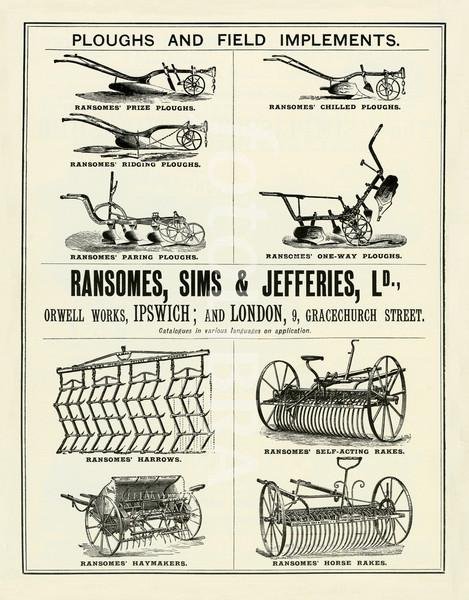
I have had an enquiry from Yorkshire from Barry Wood, the owner and restorer of an Aveling & Porter traction engine. This engine was bought new in 1872 by Mr R B Mugleston who was living at Copthall Green, near Waltham Abbey. Soon after, he took the tenancy of Littlebury farm at Stanford Rivers, as well as Stondon Hall farm. His tenancies expired in 1883 and all the stock, including the machinery, was sold by auction on 27 September. By 1905 the engine had been modified and was working in a gold mine in Rutherglen, Victoria, Australia.
Barry would welcome any information on Mr Mugleston or the purchaser of the engine. His five sons followed their father’s occupation in the area, working (amongst others) Grays Farm, Marden Ash, and Waters Farm, Stapleford Abbots.
Images

Article 2 of 14
Anglo-Scotish Migration Database
Article 3 of 14
Anglo-Scottish Migration Database
I am writing to you on behalf of the University of Manchester. As you may be aware, we are currently engaged in an exciting project, funded by the Arts and Humanities Research Council, entitled ‘Anglo-Scottish Migration and the Making of Great Britain, 1603-1762’. The project aims to bring together those with an interest in Scottish migration to England in the early-modern period with a view to assessing how well (or otherwise) Scots integrated into English society.
As part of the research programme, we are keen to secure the assistance and input of local history societies. To this end, we have been constructing an online, open-access database of Scots who made their way to England in the seventeenth and eighteenth centuries. This database is now complete and has been opened for public access, and we would encourage your members to use it as a research resource. But additionally, and crucially, the database is also available for public editing. If, therefore, any of your members have come across Scots in early-modern England in the course of their research, we would ask them to visit the website and add these individuals to the database. Users would also be very welcome to add new information to existing entries.
Should any of your members wish to contribute in this way, they can visit the database at
http://wiki.angloscottishmigration.humanities.manchester.ac.uk/index.php/Main_Page.
All they need do is login, using the details below, and then follow the link on the database homepage.
The login details are: Username: Historysocs; Password: HS2013adk!.
Alternatively, your members would be most welcome to pass details on to me directly, and I will add them to the database. We would greatly appreciate any assistance which might be offered, and we feel sure that extensive collaboration from local historians – who invariably possess a greater understanding of local sources than do university academics – offers the surest means of achieving a comprehensive understanding of Anglo-Scottish migration patterns.
Please do not hesitate to contact me if you have any questions. Thank you for your time, and I do hope to have pleasure of hearing from your members in the future.
Yours sincerely,
Dr Allan Kennedy.
Dr Allan Kennedy,
Research Associate in British/Scottish History,
S2.6-7 Samuel Alexander Building,
School of Arts, Languages and Cultures,
The University of Manchester,
Oxford Road, Manchester. M13 9PL.
http://www.angloscottishmigration.humanities.manchester.ac.uk
Article 4 of 14
Attack on a Constable
At Ongar on Saturday George Day of Waterloo Terrace, Bethnal Green, was charged with grievously wounding, and Joseph Hill of Duckett Street, Stepney, with assaulting Constable Henry Lindsey.
According to the evidence a party of men from the Est End of London had been "rounding up" horses in the fields at Stanford Rivers near Ongar and, when spoken to, they attacked the owner and Constable Lindsey. Afterwards they ran off to an inn. When the constable entered the house, Day was stated to have thrown four tumblers in succession at him, cutting his head, ear and neck. Notwithstanding his injuries, Lindsey secured Hill, and locked him up in the village smithy. A crowd tried to rescue Hill, but the blacksmith named Tyrell kept them off with an old sword.
Hill was sentenced to two months imprisonment and Day was committed for trial at the Essex Assizes.
[The Times of 12 September 1910.]
Article 5 of 14
101 Uses of a Church Porch: Stanford Rivers South Porch use for “habitacion” in 1600
I have just come across the following unusual use of the church porch at Stanford Rivers. It is in A Series of Precedents and Proceedings in Criminal Cases from the Act Books of the Ecclesiastical Courts in the Diocese of London from 1475 to 1640 (a really snappy title!) edited by William Hale, first published 1847.
This extract is from the Court of the Archdeaconry of Essex, 20 October 1600.
Willielmum Wallis, et uxorem, de Stanford Rivers: Detected, for that they have made their habitacion in the south porch of the parishe church, & therewithall he dothe not otherwise provide; but hathe suffered his wife to travaill in childbirth therein & to continue there her whole moneth
I haven't looked into this any further, but I suppose there might be a sharp comment in the parish register if the baby was baptised!
Images
Article 6 of 14
Ongar Through The Centuries. 40 Little Known Facts: a booklet just published by the Ongar Millennium History Society
The Ongar Millennium History Society has just published a booklet giving forty little known facts about the town.
Just two entries from the booklet:-
In 1893 the Ongar annual fair was ended because the event had turned into an excuse for ‘drunkenness and debauchery’. Not that the people of Ongar didn’t put up a fight to retain it. Captain Budworth became the people’s champion and stopped the early attempts to end it, but 8 years after his death the puritanical powers prevailed.
And:
In 1285 ‘John the Clerke’ was ringing the church bell hen the clapper fell off and killed him. Medieval law demanded that blame should be placed somewhere. As there was no murderer they prosecuted the bell instead and found it guilty and so it became forfeit to the crown. The King didn’t want the bell, only money. Local officials were ordered to make a valuation which they set at 8 shillings 2 pence. This was not enough for the king so they were prosecuted as well.
The booklet costs £2. and is well worth the expense. If you would like a copy please e-mail to info@omhs.org.uk
Article 7 of 14
Greenstead and the Course of St. Edmund’s Translation
Article 8 of 14
Greensted and the Course of St Edmund’s Translation
This seems a suitable occasion on which to say something as to the course taken by those who conveyed the remains of St. Edmund back to Beodricsworth (now Bury St. Edmonds) in A.D. 1013 and may be, to controvert the idea that this church was erected as a temporary resting place.
The story of the translations of the remains is full of charm but would occupy too much time to tell. The death, or martyrdom, of Edmund at the hands of pagan Danes took place in A.D. 870. Thirty-three years later the body, said to be incorruptible, was translated from Hoxne -Wood near Eye in Suffolk, where he was slain, to Beodricsworth where it remained for over one hundred years.
It is stated that miracles and wondrous healings took place and the shrine drew crowds of pilgrims whose offerings enriched the monastery at Beodricsworth, henceforward known as St. Edmund's Bury, or Bury St. Edmunds. But in A.D. 1010 the Danes, under Turchil, pillaged Suffolk and the monks of Bury fled in panic, then a faithful monk named Ailwin literally carted the saint’s remains by devious and obscure tracks to London - helped by sundry miracles on the way. There Ailwin deposited his charge in the church of St. Gregory by St. Paul, afraid to take it into the cathedral lest the bishop should permanently retain it. As at Bury, so in London, the relics proved a source of wealth, pilgrims crowding to touch the shrine. Peace of a sort was made with the Danes and in 1013 the monks of Bury, after much contest with Aelfhun, Bishop of London, possessed themselves of the remains, and commenced that return to Bury which is of special interest to us. Very different from the secret, silent journey, accomplished by Ailwin in A.D 1010, was this third translation, for this was a triumphant progress along the King's-highway, welcomed at every halting place by the population, and staying long enough to receive many offerings, or as a devout Catholic has it, "to satisfy the devotion of the faithful.”
By which exit from London Ailwin led the procession is unknown, nor are we certain of the way followed when Essex was reached. St. Edmund's latest chronicler says that Ailwin "chose as his route the ancient way that runs from London to Chipping Ongar, Chelmsford, Braintree and Clare" but this is an itinerary which can hardly be supported throughout by knowledge of the localities or by tradition. Mr. Robert H. Browne of Stapleford thinks that the "return journey was by Hainault Forest, to Havering probably, and so to the manor house of the Lords of Stapleford "crossing the river Roding at Passingford.”
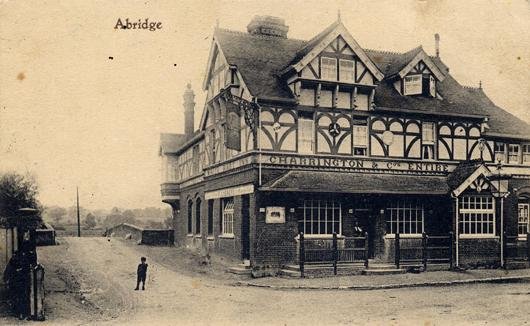
In ‘The Essex Review’ some years since I expressed the view that the course followed was likely to have been along an old road by Chigwell, crossing the river at Abridge, but the matter is involved in obscurity and I would fain believe with Mr. Browne that the saint's remains were carried to Stapleford, higher up the valley, for then we need not look on the old tale recited by Dugdale in the ‘Monasticon Anglicanum’ (1655-73) as one of those such as Speed refers to when he says “the monkes of those times made no great dainty daily to forge matter for their owne advantage."
Newcourt in his ‘Repertorium’ gives the story thus:-
“It is call'd Stapleford-Abbots for that it belong'd to the famous Abby of S. Edmundsbury, and was given by the Lord of it, to S. Edmund; because being sick, he recover'd upon Harbouring the Corps of S. Edmund, as it return'd from London to S. Edmundsbury."
Whether Ailwin and his followers crossed the Roding at Abridge by Lambourne, or at Passingford by Stapleford, it is not unlikely that ere they reached the ford they wended their way by the track, or horse road, still traceable, though fallen far from its former estate, which ran from Chigwell towards Lambourne and Stapleford along the ridge above the valley.
There can be little doubt as to the course followed from the neighbourhood of Passingford to Greenstead. Part of the great highway which now runs to Ongar probably did not exist and we may assume that Ailwin took the road by Stanford Rivers church, and so to this spot. This road, like many an ancient highway, has dwindled down to bridle-way, cart-track or footpath, but it is easily traced by those who know these Essex fields. From Greenstead the ancient way may be traced northward, and I have little doubt that the saint's remains were carried hence to the old "Suffolk Way" through the Roothings to Dunmow, where our member, Mr. Hastings Worrin, finds "St. Edmund's Way (in 1698, in an estate book), and thence by Lindsell, Great Bardfield, Finchingfield and Clare to Bury.
So we see that Greenstead, probably with the Saxon thane's hall and the huts of the tillers of the soil, stood, not as some have written in an obscure position, but alongside the king's highway, and I see no reason to suppose that the parish was churchless and must assume that this building or another on its site stood ready to hand when the relics of St. Edmund rested some days on their homeward journey. Against the commonly accepted idea that this church was hastily erected to receive the saint's remains, must also be noted that well seasoned, firmly fixed timber was used. Had oak been freshly cut the trunks would show far more evidence of shrinking apart.
Whether erected before A.D. 1013, on the occasion of the resting of St. Edmund's remains in that year, or subsequently, may the timber walls of this little edifice stand a lasting memorial of East Anglia's king, martyr and saint!
NOTES.
It is almost certain that in early days, before the Roding was confined to its present narrow channel, the whole valley was under water or in a morass-like condition with few fords, and we must consequently regard the present high road from Abridge to Passingford as a comparatively modern creation. The one ancient manor settlement on this low-lying road (known as Arnold's) is on a spit of land slightly higher than the old-time ford level, and the remnant of a chaseway shows that it was approached not from Abridge or Passingford but from the high land on the south. Bearing in mind the condition of the valley we look for a dryer track way, and we find it running from near Chigwell church, by Lambourne church and hall to Stapleford Abbots church, possibly extending past Navestock church and hall and Kelvedon Hatch church and hall and so further north. This ancient way has been in part absolutely destroyed or absorbed in later roads but for much of its length can be traced in bridle ways and footpaths.
With regard to the high road on the other side of the river, north of Passingford, leading to Chipping Ongar, it would seem that the northern part is also of comparatively modern date for not a church or ancient village is upon it and its northern end would in early Norman days have gone plump against the walls of Eustace of Boulogne's stronghold, an arrangement which would hardly have suited that feudal lord.
The line of the ancient road in this direction seems to me to have been past Suttons, along the course followed by the present high road for about a mile, then turning left by Murrell's farm and the site of the reputed manor house of Gelhowes, or Bellhouse, to Stanford Rivers church and hall, and thence to Greenstead church and hall. Old-time villages were mostly grouped round hall and church, and the position of the noticeable series of churches and halls I have mentioned leads me to conclude that the links connecting the settlements were the ancient trackways, high above the flooded valley of the Roding.
Though Ongar became of importance when Eustace of Boulogne established a stronghold there in the days of the Conquest, its development dates from the twelfth century, when Richard de Luci held the castle under Henry II. De Luci, who resided much at the castle when his arduous duties permitted, encouraged the little settlement which occupied his outer bailey and procured it the right of a market. Possibly Ongar's present direct road southward may date from De Luci's lordship, but I doubt if it is as early and imagine that even so late as his time the principal track to Ongar branched from the highway at Greenstead.
By I. Chalkley Gould, F.S.A. [Delivered (in part) 6th October, 1906]
Extracts from the Transactions of the Essex Archaeological Society (now the Essex Society for Archaeology and History).
From ‘Transactions New Series, Volume 10 Part 2’ (1907)
A new series for our Journal begins with St Edmund, who was moved from London to Suffolk in 1013. His Feast Day is commemorated on 20 November.
The scene is pictured in modern glass in the window of the north side of the chancel.
ee Saint Edmund, by the Rev. J B Mackinlay, O.B.E., 1893, for a full account of the saint’s life and the fate of his remains, told from a Roman Catholic point of view with faith and sympathy.
The Essex Review, xii, 47, 1905.
Vol xi, 234, 1902.
Vol. ii, 554, 1710.
Mr Worrin mentions a spring at Lindsell called Dedman’s Bush. The change of name from St Edmund to Tedmund and finally Dedman is evidenced elsewhere. See Essex Review, xi, 234, 1902.
All we learn from the old register of Bury is that “He [St Edmund] was also sheltered near Aungre, where a wooden chapel remains to this day.” This does not help to determine the date of construction and was, of course, written long after the event.
Article 9 of 14
The Diary of Anna Reeve of Stondon Massey, 1888
Introduction
This is the story of a Victorian lady and of life around Stondon Massey told through her personal diary of 1888.
Anna Reeve (1856 – 1938) was the oldest child of Reverend Edward James Reeve (1821 – 1893), the Rector of nearly 40 years, and of his wife, Emma (1823 – 1912). Living in the family home at the Rectory (now Stondon Massey House) in the village in that year were her sisters Elizabeth Jane (1859 – 1946), referred to as ‘J’ in her diary, and Edith (1865 – 1954), referred to as ‘E’. Whenever the three sisters went out together Anna wrote in her diary, “we 3”. Also living at home was William Francis, referred to as ‘F’, her older half-brother. The family also kept servants: the maid, Alice, is referred to twice.
Anna’s only other brother was Edward Henry Lisle Reeve (1859 – 1936), known in the family as Lisle. In Anna’s diary he is referred to as ‘L’ or more affectionately as ‘Dear’. Lisle was to succeed his father as Rector in 1893 but during the time when the diary was written lived in Colchester as Curate to Revd. J R Corbett at St Botolph’s Church in the town.
The other sibling, Alice (1860 – 1893) lived with her Aunt in New Road, Brentwood (a century later demolished to build a multi storey car park and shopping precinct).
Anna’s life, like her other sisters, was spent supporting her father and later her brother in the ministry of the church among the parishioners. Her father descended from rich gentlemen and received the tithe as his income. It is said that Edward forbade his daughters to marry, perhaps on account of the fact that he had married Emma, his first cousin. Little is known or referred to about Alice, living at Brentwood, and perhaps, perhaps wrongly, it might be assumed that her shorter life may have been a consequence of some disability.
This was a personal diary, for 1888, covering Sunday 8 January 1888 to Sunday 12 January 1889. Anna used ‘Fulcher’s Ladie’s Book, Poetical Miscellany’ to record in pencil the events of each day. The diary is no larger than five inches by four inches and has a page per week. The writing is small but mainly clear.
The pattern of writing is pretty similar from day to day. She begins with the weather, and then mentions what each family member was doing that day, concluding with any special happening. Her mother is never mentioned. In later life she became housebound and had to be cared for by her three daughters.
A typical day’s work is on Friday 11 January 1889: “J[ane] & I to Green parishing.” Anna and her sisters visited parishioners at the cottages around the Green, what we would regard now as the centre of Stondon Massey around the Bricklayers Arms. The location is mentioned 53 times. Both ‘Papa’ (The Rector) and Jane did this activity on a more regular basis.
Unfortunately for us as local historians, Anna also spent time away from home. Recorded on the inside front cover is:
“To Foxholes L[isle] there. July 14th: & to Isle of Wight July 18 -20 lunched with the Paynes en route at Portsmouth.
“Sept 28th – Oct 8th. Acklam. Oct 8th – Nov 2nd At Holtby – Nov 2nd. To Sheffield with Wheal – Nov 7th.”
The daily happenings over this month or so are probably of less interest. Nonetheless, the diary is a rare survivor, telling of the ordinary life of an individual. It came in to the author’s possession from a distant and elderly Reeve family member who offered a number of books and papers to him while writing a biography of Lisle.
A Typical Week
The following are the entries for a typical week in the life of Anna and her family. It seems that she took a Boys’ Sunday School regularly at St Peter & St Paul Church. Girls appear to have been taught at a midweek class in the Study at the Rectory. The numbers attending the Services, or taking communion, are sometimes recorded. The numbers are not huge, but Stondon Massey had a population of only about 200 at the time.
“Sunday 12 February
“Fine day. White frost. To Ch[urch] twice. 4 boys in vestry. May Ethel Cook christened.
“Monday 13 February
“Bright day mostly. I & E[dith] to Church putting up Lent sheet & banners. Papa to poor Mr Hoskins funeral in Bl[ac]kmore. Mr Prance to tea here. J[ane] to Fanes & they to tea here. We 3 & Mary to Ongar concert.
“Tuesday 14 February
“Snow. Bright morning. Papa & we 3 to Brentwood. Lunch at Aunties. L[isle] there.
“Wednesday 15 February
“Snow showers. I to Mr Perkins then School. Ash Wednesday. To Church. J[ane] to Webbs & Cooks. J[ane] & I to tea at Whites. Wrote to Snez.
“Thursday 16 February
“Very cold & dull. Indoors all day. I had 5 girls in Study. Wrote to Auntie. F[rancis] to Ongar. To Smiths to tea.
“Friday 17 February
“Very dull & cold. Papa to School & Webbs. J[ane] to Wren. I to Sch[ool] & Mrs Moss. Wrote to E Bayne.
“Saturday 18 February
“Snow & sunshine. Papa to Ongar. J started for Priors & caught in snow.”
Her father attended the funeral of Rev. Thomas Hoskin of Blackmore on Monday 13 February. He had been the incumbent at the time of his death, and was buried immediately next to the porch of the church in the parish he had served. There is no record of the induction of Rev. Walter Layton Petrie on 5 May that year. “Mr Petrie called & tea from Bla[c]kmore” on 6 June.
In 1888 Stondon Massey had a school directly supported by the Rector. This was a Church of England school for Anglican children. The Rector refused to admit non-conformists. The sisters were frequent visitors as assistants to the schoolmistress, Miss Progger, who had been at Stondon Massey School for 17 years. Her name is mentioned 24 times in Anna’s Diary (as “Miss P”). There are 109 entries referring to the school.
William Wrenn was the Parish Clerk.
‘Papa’ travelled often to Ongar on a Saturday. He was a J.P. as well as Rector and was sometimes recorded as going “to bench”.
Many names are mentioned throughout the diary. Those that regularly appear are the Whites, Lockwoods and Fanes who were friends of Anna and her circle.
The sisters were great friends with the Lockwoods whose name occurs on 38 occasions. A typical entry, on 28 February, “We 3 to tea at Lockwoods & played ‘Spoof’.” On Sunday 10 June the parents made one of many visits to the Rectory: “Mr & Mrs Lockwood to tea & garden.”
Events during 1888
Shelley Church dates from 1888, replacing one built earlier that century on the site of a medieval church. On Tuesday 5 June Anna records, “Fine day & cool. Papa F[rancis] & I to Stone laying of Shelley Ch[urch] & luncheon. E[dith] to School.” On Monday 10 December the Church was consecrated. “Lovely bright & white frost. Papa & I to Consecration of Shelley Ch[urch] & met B[isho]p of Colchester at Richards luncheon. Mrs Tanner & friend to tea here. J[ane] to Fanes.”
Another occasion was at Kelvedon Hatch Church. On Friday 29 June, “We 3 & Papa to reopening of Kelvedon Church. B[isho]p [of] Colchester preached.” This was the church which predated the present building which was constructed in the 1890s.
At his own church on Tuesday 15 May, “Papa in Vestry meet[ing]s in re[gard to the] Spire.” This is reference to the belfry which was repaired in 1888.
On Monday 11 June, Anna visited the Garrison town of Colchester, which was also the home of her brother Lisle: “Mabel R & I to Colchester to see ‘March Past’ & new colours presented by Duke of Camb[ridge].”
A Flower Show was held at Stanford Rivers on Wednesday 26 September: “J[ane] & I to Flower Show at Stanford Rivers.” Then on Wednesday 21 November, “We 3 to Chrysanthemum Show at Ongar.”
On Friday 28 December Anna was “Getting ready for dance at Budworth Hall“, which had opened only two years previously.
National sporting events are also recorded. Cambridge won the Boat Race on Saturday 24 March. Ayrshell won the Derby on Wednesday 30 May. Two days later: “‘The Oaks’. Sea Breeze won.”
Point to Point races were held at Thaxted on 9 March, although it is not clear who, if any, of the Reeves attended.
Local sporting events were part of the social round. Cricket is mentioned eleven times between May and August. “E[dith] & I to Cricket Concert with Tyn[dale] Whites” on Thursday 17 May. The Stondon Massey team played on Tuesday 29 May: “Cricket match here v. ‘Blake Hall’. Stondon won in 1 inn[in]gs.” Three weeks’ later: “Cricket match v. Blackmore. J[ane] & I to see it.”, and on Thursday 21 June “J[ane] & I in hired trap to Blackmore to see Brace’s cricket.” A boys’ cricket match was held at Navestock on 22 August.
Francis, her half-brother was a keen cricket supporter travelling, presumably by train from Ongar, to Leyton: “F[rancis] to Leyton with Mr Barnes to see ‘Australians v. Oxford [University Past and Present]’.” It was the first of a three-day match, in which Australia won the toss and decided to bat. They eventually won by 74 runs.
From May to September the sisters played tennis, sometimes twice a week, and often at the Fanes. The activity is mentioned 22 times of which once, while on holiday, and twice when there was “no tennis”. Tennis parties were very common for example on Thursday 6 September, Anna’s birthday (she was 32 years old): “Very lovely bright after[noon]. We 3 to tennis party at Banks. Very nice.” On Tuesday 10 July in the Rectory Garden it was their turn to host: “Fine day. Our garden party. 19 came. Very pleasant tennis. Papa’s birthday presents etc.”
Wimbledon tennis winners are not mentioned in Anna’s diary. The championship was just over a decade old in 1888.
At the Lockwoods croquet was played. Games are mentioned on three occasions.
The Countryside
Birdnesting, the hunt for and stealing of eggs from a bird’s nest, is now illegal but was in 1888 a legitimate pursuit. Anna’s diary records on 20 April: “J[ane] & Bessie D birdnesting.”
Fox hunting, a recent thing of past, is mentioned also in the diary. The sisters were frequent spectators, as shown in the following examples: on Monday 23 January “Lovely bright & mild. We 3 to ‘meet’ at Blackmore. G[rea]t fun.”, and Saturday 11 February,”Dull day. J[ane] & I to Meet at Myless, long walk & didn’t see much.” On Saturday 7 April “We 3 drove to ‘meet’ at Bentley.” As an aside, the sisters took themselves to Bentley by horse and a cart of some variety. (The motor car had not been invented, and there are no references at all to bicycles because penny farthing was used for sport by men rather than a mode of transport.)
There are, though, many timeless occurrences:
Saturday 14 April: “Saw brimstone butterfly & planted primroses.”
Saturday 28 April: “J[ane] & I to Church Wood. Heard 3 nightingales.”
Saturday 5 May: “Sowed flower seeds.”
Wednesday 16 May: “Sowed more flower seeds.”
Friday 13 July (also 21 & 24 July): “Picking raspberries.”
Thursday 26 July (also 4 & 10 August): ”Picked currants.”
The diary does not mention the harvest or gleaning, probably on account that this was not lady’s work, or the harvest festival service or supper, because Anna was away from Stondon on holiday during the latter part of September.
The weather
The diary provides a snapshot of the weather each day suggesting that 1888 was considerably colder on average than the weather now. There were 20 days, from January until 9 April, when it snowed, with one such event in October while on holiday. There are 15 references to frost. There are 13 references to ‘skating’, from 1 to 3 February, 27 February to 5 March 1888 and 4 and 7 January 1889. Adults skated at Priors or the Fanes. The entry for Friday 2 March reads “Lovely bright & thawing. Wrote to L[isle]. Papa to School. J[ane] to Fanes skating. I to School. E[dith] & J[ane] to Gilberts & Fanes. Mrs Fane & F Bloom here for skating.”
Thunder or thunderstorms are mentioned on 11 occasions. On Wednesday 1 August, a “very wet day” there was a “Thunderstorm from 8 to 12P.M. [midnight]” which resulted in floods the following day: “I to School in morn through Lockwoods garden because of flood. Papa to Nichols at [Hallsford?] B[ri]dge. Floods tremendous!” Presumably the road, which has a dip between the Rectory and the School, was impassable. The entry indicates that the Lockwoods were near neighbours.
The word ‘hot’ appears on 14 occasions, once in connection with thunder. There were only three days during the summer of 1888 when words such as lovely bright and sunny coincided in the diary. Perhaps summers of old are not as good as ours now?
Christmas in 1888
Diary entries for the week up to and around Christmas are interesting.
The first reference to the season is on Thursday 20 December: “Fine day. Papa to Miss P[rogger] at Assers. I to School. E[dith] to Green. Miss P[rogger] to tea here. Wrote to L[isle] & sent off Xmas cards. Practice. All went. Presentation to Miss P[rogger].” This was also the day which marked the end of Miss Progger’s employment as schoolmistress and, it seems, pianist to the choir. Anna records the following day, “Presentation to Miss P[rogger] by school children & Goodbye! to her after 18 years.”
On Saturday 22 December: “Fine day. Doing decorations. Papa to Green & dined at Whites. Sent off cards” with the Sunday before Christmas, much as usual, “Fine day. To Ch[urch] twice. Sch[ool] once. F[rancis] to Doddinghurst 6P.M.”
The preparations for the big day began on Christmas Eve: “Fine day. Putting up decorations. Papa to Ongar. Sent off Xmas cards.”
The entry for Christmas Day, Tuesday, reads “Christmas Day. To Ch[urch] twice. Bright morn[ing]. Rain after[noon]. Lots of cards by both posts.” There is an absence of references to presents – which we assume were given, much like on birthdays – but strikingly the cards received by both posts that day, from the Post Office at Kelvedon Hatch.
Anna visited the School on Wednesday 26 December: “Fine, shower of rain. Fine. E[dith] & I called on ‘Elise’. I to the Scho[ol]. E[dith] to Howes. Major & Mrs Gilbert to tea.” The only other reference to the season is “Herbert Gibson to turkey dinner with us” on Saturday 29 December.”
Conclusion
Anna’s life is told through her diary. It tells on the one hand of her support to her father in caring for her neighbours and of a Christian ministry: a Sunday School teacher, as support to the schoolmistress. On the other hand it also refers to the social circle in which she revolved. These were the expectations of a Victorian lady, and spinster: expectations which were to continue after the death of her father and throughout the 42-year ministry (until 1935) of her brother, Lisle, as Rector.
The diary also opens a field of further research. Each entry is only a glimpse on life in and around Stondon Massey in 1888. Pursuing each topic, such as the Cricket match at Leyton, and each name, through census research, would enlighten further these life and times. Having transcribed the diary and written these notes, there is much more that could be done – if time allows!
Article 10 of 14
Hill Hall and Copt Hall
Hill Hall, between Epping and Ongar, is one of the least known yet most interesting places in the county. Its splendid park and high situation provide magnificent views, and its fine approach through an avenue of elms adds extremely to its charm. For over three hundred
years it has been the seat of the Smyth or Smijth family.
The house was built about 1548 in the then prevailing Renaissance fashion by Sir Thomas Smyth, who is said to have derived the design, during his travels in Italy, from John of Padua, a famous architect About 1713 Hill Hall, like so many old Tudor houses in Essex, underwent severe treatment in order that it might more closely resemble the prevailing fashion of classical architecture.
Many features of the old house were preserved; a grand entrance hall fifty-six feet by twenty feet is a later feature. Sir Thomas Smyth must be sought for among the Essex Worthies, for he is one of our shining lights. Some Holbein portraits of his time are still among the treasures of the house.
Contemporary with the modern portion of Hill Hall a number of houses may be named.
Copt, or Copped, Hall, Epping, overlooking the famous Forest, was originally built soon after 1564 by Sir Thomas Heneage, and was said at that time to be the “noblest house in Essex." It had a fine chapel and a gallery fifty-six yards long, which was blown down in a hurricane in November, 1639. It was built by John Conyers, whose family held it for more than a hundred years ; it is now the property of E. J. Wythes, Esq., a former High Sheriff of the county.
Images
[A description of Hill Hall, Theydon Mount, and Copt Hall, Epping taken from ‘Memorials of Old Essex’, published in 1908.]
Article 11 of 14
In Memoriam. Lewis Newcomen Prance
The death of the Rev. Lewis Newcomen Prance, which occurred in the middle of April [1913], has deprived our Society of an old and valued member, a constant attendant at its Council Meetings, and one who, until quite lately, but rarely missed an archaeological excursion. He was a man of great physical activity, and bicycled long distances swiftly and without apparent fatigue.
Mr. Prance graduated from Trinity college, Cambridge, in 1863 and was ordained deacon in the following year. During those two years he held an assistant mastership of Haileybury college. From 1869 to 1872 he was rector of Ayott St. Peter, Herts., and in the latter year went to Stapleford Tawney, which rectory he held, together with that of Theydon Mount, until his death. Mr. Prance, in conjunction with a friend, transcribed and edited the registers of the parish of Stapleford Tawney, and was elected a Fellow of the Society of Antiquaries in 1892,
W[illiam] C[hapman] W[aller]
[Extracts from the Transactions of the Essex Archaeological Society (now the Essex Society for Archaeology and History).
From ‘Transactions New Series, Volume 13 Part 2’ (1913)]
Article 12 of 14
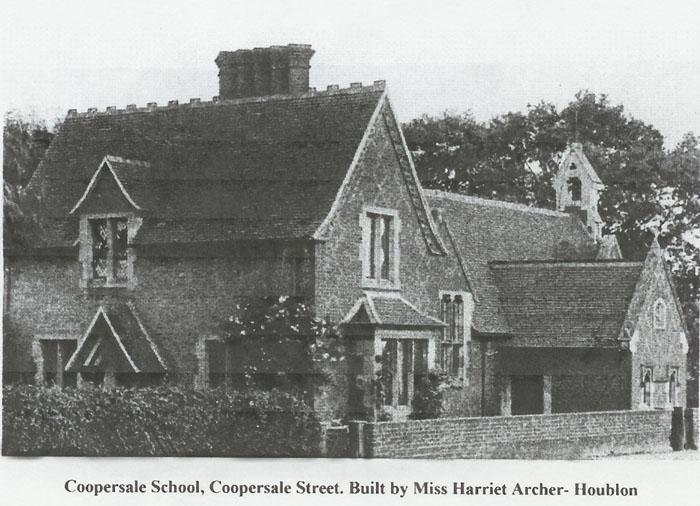
Harriet Archer-Houblon
Harriet was born on the 28 December 1812, the daughter of John Houblon (Archer-Houblon) and Mary Anne Bramston, who had 9 children in total. Harriet was a spinster and lived at Coopersale House, Theydon Garnon.
She died at The Vicarage, Wanstead, Berkshire on the 29 July 1896, at the age of 83. She left nearly £50,000 in her will.
She did a tremendous amount for the local community. In 1850 she built a National School and teacher's house at Coopersale. During the following years she contributed much of the school's income and took a personal interest in its work. The school was immediately successful. In 1858-9 it had an average attendance of 88 and was described by an inspector as 'a fair village school'. By 1871 attendance was over 100. It continued to rise and in 1879 Miss Archer-Houblon enlarged the school at a cost of £300 to provide total accommodation for 180 pupils.
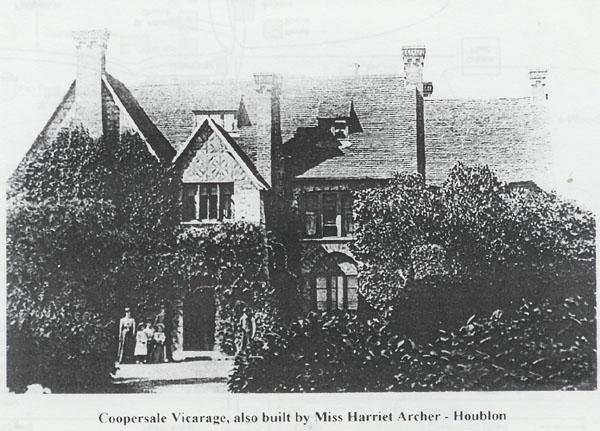
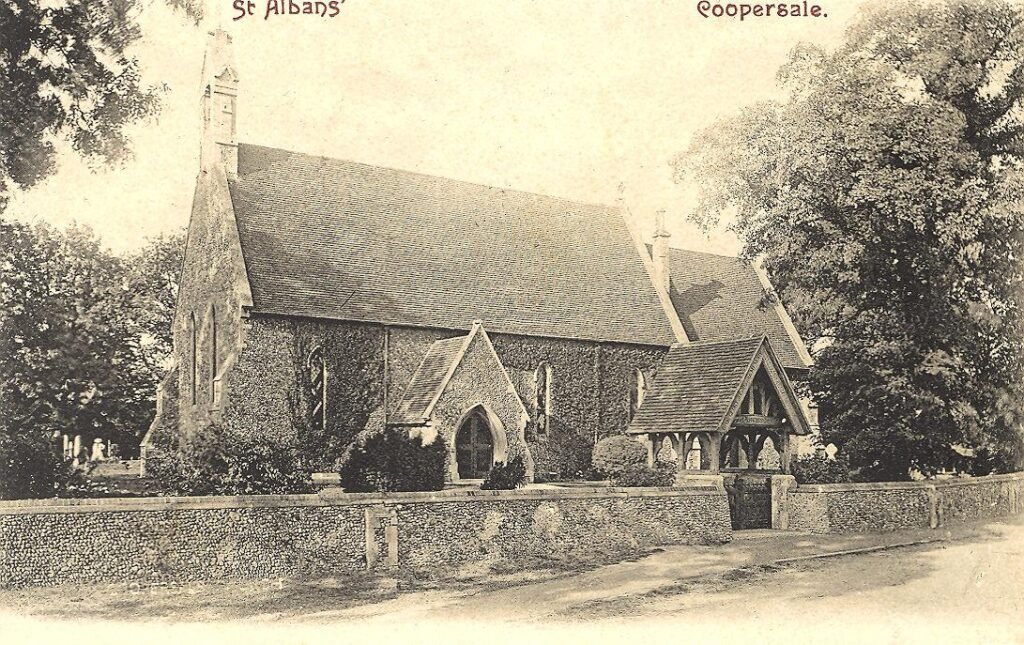
Coopersale Church, St. Albans, was built in 1852 with land and funds provided Harriet, together with the vicarage, all built by notable architects.
Local resident Fred Brown wrote a booklet on the history of Coopersale, and in it he wrote:
'There was a great frost in February 1895, which caused many problems. Hydrants were frozen up, and the large lake at Coopersale House was frozen over. Miss Archer-Houblon invited skaters to use the lake, around which Chinese lanterns were hung. Trees were also illuminated with fairy lights, tea and refreshments were provided and an Ice Carnival was held in the evening, culminating in a firework display.' What a wonderful sight it must have been.'
The family connection with Coopersale was soon to end the contents of Coopersale House were disposed of in 1908, and the whole estate sold in 1914. Members of a religious order occupied it during the World War I, then in 1920 it was bought by a Mr H J I Camps, who surprised his neighbours by removing the top storey and part of the north-east wing. Like Miss Archer-Houblon, he become a local benefactor and built the Village Institute.
Coopersale House changed hands again several times during the 20th century, its owners including the banker Major Jocelyn Hambro and the media magnate Rupert Murdoch.
Images
Article 13 of 14
Kelly’s Directory 1833 – Coopersale
COOPERSALE, adjoining Epping, was formed into an ecclesiastical parish Oct. 22, 1852, out of the civil parish of Theydon Garnon, but for civil purposes is now principally in the parish of Epping, and still remains a part of the rectorial parish of Theydon Garnon ; it is 2 ½ miles north-east from Epping station on the Ongar branch of the London and North Eastern railway, and 7 miles east from Waltham Abbey, in the Epping division of the county, Ongar hundred, Epping rural district and petty sessional division, Waltham Abbey county court district, Chigwell rural deanery, archdeaconry of Southend and Chelmsford diocese.
The church of St. Alban, erected in 1852, at the cost of Miss Archer- Houblon, is an edifice of flint in the Early English style, consisting of chancel, nave, south porch and a western turret containing one bell: the east window is a memorial to members of the Houblon family, and a south window to Miss Archer-Houblon: an oak reredos, in memory of the late Mrs. Grain, was erected in 1923; the chancel has a credence and piscina, and on the south side are sedilia: there are 220 sittings: in 1907 a lych gate was erected as a memorial to William and Elizabeth Pearson. The register dates from the year 1852. The living is a vicarage, net yearly value £350, with 5 acres of glebe and residence, in the gift of the Bishop of Chelmsford, and held since 1931 by the Rev. Horace Baggallay Reiss M.A. of Queen's College, Oxford ; the vicarage house was built at Miss Houblon's expense. A parish room was built in 1882, opposite the vicarage, at the expense of Miss Archer—Houblon.
The Epping Institution, available for 200 inmates, is in this parish. The Institution infirmary and master's residence were erected in 1912. In 1927 an Institute was built at the cost of £1,700. Cottage Homes for 40 children have been built here.
Coopersale House, the residence of H. E. J. Camps esq. is an ancient mansion of brick and stone, situated on a declivity, to the right of the road to Epping; the grounds, of about 27 acres, are well arranged and contain a large sheet of water ; the estate was held by the Archer family from the time of Henry V. who is said to have changed the name of this family from Dubois to Archer on the occasion of a shooting match at Havering, when one Simon Dubois, his attendant at Agincourt, acquitted himself so remarkably as to win from the king this distinction. Coopersale Hall, an ancient mansion, is within the parish of Theydon Garnon. The population in 1921 was 756.
Post & Tel. Call Office, Coopersale. Letters through Epping, nearest M. O. & T. office
Article 14 of 14
Programme of Events 2014
PROGRAMME for 2014
Thursday 3rd April
(Please not the change of date)
Annual General Meeting
Followed by
+ Wine and Cheese
+ Film Show ‘1953’
(members will be charged £2 on this occasion)
Thursday 24th April
Essex Place Names
Paul Marden
Thursday 29th May
Traditional Buildings of Ongar
Anne Padfield
Thursday 26th June
(to be confirmed)
Thursday 24th July
Vaughan Williams Folk Songs
Sue Cubbins.
Thursday 23rd October 23
Archaeology of Stansted Airport
Richard Havis
Senior Historic Environment Advisor Essex County Council
Visitors £3. Refreshments