High Country History Group
Contents
See images from this issue
Images from this issue
Article 1 of 17
Notable Anniversaries in 2014
Apart from the 100th anniversary of the commencement of the Great War on the 4th August, there are a number of other notable anniversaries occurring in 2014.
70th Anniversary of D. Day. (6th June)
200th Anniversary of the burning down of the White House by the British during the war with America.
300th anniversary of the death of Queen Anne of Great Britain and Ireland, the last Stuart monarch. (1st August)
50th anniversary of the last executions to take place in Britain. Two murderers were hanged: Gwynne Evans at Strangeways Prison, and Peter Allen at Walton Prison, (13th August 1964).
200th Anniversary abdication of Emperor Napoléon. He retained the title of Emperor and was given sovereignty over the island of Elba. He received 2,000,000 francs per year and 600 soldiers. (16th April 1814).
50th Anniversary of Nelson Mandela and seven other opponents of apartheid sentenced to life imprisonment in Pretoria. (12th June)
500th Anniversary of Trinity House.
And of course there are many more

Article 2 of 17
Unhealthy Occupation
They write from Ongar in Essex, that on the 14th instant died there, the Revd. Dr. Jones, Rector of that place: Tis remarkable that within about 12 months past 10 clergy of the neighbouring parishes round the town have died, and in less than two years 17 have died.
From the Derby Mercury 17th November 1749
Article 3 of 17
Centenary of Chelmsford Diocese (1914 – 2014)
Chelmsford Diocese celebrates its centenary in 2014. One hundred years ago a new Anglican diocese was formed out of the See of St Albans.
The massive expansion of London during the nineteenth and early twentieth centuries had led to a number of reorganisations. Until 1846 Essex was part of the Diocese of London; for the 31 years which followed, the cathedral church was Rochester for the vast majority of the county’s parishes. Thomas Legh Claughton, who lived in Essex, transferred as Bishop from Rochester to St Albans in 1877. This new diocese covered the whole of the counties of Essex and Hertfordshire. By the early twentieth century the Diocese had become unmanageable perhaps contributing, thought Revd Reeve of Stondon Massey, to the untimely death of Bishop Festing who suggested that it “is easier for a Bishop to know his Bradshaw than his Bible”.
In 1905 a proposal was made to divide the Sees of St Albans, Ely and Norwich into five areas, creating new Dioceses in Essex and Suffolk. The Suffolk cathedral was to be situated at Bury St Edmunds. The Essex See was to be coterminous with the historic county boundary.
Several towns put forward submissions for cathedral city status. On 5 March 1908 a meeting was held at which 388 out of 461 benefices in the county, representing a population of 1,088,857 (1901 census) submitted their preference for their choice of town for the new cathedral.
Twenty-eight benefices gave their first votes for Woodford, Barking, Waltham Abbey or Thaxted.
Chelmsford obtained the votes of 191 benefices, 256 clergy, and 428,375 laity.
Colchester 101 benefices, 121 clergy, and 120,657 laity.
West Ham 63 benefices, 119 clergy, and 321,677 laity.
Much the same result was arrived at by the votes of public meetings – namely, Chelmsford 65, Colchester 40, and West Ham 36.
“It was consequently resolved:
That the church of Essex having in so unmistakable manner expressed its opinion, Chelmsford shall be suggested to the authority as the most suitable seat for the new diocese; that for the present no residence be purchased for the Essex bishop, but that the sum of £10,000 be invested, and the interest thereof be paid over to the bishop until the new see is instituted, for the rent of the house“
It was probably the central geographic location which clinched the choice of Chelmsford.
It took a considerable time for the Bill to pass through Parliament, in part due to the poor constitutional relationship between the House of Lords and House of Commons at that time. A General Enabling Bill was finally passed “at the extreme end of the Parliamentary session in 1913: and, having received the consent of the House of Lords and His most gracious Majesty King George V, passed into Law on August 15th”.
Dr Watts-Ditchfield was consecrated as the first Bishop of Chelmsford at St Pauls Cathedral in February 1914 and enthroned “in the Church at Chelmsford, now to be known as the Cathedral … on Thursday, April 23rd”.
St Mary’s Church, Chelmsford, was thus elevated to cathedral status. Plans to enlarge the building to reflect its new role was made but these did not come to fruition.
The town of Chelmsford had to wait until 2012 for City status.
Images
ERO T/P 188/3 f11
Article 4 of 17
Dedication of Church at Theydon Mount
The double dedication of the Church in this parish, left blank by Newcourt, occurs in the Register of Papal Letters, V. 277. In the year 1400 a relaxation of one hundred days of enjoined penance was, inter alia, granted to those penitents who, during certain octaves and days, visited and gave alms for the repair and fabric of the parish church of SS. Michael and Stephen, Theydon Mount (ad montem), in the diocese of London.
W.C.Waller
An extract from the Transactions of the Essex Archaeological Society. ‘New Series’ Volume 12 Part 3 (1911) p255.
Article 5 of 17
William Sworder of Stapleford Tawney
William Sworder of Stapleford Tawney Hall was not a young man when I first made his acquaintance, but he was what he always continued to be while he could throw his leg across a horse – a customer across country. With fine seat, iron nerve and great experience, whatever horse he rode he was always seen in the can. No truer friend to hunting ever lived. No more courteous gentleman have I ever met in the hunting field or elsewhere. He was a fine type of yeoman farmer, a type, alas, which too surely is passing away, but which while a Sworder lives at Tawney Hall will never die out. Such men have formed the pride of the country side, and he has left behind him several sons worthy successors of a good father, as long as being a straight, God-fearing citizen counts for anything.
Taken from Leaves from a Hunting Diary, by H. Beauchamp Yerburgh [1900]
In the 1871 Census, William is living at Great Tawney Hall. He is described as a farmer, farming 600 acres, and employing 19 men and 4 boys. He is married to Esther and they have 2 daughters, Emma and Fanny and 3 sons, Charles, Hugh and Harry. He also employs a cook and a housemaid.
In the 1881 Census, Hugh (aged 27years) is described as head of the household, although both his sisters, Emma and Fanny are still residing with him. Hugh is described as a farmer’s son. He employs two servants. William who by this time was a widow was living with his brother Charles (also a farmer) in Hertfordshire.
William Sworder (pictured below) died on the 26th July 1889, aged 77 years.
By the time of the 1891 Census, the head of the household is Harry Sworder, again described as a farmer. He is married to Eleanor and they have two sons, Norman aged 4 years and Gerald age 3 years, and a daughter aged 1 year. A Governess is employed together with a general servant, Emily Hoy, aged 11 years.
Norman and another brother Malcolm, both served in the Great War and made the ultimate sacrifice. Norman was killed in 1918 whilst serving with the Royal Air Force and Malcolm was also killed in 1918 whilst serving with the Royal Flying Corp. Both their names appear on the war memorial at St Mary’s, Stapleford Tawney.
Images
Article 6 of 17
Inquest of the body of William Reed, 1788
On Tuesday another inquisition was taken at Stanford Rivers, before the said coroner (William Reynolds Esq.), on the body of Willian Reed, who was killed by excess of drinking, being at the harvest supper, and three other workmen, with the family where they harvested; Reed drank very freely of beer mixed with gin, which intoxicated him, and being left sleeping in the room, was found dead the next morning.
Ipswich Journal, 6th September 1788.
Article 7 of 17
Christmas Eve 1886
Christmas Eve, 1886. – A day snatched from the frost by a few keen sportsmen. The frost was certainly not out of the groun at 11 a.m., but “fortune favours the brave,” and my informant relates that there were no mishaps, and that the ground rode very well. Lucky dogs! How I envy them. My mouth waters now as I think of the sport that they had; and others will have the same feeling who know the country and follow the line. Mind you, hounds had not been out for over a week, and when they will get out again remains a problem to which tonight (Tuesday, Dec.28) has given no clue. To-morrow, ye gods! We may be sleighing, skating – hunting alas, I am afraid not.
But I must cease this drivelling, and drop you at once into Beachetts’ the hour about 1 p.m., I believe, as my friend rode into the middle ride in time to see Bailey laying hounds on to a fox that had gone away across Mr Daniel Miller’s farm towards Tawney Hall. A lovely line this; but as good or bad luck would have it, for very minute the going was improving, this fox made good his escape. Bailey held the hounds all round the meadows to Weel-eves, but could not hit it off, so took them on to Shalesmore, and not finding there, went to Bush – grove, a small covert at the top of Hill Hall Park.
They had not been in a minute before he was on foot, they rattles him round once, and out he went down the hill towards Brook House, bore to the right, across Mr. D. Rumball’s fields, and straight across the park out by Mount Church, across the road down the hilly fields to Shalesmore, across the meadow in front of Mr. Sworder’s House – (how the sight must have thrilled that verteran’s heart, and brought back glad memories of other days when he himself was always in the van; but he lives again in his son, and today is in the van once more; that neat black cost follows no guide, needs no lead, and covers a heart that never beat with a jealous throb) – hounds drove on, crossing the road and over Mr Sworder’s ploughed land towards Sir Charles Smith’s house.
Running for Shalesmore
The pace up to here had been very fast, and a slight check came as a welcome respite to horses, on whose condition a week’s frost had already begun to tell tales. A man at plough had turned the fox, and hounds were soon on terms again, straight to Stanford Rivers Rectory, where they got a bit too much to the right (30 minutes to this point). A holloa back a little on the left – (it was here about six more who had been riding to find hounds all day nicked in) – Bailey took hounds to holloa, and got them on the trail, but the fox must have been headed, as hounds ran straight back to right.
One hound had stayed behind puzzling out the forward line herself, to her Bailey soon came back with the pack, and they ran on through Kettlebury Springs, down to the bottom, along the brook, until they came to the lane that runs to Toot Hill, up which they ran for some distance, as if they were going straight to Ongar Park, but he had turned sharp to the left across some meadows, and Northlands now seemed his point. However, he took a right-handed turn, and set his head straight for Ongar Park, and led them right up to the Toot-hill road, but was probably headed by a boy clamping mangels.
Once more he took to the open in the direction of the Mole Trap, across the big ploughed fields on Tawney Common, nearly up to Beachetts, and turning sharp to the right across the road, at the end of an hour and a quarter reached what proved to be the sanctuary of Mr Chisenhale Marsh’s Woods. He was seen by a woodman in covert dead beat, and he was hunted on and off for another three-quarters of an hour, during which he was actually rolled over by a single hound, but out of the very jaws of death, in spite of the determined efforts and patient perseverance of Bailey, he managed to get away.
My informant further adds: “I never saw hounds and huntsmen work better all though; it was a real treat; npobody to ride over them; no cramming and jambing for places; you can just imagine what an opportunity it was for seeing them work. The going was first-rate, a bit heavy on the plough, but the rain in the morning had made the banks all right.”
Major Tait, Mr R. Bevan, Mr Neave, Mr Miller, Mr Cross, Mr Horner and Mr Harry Sworder were among the fortunate few who saw this sporting run.
Images
Taken from the Leaves of a Hunting Diary
Article 8 of 17
Hue and Cry: Stanford Rivers Imprisonment for Fowl Stealing, 1897
ONGAR MAY 22 1897
Justices present: L. Pelley Chairman, F. Carter and H.E. Jones, Esqrs.
Stanford Rivers: Imprisonment for Fowl Stealing
Frederick Fogg and Albert Clark of Fyfield, were charged with stealing two hen, valued at 5s., the property of Emily Murton, of the Woodman Inn, Stanford Rivers, on the 17th May. Mr F. Murton stated that he heard the fowls making a noise, and went to the spot. He saw two men, who on observing him, jumped the hedge and landed in cesspool. He caught one of them (Fogg), who had nothing in his possession. The other man escaped. Witness then gave information to Pc Danes, who was passing. Pc Danes said that he, accompanied by Pc Rolfe, proceeded in pursuit of the men and overtook them near Chigwell. He searched Clark's cart and found the fowls there, which Mr Murton swore were his. A strange cap was found at the Woodman Inn, and Clark had no cap on. Pc Rolfe having given corroborative evidence, the bench convicted the prisoners and sentenced each to six weeks hard labour.
Article 9 of 17
The Queen’s Jubilee and the Woes of Stanford Rivers
The Chelmsford Chronicle 14th May 1897
STANFORD RIVERS
A PUBLIC MEETING was held in the National Schoolroom, on Tuesday evening, to consider how to commemorate the Jubilee. Mr Christy presided. There was a lively discussion on the various suggestions brought forward some of which were as follows: - A cottage hospital; a new bell for the Church; a drinking fountain; a reading and recreation room; a library; and a mission hall at Toot Hill. It was evident from the trend of the meeting, that any one of these objects alone would not meet with the approval of the parish. Mr Muggleston proposed that a “feed” be given to all the poor and children in the place, which was largely supported. Eventually a committee was formed consisting of Messrs. Palmer, C. Millbank, R.B. Muggleston, J. F. Muggleston, H. Newmarch, Jas. Crouch, Comyns Owers, and N. Wilson, to make some definite arrangements.
The Chelmsford Chronicle 25th June 1897
The festivities in this parish took the form of a tea to all children under 15 years old; a tea to the parents in charge of children: and ?lbs of beef to 75 persons above 60 years old. About 300 children and parents were comfortably seated in the schoolroom, and were served with a sumptuous tea. The Misses Christy, Freeman, Millbank, Sadler, Pennington, &c., attended to the wants of the company. Sports took place in a meadow, and a medal was presented to each child by Lady Cunliffe Smith. Refreshments were again served, and “God save the Queen” was heartily sung. Sufficient money has been collected to provide a fountain near the schoolroom as a permanent memorial. The arrangements were carried out by Sir.C.C. Smith, Bart., Messrs. D. Christy, P. McConnell, J.S. Freeman, W. Millbank, and N. Wilson, with Mr. R. Waltham hon. secretary and treasurer.
The Chelmsford Chronicle 18th March 1898
Bright eyed, ruddy faced, and genial, Mr Mugleston, of Littlebury Hall, Stanford Rivers, has given us a call to tell us of the woes of that parish. The tornado of the Queen's Jubilee, it seems, is still blowing over it. When the Jubilee was in prospect a public meeting was held to consider what should be done. Plans were proposed in goodly variety. One wanted a hospital, another, a parish nurse, a third, a reading room; a fourth a bell to call the school children; a fifth, a fountain in the school yard, and so on.
When all these bewildering subjects has been threshed out, it was resolved, on the motion of Mr Mugleston, that the school bell should be provided, and that a tea should be given to the adults and children of the parish. Everything then promised to flourish like a field of goodly wheat; but some enemy went about and sowed tares, with the result that a private meeting was held to undo the work of the public meeting, and the bell was replaced by the fountain, and the adults were knocked clean out of the feast, though certain elderly widows were put down for a distribution of meat.
The news we gathered from Mr Mugleston, fell upon Stanford Rivers like a shower of sleet. Discontent reigned supreme, and on Jubilee Day, when the rest of the world was merry with music and dancing, three black flags were exhibited - not out of any sort of disloyalty to our beloved Queen, but in disapproval of the exiguous nature of the local rejoicings. Later on, says Mr Mugleston, the friends of the fountain found they couldn't get money enough to carry out their scheme, but they have carried it out partly, he adds, by availing themselves of a sum of £16 out of the school funds, and that the fountain, if fountain there is to be, should be paid for by those who want it, especially as, in his view, the supply of water to the school was already sufficient and satisfactory. On account of the alleged misuse of the school funds, Mr Muglestone has declined any longer to pay his share of the voluntary rate in aid of the schools, and now, he says, people are traducing him by saying that he won't pay because he wants to see a School Board. We can only hope that order will soon prevail at Stanford Rivers, as at Warsaw. Certainly, we think we could soon make peace with a bluff and honest looking Englishman like Mr Mugglestone.
The Woes of Stanford Rivers:
Old Nat Wilson's Version
25th March 1898
Sir, I was surprised when I read in "Current Topics" of your last week's Chronicle that Mr Muglestone called to tell you the woes of Stanford Rivers parish. If the tornado of the Queen's Jubilees is still blowing over it, it must be himself that is puffing it about, for I don’t hear anyone else, and he might as well blow at a south-west wind for effect it takes. He is correct in saying that there were plans proposed in good variety, but it was the feeling of the parish that there should be something permanent and beneficial to everybody, and your humble servant Old Nat Wilson, proposed a public drinking fountain to be erected at the school, for the use of the public and the thirsty little souls attending school, in number about 200. Mr Muggleston says the supply of water is quite sufficient and satisfactory at the school, which is quite untrue. Now I went to the same school over 40 years ago, and had to drink water out of a ditch, and the children going to school now have had to do the same. As far as I can understand there is no pure drinking water on the school premises. If Mr Muglestone calls that a satisfactory supply of water I would like to know where the unsatisfactory supply would come in. On viewing the place where the children get their water a gentleman told Mr Muggleston that it was a disgrace to the parish, and his children should not go to a school to drink such water. When the fountain is finished and in working order I hope Mr Muggleston will not dim his bright eyes with tears, for he will be as welcome to have a drink out of it as if he had paid towards it. I was one of the committee to seect and carry out what we thought best to satisfy the people and to celebrate her Majesty’s sixty years’ reign. I attended three committee meetings, and there was nothing done. At the end of the third meeting, Mr Muggleston proposed that I (N. Wilson) should form my own committee and carry out my own plans, and erect a fountain or monument of York stone if I liked. I thanked Mr Muggleston, and the committee broke up. I lost no time. I went next day and got a kind friend to assist me, and we formed a new committee and started upon business. It was proposed that a substantial tea should be provided for the whole of the women and children in the parish, that a medal be given to every child under fifteen years of age, that a long list of prizes be got out for sports for the school children, and that beef be given to every cottager over sixty years of age (not elderly widows only, as Mr Muggleston would make you think). A public drinking fountain was also to be erected at the school. We had to cut our coat according to our cloth. So you see by the above list we helped those who could not help themselves. For my own part I can’t see the use of taking fourpenny worth of bread and butter and cake away from a child and giving it to an able-bodied man for a pot of four-penny. When Mr Muggleston told you everything promised to flourish it puzzles me what he meant. I suppose the enemy that went about and sowed the tares was myself (Nat Wilson); but instead of sowing tares it looks to me more like sowing milk and honey for the dear little children that go to school. For it is my opinion that to them a good supply of pure water to drink on the school grounds will please them quitter as much as, and b more beneficial, than Mr Muggleston’s bell ting-tangling, in there dear little ears.
OLD NAT WILSON.
The Woes of Stanford Rivers
Old Nat Wilson’s Version Corrected.
1st April 1898
Sir, Allow me a few lines to correct “Old Nat Wilson’s Version.” I feel sure “Old Nat,” has lent himself to the seedsman. Anyway, they have not confined themselves to what is correct by a long way. They say we had three meetings and nothing was done. That is inaccurate. A ‘high tea and sports for all’ were put to the meeting and carried by 28 votes, against six for the fountain; a committee was formed, and a subscription-list prepared. Then came the sower of the tares, arranged a private meeting in a private house, and a fountain was decided upon. Of course, if they wish for a fountain they should pay for it, and not take it from the Government grant. This “old Nat” did not mention. The main point is that we have a voluntary school. The Government grant is £150 and 15s. for each child. The deficiency is made up by the rate. This does not affect “Poor Old Nat,” as he is a non-ratepayer in the parish. His house is assessed at about £4 per annum, which his landlord pays. There are several in the parish who object to the money they pay to the school being used for another purpose. Will the Education Department approve the money being taken from the school funds for the fountain? Will it be passed by the auditor?
R.B. Muggleston
Littlebury Hall, near Ongar, March 29th.
The Woes of Stanford Rivers.
Mr Muggleston and Old Nat Wilson
8th April 1898
Sir, Mr Muggleston says he feels sure that I have lent myself to the seedsman. Let me tell him that I truthfully exonerate any person from having anything to do with the letter I sent to the press. I moreover tell him that I don’t do other people’s dirty work, nor do I get other people to do mine. I likewise say that I have confined myself to what is correct. Now Mr Muggleston says a high tea was put to the meeting. That I never heard put to any meeting, and I attended every one that was held. Mr Muggleston proposed a feed for all, but perhaps he has been among the aristocrats since last May, and so he has greatly refined the vulgar word feed into high tea. I adhere to what I said. I attended three committee meetings and there was nothing done, for after Mr Muggleston’s proposal fell through and the committee broke up, a meeting was called for those that were in favour of a fountain, and he had the impertinence to attend on purpose to upset the meeting. A gentleman said to him, “Mr Muggleton, I suppose you come tonight to upset this meeting?” He said, “I did.” The ladies present were so disgusted with the hubbub that we adjourned to a private house to carry on our business. That answers, I think, the private meeting which Mr Muggleston does not seem able to forget. Then he goes on to say, “If they want a fountain let them pay for it,, not take the school funds to pay for it.” Why does he keep harping on that? He would try and make people think that he was nearly the only supporter of our beautiful commodious school. Mr Muggleston says it is a voluntary school kept up by a rate. Now does he pay up his full or proper share of the rate? I say no, not above half. I am surprised at a man in his position making all this blubber and fuss because he pays somewhere about thirty shillings a year to the school funds. He terms me a non-ratepayer. I am a ratepayer and so is every householder, although not direct, but through our landlords. Mr Muggleston says there are several in the parish who object to the money they pay to the school being use for another purpose. Now the money in question is used to supply the school officers with pure water as well as the dear little ones attending school, as there is no pure water on the school premises. I think that answers Mr Muggleston’s main point.
OLD NAT WILSON
Stanford Rivers
April 4th.
[Editor’s note: There appears to be no further correspondence regarding this issue in the Chronicle.]
The Adversaries:
Robert Mugglestone. In the 1901 Census, he is shown as living at Littlebury Hall, Stanford Rivers. He is 70 years of age, and his occupation is shown as ‘Farmer and Flour Miller. He is married to Elizabeth. They have three adult children living with them. He employs one domestic servant
Nathan Wilson. In the 1901 Census Nathan Wilson, was aged 52 years. His address in Stanford Rivers is given as the ‘Gravel Pit.’ His occupation is given as a ‘gardener domestic.’ He is married to Emily, and they have three children, aged 20, 10 and 6 years, which perhaps gives an indication of his interest in the school, as his two youngest children would attend Stanford Rivers school.
However this is not quite the end of the saga!
The Chelmsford Chronicle 30th September 1898
OPENING OF A JUBILEE FOUNTAIN
AT STANFORD RIVERS
On Monday afternoon the parishioners of Stanford Rivers turned out en masse to witness the opening ceremony of the Jubilee Fountain which had been erected in commemoration of the Queen’s long reign. The fountain, which is a substantial structure of terra cotta, erected on the edge of the National School playground is really for the use of the school children, who formerly had to get their supply from a ditch nearby. Two gun metal cups engraved with the letters “V.R.” form the drinking vessels. An excellent supply of water has been obtained and by turning a tap it gushes forth bright and clear. The fountain and the festivities on Jubilee Day have cost about £90, which was raised by public subscription. Sir Charles C. Smith, who takes a great interest in all appertaining to the village, and who recently had a new wing added to the school at considerable expense, being a liberal subscriber. Messrs. F.N. Noble and Son, of Ongar, were the builders; and Mr F. Rowntree, of Glasgow, was the architect. The following inscription appears on the fountain:-
Erected by the parishioners of Stanford Rivers in commemoration of the 60 years’ glorious reign of our gracious Queen Victoria, A.D. 1897.
Lady Cunliffe Smith was announced to open the fountain.
Sir Charles C. Smith, Bart., in the course of a few appropriate remarks, alluded to the advantages we now enjoy compared with 60 years ago, and to the time of peace we have had during her Majesty’s reign. Sir Charles went on to say that many schemes were suggested for commemorating the Jubilee in that parish, and that for the erection of a fountain was most popular.
It was wisely determined upon, because although jollifications were very nice while they lasted, no subsequent enjoyment was received from them. He trusted the children of to-day would be as much in advance in 60 years time as we were now compared with 60 years ago.
The children, who had been marshalled in the playground, then sang the Jubilee hymn, “O King of Kings.”
Her Ladyship then turned on the tap, and a splendid supply of water poured forth, some of which she drank.
Sir Charles followed her example, exclaiming, “Very good stuff?” Her Ladyship, “Excellent.” [Laughter].
A beautiful bouquet was presented to her Ladyship by one of the school children.
Mr D. Christy, having also tasted the water, proposed a vote of thanks to her ladyship, Sir Charles briefly responding.
Cheers were given for that gentleman, Lady Smith, and Mr. R. Waltham, the secretary to the committee, who replied. Thanks were also voted to Mr. F. N. Noble, the builder, and the proceedings terminated with the National Anthem and a distribution of buns to the school children.
The committee who so successfully carried out the arrangements consisted of Sir C.C. Smith, Bart., Messrs. W. Millbank, J.S. Freeman, P. McConnell, N. Wilson, D. Christy, and R. Waltham.
During the ceremony Mr. A.S. Day took several photographs.
The school was closed in 1965, he school demolished in 1969 and the site converted into a Traveller site. The fountain is still there, but somewhat neglected and overgrown.
Article 10 of 17
Opening of a Jubilee Fountain at Stanford Rivers, 1898
Images
Article 11 of 17
The Pilgrims Way: a reference to St Edmund
The old Pilgrim way to Bury St Edmunds used for fully five hundred years by pilgrims to the shrine of the Martyr- Knight – Beodericsworth of old - the Bury St Edmunds of our time - passed within a short two miles of Theydon Mount.
The way taken by the monk Ailwin, when he tranlated the body of St Edmund form London back to Bury in AD 1013, passed through Stapleford Abbotts, Greensted, Chipping Ongar, Chelmsford and Braintree on to Clare in Suffolk and hence to the great Abbey where was the Saint's shrine.
Pilgrims would be drawn to visit Theydon Mount to benefit by the Indulgence given by Pope Boniface IX, who in the year AD 1400 granted Relaxation of Penance for three years and 120 days to those who visited Theydon Mount on the several days specified in the grant (Papal Letters vol v. p277).
[Taken from a handwritten note by Sir Robert Hudson]
ERO - D/P 142/28/5
Article 12 of 17
Place Names Quiz (answers)
Here are the answers to our quiz which appeared in the last Journal.
Further Comments on the Feet of Fines for Essex by the Rev Llewellyn C Watson Bullock
“As regards the old form of place-names, the present instalment gives us, among others, the following …
Assyndon (Ashingdon)
Bartlisden (Basildon)
Branketre (Braintree)
Brendwod (Brentwood)
Bubbyngeforde (Bobbingworth)
Castellanger (Chipping Ongar)
Dakenham (Dagenham)
Fifhyde (Fyfield)
Godythestre (Good Easter)
Gyngemounteneye (Mountnessing)
Hatfeld Brodhok (Hatfield Broadoak)
Heghangre (High Ongar)
Herewyche (Harwich)
Laufare Maddeley (Magdalen Laver)
Macchyng (Matching)
Maisshebury (Mashbury)
Plassy (Pleshey)
Rothyng Abbatisse (Abbess Roding)
Westhanyfeld (West Hanningfield)
Writcle (Writtle)”
Article 13 of 17
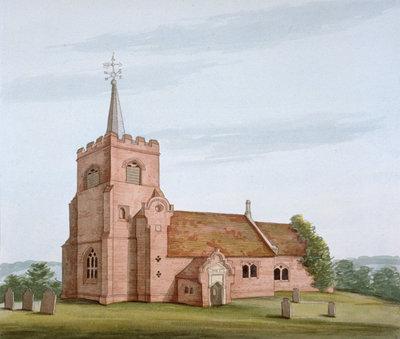
400th Anniversary of St Michael’s, Theydon Mount
“For Two yeeres we had none Christened in o[u]r Church because it was so long in building after it was burnt.” So wrote the Rector of Theydon Mount Church, Thomas Juby, in the old parish register, to explain the blank pages in 1612 and 1613. The church had caught fire, perhaps struck by lightning, and the newly rebuilt church was re-opened in 1614. In this its anniversary year there will be a celebration weekend at the end of September – Michaelmas-tide.
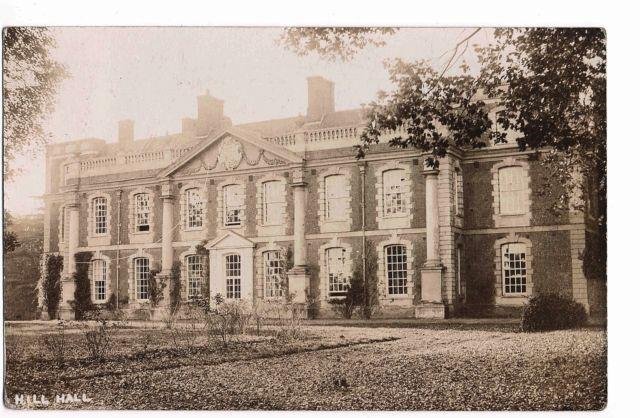
St Michael’s Church is listed Grade I, as a rare example of an early 17th century church. Made with bricks from the local brickfields, it has some Renaissance decoration on the outside, as well as the initials of the Smyth family of nearby Hill Hall – who paid for most of it – above the porch door. It has a remarkably complete 17th century interior, crowded with fine sculptures, monuments and hatchments commemorating the Smyth family. It also has the only ‘Maiden’s Garland’ in Essex – a crown shape decoration trimmed with sprigs of 300-year-old boxwood, tassels and ribbons, carried on the coffin of a virtuous maiden who died before her wedding.
The striking stained glass East window is an allegory of the First World War – in everyone’s mind at present – and was designed by Wilfrid de Glehn, a friend of the famous painter John Singer Sargent.
On Saturday 27th September the church will be open all day for an exhibition of photos, engravings and artefacts – some never seen in public before - with light refreshments served throughout. In the evening there will be a presentation illustrating the history of the church in words and music. On Sunday 28th September the Bishop of Chelmsford will be leading a celebration service at 10am, followed by champagne and cake, and a further opportunity to view the exhibition.
As part of the anniversary, an updated and expanded version of the guide book will be available, including new research and colour photographs, and items of commemorative memorabilia.
Images
Article 14 of 17
Parliamentary and Parochial Electors for Stapleford Tawney, 1914
Sir Drummond Cunliffe Smith
Walter Threader Bass
Harold Owen Blott
Charles Carter
Thomas Clayfield
Samuel Crabb
Amos Dempster
Alfred Dennis
John Dockerill
George Dorrington
Harry Freshwater
Thomas Godsave
Henry Gould
Anthony Green
George Hartgrove
Charles Mepsted
Jacob David Miller
Frank Page
William Perry
John Purnell
George Parker
Edward Wright Pittam
Harry Sarling
Thomas Staines
Benjamin Starling
Reginald P. Scott
James Stammers
Thomas Stubbings
Frederick Speller
Charles Tucker
William West
James Warden
Bertie West
George Whitbread
James Withers
George Wooley.
Article 15 of 17
Dr. Livingstone I Presume!
David Livingstone was sent to Chipping Ongar in 1838 as part of his training to become a missionary. He resided at what is now Livingstone Cottages in the High Street, for more than a year under the tutorship of the Revd. Richard Cecil, who was then the minister of the Congregational Church.
Livingstone was a keen walker and possessed the sense of adventure he would need in later life when he crossed Africa, from the Atlantic to the Indian Ocean, walking thousands of miles in the process.
Whilst he was in Ongar he decided to walk to London to visit a sik relative – a round trip of some 50 miles. Things dod not start that well. He set off in the early hours of the morning and in the darkness, managed to stumble down a deep ditch. Undeterred he battled on. He could not have spent long in London before it was time to make the return journey to Ongar. However the darkness and fog soon descended and Livingstone discovered that he was well and truly lost. He decided to give up and look for a ditch where he could lie down for the night. One can only assume he could not find one. However much to his relief he found a direction post at Stanford Rivers that pointed the way to Ongar. After getting his bearings, Livingstone arrived home in the middle of the night, footsore and weary; he was the butt of many jokes from his fellow students the next morning, thought they were amazed by his energy and determination.
Images
Adapted from The A-Z of Curious Essex: Strange Stories of Mysteries, Crimes and Eccentrics, by Paul Wreyford [2013]
Article 16 of 17
The Historical Register for 1738
November.
A dispensation passed to enable the Revd. John Harris, M.A., to hold the Vicarage of Tillebury (Tilbury?) in the County of Essex, and the Diocese of London, together with the Rectory of Greensted near Ongar, in the said County and Diocese.
Article 17 of 17
That’s My Seat – Anne Archer of Theydon Garnon
‘To remove any from the place where they and their ancestors have time out of mind accustomed to sit will beget more brabbles, suits in law and prohibitions than either you or I would be contented to be troubles with.’
Archbishop Neile, 1635.
In 1616 Anne Archer, widow of Henry Archer, gentleman and lord of the manor of Hemnalls, in Theydon Garnon, made a formal complaint to the Bishop of London’s Consistory Court. Until her husband’s recent demise she had sat in the uppermost place in the foremost pew in the nave of the parish church, together with her neighbours Mistress Carleton and Mistress Mitchell. But recently she had arrived at church to find that,
‘without the consent and against the will of the said Anne Archer and without any lawful authorisation…..Mistress Carleton had….sett a locke on the door wherein the said Mistress Archer was to sitt and by that meanes kept her out.’
The Archers, Carletons and Mitchells were all members of the parish elite, although the Carletons were of slightly higher status in terms of wealth and landholdings than the Archers and Mitchells. The Carletons and the Mitchels had interest in lands that formed part of the manor of Theydon Garnon, and the Carletons had a turn in presentations to Theydon Garnon rectory. Mistress Carleton was taking advantage of Anne Archer’s social vulnerability as a new widow to assert a perceived precedence of symbolic status.
However, the Bishop’s Chancellor defended Mistress Archer’s title to her former seat and her status, reputation and property were protected.
Taken from Gender and Space in Early Modern England, by Amanda Flather [2007]
Consistory court is a type of ecclesiastical court, especially within the Church of England.